The Ford 5R110W TorqShift was the transmission behind every 6.0L, 6.4L, and 7.3L Power Stroke diesel Super Duty from 2003 through 2010. It is a five-speed automatic designed to handle the torque output of a diesel truck, and it does that job reasonably well when maintained. When it is not maintained — or when it is behind a 6.0L that has been modified to push more power — it develops predictable problems.
This guide covers the service procedure, the failure patterns that show up consistently, and what the aftermarket offers for owners who are keeping these trucks for the long haul.
See all Ford transmission guides and email courses on our Ford hub page.
Service Intervals and Fluid Specification
What Ford Says vs. What Works
Ford did not split this one into normal and severe columns. Per the ATSG teardown published in Transmission Digest when the unit launched, Ford recommends replacing the fluid and the bottom-pan filter every 48,000 km (30,000 miles) regardless of normal or special operating conditions. That is the whole interval. Treat 30,000 miles as a ceiling rather than a target on a truck that tows and idles, because the torque spikes from a diesel generate more heat than the fluid specification accounts for.
The 5R110 requires Mercon SP. This is not a preference and it is not marketing: Mercon SP is not interchangeable with Mercon or Mercon V, and the use of any fluid other than Mercon SP can result in abnormal operation and/or transmission failure. Mercon SP carries a friction modifier package matched to the clutch materials in this unit, and the wrong fluid shows up as TCC shudder and poor shift quality almost immediately. Later Ford service information approves Mercon LV as the supersession: Ford's current FCSD automatic transmission fluid chart lists the 5R110 TorqShift under a note that authorizes back-servicing with MERCON LV for complete refill and top off [5]. Check the current application listing for the specific truck before you buy a case of anything, and do not mix fluids on a partial service.
Service Procedure
- Warm the transmission to operating temperature before draining
- Drop the pan — the 5R110 pan holds approximately 7 quarts during a pan service
- Inspect pan contents: note color, presence of clutch material, and metallic debris
- Replace the pan filter — it is serviceable and gets changed at every pan drop
- Replace the remote spin-on filter in the cooler lines at the same interval. It is easy to forget because it does not live in the pan, and it is not optional: the remote filter passes about 10 percent of the fluid through a small orifice into the screw-on element, then returns it to the rear lube circuit through the remote-filter manifold
- Clean the pan and reinstall with a new gasket
- Refill with Mercon SP to the correct level — check level with engine running, in Park, at operating temperature
One more that catches people out on an overhaul: this unit runs an oil-to-air cooler in front of the radiator, and Ford's position is that the OTA cooler gets replaced as part of any overhaul or exchange rather than back-flushed and cleaned. Debris from a failure does not come out of that core reliably, and it goes straight back into the new unit.
Total fluid capacity for a complete drain and fill is approximately 17 quarts. A pan service only exchanges around 7 quarts. For a more complete fluid exchange, use a fluid evacuator after the pan service to pull additional fluid through the dipstick tube, or perform two pan services back-to-back within 5,000 miles.
Common Failure: Solenoid Pack Degradation
What the Solenoid Pack Controls
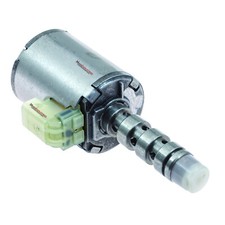
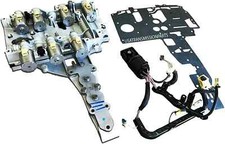
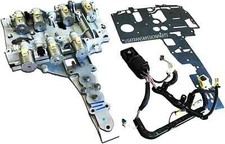
The 5R110 uses a single solenoid body that contains all shift solenoids, the TCC solenoid, and the pressure control solenoid. Sonnax's solenoid identification chart lists seven: SSPC-A on the coast clutch, SSPC-B on the overdrive clutch, SSPC-C on the intermediate clutch, SSPC-D on the direct clutch, SSPC-E on the low/reverse clutch, plus TCC and EPC/PC-A for line pressure. A solenoid and a pressure switch are dedicated to each clutch pack except the forward clutch, which the manual valve controls, and there are no other shuttle valves in the solenoid body.
Half of them work backwards from the other half, which matters when you are reading scan data. SSPC-B, SSPC-C, SSPC-E and TCC are directly proportional: current varies from 0 to 1 amp and 1 amp is maximum pressure. SSPC-A, SSPC-D and EPC/PC-A are inversely proportional: same 0 to 1 amp range, but 0 amps is maximum pressure. Read a line pressure command of 0.9 amps as low pressure, not high. When solenoids wear or leak internally, the results range from harsh shifts to limp mode to no movement at all, depending on which one went.
Failure Patterns
The most common electrical failure on the 5R110 solenoid pack is wear of the solenoid plunger bores over mileage. The solenoids develop internal leakage, which causes inconsistent pressure regulation. Symptoms include intermittent harsh shifts, TCC cycling in and out at highway speed, and delayed engagement from a stop. Common codes include P0715 (Input Speed Sensor), P0720 (Output Speed Sensor), P0740 (TCC Solenoid Circuit), and P0750 through P0770 series for individual shift solenoid faults.
Diagnosis
Start with a full code scan. On a 5R110, distinguish between solenoid electrical faults (resistance out of range, circuit open or shorted) and solenoid performance codes (commanded vs. actual gear mismatch). An electrical fault points to wiring or the solenoid itself. A performance code with no electrical fault may indicate valve body wear or hydraulic pressure issues rather than a failed solenoid. Check wiring harness integrity at the transmission connector — the external harness on the 5R110 is known to chafe against the case on some applications.
Torque Converter Failure and the Billet Upgrade
Stock Converter Weakness
Before you condemn a converter, rule out the two bores that imitate one. Sonnax attributes low line pressure and TCC concerns on this unit to pressure regulator bore wear in the pump, which also cuts converter and lube circuit flow and typically shows up with codes 1744 and 1783; the repair is reaming the bore and fitting an oversized valve. On 2005-and-later units, bore wear at the converter pressure limit valve produces harsh or soft TCC apply, TCC codes, TCC slip, erratic apply pressure, excess converter pressure and TCC lining failure, and in extreme cases pressure climbs far enough to balloon the converter. Vacuum test both bores. A ballooned converter and a cracked one feel similar from the driver's seat and have completely different causes.
The stock 5R110 torque converter was designed for the original torque output of the 6.0L Power Stroke. Many of these trucks have been tuned, and even untuned 6.0L engines produce torque spikes under load that stress the factory converter. The most common converter failure on the 5R110 is front cover cracking, which results in an internal fluid leak and TCC shudder or complete TCC failure. When the front cover cracks, metal fragments are released into the transmission and contaminate the valve body.
The Billet Converter Option
Aftermarket billet torque converters for the 5R110 replace the stamped steel front cover with a machined billet steel cover that will not crack under diesel torque. For any 5R110 that is being rebuilt, the billet converter upgrade is worth considering, especially if the truck is used for towing or has been tuned. The cost difference versus a factory replacement is substantial, but the repeat failure rate on billet units is near zero. Sun Coast, BD Diesel, and Suncoast all offer billet converter options for the 5R110.
Signs the Converter Has Failed
- TCC shudder that does not respond to fresh Mercon SP
- Metallic debris in the pan with no evidence of clutch burnout
- Loss of TCC lock-up at highway speeds
- Slight vibration under light throttle at cruise speed
- P0741 or P0742 (TCC Performance/Stuck On codes)
Fluid Contamination from the 6.0L Engine
This point deserves its own section because it is specific to the 6.0L Power Stroke application. The 6.0L diesel has a well-documented history of EGR cooler and oil cooler failures. When the oil cooler fails, coolant can migrate into the engine oil, and in some failure modes into the transmission fluid. If you are servicing a 5R110 behind a 6.0L and the fluid has a milky or foamy appearance, suspect coolant contamination before assuming it is simply over-mileage fluid degradation. Coolant in the transmission fluid destroys the friction materials and corodes the solenoid pack. A transmission with confirmed coolant contamination needs a complete teardown and cleaning — a fluid service alone will not save it.
Need parts for this job?
Rebuild kits, hard parts, solenoids, valve bodies, filters, gaskets and the correct fluid for this unit — shipped fast from the USA on secure checkout.
Shop 5R110 TorqShift parts →