The Ford 10R80 is one of the highest-volume transmissions on the road right now. It has been in production since the 2017 model year and sits behind every F-150 with the 2.7L EcoBoost, 3.5L EcoBoost, 5.0L Coyote, and 3.3L V6. It is also in the Mustang GT, Expedition, Explorer, Ranger, and Lincoln Navigator. Ford and GM co-developed the 10-speed architecture -- the GM version is the 10L80/10L90 -- but the calibration, solenoid body, and clutch application charts are Ford-specific. If your shop works on Ford trucks, you are already seeing these units regularly. Here is what you need to know about them.
For more Ford transmission resources, visit our Ford hub page.
Which Vehicles Have the 10R80
The 10R80 covers a broad range of applications. Ford uses it across most of its RWD and AWD lineup from 2017 forward.
| Vehicle | Model Years | Engine Pairings |
|---|---|---|
| F-150 | 2017+ | 2.7L EcoBoost, 3.5L EcoBoost, 5.0L Coyote, 3.3L V6 |
| Mustang GT | 2018+ | 5.0L Coyote (automatic only) |
| Expedition | 2018+ | 3.5L EcoBoost |
| Explorer | 2020+ (RWD platform) | 2.3L EcoBoost, 3.0L EcoBoost, 3.3L V6 |
| Ranger | 2019+ | 2.3L EcoBoost |
| Lincoln Navigator | 2018+ | 3.5L EcoBoost |
| Lincoln Aviator | 2020+ | 3.0L Twin-Turbo V6 |
The sheer volume means independent shops are seeing these transmissions for service more frequently than anything else in the Ford lineup. The 6R80 is still out there in older trucks, but the 10R80 is now the dominant unit rolling through service bays.
Common Complaints: What Customers Describe
The 10R80 generates three primary complaint patterns. Understanding which pattern the customer is describing tells you a lot about where to start.
Harsh 1-2 Shift
This is the single most common complaint. The customer describes a firm or clunky shift from first to second gear, usually at light throttle around town. It feels like a bump or jolt. In many cases this is a calibration issue rather than a hard-parts failure. The 1-2 shift in the 10R80 involves the B clutch releasing and the E clutch applying while the C clutch stays applied. The timing window is tight, and if the adaptive values have drifted or the fluid is degraded, the overlap gets sloppy. Before pulling the pan, check for TSB applicability and consider an adaptive reset.
Gear Hunting Between 3rd and 5th
The second most common complaint. The customer says the transmission cannot decide what gear to be in during light-throttle cruising at 25-45 mph. It shifts up, shifts down, shifts up again. This is partly by design -- a 10-speed has very narrow ratio splits, and the PCM is constantly trying to find the most fuel-efficient gear. But when it becomes excessive, the root cause is usually degraded adaptive values, a torque converter clutch that is cycling on and off at the wrong time, or a throttle position sensor calibration drift. Ford addressed this with multiple PCM calibration updates.
Shudder at Light Throttle
The customer describes a vibration or shudder during light acceleration, typically between 35-55 mph. This feels different from an engine misfire -- it is a rhythmic oscillation that goes away when you either lift off the throttle completely or press the pedal harder. This is a torque converter clutch shudder and it is almost always fluid-related. The 10R80 torque converter clutch applies at very low speeds and partial throttle to maximize fuel economy, and it is extremely sensitive to fluid condition. This is the complaint that the Mercon ULV fluid change addresses.
TSBs That Actually Matter
Ford has issued several TSBs for the 10R80. These three are the ones that shops should have memorized.
SSM 47334 -- Adaptive Learning Reset
This is a Special Service Message, not a full TSB, but it is referenced constantly. It covers harsh or erratic shifting complaints and directs the technician to perform an adaptive learning reset using a scan tool, then drive the vehicle through a specific relearn procedure. The reset clears the transmission's stored shift correction values and forces the PCM to start relearning from baseline. This alone fixes a significant percentage of shift quality complaints, especially on vehicles that have had fluid services, clutch pack wear changes, or PCM updates without a corresponding adaptive reset.
TSB 19-2396 -- Torque Converter Clutch Shudder
This is the big one. Covers 2017-2019 F-150, 2018-2019 Mustang, 2018-2019 Expedition, and 2018-2019 Navigator with torque converter shudder complaints. The fix is a complete Mercon ULV fluid exchange -- drain and fill is not adequate, this needs a full fluid exchange to get the contaminated fluid out of the converter -- followed by an adaptive reset. Ford specifically states that a drain-and-fill will not resolve the shudder because too much degraded fluid remains in the torque converter and cooler circuit. The fluid exchange requires approximately 13-14 quarts of Mercon ULV.
TSB 21-2143 -- Shift Quality After Fluid Service
This one catches shops that do the fluid service correctly but skip the adaptive reset. After any fluid change on the 10R80, the adaptive values must be reset. The transmission learned its shift calibrations based on the friction characteristics of the old fluid. New fluid has different friction properties, and the old adaptive values will cause harsh or delayed shifts until the system relearns. The TSB directs a scan tool adaptive reset followed by a minimum 20-minute mixed-driving relearn cycle. If you change the fluid and do not reset the adaptives, the customer will be back in a week complaining that the transmission is worse than before you touched it.
TSB 23-2152 -- Harsh Engagement And/Or Harsh/Delayed Shift
This is the bulletin to actually work from on the earlier trucks, and it is public on the NHTSA document server. Ford TSB 23-2152, dated 22 May 2023, supersedes 23-2123 (which itself superseded 22-2139) and covers 2017-2020 F-150, 2018-2021 Expedition/Navigator/Mustang and 2019-2023 Ranger with the 10R80. Ford attributes the condition to the keep alive memory in the PCM/TCM or to the main control valve body, and directs the technician to overhaul the main control valve body and/or perform an adaptive learning drive cycle. Note that Ford's own 23-2123 revision blamed "incompatibility of the adaptive calibration to adapt to hardware break-in over time" — the 23-2152 revision changed the issue statement, which tells you how much of this complaint is calibration versus hardware.
The applicable DTC list is long and worth recognizing as a pattern: P0751, P0752, P0756, P0757, P0761, P0762, P0766, P0767, P0771, P0772, P2700 through P2708, P0729, P0731 through P0736, P076F, P07D9, P07F6 and P07F7. The parts list confirms the fluid as XT-12-QULV Motorcraft Mercon ULV, and includes application-specific separator plates — HL3Z-7Z490-D for the 2017 F-150, JL3Z-7Z490-E for column-shift Expedition, Ranger and 2018-2020 F-150, JL1Z-7Z490-C for rotary-shift Expedition and Navigator, JL3Z-7Z490-D for Mustang built on or before 13-Jan-2021, and L1MZ-7Z490-J for 2021 Mustang built on or after 14-Jan-2021. Order off the build date, not the model year.
TSB 24-2254 -- CDF Clutch Cylinder Sleeve Movement
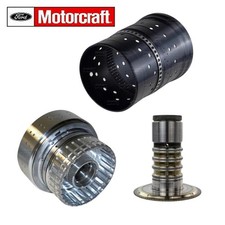
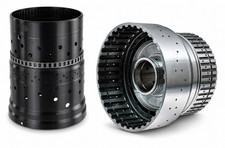
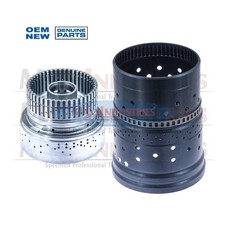
For the later units, the story changed. Ford TSB 24-2254, dated 23 August 2024, covers 2020-2022 Explorer, 2020-2023 Transit, 2021-2022 F-150, 2021-2022 Mustang and 2022 Expedition/Navigator with a 10R80 (excluding hybrid) built on or before 15-Aug-2022. Same symptom set, same DTC list — but Ford names a specific mechanical cause: axial movement of the CDF clutch cylinder (7H351) sleeve causing hydraulic circuit leaks. The service procedure is to verify hydraulic circuit leakage and replace the CDF clutch cylinder if necessary.
That verification step needs real equipment. Ford calls out the Pressure Vacuum Transducer Kit (Rotunda 164-R9833) and the VCMM Transmission Extension Kit (Rotunda 164-R9534), both discontinued from the VCMM Advanced Kit in July 2023. If you do not have vacuum-transducer capability, you cannot confirm the CDF leak and you are guessing. This is the single most important 10R80 development in recent years: on a 2020-2022 unit, harsh and delayed shifts are no longer automatically an adaptive problem.
On the bench, the same failure has a cheaper tell. Sonnax identifies sealing ring and hub bushing wear as one of the biggest causes of lost charge pressure on the Ford and GM 10-speeds, which leads directly to lockup and overheat complaints. Before the clutch assembly goes into the case, air check each drum through the pump. That one test tells you whether a clutch pack is leaking and whether the shaft plugs — the plugs that keep fluid in its intended circuit — are holding. Sonnax CDF drum saver kit 129910-01K addresses the drum itself; Ford's redesigned cylinder adds an internal lip to stop the sleeve from moving. Catch it out of the case and you save a second teardown.
Fluid Specification: Mercon ULV
The 10R80 requires Mercon ULV (Ultra Low Viscosity) fluid. This is critical. It does not use Mercon LV, Mercon V, Mercon SP, or any other ATF variant. Mercon ULV is a dedicated specification with a viscosity profile designed specifically for the 10-speed architecture.
Why the Wrong Fluid Kills It
Ford's own Motorcraft product data sheets put MERCON ULV at 4.5 cSt at 100 C and 19.2 cSt at 40 C, against 6.0 cSt and 29.6 cSt for MERCON LV. That is about 25 percent thinner at operating temperature. The 10R80 solenoid body and valve body are calibrated for the thinner fluid, and Ford's Motorcraft fluid page states ULV is not interchangeable with LV, V or SP. Using MERCON LV or any other heavier fluid causes problems:
- Shift timing errors: The clutch apply and release pressures are calibrated for ULV flow rates. Heavier fluid flows slower through the same orifices, causing delayed applies and extended release times. This shows up as flared shifts, harsh engagements, or bind-up between gears.
- TCC shudder: The converter clutch is controlled around ULV's friction and flow characteristics. A different fluid changes how the lockup clutch applies and slips, and the fluid exchange called out for shudder in the bulletins specifies MERCON ULV only.
- Additives make it worse: Ford's fluid chart warns in capitals against supplemental transmission fluid additives, treatments or cleaning agents. Do not try to fix a shift complaint with a bottle.
Fluid Capacity and Service Procedure
Sonnax, citing Ford service information, lists 13.0 qt (12.3 L) of MERCON ULV for a dry 2020 F-150 4x4 unit after internal repair, and the cooler circuit adds to that. A pan drop recovers only part of the total because the converter and cooler keep their fluid, so measure what comes out and put that much back. A full fluid exchange through the cooler lines uses 13 qt or more. For a shudder complaint, always do the full exchange. For routine maintenance on a vehicle with no complaints, a drain-and-fill with an adaptive reset is acceptable -- but the customer needs to understand that only about half the fluid is being replaced.
Most factory 10R80 pans have no drain plug, so the pan comes off to drain it. There is no traditional dipstick on most applications. The level indicator is built into the fill plug on the side of the case, and the level is only valid at 96-101 C (206-215 F) transmission fluid temperature on a level surface, engine running, after cycling through each range. On an A/B indicator the level belongs at the center of B; on a 1-6 indicator, between 4 and 5. Sonnax found that as little as 1 qt overfilled causes overheating and venting, usually from filling to the top mark cold. The full step-by-step, filter part numbers by vehicle, and the ULV-versus-LV numbers are in our 10R80 fluid type and capacity guide.
Adaptive Learning: How It Works and When to Reset
The 10R80 uses an aggressive adaptive learning strategy. The PCM monitors every shift event -- apply time, release time, slip duration, torque phase, inertia phase -- and continuously adjusts clutch apply pressures and timing to maintain target shift quality. Over thousands of shift events, the adaptives build up a detailed correction map for every gear change at every throttle position and temperature range.
When to Reset
Reset the adaptive values any time the fluid is changed, any time the valve body or solenoid body is replaced, any time a PCM update is performed, and any time a clutch pack is replaced during a rebuild. The adaptives that were learned on old, degraded fluid or worn clutch packs do not apply to fresh fluid or new friction material. Leaving old adaptive values in place is the number one reason customers complain after a transmission service.
How It Relearns
After an adaptive reset, the transmission starts with baseline shift calibrations. These are conservative -- shifts will feel slightly soft or slightly delayed for the first 50-100 miles. The PCM needs a variety of driving conditions to fully relearn: light throttle acceleration, moderate acceleration, highway cruising, stop-and-go traffic, and cold-start shifts. A 20-30 minute drive through mixed conditions covers most of the learning map. Hard acceleration events during the relearn are fine -- the PCM needs those data points too.
Why a Scan Tool Reset Matters
The adaptive reset must be done with a scan tool that can communicate with the PCM's transmission control module. Disconnecting the battery does not reset the transmission adaptives on the 10R80 -- those values are stored in non-volatile memory. A basic OBD-II scanner will not reach them either. You need a Ford-capable scan tool (IDS/FDRS, or aftermarket tools like Autel MaxiSys, Snap-on Zeus/Apollo, or Launch X431 with Ford software) that can execute the adaptive reset function. Some shops have tried the "disconnect the battery for 30 minutes" approach and it does not clear these values.
What Shops Actually See: Hard-Parts Failures
When a fluid change and adaptive reset do not fix the complaint, the problem is internal. Here are the failure patterns that shops are pulling out of these units.
D7 Clutch Pack Failure
The D clutch (also called clutch D or the D7 clutch pack in some service literature) is responsible for multiple gear applications in the 10R80. It is the most failure-prone clutch pack in the unit. When the D clutch burns, the transmission loses the ability to hold specific gear combinations cleanly, and you will see flared shifts, slipping, or codes related to clutch slip events. On teardown, the D clutch friction plates show glazing, material transfer, and in advanced cases, the steel separator plates are heat-discolored. This failure is accelerated by contaminated fluid, delayed service intervals, and heavy towing.
Solenoid Body Issues
The 10R80 uses a separate solenoid body that bolts to the valve body. The solenoids are variable-force units that control clutch apply pressures and timing. The most common solenoid failure mode is contamination -- debris from clutch material, converter lining wear, or manufacturing residue gets into the solenoid and causes sticking or erratic pressure output. A sticking solenoid causes unpredictable shift quality that comes and goes. Some shops replace the solenoid body as an assembly rather than individual solenoids because the cross-contamination risk means one bad solenoid usually means the others are not far behind.
Before you condemn a solenoid body, load-test the batteries. Sonnax documents a pattern on 10R80 and 10R140 work trucks where the unit comes back from repair acting like it will not adapt — harsh engagements, erratic upshifts and downshifts — then behaves once it warms up and gets driven. The fault is a failing battery, not the valve body, and Sonnax notes that Ford and GM batteries generally last about three years. A truck that sat in your bay for several days of repair is exactly the vehicle this happens to.
Valve Body Bore Wear
The valve body in the 10R80 has aluminum bores with steel valves. Over time, the bores develop wear patterns that allow crossleaks between circuits. The symptoms are subtle at first -- a slightly delayed apply here, a slightly soft shift there -- and progressively worsen. Bore wear is more common in high-mileage units (150,000+ miles) and in vehicles that ran with contaminated or degraded fluid for extended periods.
Sonnax names the specific bores worth checking on any 10R80 valve body, new or used: the main pressure regulator valve, the TCC priority valve, the TCC regulator valve and boost valve, and the latch valves, which get beat up by the retainer clip. Main pressure regulator wear reads as low line pressure, delayed engagement, poor shift quality and burnt clutches; TCC regulator bore wear cuts converter apply flow, release flow and cooler flow at the same time. Sonnax covers these with main pressure regulator kit 105740-12K (oversized 105740-20K for severe wear) and TCC regulator kit 105740-15K for 10R80 units without the ridge mark on the OE valve. Worth noting: neither main pressure regulator kit works in '23-later 10R140 units with casting numbers starting with PC3P.
Two inspection items get skipped and should not be. First, the separator plate — the impregnated plate filters come loose and stick valves, and Ford currently sells a new OE plate. Second, the solenoids themselves: 10-speed valve bodies use casting-integrated direct-acting solenoids held in with retainer clips that work directly on the clutch control valve, and they need to be checked for bore tightness. Sonnax sells solenoid stabilization retainers 105740-19K to hold the heavy solenoids and prevent spring retainer collapse.
If you are buying a "new" OE Ford valve body, check the separator plate color before you install it. Per Sonnax, the plate shipping with new Ford valve bodies today is light brown; Ford previously used yellow. Shops have reported receiving used cores sold as new, and plate color is the fastest tell. And when the valve body goes back on, do not lose the steel-rubber pump seal that sits between the valve body and the case — leaving it out or mispositioning it gives you no movement and no line pressure on a unit you just finished.
Recommended Products
Need parts for this job?
Rebuild kits, hard parts, solenoids, valve bodies, filters, gaskets and the correct fluid for this unit — shipped fast from the USA on secure checkout.
Shop 10R80 parts →Rebuild vs. Fluid Change + Reset: Making the Call
This is the decision that costs shops credibility if they get it wrong. Sell a rebuild when a fluid change would have fixed it, and the customer tells everyone you ripped them off. Send it home with a fluid change when it needed a rebuild, and the customer is back in 3,000 miles blaming you for the failure.
When a Fluid Change + Adaptive Reset Fixes It
- TCC shudder with no stored codes or only P0120-range TCC performance codes
- Harsh 1-2 shift with no slip codes, especially on vehicles with 60,000+ miles since last fluid service
- Gear hunting between 3-5 with no mechanical codes
- Post-service shift quality complaints where the previous shop did not reset adaptives
- Vehicle has less than 100,000 miles and no history of overheating events
When It Needs Internal Work
- Clutch slip codes (P0730, P0731-P073A range) that return after a fluid change and reset
- Harsh engagement into drive or reverse from park -- indicates forward clutch or low/reverse clutch damage
- Fluid is dark brown or smells burnt on the initial drain -- the friction material is already compromised
- Metallic debris on the pan magnet or in the filter -- hard parts are wearing
- Loss of specific gears -- a gear that drops out entirely is a clutch pack or hydraulic circuit failure
- Vehicle has a towing or overheating history with any of the above symptoms
The scan tool data matters here. Look at clutch slip counts in the transmission data PIDs. A transmission with accumulated slip events across multiple clutch packs is telling you the friction material is worn beyond what fresh fluid can recover. A transmission with a single shudder-type code and clean fluid pan is a candidate for the conservative approach.
Cost Breakdown for Customers
These are real-world numbers for independent transmission shops. Dealer pricing is typically 20-30% higher.
| Service | Cost Range | What It Includes |
|---|---|---|
| Fluid exchange + adaptive reset | $250 - $400 | Full fluid exchange (13-14 qt Mercon ULV), new filter, scan tool adaptive reset, relearn drive |
| Drain-and-fill + reset | $150 - $250 | Pan drop, 6-7 qt Mercon ULV, new filter, adaptive reset |
| Solenoid body replacement | $800 - $1,400 | New or reman solenoid body assembly, fluid, filter, adaptive reset |
| Valve body replacement | $1,200 - $1,800 | New or reman valve body with solenoids, fluid, filter, adaptive reset |
| Full rebuild | $3,500 - $5,000 | Complete teardown, all friction clutches, steels, seals, bushings, filter, fluid, converter evaluation |
| Reman unit (remove and replace) | $4,000 - $6,000 | Remanufactured 10R80 installed, new converter, fluid, programming, adaptive reset |
Mercon ULV runs about $12-$15 per quart at wholesale. A full fluid exchange uses 13-14 quarts, so the fluid cost alone is $160-$210 before the filter and labor. That is significantly more expensive than a Dexron VI or Mercon LV service, and customers need to understand why. The fluid is formulated for a specific purpose, and there is no acceptable substitute.
For the rebuild vs. replace vs. reman decision, read our full breakdown.
Maintenance Recommendations
Ford's official maintenance schedule calls for 10R80 fluid changes at 150,000 miles under "normal" conditions. That is too long. Any transmission specialist who has seen what 150,000-mile Mercon ULV looks like will tell you the same thing. The fluid degrades, the friction modifiers deplete, and the shudder complaints start rolling in well before that interval.
For customers who want to keep the 10R80 healthy:
- Non-towing, normal driving: Fluid exchange every 60,000-80,000 miles
- Towing or heavy-load use: Fluid exchange every 30,000-50,000 miles
- Performance applications (Mustang GT, tracked vehicles): Fluid exchange every 20,000-30,000 miles
Every fluid service must include an adaptive reset. No exceptions. Write it on the work order, put it in the shop's procedure checklist, and make sure every tech knows it. The 10R80 is not forgiving of skipped resets.
For a complete breakdown of ATF fluid types and specifications, see our full fluid guide. For the transverse eight-speed that shares Ford's Mercon ULV requirement, see our 8F35 problem and bulletin guide.
Sources
- Ford Motor Company — Technical Service Bulletin 23-2152, "10R80 — Harsh Engagement And/Or Harsh/Delayed Shift," 22 May 2023 (supersedes 23-2123, which superseded 22-2139). Source for the affected 2017-2020 F-150, 2018-2021 Expedition/Navigator/Mustang and 2019-2023 Ranger applications, the keep alive memory and main control valve body cause, the full applicable DTC list, the XT-12-QULV Mercon ULV fluid requirement, and the application-specific separator plate part numbers. Hosted on the NHTSA document server. static.nhtsa.gov/odi/tsbs/2023/MC-10236683-0001.pdf
- Ford Motor Company — Technical Service Bulletin 24-2254, "10R80 Transmission — Harsh/Delayed Engagement And/Or Harsh/Delayed Shift — Built On Or Before 15-Aug-2022," 23 August 2024. Source for the axial movement of the CDF clutch cylinder (7H351) sleeve as a hydraulic leak path, the affected 2020-2022 Explorer / 2020-2023 Transit / 2021-2022 F-150 / 2021-2022 Mustang / 2022 Expedition and Navigator applications, and the Rotunda 164-R9833 and 164-R9534 equipment requirements. Hosted on the NHTSA document server. static.nhtsa.gov/odi/tsbs/2024/MC-11006772-0001.pdf
- Ford Motor Company — Technical Service Bulletin 23-2123, "10R80 — Harsh/Delayed Engagement And/Or Harsh/Delayed Shift," 13 April 2023. Source for the earlier "incompatibility of the adaptive calibration to adapt to hardware break-in over time" issue statement that 23-2152 later revised, and for the solenoid retaining clip (HL3Z-7G007-A) and filter (HL3Z-7A098-A) part numbers. Hosted on the NHTSA document server. static.nhtsa.gov/odi/tsbs/2023/MC-10234596-0002.pdf
- Ford Customer Service Division / Motorcraft — Automatic Transmission Fluid Application Chart. Source for the Mercon ULV requirement across the 10R60 and 10R80 applications by vehicle, engine and model year, and for the LV-versus-ULV distinction within the same vehicle lines. fcsdchemicalsandlubricants.com/quickref/atf2US.pdf
- Sonnax — "Tackling Ford & GM 10-Speed Valve Body Problems, Failing Batteries & More!" Jim Mobley, TASC Force, 4 March 2025. Source for the light-brown-versus-yellow Ford separator plate color change used to spot a used core sold as a new valve body; the casting-integrated direct-acting solenoid (CIDAS) design held by retainer clips that only makes clutch pressure with current; the instruction to check the main pressure regulator, TCC priority, TCC regulator, boost and latch valves for bore wear; loose impregnated separator plate filters sticking valves; the steel-rubber pump seal that causes no movement and no line pressure if left out or mispositioned; Sonnax kits 105740-12K, 105740-20K, 105740-15K and 105740-19K and the '23-later 10R140 PC3P casting exclusion; and the failing-battery pattern on 10-speed work trucks that mimics a valve body fault, with Ford and GM batteries lasting roughly three years. sonnax.com/tech_resources/1479
- Sonnax — "Troubleshooting Pressure Loss in 10-Speed Clutch Packs," Caleb Perham, TASC Force, 7 April 2025. Source for sealing ring and hub bushing wear as a primary cause of lost charge pressure leading to lockup and overheat concerns; CDF drum saver kit 129910-01K for slipping, slide bumps, neutral conditions and ratio error codes; the instruction to air check each drum and the complete assembly through the pump before loading it into the case, including the shaft plugs that keep fluid in its intended circuit; the early Ford and GM 10-speed converter design that uses fluid pressure to push the lockup piston away from the engine with friction material mounted to the turbine and the reaction surface in the impeller, a design Ford kept; and the requirement to use Mercon ULV or Dexron ULV rather than a universal or older-spec fluid. sonnax.com/tech_resources/1481
- Motorcraft — MERCON ULV and MERCON LV Product Typicals data sheets. Source for ULV at 4.5 cSt (100 C) and 19.2 cSt (40 C) versus LV at 6.0 cSt and 29.6 cSt. ULV data sheet (PDF) and LV data sheet (PDF)
- Sonnax — Jim Mobley, "Tips for Troubleshooting Ford 10-Speed ATF Venting & Overheating." Source for the 13.0 qt (12.3 L) dry fill for a 2020 F-150 4x4, the 96-101 C (206-215 F) level check temperature on a level surface, and 1 qt of overfill causing overheating and venting. sonnax.com
- Transend — 10R80 Installation Guide. Supplementary remanufacturer documentation for the fill-plug level indicator reading (center of B, or between 4 and 5, at 96-101 C). cdn.transend.us (PDF)