The ZF 8HP is one of the most widely licensed automatic transmissions in the industry. ZF builds it, and it shows up under the hoods of BMWs, Chrysler 300s, Dodge Challengers, Dodge Chargers, Jeep Grand Cherokees, Ram 1500s, Aston Martins, Bentleys, and a list of others that keeps growing. If you do not know this unit yet, you will. As 2010–2020 model year vehicles age into the independent shop market, ZF 8HP service work is going to be a regular line item.
This guide covers what the unit is, the failure patterns, the fluid requirements, and the adaptation reset procedure that techs skip and then wonder why the shift quality is poor after a service.
The ZF 8HP appears in many makes -- see our Dodge, Jeep, and RAM hub pages for make-specific transmission resources.
What the ZF 8HP Is
Architecture Overview
The 8HP is an eight-speed automatic built around four planetary gear sets. What makes the design unusual is the shift element count: per ZF's own product documentation, the gear set concept needs only five shift elements for those four gear sets, and it uses three multidisk clutches and two brakes to do it. Because only two shift elements are open in any given gear, drag losses drop sharply compared with designs that leave more elements spinning unloaded. ZF rates the family across a torque range of 220 to 1,000 Nm, quotes 87 kg for a mid-size 8HP70 including oil, and gives the family a total ratio spread of 7.0. Despite carrying two more gears than the 6HP it replaced, the package dimensions stayed the same and the weight came down by as much as three percent.
That matters on the bench for one practical reason: with only two elements open per gear, a single leaking circuit shows up as a specific pair of gears misbehaving rather than as a general slip. Get the apply chart in front of you before you start guessing.
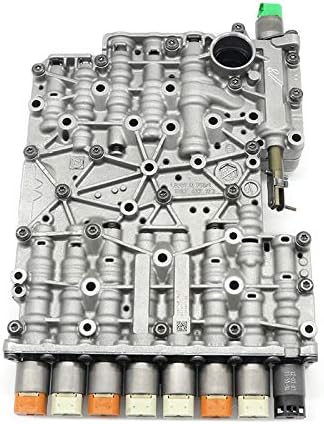
The transmission uses an electrohydraulic valve body with integrated mechatronic unit. The mechatronic unit combines the solenoid pack, the TCM (transmission control module), and the hydraulic valve body into a single assembly. This integration is both a design achievement and a service complication: when the valve body fails, you are often replacing the mechatronic unit as a complete assembly rather than individual solenoids.
Variant Identification
ZF designates variants by torque capacity and configuration. The 8HP45 is the base unit. The 8HP70 is the higher-torque version found in V8 Challengers, Chargers, Jeep Grand Cherokee V8 applications, and Ram 1500 with the HEMI. The 8HP75 is used in some BMW M applications and higher-output Chrysler products. The service procedures are similar across variants, but the fluid capacity and mechatronic unit part numbers are not interchangeable.
Generation 1 vs. Generation 2
This is the identification that decides whether the parts you ordered will work. Sonnax technical specialist Jim Dial, writing in Transmission Digest, documents that in 2019 some Chrysler, Ram and Jeep applications moved to a second-generation ZF8. Gen 1 units are classified as 8HP45, 8HP70 and 8HP90; Gen 2 units are 8HP50, 8HP75 and 8HP95. The change was not cosmetic. Gear ratios changed, which drove numerous hard part changes, and one of the clutch/brake-related circuits was eliminated.
The specific difference worth knowing on a teardown is at the B brake, located in the back of the pump housing. A Gen 1 B brake piston has both an apply circuit (B1) and a release circuit (B2). On Gen 2, the B2 release circuit was eliminated and replaced with a return spring assembly, and wave springs were added between the steel plates on both the A and B brake assemblies to release them faster. The valve body changed with it, because the B2 hydraulic circuit went away. A Gen 1 valve body in a Gen 2 case is not a parts-bin substitution.
Fluid Requirements
ZF Lifeguard 8 vs. Alternatives
The factory fluid for every ZF 8HP application is ZF Lifeguard Fluid 8 (also sold as ZF PN 1087.298.xxx depending on the vendor). This is a low-viscosity fluid specifically formulated for the 8HP’s friction materials and gear set. Do not substitute Dexron VI, Mercon LV, or any multi-vehicle ATF for ZF Lifeguard 8. The friction coefficient requirements are different, and the wrong fluid will produce shift quality issues and may cause clutch pack wear.
Some Chrysler/Stellantis service documentation specifies their house-brand equivalent (ATF+4 in older documents, or a ZF-equivalent in newer documents). Always verify against the VIN-specific service information. When in doubt, use ZF Lifeguard 8.
Fluid Capacity
Pan service capacity is approximately 3.7 liters (roughly 4 quarts). Total system capacity is approximately 8.5 liters. The 8HP does not have a traditional dipstick in most applications — fluid level is checked via an overflow plug on the side of the pan with the fluid at operating temperature. Fill to overflow, reinstall the plug. Overfilling causes aeration and foaming, which produces erratic shift behavior.
Service Interval, and How to Sell It
The dealer line is that the fluid is filled for life. ATRA's Gears magazine puts the real number plainly: on most vehicles carrying the ZF 8-speed the manufacturer recommends a fluid and filter change at 70,000 to 80,000 miles, and that is also the interval ZF itself recommends. Expect the customer to push back on price, because the pan, filter and fluid alone run north of $350 at dealer cost.
There is a way to show the customer data instead of arguing. Gears documents using the scan tool to read the clutch fill values the TCM keeps for each of the five clutch packs: Fast Filling Counter in counts, Filling Counter in counts, Filling Pressure in millibar, and Filling Time in milliseconds. One millibar is 0.014 psi, so the pressure figure needs converting before it means anything to you. Compare each value against the standard and look at the deviation. One caution from the ATRA seminar material: the fill counter needs to be above 14 for the data to be meaningful, because a lower count means the history was cleared too recently to have accumulated a reliable sample. The check takes about 15 minutes and it turns a fluid service conversation into a documented recommendation.
Common Failures
Mechatronic Unit Failure
The integrated mechatronic unit is the most common service item on high-mileage 8HP units. When individual solenoids wear or the valve body develops internal leakage, the entire mechatronic assembly typically needs replacement because the components are not serviceable individually at the independent shop level. Symptoms of mechatronic failure include erratic shift patterns, harsh engagement, transmission entering limp mode, and codes in the P0700–P0799 range related to TCM communication or solenoid performance.
Before condemning the mechatronic unit, verify the fluid level and condition. A low or degraded fluid charge causes symptoms that are nearly identical to mechatronic failure. If the fluid is correct and the level is within specification, a full code scan with a scan tool that reads ZF-specific data will point toward the actual failed component.
Park Rod/Actuator Failure
The ZF 8HP uses an electronic park actuator in some applications rather than a traditional mechanical park pawl linkage. When this actuator fails, the vehicle may not release from Park, or may not engage Park properly when the selector is moved. This is a known issue on BMW applications and shows up occasionally on Chrysler products. The failure mode is usually a position sensor or the actuator motor itself.
Torque Converter Shudder
TCC shudder on the 8HP is almost always a fluid issue. The 8HP runs the TCC locked through a very wide speed and load range to maximize fuel efficiency. When the fluid degrades, the TCC friction disc cannot maintain consistent engagement. Fresh ZF Lifeguard 8 resolves shudder complaints in most cases when no mechanical damage is present.
Adaptation Reset Procedure
Why This Matters
The ZF 8HP TCM continuously learns clutch fill times and shift characteristics over the life of the transmission. These learned values are stored as adaptation data. When the mechatronic unit is replaced, when the valve body is serviced, or after any internal repair, the adaptation data must be reset. If the old adaptation values are retained after hardware changes, the new or serviced components will operate based on incorrect fill times and pressures, resulting in poor shift quality that looks like the repair was unsuccessful.
Reset Procedure
The adaptation reset is performed through the scan tool using a manufacturer-specific function — it is not accessible through generic OBD2 mode. On BMW applications, the reset is performed through ISTA or a compatible BMW-capable scan tool. On Chrysler/Stellantis applications, use WiTECH or a compatible scan tool with Stellantis coverage. After the reset, the transmission requires a learning drive cycle: gradual acceleration through each gear, several full deceleration events, and some steady-state highway driving. The TCM will re-learn clutch fill characteristics over the first 50–100 miles of varied driving.
Tell customers to expect slightly different shift feel for the first week after a service that includes an adaptation reset. The shifts will firm up and smooth out as the learning process completes.
Need parts for this job?
Rebuild kits, hard parts, solenoids, valve bodies, filters, gaskets and the correct fluid for this unit — shipped fast from the USA on secure checkout.
Shop ZF8HP parts →