The 6F35 and the 6F50 are both Ford front-drive six-speeds, both take MERCON LV, and both show up in the same showroom. A 2016 Explorer can have either one depending on the engine, and so can an Edge or a Fusion. That is why parts get ordered wrong. They are not two sizes of the same transmission. They come from different branches of the Ford-GM six-speed program, and almost nothing inside them interchanges.
This guide covers how the two are related, how to tell which one you have before you order anything, the generation changes inside each family, the failures each one is known for, and what to check on the scan tool. Sources are listed at the bottom.

The Short Answer
The 6F35 is the smaller unit. It is the Ford cousin of the GM 6T40, built for four-cylinder engines and the smaller EcoBoost engines [2]. The 6F50, and its higher-capacity 6F55 version, is the Ford cousin of the GM 6T70 family, built for the V6 engines and the larger EcoBoost engines. Sonnax lists the 6F50 as introduced in 2007 and the 6F55 in 2009, with a 2.0L to 3.7L engine range and a wet weight of about 220 lb [1].
Both use five clutches and a one-way clutch to make six forward speeds, and both are controlled by solenoid pressure. The cases, valve bodies, solenoid bodies, drums, clutch packs and pumps are different. If you remember one thing, make it this: a 6F35 part does not fit a 6F50, and a GM 6T70 part does not automatically fit a 6F50 either [1][3].
How to Tell Which One You Have
Do not go by the vehicle name. Ford's own fluid chart shows the overlap [5]:
- Edge: 6F35N with the 2.0L EcoBoost; 6F50/55 with the 3.5L and 2.7L EcoBoost.
- Explorer and Police Utility: 6F35N with the 2.3L EcoBoost; 6F50/55 with the 3.5L, 3.5L EcoBoost and 3.7L.
- Fusion: 6F35N with most engines, and 6F50N/6F55N listed for 2017-2020.
- Escape: 6F35N with the 2.5L, and the 2.0L and 1.5L EcoBoost engines for 2017-2019.
The fastest check is the door tag. Sonnax notes that position 8 of the vehicle certification label on the driver's B-pillar is the transmission code: 6 = 6F35, J = 6F50, C = 6F55. Position 7 is the axle (final drive) code [1]. Read the tag, write the code on the repair order, and order from that. If the tag is gone, the engine is your next best clue, followed by the transmission ID tag on the case.
| 6F35 | 6F50 / 6F55 | |
|---|---|---|
| GM cousin | 6T40 / 6T45 | 6T70 / 6T75 |
| Door tag code (pos. 8) | 6 | J (6F50), C (6F55) |
| Typical engines | 2.5L, 1.5L/2.0L/2.3L EcoBoost | 3.5L, 3.7L, 3.5L and 2.7L EcoBoost |
| Ford fluid | MERCON LV | MERCON LV |
| Generation split | Gen 1 to mid-2013, Gen 2 from 2013, later Gen 3 | Early FD6F50E '07-'09, late FD6F50L '09-up valve body |
| Known weak spots | Solenoid regulator bore, stator bushing, 2.3L converter | Solenoid pressure regulator and PR bore wear, wrong valve body ID |
Inside the 6F50 and 6F55
Ford and GM share the gear train layout and clutch logic, but they name the clutches differently, which confuses anyone reading a GM bulletin while working on a Ford. Sonnax's cross-reference: GM 1-2-3-4 = Ford Forward, GM 3-5-R = Ford Direct, GM 4-5-6 = Ford Overdrive, GM 2-6 = Ford Intermediate, and Low/Reverse is Low/Reverse in both [1]. The gear ratios Sonnax lists for the 6F50 are 4.484 first, 2.872 second, 1.842 third, 1.414 fourth, 1.000 fifth, 0.742 sixth and 2.882 reverse, with final drives from 2.77 to 3.65 [1].
The 6F50 differs from the 6T70 in the case, final drive, torque converter, one-way clutch, solenoid pack, clutch packs, wave plates, fluid and the 3-5-R/4-5-6 drum [1]. The biggest practical difference is control. The GM 6T70 carries its TCM bolted to the valve body. The 6F50 solenoid body has no TCM on it; Sonnax notes the 6F50 TCM is in the engine compartment, and the Gen 1-style 6F50 solenoid body has no pressure switches [1]. The solenoid body carries a line pressure control solenoid, a TCC pressure control solenoid, shift solenoids SSA (forward), SSB (direct), SSC (intermediate), SSD (low/reverse and overdrive), an on/off SSE, and the fluid temperature sensor [1].
Valve body ID is where 6F50 jobs go wrong. Sonnax warns that 6F50 valve bodies are mistaken for 6T70 bodies, and that early and late 6F50 bodies look almost identical but do not interchange. The tell is the number cast on the side: BS7T4P is the early FD6F50E ('07-'09) with a 1.35-ratio 3-5-R clutch regulator valve, and BSAA5P is the late FD6F50L ('09-later) with a 1.83-ratio valve [3]. Put a late body on an early unit, or the other way around, and the Direct clutch apply feel is wrong from the first shift.
Ford also released an updated spacer plate, valve body and calibration for 2009-2011 6F50 applications on MERCON LV that had poor acceleration from 0-5 mph or a harsh bump or slip on takeoff. One checkball and one spacer plate hole were eliminated [1]. On a 2009-2011 unit with a takeoff complaint, check which plate is in it before you condemn clutches.
Inside the 6F35
The 6F35 changed more over its life than most people realize, and the changes matter for parts. Sonnax breaks it into Gen 1, Gen 2 and Gen 3 [2]:
- Gen 1 uses a single rubber damper, the same style as the ZF6/6R60/6R80, on the 1-2-3-4 solenoid A output circuit. A flattened damper can cause a harsh or double-bump engagement into Drive or a downshift clunk.
- Gen 2 (from 2013) and Gen 3 replace that rubber damper with a piston and spring and add damper assemblies for the SSD, SSB, SSC and EPC solenoid circuits. The solenoid regulator valve got a longer outboard spool, its exhaust path was closed, and the valve body casting changed.
- Gen 1 solenoids have blue and yellow caps like the old ZF6 design. Gen 2 and 3 solenoids have band numbers on the canister and nearly clear caps. They are not interchangeable with 6R60/6R80 solenoids [2].
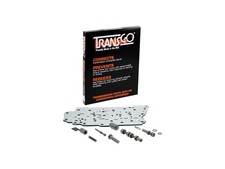
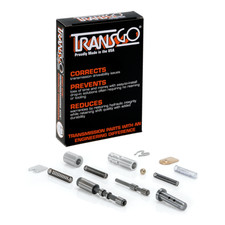
The generation split is why TransGo sells two different 6F35 kits. SK 6F35-A fits Gen 1 units from 2009 to mid-2013 and does not fit Gen 2 [6]. TransGo lists the common Gen 1 complaints as 2-3 cut-loose, no reverse, TCC slip, and gear ratio and solenoid performance codes, and traces most of them to wear in the solenoid pressure regulator valve bore. That valve limits the feed pressure to the solenoids. If the feed is too high or too low, every solenoid's output follows it, and you get shift complaints plus low or high line pressure [6].
The other 6F35 weak spot is the stator support bushing. Sonnax says the OE bushing wears early, and because the 6F35 stator bore is tapered from the factory, replacement bushings tend to spin, often on the test drive. The result is TCC slip, no TCC apply and codes P0741 and P1744. Their fix (144036B) requires machining the taper out of the bore and pressing the bushing in with an arbor press [4].
The 2.3L Explorer and MKC Converter Program
If the job is a 6F35 behind the 2.3L EcoBoost, check coverage before quoting. Ford Customer Satisfaction Program 20N07 extended torque converter coverage on certain 2015-2019 Lincoln MKC and 2016-2019 Explorer vehicles with the 2.3L and 6F35. The listed symptoms are NVH, vibration or rough idle in Drive or Reverse, poor launch, sluggish operation and shudder. The dealer repair is a converter replacement plus inspection of the internal components. Coverage runs 12 months from the date of the PCM reflash done under program 20B27 [7]. A customer whose reflash was recent may still be covered at the dealer.
Diagnosis: What to Check on Each
The approach is the same on both units. Only the parts differ.
1. Confirm the unit and generation
Door tag position 8, then the valve body: generation on a 6F35, BS7T4P or BSAA5P on a 6F50 [1][2][3]. Do this before you order a valve body, solenoid or shift kit.
2. Fluid level and condition at temperature
Both take MERCON LV per Ford [5]. Check the level hot, using the procedure for that vehicle. A unit run low will set ratio codes and slip that look like hard failures. Burnt fluid with clutch material means the clutches are already damaged, and a valve body alone will not fix it.
3. Watch the data, not just the codes
With a scan tool that reads Ford transmission PIDs, watch commanded gear against actual gear ratio, TCC slip rpm, and fluid temperature on a road test. TCC slip that stays high when lockup is commanded, together with P0741 or P1744, points at the converter feed. On a 6F35 that means the stator bushing first [4]. Ratio errors on one shift, with clean fluid, point at the solenoid feed or a clutch regulator valve. That is the bore wear that TransGo and Sonnax build their kits around [3][6].
4. Vacuum test the valve body
Sonnax notes valve body wear is common across the 6T70 and 6F50 families, and vacuum testing shows the worn bores [1]. Test the solenoid regulator, pressure regulator, TCC regulator and the clutch regulator bores before deciding between a kit repair and a reman body.
Which One Holds Up Better?
Neither is a bad transmission when it is the right size for the engine. The 6F50/6F55 is the heavier unit, sized for the V6 and larger EcoBoost engines [1]. The 6F35 lives behind smaller engines, and most of its trouble comes from a few specific parts: the solenoid regulator bore, the stator bushing and, on the 2.3L, the converter [4][6][7]. Fix those with the right generation-specific parts and both units go back into service well. The expensive mistake is ordering by vehicle name and getting the wrong family or generation.
6F35 and 6F50 parts at CoreTransmissionParts
Shift kits, solenoids, valve bodies and rebuild kits for both Ford six-speed families. Have the door tag code ready when you order.
Shop 6F35 parts at CoreTransmissionParts →Need parts for this job?
6F35 shift kits, valve bodies, solenoid kits and master rebuild kits, plus 6F50 kits, all with secure checkout on our site.
Shop 6F35 parts → Shop all parts →FAQ
What is the difference between a 6F35 and a 6F50?
The 6F35 is Ford's smaller front-drive six-speed, the cousin of the GM 6T40, used behind four-cylinder and smaller EcoBoost engines. The 6F50 and 6F55 are the larger units, cousins of the GM 6T70 family, used behind the V6 and larger EcoBoost engines. Both take MERCON LV, but the case, valve body, solenoids, drums and clutch packs are different and do not interchange.
How do I know if I have a 6F35 or a 6F50?
Read the vehicle certification label on the driver's door B-pillar. Position 8 is the transmission code: 6 is a 6F35, J is a 6F50 and C is a 6F55. Do not go by the vehicle name, because the Edge, Explorer and Fusion each used both families depending on the engine.
Do the 6F35 and 6F50 use the same transmission fluid?
Yes. Ford's Motorcraft fluid chart lists MERCON LV for both the 6F35N and the 6F50/55. Check the level hot using the procedure for the specific vehicle, because both are sensitive to being run low.
Will a 6T70 valve body fit a 6F50?
No. Sonnax warns that 6F50 valve bodies are often misidentified as 6T70 bodies, and that early and late 6F50 bodies do not interchange either. Check the number on the side of the body: BS7T4P is the early 2007-2009 unit and BSAA5P is the 2009-later unit.
Why does my 6F35 have TCC slip and code P0741?
A common cause is the stator support bushing. Sonnax says the OE bushing wears early and the 6F35 stator bore is tapered, so replacement bushings tend to spin. That causes TCC slip, no TCC apply and codes P0741 and P1744. The fix is to machine the bore and press in a steel-backed bushing with an arbor press.
Sources
- Sonnax, "GM 6T70/75/80 and Ford 6F50/55" technical webinar (PDF). Backs the 6F50 2007 and 6F55 2009 introductions, the 2.0-3.7L engine range, the 6F50 gear and final drive ratios, the 220 lb wet weight, the door tag codes (position 8: 6/J/C), the Ford-GM clutch name cross-reference, the 6F50-vs-6T70 differences, the 6F50 solenoid body layout with the TCM in the engine compartment, the 2009-2011 MERCON LV spacer plate update, and valve body wear and vacuum testing. sonnax.com (PDF)
- Sonnax, Jim Dial, "Solenoid Differences Between Ford 6F35 Gen. 1, 2 & 3 Transmissions" (2017). Backs the 6F35-6T40 relationship, the single Gen 1 rubber damper on the solenoid A circuit, the 2013 Gen 2 change to piston-and-spring dampers on SSD, SSB, SSC and EPC, the solenoid regulator valve and casting changes, and the warning that the solenoids do not interchange with 6R60/6R80. sonnax.com
- Sonnax, "Ford 6F50 & 6F55 Identification Guide" (2018). Backs the 6F50-vs-6T70 valve body misidentification warning, the non-interchangeable early and late bodies, and the BS7T4P (FD6F50E '07-'09, 1.35 ratio) and BSAA5P (FD6F50L '09-later, 1.83 ratio) 3-5-R clutch regulator valve identifiers. sonnax.com
- Sonnax, Stator Support Bushing 144036B (6F35 Gen. 1-3, 6T40). Backs the early wear of the OE stator bushing, the tapered 6F35 stator bore, TCC slip and no TCC with P0741/P1744, and the machining and arbor press installation requirement. sonnax.com
- Ford Motorcraft, Automatic Transmission Fluid Quick Reference Chart (U.S.). Backs MERCON LV for the 6F35N and 6F50/55, and the engine-by-engine split between the 6F35N and the 6F50/55 in the Edge, Explorer, Fusion and Escape. fcsdchemicalsandlubricants.com (PDF)
- TransGo, SK 6F35-A Shift Kit (6F35 Gen 1, 2009-mid 2013). Backs the Gen 1-only fitment, the common complaints (2-3 cut-loose, no reverse, TCC slip, ratio and solenoid performance codes), and how solenoid pressure regulator bore wear affects solenoid output and line pressure. transgo.com
- Ford Motor Company, Customer Satisfaction Program 20N07 (October 9, 2020), via NHTSA. Backs the extended torque converter coverage on certain 2015-2019 MKC and 2016-2019 Explorer vehicles with the 2.3L and 6F35, the listed symptoms, the repair, and the 12-month term after the 20B27 PCM reflash. static.nhtsa.gov (PDF)
Shop at CoreTransmissionParts →
Get the Spec Chart →