The Ford 4R100 is a heavy-duty four-speed automatic that Ford used in its Super Duty trucks and Excursion from 1999 through 2003. It replaced the E4OD and was itself replaced by the 5R110W TorqShift starting in 2003. Even though the last 4R100 rolled off the line over two decades ago, these transmissions are still everywhere. The trucks they went behind -- 7.3L Power Stroke and 6.8L Triton V10 Super Dutys -- are workhorses that owners refuse to let die. If your shop works on Ford trucks, you are still seeing 4R100 units on a regular basis, and you will be for years to come.
For more Ford transmission resources, visit our Ford hub page.
Which Vehicles Have the 4R100
The 4R100 went into Ford's heavy-duty applications exclusively. It was never used in half-ton trucks -- those got the 4R70W. Here is the complete application chart.
| Vehicle | Model Years | Engine Pairings |
|---|---|---|
| F-250 Super Duty | 1999-2003 | 7.3L Power Stroke, 6.8L Triton V10, 5.4L Triton V8 |
| F-350 Super Duty | 1999-2003 | 7.3L Power Stroke, 6.8L Triton V10, 5.4L Triton V8 |
| F-450/F-550 Super Duty | 1999-2003 | 7.3L Power Stroke, 6.8L Triton V10 |
| Excursion | 2000-2003 | 7.3L Power Stroke, 6.8L Triton V10 |
| E-350/E-450/E-550 Econoline | 1999-2003 | 7.3L Power Stroke, 6.8L Triton V10 |
The 7.3L Power Stroke pairing is by far the most common unit you will see in a shop. Those trucks are still actively towing, plowing, and hauling every day. Many of them have 250,000-400,000 miles on the odometer and are on their second or third transmission.
How the 4R100 Differs from the E4OD
The 4R100 is not just a renamed E4OD. Ford made significant changes when they introduced it for the 1999 model year. Understanding the differences matters because E4OD and 4R100 parts are not always interchangeable, and some of the E4OD's worst failure patterns were addressed in the 4R100 design.
- Wider intermediate band: The 4R100 uses a wider intermediate band than the E4OD, which gives it more surface area and better heat dissipation. The E4OD intermediate band was a known weak point under heavy towing loads.
- Stronger output shaft: The 4R100 output shaft is a larger diameter than the E4OD shaft. The E4OD output shaft was prone to breakage in high-torque diesel applications, and Ford addressed it with a beefier design.
- Updated solenoid pack: The 4R100 uses a revised solenoid pack with different connector pinout and updated solenoid flow ratings compared to the E4OD. The two are not interchangeable. The 4R100 solenoid pack connector is a rectangular 9-pin design versus the E4OD's round connector.
- Revised valve body: The valve body casting was updated with tighter tolerances and revised orifice sizing to improve shift quality under load. The accumulator circuits were also revised.
- Higher torque capacity: Ford rated the 4R100 for up to 650 lb-ft of input torque in stock form, versus approximately 550 lb-ft for the late E4OD. The stronger internals, wider band, and revised converter made the difference.
- Electronic improvements: The 4R100 runs on Ford's updated PCM strategy with better torque management during shifts. The E4OD used an older control strategy that was less refined in managing engine torque reduction during gear changes.
One important note: early 1999 4R100 units (built before approximately January 1999) used some transitional parts that are closer to E4OD specifications. If you are sourcing a used unit or hard parts for an early 1999 truck, verify the build date on the case tag before ordering.
The Pump and Coast Clutch Drum Are Where Interchange Really Bites
Per Mike Riley's teardown of the component changes in Transmission Digest, Ford standardized on a common pump body and cover casting in 1998, marked F81P, to cover three different pump assemblies: E4OD, 4R100 with on-off lockup, and 4R100 with PWM lockup. Same casting, three different units. That is exactly the kind of change that gets a rebuilder in trouble, because the casting number tells you nothing about which one you are holding.
The way to tell them apart is the stator support. On an E4OD, the coast clutch drum sealing rings sit toward the pump cover, which puts the drum bushing journal away from the cover. Every 4R100 is the opposite, because the PTO gear loads the coast clutch drum and the journal had to move forward to carry it. Then check the TCC valve bore for end plug depth: on an E4OD and a non-PWM 4R100 the end plug sits more than an inch down from the pump cover outside diameter, while a PWM TCC valve end plug is recessed only about a quarter inch, because on a PWM unit that plug is actually a long sleeve with a valve inside it. Match the solenoid block to the pump design, not to the year.
The coast clutch drum has its own list. The E4OD drum is cast iron. The 1998 4R100 drums went to stamped steel with wider-tooth coast clutch steels, in two versions: a non-PTO drum with two friction plates (YC3Z-7G387AA), and a PTO drum that takes three frictions and rides on a ball bearing instead of a bushing (YC3Z-7G387BA). Ford later upgraded the non-PTO drum to the bearing design as well, which changed the part number to 1C3Z-7G387AA and deleted the thrust washer between pump and drum. The latest PTO drum, 1C3Z-7G387BA, uses a narrower bearing inner race flush with the outer race plus an oil dam washer to control flow, and that oil dam must be used with that drum and only that drum or the stack-up will be wrong. Mixing a drum from one generation with the washer setup from another is how a fresh rebuild ends up with a wrong endplay number.
Common Failure Points
The 4R100 has a predictable set of failure patterns. After seeing hundreds of these units on the bench, the same parts come up over and over. Knowing what to look for before you even pull the pan saves diagnostic time.
Coast Clutch Drum
The coast clutch drum is the most common hard-parts failure in the 4R100. The drum cracks at the weld seam where the hub attaches to the drum body. When the coast clutch drum cracks, the transmission loses engine braking in manual low and manual second. The customer complaint is usually that the truck will not hold on hills in manual low -- the engine braking disappears and the truck freewheels. On teardown, the crack is often visible without magnification, running circumferentially around the weld seam. The OE drum (Ford part number F81Z-7A262-AA) has been superseded, and most rebuilders use an aftermarket unit with a reinforced weld. Alto, Raybestos, and Sonnax all offer upgraded coast clutch drums.
Forward Clutch Piston
The forward clutch piston develops cracks in the check ball area. When the piston cracks, it leaks pressure and the forward clutch slips or fails to apply fully. Symptoms include a delayed or soft engagement into drive, forward clutch slip under load (especially when pulling a trailer up a grade), and eventually a no-drive condition. The piston is a stamped steel part and the cracking is fatigue-related -- it happens with age and mileage, not necessarily abuse. Always replace the forward clutch piston during a rebuild regardless of whether it looks cracked. A hairline crack that is invisible during inspection will open up under hydraulic pressure and put the customer back in your bay.
Center Support
The center support is a cast aluminum piece that supports the intermediate shaft bearings and seals the intermediate clutch circuit. The bores in the center support wear over time, allowing crossleaks between the intermediate clutch circuit and the exhaust circuit. The symptom is a flair on the 2-3 shift -- the engine revs up between second and third gear because the intermediate clutch is losing apply pressure through the worn bore. This gets worse when the transmission is hot because the aluminum expands and the clearances open up further. On teardown, check the intermediate clutch seal ring bore in the center support with a bore gauge. If the bore is worn more than 0.002 inches beyond specification, the center support needs to be replaced. This is the part that many shops miss -- they replace the clutch packs and seals, reuse the center support, and the transmission comes back with the same 2-3 flair within 6,000 miles.
Valve Body Issues
The 4R100 valve body develops bore wear in the pressure regulator valve bore and the shift valve bores over time. The pressure regulator bore wears oval, which causes line pressure to fluctuate and produces erratic shift quality across all gear changes. The 1-2 shift valve and 2-3 shift valve bores are also prone to wear, causing delayed or slipping shifts in specific gears. Sonnax offers oversized valve kits and bore repair sleeves for the most common wear locations. The valve body should always be disassembled, cleaned, and inspected during a rebuild -- never just rinse it and reinstall it.
Solenoid Pack Failures
The 4R100 solenoid pack contains five solenoids: shift solenoid 1 (SS1), shift solenoid 2 (SS2), shift solenoid 3 (SS3), the torque converter clutch solenoid (TCC), and the electronic pressure control solenoid (EPC). The entire pack mounts to the valve body and is accessible by dropping the pan -- no need to remove the valve body to replace the solenoid pack.
Symptoms by Solenoid
| Solenoid | Failure Symptoms | Common DTCs |
|---|---|---|
| SS1 (Shift Solenoid 1) | No 2nd gear, starts in 2nd gear (limp mode), harsh 1-2 shift | P0750, P0755 |
| SS2 (Shift Solenoid 2) | No 3rd or 4th gear, stuck in 2nd gear | P0760, P0765 |
| SS3 (Shift Solenoid 3) | No overdrive, harsh 3-4 shift, no engine braking in manual ranges | P0743, P0770 |
| TCC (Torque Converter Clutch) | TCC cycling on and off, shudder at highway speed, no lockup | P0740, P0741, P0743 |
| EPC (Electronic Pressure Control) | Harsh shifts in all gears, soft shifts in all gears, erratic line pressure | P0745, P0746 |
When a customer comes in with a "no 3rd or 4th" complaint, the solenoid pack is the first thing to check. Electrical testing is straightforward -- resistance should be 20-30 ohms for the shift solenoids and TCC solenoid, and 3-5 ohms for the EPC solenoid. But resistance testing only tells you the coil is intact. A solenoid can have correct resistance and still be mechanically stuck due to contamination or internal wear. Flow testing on a bench is the definitive test.
Replace the Whole Pack
Individual solenoid replacement is possible on the 4R100, but most experienced shops replace the entire solenoid pack as an assembly. The reasoning is simple: if one solenoid failed due to contamination or age, the others are operating in the same contaminated fluid and are likely close behind. A new solenoid pack (Rostra 52-0278 or equivalent) runs approximately $120-$180 wholesale. The labor to drop the pan and swap the pack is under an hour. Replacing one solenoid, having the customer come back in 90 days with a different solenoid failure, and doing the job again for free is not a good business model.
The EPC Solenoid: Why It Fails First
The EPC solenoid deserves its own section because it is the most failure-prone solenoid in the 4R100, and its failure mode is often misdiagnosed.
The EPC solenoid is a variable-force solenoid that controls mainline pressure. The PCM adjusts the EPC duty cycle to raise or lower line pressure based on throttle position, gear selection, engine load, and temperature. It is constantly cycling -- unlike the shift solenoids which are either on or off, the EPC is modulating continuously. That constant cycling wears the armature bore and allows contamination to accumulate around the plunger.
What a Failing EPC Looks Like
A failing EPC solenoid produces pressure symptoms that mimic multiple other failures. Here is what to look for:
- Low EPC pressure (stuck open or partially stuck): Soft, slipping shifts in all gears. The transmission feels like it is slipping because line pressure is too low to fully apply the clutch packs. Customers describe it as "the transmission is lazy" or "it slips going up hills." This mimics worn clutch packs, a failing pump, or a leaking forward clutch circuit.
- High EPC pressure (stuck closed or restricted): Every shift is harsh and banging. 1-2, 2-3, 3-4 -- all of them hit hard. Garage shifts (Park to Drive, Park to Reverse) are also harsh. This mimics a stuck pressure regulator valve, a plugged accumulator, or a misadjusted TV cable (which the 4R100 does not have, but techs who are used to older transmissions sometimes look for one).
- Intermittent EPC issues: Shift quality changes with temperature. The transmission shifts fine when cold and gets harsh or soft as it warms up. Or the opposite -- harsh when cold, softens up at operating temperature. The EPC solenoid bore changes clearance with temperature, and a worn solenoid will have different leakage rates at different temperatures.
The definitive diagnostic is a line pressure test. Connect a pressure gauge to the line pressure test port on the case. With the engine at idle in Drive, line pressure should be 55-65 PSI. At wide-open throttle in Drive, line pressure should climb to 225-265 PSI. If line pressure is out of range and does not respond correctly to throttle input, the EPC solenoid or the pressure regulator valve circuit is the problem. If line pressure responds correctly at the gauge but shift quality is still wrong, the issue is downstream in the valve body or clutch circuits.
Fluid Specification: Mercon V
The 4R100 uses Mercon V ATF. This is a critical detail because it is easy to get wrong. The 4R100 does NOT use Mercon LV, Mercon ULV, or Mercon SP. Those are thinner fluids designed for later Ford transmissions with tighter solenoid tolerances and different friction modifier requirements.
Why This Matters
Mercon V has a kinematic viscosity of approximately 7.4 cSt at 100 degrees C. It uses a specific friction modifier package that matches the friction material in the 4R100 clutch packs and band. Using a thinner fluid like Mercon LV (approximately 6.3 cSt at 100 degrees C) in a 4R100 causes the clutch packs to slip earlier than designed, the band to lose holding capacity under load, and the solenoids to leak internally due to lower fluid viscosity. It also does not protect the bushings and thrust washers adequately because the film strength is too low for the 4R100's clearances.
Mercon V is becoming harder to source from some distributors because Ford has moved on to newer fluid specifications for current production vehicles. Motorcraft XT-5-QMC is the OE Mercon V, and Ford's own product data lists it as the fluid for applications that formerly specified Mercon (Ford consolidated to Mercon V after Mercon was discontinued). Castrol Transmax Import Multi-Vehicle is Mercon V licensed. Valvoline MaxLife Multi-Vehicle ATF also meets the Mercon V specification. Make sure whatever you are buying actually has the Mercon V license -- not just "compatible with" language on the label.
Capacity
Total system capacity for the 4R100 is approximately 17.5 quarts, including the torque converter. A pan-drop drain-and-fill recovers approximately 7-8 quarts. If you are doing a full fluid exchange through the cooler lines, plan on 18-20 quarts to flush the system completely.
Filter and Fluid Service Intervals
Ford's original maintenance schedule called for 4R100 fluid changes at 30,000 miles under "severe duty" and did not specify a normal-duty interval (which effectively meant "never" for many owners). That severe-duty interval is appropriate for most 4R100 applications because nearly every truck with this transmission qualifies as severe duty: towing, hauling, dusty conditions, hot climates, or stop-and-go driving.
- Towing or heavy hauling: Fluid and filter every 30,000 miles. No exceptions. The 4R100 runs hot when towing, and Mercon V breaks down rapidly above 230 degrees F. If the truck is towing at or near its rated capacity regularly, an auxiliary transmission cooler and a transmission temperature gauge are mandatory.
- Mixed use (some towing, daily driving): Fluid and filter every 40,000-50,000 miles.
- Light duty (rare for this transmission, but some Excursions are just family haulers): Fluid and filter every 50,000-60,000 miles.
The 4R100 uses a flat, screen-type filter (Motorcraft FT-114 or equivalent) that attaches to the bottom of the valve body with a gasket. It is a spin-in design -- not a bolt-on -- so make sure the filter is fully seated and the gasket is positioned correctly. A loose filter or displaced gasket causes a pump intake leak that introduces air into the hydraulic circuit, producing erratic shifts and foamy fluid.
Torque Converter Issues
The 4R100 torque converter is a heavy-duty lockup unit with a damper assembly. Two failure modes dominate.
Lockup Shudder
TCC shudder in the 4R100 feels like driving over rumble strips at 45-65 mph under light throttle. It is caused by degraded friction material on the converter clutch disc or contaminated fluid that has lost its friction modifier package. In many cases, a full fluid exchange resolves the shudder -- the fresh Mercon V restores the friction modifier chemistry and the shudder disappears. But there is a hydraulic cause worth knowing before you condemn the converter: the 4R100's PWM lockup uses a TCC control plunger valve and coil spring to cushion apply, and continuous oscillation wears the sleeve I.D. so that regulated converter pressure leaks past it -- which Sonnax documents as a cause of premature or bumpy TCC apply and shudder, correctable with its TCC control plunger valve kit (part 36424-08K) rather than a new valve body. If the shudder persists after a fluid exchange and the valve checks out, the converter clutch lining is damaged and the converter needs to be replaced or rebuilt. Do not try to chase a persistent shudder with friction modifier additives. If the lining is damaged, additives are a temporary fix that puts the customer back in your bay in 3-6 months.
Stall Speed Changes
A change in stall speed indicates internal converter damage. The stock stall speed for the 4R100 behind the 7.3L Power Stroke is approximately 1,900-2,100 RPM. Behind the 6.8L V10, it is approximately 2,000-2,200 RPM. If stall speed has dropped significantly (engine bogs immediately when you load it in gear against the brake), the stator one-way clutch has locked up. If stall speed is high (engine revs past 2,500 RPM before the vehicle starts to move), the stator one-way clutch has failed open or the converter is ballooned and not transferring torque efficiently. Either condition requires converter replacement.
When replacing the converter, use a unit rated for the application. A stock-replacement converter for the 7.3L diesel application should have a billet front cover and a furnace-brazed impeller. The diesel's torque output (525 lb-ft stock, significantly more if the truck has aftermarket tuning or injectors) will destroy a light-duty converter quickly. Reputable converter rebuilders include Precision Industries, Suncoast, and RevMax. Expect to pay $350-$600 for a quality rebuilt unit depending on whether it is a stock-stall or modified-stall converter.
Rebuild Cost Range and Considerations
A 4R100 rebuild for an independent shop typically falls in the $2,500-$4,500 range depending on the converter choice and what hard parts need to be replaced. Here is how that breaks down.
| Component | Cost Range (Shop Cost) | Notes |
|---|---|---|
| Master rebuild kit (friction, steels, seals, gaskets) | $300-$500 | Raybestos, Alto, TransTec kits. Includes all friction clutches, steel separator plates, bands, seals, and gaskets. |
| Torque converter (rebuilt) | $350-$600 | Higher end for diesel-rated billet units. Never reuse a converter from a failed transmission. |
| Solenoid pack (new) | $120-$180 | Always replace during a rebuild. Not worth cleaning and reinstalling. |
| Hard parts (as needed) | $100-$800 | Coast clutch drum, forward clutch piston, center support, pump gears, output shaft -- depends on what is worn. |
| Shift kit (TransGo SK4R100) | $80-$110 | Recommended on every rebuild. Details below. |
| Fluid (Mercon V, 17-18 quarts) | $85-$130 | At $5-$7 per quart wholesale. |
| Labor (R&R plus bench time) | $1,200-$2,000 | 8-12 hours depending on vehicle configuration and shop efficiency. |
The biggest variable is hard parts. A transmission that came in with a simple solenoid failure and has clean fluid might only need the master kit, converter, solenoid pack, and shift kit -- putting the total shop cost around $1,100-$1,500 in parts. A unit that came in smoked with burnt fluid, a cracked coast clutch drum, a worn center support, a damaged pump, and metallic debris throughout the case can push parts cost over $2,000. Price the job after teardown and inspection, not before.
Recommended Products
Need parts for this job?
Rebuild kits, hard parts, solenoids, valve bodies, filters, gaskets and the correct fluid for this unit — shipped fast from the USA on secure checkout.
Shop 4R100 parts →Common Rebuild Mistake: Reusing the Center Support Without Checking the Bore
This deserves its own heading because it is the single most common reason a 4R100 rebuild comes back. The center support looks fine on visual inspection. It is not cracked, not discolored, not obviously damaged. So the rebuilder cleans it, installs new seal rings, and puts it back in the unit. Six months later, the customer is back with a 2-3 flare that gets worse when the transmission is hot.
The problem is bore wear in the intermediate clutch seal ring area. The seal rings ride in the bore and over time the bore wears egg-shaped or oversize. New seal rings in a worn bore do not seal. The intermediate clutch circuit leaks pressure during the 2-3 shift, causing the engine to flare between gears.
The fix is to measure the bore with a snap gauge or bore gauge before reinstalling the center support. The specification for the intermediate clutch seal ring bore is 2.9830-2.9860 inches. If the bore measures more than 2.9880 inches, the center support is worn and needs to be replaced rather than resealed.
Before you condemn a center support, rule out the accumulator side of the same complaint. Sonnax's E4OD/4R100 vacuum test guide lists the direct clutch accumulator regulator valve and the direct clutch accumulator plunger (both addressed by kit 36948-13K) as producing soft shifts, no 2nd, no 3rd and premature clutch failure when their bores wear. Those symptoms overlap heavily with a leaking center support, and the accumulator body is a great deal faster to test. Vacuum-test the accumulator body first, then measure the support bore.
Make this a standard part of your 4R100 rebuild checklist. Measure the bore, document the measurement on the work order, and replace or upgrade if it is out of specification. A $180 center support is a lot less expensive than eating the labor on a warranty comeback.
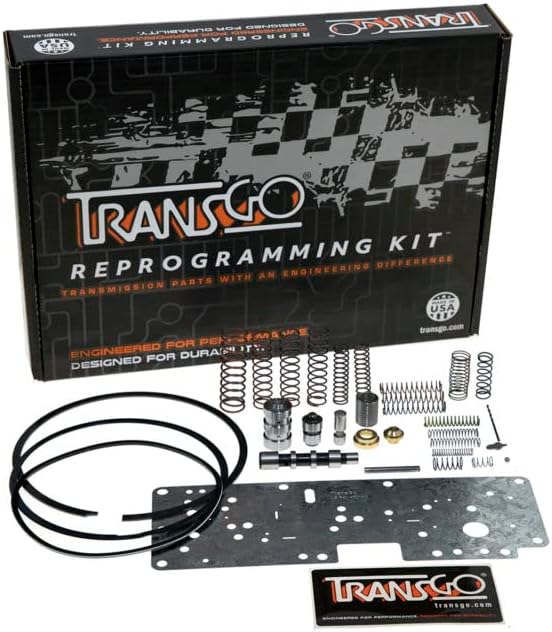
TransGo SK4R100 Shift Kit
The TransGo SK4R100 is a valve body recalibration kit that improves shift quality and durability in the 4R100. It is not a "performance" shift kit in the sense that it makes the transmission shift harder for the sake of it. What it does is tighten up the shift timing and increase clutch apply pressure during shifts to reduce the overlap period where clutch packs are slipping. Less slip time means less heat, less friction material wear, and longer transmission life.
What It Actually Does
- Recalibrates accumulator circuits: The kit includes new accumulator pistons and springs that change the pressure ramp-up profile during shifts. The stock accumulator calibration allows extended cushion time that generates heat. The TransGo calibration shortens the cushion phase without making the shift feel abrupt.
- Adds line pressure boost: The kit modifies the pressure regulator circuit to increase line pressure under load. This means the clutch packs are squeezed harder during shifts and while holding gears, which reduces slip and heat generation. The boost is proportional to throttle position -- light-throttle shifts remain smooth.
- Corrects TCC apply: The kit includes modifications to the TCC apply circuit that improve lockup quality and reduce the tendency for TCC cycling at light throttle. This directly addresses the lockup shudder complaint.
- Addresses known valve body wear: The kit includes specific valves and modifications that compensate for wear patterns that develop in the 4R100 valve body over time.
When to Recommend It
Install the SK4R100 on every rebuild. There is no downside for a towing application or a daily-driver Super Duty. The shift quality improvement is noticeable but not aggressive -- customers will not complain that the shifts are too hard. For trucks with aftermarket tuning, larger injectors, or modified turbo setups that are putting more torque through the transmission than stock, the shift kit is not optional -- it is mandatory to prevent the stock accumulator calibration from allowing clutch pack slip at the higher torque levels.
The kit retails for approximately $80-$110 depending on your supplier. Installation adds about 30-45 minutes to the valve body assembly during a rebuild. It comes with detailed instructions and a DVD. Follow the instructions exactly -- the accumulator spring selection and check ball placement are specific to the application (diesel versus gas, 2WD versus 4WD).
Pressure Test Before Teardown
Every 4R100 that rolls into your shop with a shift complaint should get a line pressure test before you decide to pull it. This takes 15 minutes and tells you more about the condition of the transmission than any scan tool data or road test.
The Test
Connect a 0-300 PSI gauge to the line pressure port on the passenger side of the case. With the engine at operating temperature and the transmission in each gear range, record the pressure at idle and at wide-open throttle (with the brakes applied and wheels blocked, or on a lift with the wheels free).
| Range | Pressure at Idle | Pressure at WOT Stall |
|---|---|---|
| Park / Neutral | 55-65 PSI | N/A |
| Drive (D) | 55-65 PSI | 225-265 PSI |
| Manual 2nd | 55-80 PSI | 225-265 PSI |
| Manual 1st | 85-110 PSI | 225-265 PSI |
| Reverse | 85-110 PSI | 240-290 PSI |
What the Numbers Tell You
- Low pressure in all ranges at idle and WOT: Pump wear, pressure regulator valve stuck, or EPC solenoid stuck open. Start with the EPC solenoid, then move to the valve body and pump if replacing the solenoid does not correct it. On units that also run hot with converter-overheat and low-cooler-flow codes (Ford 62, 628, 1744), suspect a worn line-to-lube pressure regulator valve restricting converter and cooler charge -- Sonnax addresses that specific failure with its 36424-04K drop-in valve.
- Normal pressure at idle, low pressure at WOT: EPC solenoid not responding to PCM commands, or wiring issue between PCM and EPC solenoid. Check the connector and wiring harness at the case pass-through. If the electrical side checks out, go to the valve body: Sonnax's E4OD/4R100 valve body layout puts the solenoid regulator valve (36947-14) behind 2nd or 3rd gear starts, TCC cycling or slip, and reduced lube oil from the center support, and the oversized manual valve (36947-13K) behind delayed reverse, reverse slip, low/reverse clutch failure and low line pressure in reverse and manual low.
- High pressure in all ranges: EPC solenoid stuck closed or disconnected. When the EPC solenoid loses its control signal, the valve body defaults to maximum line pressure. This causes all shifts to be harsh.
- Normal pressure but transmission still slips: The hydraulic supply is fine, which means the problem is downstream -- leaking clutch seals, worn clutch packs, or a cracked apply piston. This transmission needs internal work.
- Pressure drops slowly after initial apply: Internal seal leak. The circuit charges initially but cannot hold pressure as fluid leaks past a damaged seal or worn bore.
The pressure test separates EPC solenoid issues and pump issues from internal clutch circuit failures in 15 minutes. Without it, you are guessing. And guessing costs money -- either the customer's money if you tear down a transmission that only needed a solenoid pack, or your money if you replace a solenoid pack on a transmission that actually needs a rebuild and has to come back out.
Bottom Line
The 4R100 is a straightforward transmission once you know its failure patterns. The coast clutch drum, forward clutch piston, center support, and EPC solenoid account for the vast majority of failures. Pressure test before you pull it, measure the center support bore before you reuse it, install the TransGo SK4R100 on every rebuild, use Mercon V and nothing else, and replace the solenoid pack as an assembly. These trucks are not going away -- the 7.3L Power Stroke platform has a fanbase that keeps these things on the road indefinitely. Build the transmission right the first time and it will be another 200,000 miles before you see it again.
For shops working on the newer Ford diesel platform, see our guide to the 5R110W TorqShift, which replaced the 4R100 starting in 2003.
Sources
- Sonnax — "Ford E4OD, 4R100 Vacuum Test Guide," critical wear areas and vacuum test locations. Backs the valve-by-valve complaint map used in this article, including the direct clutch accumulator regulator valve and plunger (kit 36948-13K) causing soft shifts, no 2nd, no 3rd and premature clutch failure; the low/reverse modulator valve plunger and sleeve (36947-06K) causing no engine braking, burnt low/reverse clutch and low pressure at the low/reverse clutch; the engagement control valve causing delayed forward and reverse engagement with burnt forward and direct clutches; and the note that worm tracks and test locations match 1996-1998 E4OD but differ on 1989-1995 E4OD. sonnax.com
- Sonnax — "Ford E4OD, 4R100 Valve Body Layout." Backs the valve-train location guide referenced in the pressure-test section, including the solenoid regulator valve (36947-14) tied to 2nd or 3rd gear starts, TCC cycling or slip and reduced lube oil from the center support, and the oversized manual valve (36947-13K) tied to delayed reverse, reverse slip, low/reverse clutch failure and low line pressure in reverse and manual low. sonnax.com
- Transmission Digest — "E4OD/4R100 Component Upgrade: Mix and Match Is Not an Option," Mike Riley, Technical Editor, September 1, 2014. Backs the interchange section: the common F81P pump body and cover casting introduced in 1998 covering E4OD, 4R100 on-off lockup and 4R100 PWM lockup assemblies; the stator support and TCC end-plug-depth identification methods (over an inch on E4OD and non-PWM 4R100 versus roughly a quarter inch on PWM); and the coast clutch drum part numbers YC3Z-7G387AA, YC3Z-7G387BA, 1C3Z-7G387AA and 1C3Z-7G387BA with the oil dam washer requirement on the latest PTO drum. transmissiondigest.com
- Sonnax — Line-To-Lube Pressure Regulator Valve 36424-04K (E4OD/4R100). Backs the converter-overheat diagnosis in the pressure-test section: OE valve wear causing high line pressure, low cooler flow, converter overheat and Ford codes 62, 628 and 1744, and the drop-in replacement that corrects it. sonnax.com
- Sonnax — Ford 4R100 unit page, parts and component reference. The index for the 4R100 valve body layout, vacuum test guide and hard-part coverage cited above. sonnax.com
- Ford Customer Service Division (Motorcraft) — Mercon V automatic transmission and power steering fluid product data. Backs the fluid specification section: Mercon V (Motorcraft XT-5-QMC) and its use in applications that formerly called for Mercon. fcsdchemicalsandlubricants.com