P0741 gets sold as a solenoid job more often than any other code on a Ford 6R80. It is usually not a solenoid job. The word in the code definition that matters is performance: the PCM did not detect a broken wire, it detected that it commanded the converter clutch on and the converter kept slipping anyway. That is a hydraulic verdict, and hydraulic verdicts get settled with a pressure gauge, not a parts catalog.
The 6R80 and its ZF parent give you a factory pressure tap that answers the question directly. Here is how that circuit works, how to test it in about twenty minutes, and which four valve bores cause most of these.
The short version: The 6R80 converter clutch is released by pressure, not applied by it. The release circuit ZF calls WK holds the friction ring off the cover; to lock the converter, the TCC solenoid dumps that pressure toward zero. So a stuck-off clutch means WK pressure is not going away, and that traces to a worn bore at one of four valves in the pump and valve body, a contaminated solenoid, or fluid that is low or aerated. Tap the WK port on the driver side of the bell housing and watch what the pressure does when the scan tool says the clutch is commanded on.
How the 6R80 Actually Locks the Converter
The 6R80 is Ford's licensed build of the ZF 6HP26, and the converter control carries over from the ZF design. That matters because the good technical literature on this circuit is written in ZF's valve names, and the valve body in front of you uses them.
The converter is a two-path design. Pressure entering the release circuit gets between the friction ring and the converter cover and holds them apart. Sonnax technical vice president Bob Warnke, writing on ZF6 and 6R60/6R80 converter diagnosis, describes WK plainly: it corrals the oil pressure that disengages the clutch piston from the cover, and it is the release circuit. Apply is what happens when that pressure is taken away.
The TCC solenoid on these units is normally vented, or normally open. As commanded amperage climbs, apply increases and WK pressure drops. If you have both a scan tool and a gauge on the truck, the relationship is a straight line you can watch in real time, and that single relationship is the whole diagnosis.
One design note trips people up: the 6R80 does not run a continuous controlled slip the way a GM unit does. Per Sonnax, the ZF6 family applies the clutch full-on and as early as it can for fuel economy, commonly right after the 2-3 shift and in many cases just after the 1-2 completes. Expect a hard lock at light throttle early in the drive, not a lazy partial apply at highway speed.
What Sets the Code
The PCM computes converter slip by comparing engine speed against turbine shaft speed. Command the clutch on, and if the two do not converge inside the calibration window it stores P0741. There is no continuity test in that decision, which is why an ohm reading on the solenoid so often comes back fine on a truck that has carried the code for months.
It also means the code can be set by things that have nothing to do with the converter. Anything that makes engine RPM wander independently of the transmission lands in that math as slip. Hold that thought.
Step One: Fluid, Before Anything Else
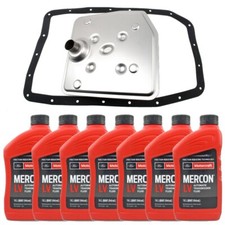
The 6R80 takes MERCON LV, Ford specification WSS-M2C938-A, and nothing else. Ford's own Customer Service Division fluid application chart lists MERCON LV for this unit, and the Motorcraft service part number that appears in Ford's 6R80 bulletins is XT-10-QLV. Do not put MERCON V, MERCON SP, or a universal fluid in one of these and expect a converter clutch to behave.
There is a Ford-specific fill trap here that is worth more than any scan tool trick. The 6R80 has a thermal element in the converter circuit ahead of the case outlet, the same idea Ford used in the 5R55W and 5R110W. Below roughly 125°F, that element redirects converter oil back to the bushings instead of out to the cooler. Sonnax's guidance is direct: servicing one of these requires letting converter oil temperature rise enough to open the element, or the cooler never fills and the unit ends up low on fluid after the first drive cycle. A 6R80 that was serviced cold and is now a quart or two down will slip the converter clutch and set P0741 with nothing mechanically wrong inside it.
So: level checked hot, at the temperature the workshop manual calls for, vehicle level. Fluid that is dark, smells cooked, or carries clutch fuzz answers the question before you pick up a gauge.
Step Two: The WK Pressure Test
This is the test that separates a real 6R80 diagnosis from a guess. Both ZF and Ford give the case exactly one pressure tap, and it is the WK port, located on the driver side of the bell housing just above the cooler lines. ZF cases label the fitting AUF WK. Ford left it unmarked, but it is the same port fed from the same circuit.
Two practical notes. The fitting uses a 10 x 1.00 mm ZF thread, so you need an adapter or a modified ZF5/ZF6 pressure plug drilled for a 90-degree fitting. And you must read all the way down to zero, so leave the 500 psi line-pressure gauge in the drawer — WK never exceeds about 80 psi (5.5 bar). Use an accurate 100 psi gauge, or a 100 psi transducer you can graph next to scan data.
Here is what a healthy circuit does, per Sonnax's published ranges:
| Condition | Expected WK pressure | What it tells you |
|---|---|---|
| Key on, engine running, cold | 70 to 75 psi (4.8 to 5.1 bar), instant and steady | Clutch is being held off the cover; this is what gives a smooth idle |
| At operating temperature, clutch released | 65 to 68 psi (4.5 to 4.7 bar) | Normal warm bleed-down of the release circuit |
| Selecting Reverse | Sharp dip to about 50 psi (3.4 bar), then back to 65 to 75 | Normal. Line pressure is priority oil, converter charge is secondary |
| TCC commanded on, at temperature | 0 to 2 psi (0 to 0.13 bar) | Zero is full apply. 1.5 to 2 psi is a deliberate sliver of slip for NVH |
Read it like this. Scan tool commanding the lockup solenoid and WK still up at 30, 40, 60 psi means the clutch is stuck off hydraulically. WK dropping cleanly to zero while engine RPM still will not sit down on turbine RPM means the hydraulics did their job and the converter or its lining is the suspect. WK never reaching 70 psi cold means a supply problem upstream, with the converter clutch only the symptom that got noticed.
Cross-check the scan tool the whole time. With WK at zero, engine RPM and turbine or input shaft RPM should match each other. Some tools also give a Torque Converter Amplification value; at full lock with zero WK it should read zero as well.
Step Three: The Four Bores That Cause It
When WK is out of range, the cause is almost always a worn valve bore letting the circuit leak. Sonnax names the specific valves in ZF nomenclature, and this is the order worth checking:
- SYS.DR-V, the main pressure regulator valve. Line pressure is priority oil, so wear here robs converter feed before anything else notices. Sonnax kit 95740-01K covers this on 2009-2014 units without the 053 separator plate, and its cure list includes TCC slip alongside flare shifts and erratic line pressure.
- WK-V, the converter release regulator valve. This is what controls converter internal pressure once oil leaves the converter and returns to the valve body. Sonnax kit 95740-05K. Symptom list: excess TCC slip RPM and related codes, harsh TCC apply and release, low TCC release pressure, rough idle in Reverse, overheated converter.
- WD-V, the bypass clutch control valve. This one is the switch. Sonnax's own description of the failure is a P0741 written in plain English: as the bore wears, the apply rate of the clutch slows and the clutch release pressure will not vent. Kit 95740-13K reams the bore and installs a hardcoat anodized aluminum oversized valve with annular grooves for centering. Tooling is F-95740-TL13 plus the VB-FIX fixture.
- DR.REO-V, the solenoid pressure regulator valve. It feeds regulated pressure to every solenoid, TCC included. A worn bore here pushes all solenoid output high or low at once, which is why a truck with a TCC code frequently also has shift quality complaints.
You do not guess at these. Vacuum test them. Sonnax's method pulls a calibrated vacuum through the clearance between the spool and the casting bore; 25 in-Hg represents a complete seal, and the reading falls in direct proportion to the wear. Sonnax publishes free vacuum test guides for the Ford 6R100 and 6R80 (2015-later) valve body and for the ZF6HP Gen. 1 and 6R80 (2009-2014) layout, with the port locations printed on the casting drawing. Print the correct one — the two layouts are not interchangeable.
Two non-valve items belong on the same list. The TCC solenoid is known to wear out or become contaminated, and in this family that failure is typically mechanical rather than electrical — another reason the ohm test lies. And the end plugs between the shift valves and the solenoids work loose and leak the circuit. Seal them while you are in there.
6R80 7-Piece Solenoid Kit (2007-2014), OEM AL3P-7G276-AF
If the vacuum test clears the bores and the TCC solenoid is what failed, this is the honest way to fix it: replace the set, not the one. These solenoids age together, and the PCM adapts around all of them. Around $226 at Core Transmission Parts, our sister store, with the OE Ford part number on the box.
Shop the 6R80 solenoid kit →Browse all transmission solenoids at CoreTransmissionParts.com
Step Four: Prove It Is Even the Transmission
This is the part that saves a rebuild. Because P0741 is computed from an RPM comparison, an engine that surges paints itself onto the TCC slip PID and looks exactly like a slipping converter clutch.
Certified Transmission diagnostician Troy Hopp published a case in Transmission Digest worth reading before you condemn a converter. A 2015 Expedition 4WD with the 3.5L turbo V6 came in with fluctuating RPM and a whirring noise, after another shop had already fitted a remanufactured unit chasing a converter clutch shudder. Scan data clearly showed TCC slip. They replaced the transmission under warranty, flushed the coolers, reprogrammed the PCM, entered the correct solenoid strategy and body ID, and reset KAM and adapts. Nothing changed. A broken chassis ground and corroded battery terminals were found and repaired. Still nothing.
The break came from power-braking it stationary: that reproduced the whirring noise and the RPM fluctuation, and the scan tool showed TCC slip surging with the vehicle not moving at all. Then the MIL set P0234, turbocharger boost pressure, pointing to Ford TSB 16-0013. Replacing the left turbocharger assembly resolved every symptom.
The takeaway is not that P0741 is usually an engine fault. It is that the slip PID is a calculation, not a measurement, and it is only as honest as its inputs. Before you pull a unit, scan the engine side, verify grounds, and confirm the slip is real on the WK gauge rather than trusting a derived number.
Doing the Repair
Once the bad bore is identified, you have three legitimate paths, and they are priced very differently:
- Ream and sleeve the specific bore. Cheapest in parts, but it needs the correct Sonnax tool kit and the VB-FIX fixture, and it is only worth doing if the rest of the casting vacuum-tests well.
- Install a Zip Kit or full valve body repair kit. Sensible when several bores are marginal, the usual finding on a high-mileage 6R80.
- Fit a remanufactured valve body. Sonnax lists FD6R80-3 for 2015-later units without Start-Stop and FD6R80-4 for 2015-later units with Start-Stop. Fit the wrong one and the unit will not behave.
Whichever route you take, program the solenoid strategy code and solenoid body ID into the PCM afterward. Sonnax's Jim Dial notes that the variable bleed solenoids on the 6R80 lose their calibration or banding over time — a valve that was band 3 comes back as band 5, or band 1.5 — and the PCM needs the correct banding, 1 through 5, to control overlap and adaptation. With the codes entered, relearn can complete in as few as three to five shift cycles. Skip it and you will chase shift complaints unrelated to what you just repaired.
And do not reuse a converter that ran hot with a slipping clutch. Ford's 6R80 converter service part number in bulletin TSB 13-6-4 is BR3Z-7902-C, with converter nut W714689-S437 (4 required) and pump seal 6L2Z-7A248-AA. That bulletin also confirms the fluid: MERCON LV, XT-10-QLV. Gearbox Insider does not sell torque converters, so take those as specs and source the converter from your usual supplier.
Keeping It From Coming Back
Ford calls the 6R80 fill "filled for life," and a slipping converter clutch is the receipt for what that phrase costs. Prevention is short: change the fluid with MERCON LV on a real interval, service it hot enough for the thermal element to open so the cooler fills, flush the coolers any time a converter or unit is replaced, and vacuum test the valve body during an overhaul instead of assuming a clean-looking casting is still within clearance. Bore wear is progressive, and every mile with a slipping clutch cooks more fluid into the varnish that accelerates the next bore.
Valve body kits, solenoid sets, filter and pan gasket kits, master rebuild kits and MERCON LV — matched to your 6R80 and shipped fast from the USA.
Shop 6R80 parts →FAQ
Does P0741 on a 6R80 always mean the torque converter is bad?
No, and assuming it does is how good converters get thrown away. P0741 only reports that commanded lockup did not produce the expected drop in slip. On a 6R80 the far more common cause is that the WK release pressure never vented, because a worn bore at the bypass clutch control valve, the converter release regulator valve, or the main pressure regulator valve is leaking the circuit. Tap the WK port and watch the pressure before you condemn the converter.
Can low transmission fluid cause 6R80 P0741?
Yes, and it is one of the most common causes right after a service. The 6R80 has a thermal element that keeps converter oil away from the cooler until roughly 125 degrees F, so a unit filled cold and driven away will be low once that element opens and the cooler fills. Low or aerated fluid lets the converter clutch slip under load, which is exactly what the PCM is measuring. Check the level hot, at the correct temperature, before doing anything else.
What pressure should WK be on a Ford 6R80 when the converter clutch is applied?
Zero to 2 psi. Zero indicates full apply, and 1.5 to 2 psi means the TCM is allowing a small deliberate slip to control noise and vibration. Cold, with the clutch released, WK should sit at 70 to 75 psi, dropping to about 65 to 68 psi at operating temperature. If the scan tool says the clutch is commanded on and WK is still up in the 30s or higher, the clutch is stuck off hydraulically.
Which transmission fluid does a Ford 6R80 take?
MERCON LV, which is Ford specification WSS-M2C938-A. The Motorcraft service part number that appears in Ford's own 6R80 bulletins is XT-10-QLV. MERCON V and MERCON SP are different fluids and are not substitutes. Putting the wrong viscosity fluid in this unit affects converter clutch apply behavior directly.
Will replacing the TCC solenoid fix 6R80 P0741?
Sometimes, but only after the hydraulics are cleared. The TCC solenoid in this family does fail, usually mechanically through wear or contamination rather than electrically, which is why a resistance check often passes on a bad one. Vacuum test the solenoid and the four valve bores first. If the solenoid is genuinely at fault, replace the full set rather than the one, and program the solenoid strategy and body ID codes afterward.
Sources
- Sonnax — "Six Ways from Sunday: Diagnosing ZF6 & Ford 6R60/80 TC-Related Drivability Concerns," Bob Warnke, March 23, 2016. Backs the WK release-circuit description, the single case pressure tap on the driver side of the bell above the cooler lines and its AUF WK label, the 10 x 1.00 mm ZF thread, the 80 psi ceiling and 100 psi gauge recommendation, the cold 70 to 75 psi / hot 65 to 68 psi / Reverse dip to 50 psi / applied 0 to 2 psi ranges, the normally vented TCC solenoid behavior, the full-apply strategy after the 1-2 or 2-3 shift, the SYS.DR-V, WK-V, WD-V, SCHM-V and DR.REO-V root-cause list, the mechanical rather than electrical solenoid failure mode, the loose end plugs, and the 125 degree F thermal element fill warning. sonnax.com/tech_resources/325
- Sonnax — Oversized Bypass Clutch Control Valve Kit 95740-13K product and application data. Backs the WD-V OE valve name, the applications covering 6R60, 6R75, 6R80 (2009-2014), 6R80 (2015-later), 6R100 and ZF6HP19/26/32 Gen. 1, the failure description that a worn bore slows clutch apply and prevents release pressure from venting, the TCC codes and excess TCC slip symptom list, the hardcoat anodized oversized valve with annular grooves, and the F-95740-TL13 and VB-FIX tooling requirement. sonnax.com/parts/2677
- Sonnax — Oversized Converter Release Regulator Valve Kit 95740-05K product data. Backs the WK-V OE valve name and its cure list of excess TCC slip RPM and related codes, harsh TCC apply and release, low TCC release pressure, rough idle in Reverse and overheated converter. sonnax.com/parts/2671
- Sonnax — "Ford 6R100, 6R80 (2015-Later) Vacuum Test Guide," November 11, 2020, and the companion ZF6HP19/26/32 (Gen. 1), Ford 6R60, 6R75, 6R80 (2009-2014) guide. Backs the vacuum test method, the critical wear areas and port locations printed on the valve body casting drawing, the separate layouts for the two 6R80 generations, and the FD6R80-3 (without Start-Stop) and FD6R80-4 (with Start-Stop) remanufactured valve body split. sonnax.com/tech_resources/928
- Sonnax — "Troubleshooting Ford 6R80 & 6R140 Timing-Related Shift Issues," Jim Dial, August 15, 2022. Backs the variable bleed solenoids losing calibration or banding over time, the band 1 through 5 solenoid strategy and body ID codes needing to be programmed into the PCM, and the three to five shift cycle relearn. sonnax.com/tech_resources/1137
- Transmission Digest — "6R80 whirring noise: TCC slip or engine surge?", Troy Hopp, Certified Transmission, May 28, 2024. Backs the 2015 Expedition 4WD 3.5L turbo case study: verified TCC slip on the scanner with RPM fluctuation, a warranty transmission replacement that changed nothing, PCM reprogramming with solenoid strategy and body ID plus KAM and adapt reset, the repaired ground and battery corrosion, the stationary power-brake test that reproduced surging TCC slip, and the P0234 turbo boost code and TSB 16-0013 that led to the left turbocharger replacement which resolved it. transmissiondigest.com/6r80-whirring-noise-tcc-slip-or-engine-surge
- NHTSA / Ford Motor Company — Technical Service Bulletin 13-6-4, "3.7L Engine and 6R80 Transmission — Whine Noise on Acceleration." Backs the 6R80 torque converter service part number BR3Z-7902-C, converter nut W714689-S437 (4 required), converter pump seal 6L2Z-7A248-AA, and the MERCON LV automatic transmission fluid part number XT-10-QLV specified for the unit. static.nhtsa.gov/odi/tsbs/2013/SB-10053083-4324.pdf
- Ford Customer Service Division, Chemicals & Lubricants — Automatic Transmission Fluid Application Chart. Backs MERCON LV, Ford specification WSS-M2C938-A, as the specified fluid for the 6R80. fcsdchemicalsandlubricants.com/quickref/atf2US.pdf