A 45RFE service gets quoted wrong more often than almost anything else that rolls into a shop, and not because the job is hard. Three numbers get guessed at: what fluid goes in, how much of it a pan drop actually replaces, and how long the vehicle gets before the next one. Guess the first and you have a converter clutch complaint in six months. Guess the second and you hand back a transmission still two-thirds full of the fluid the customer paid you to remove.
Every capacity below comes off a Chrysler document, and the pressure and flow numbers off a bench. Where I break from the factory position I say so and show the reason.
One naming note, because it trips people up in the parts system: the 45RFE is a four-speed introduced in 1999, and the 545RFE is the five-speed derived from it in 2001. Chrysler's own capacity sheet lists them on a single row as "45RFE & 545 RFE 5-Speed Automatic." That label is a documentation carryover; the capacities are correct for both.
The Fluid: ATF+4 Means MS-9602, Not a Viscosity
ATF+4 is not a weight and not a color. It is Chrysler Material Standard MS-9602, a licensed specification with a friction-durability requirement attached. A blender either holds that approval or does not.
Look at what an approved fluid publishes. Mobil's ATF+4 product data sheet lists the approval flatly — "Chrysler MS-9602" — alongside typical properties: kinematic viscosity of 34.4 mm²/s at 40°C and 7.5 mm²/s at 100°C, viscosity index 192, Brookfield viscosity of 8,800 mPa·s at -40°C, flash point 200°C (392°F), and pour point -50°C (-58°F).
Two of those numbers do real work on an RFE. The Brookfield figure is a cold-flow number, and this family runs a three-gear pump feeding a valve body full of small-diameter spool valves; fluid that thickens too much at -40°C makes for slow, ugly engagements on a January morning. The viscosity index of 192 keeps that same fluid from thinning far enough at operating temperature to stop holding clutch apply pressure and feeding the cooler at the same time.
Read the jug, not the shelf tag
Multi-vehicle fluids will say they are "recommended for use where ATF+4 is specified." That sentence was written by a marketing department and means the blender decided to recommend it. An approved fluid names the material standard. If a label will not commit to MS-9602 in print, it has not been through the test that standard describes — and on this unit the property being tested is friction durability under slip.
You are not locked into a Mopar-branded bottle, though. Any fluid genuinely holding the MS-9602 approval meets the same standard, and the same Mobil sheet states it covers services calling for ATF+, ATF+2 and ATF+3. Buy on the approval, not the label.
Capacity: A Pan Drop Is About a Third of the Fluid
Chrysler publishes the figures in the Ram Body Builder Guide fluid capacity sheet. For the 45RFE and 545RFE:
| Fill | Liters | Pints (as published) | US quarts |
|---|---|---|---|
| Service fill, 4x2 | 5.20 L | 11.00 | ~5.5 qt |
| Service fill, 4x4 | 6.20 L | 13.00 | ~6.6 qt |
| Overhaul (dry) fill | 14.00 – 16.00 L | 29.00 – 33.00 | ~14.8 – 16.9 qt |
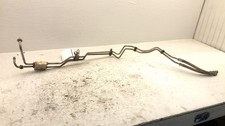
Footnote 5 on that sheet is the part people skip. Chrysler states the dry fill varies with "type and size of internal cooler, length and inside diameter of cooler lines, or use of an auxiliary cooler." A Dakota with the factory in-radiator cooler and a Ram 1500 running a stacked-plate auxiliary are not the same fill, and no published number will make them the same.
Now run the arithmetic, because this number should shape how you sell the job. The system holds roughly 15 to 17 quarts and a pan drop gives back 5.5 to 6.6 of them. A conventional pan-and-filter service replaces something like a third to 40 percent of the fluid in the vehicle. The balance sits in the converter, the cooler and the lines, exactly as tired as when the truck rolled in.
Two ways to deal with that, both defensible:
- Serial drains. Pan and both filters, drive it 300 to 500 miles, drop and refill again. Two passes puts you over 60 percent fresh, three past 75. Slow, but it never introduces pressure into the circuit.
- Cooler-line exchange. Pull the return line into a jug, run the engine, feed new fluid in as fast as the pump pushes old fluid out. Do it after the pan and filters, never before, so you are not pumping the pan's debris through a new filter.
Neither is a chemical flush, and I do not run chemical flushes on high-mileage RFEs. On a unit with clutch material already in suspension, solvent chemistry loosens varnish that was doing the modest favor of taking up clearance, and then you get to explain a slipping overdrive that was fine on the way in.
Two Filters. Most Services Only Change One.
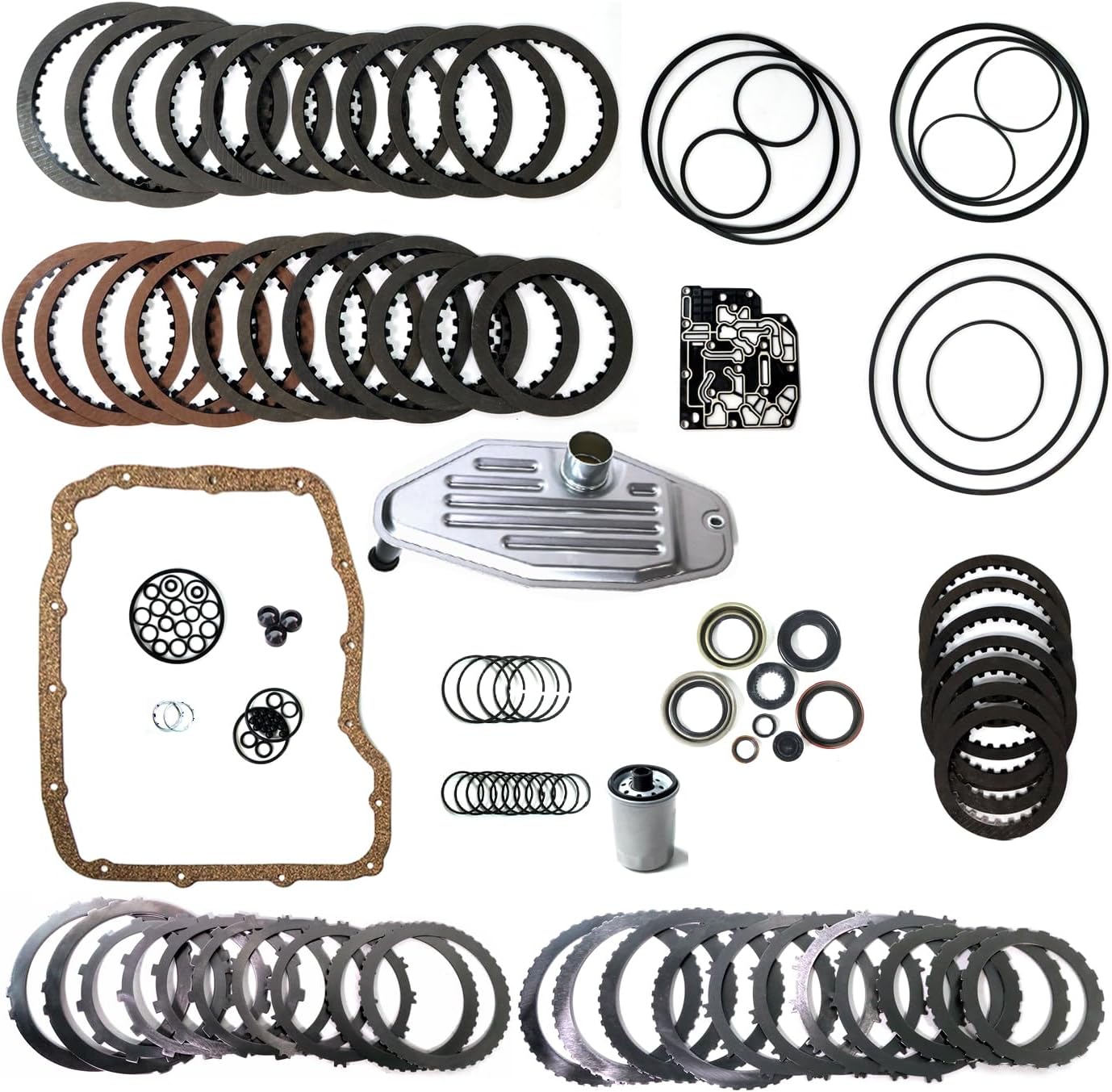
This is the most common half-finished job on the platform. The 45RFE carries a flat sump filter with a snout that seals into the pump, and a spin-on cooler-return filter resembling a small oil filter. Both live above the pan. Both get replaced.
The cooler-return filter is a second stage of filtration on fluid coming back from the cooler before it re-enters the hydraulic circuit — sensible design on a unit whose valve body is full of close-tolerance spool bores. Leave a loaded one in place during a rebuild and you have installed a bag of the old unit's debris upstream of your new valve body. If a quoted service lists one filter, it is half a service. Price it as two.
While the pan is off: the M6 pan bolts here are a low-torque fastener. Mag-Hytec's installation sheet for their 45RFE/545RFE pan calls for 7 to 9 ft-lb, or 105 in-lb. Reach for an inch-pound wrench, not the 3/8 ratchet you tighten drain plugs with. A warped RFE pan rail leaks from the day it leaves.
Heat and Cooler Flow Set the Real Interval
This is what decides whether any published interval means anything on the vehicle in front of you. Sonnax has documented low cooler flow across the RFE family since the platform's 1999 introduction, and the finding is specific: on these transmissions, cooler flow is a function of where the pressure regulator valve is sitting — not of how hot the fluid is or how fast the vehicle is moving. They published the scan-tool numbers separating stock programming from a tune, and the flow that goes with each:
| In Drive, at a stop | Stock programming | Tuned programming |
|---|---|---|
| Desired and actual line pressure | 60 – 70 psi | 100 – 105 psi |
| Line pressure duty cycle | 22 – 24% | 5.1% |
| Pressure at stall | 160 psi | Over 160 psi |
| Cooler flow at idle | 1.3 GPM | 0.5 GPM or lower |
The mechanism explains why an interval that works on one truck cooks another. The pressure regulator valve has a small undercut on its spool forming the connection from line pressure to the lube and torque converter circuits. At 60 to 70 psi desired, that connection is wide open and the cooler sees 1.3 GPM. Raise desired pressure to 105 psi and the valve strokes to a position where the undercut is barely connected, and flow collapses — Sonnax measured it falling to 0.3 GPM with pressure at maximum. A duty cycle down at 5.1 percent means the pump is running near its ceiling just to hold that pressure.
Note what this is not: a wide-open-throttle problem. It is an idle and low-RPM problem, which puts it precisely where these vehicles spend their worst hours — sitting in Drive at a jobsite, creeping in traffic with a trailer, idling at a scale. The fluid is worked hard and barely moving through the cooler at the same time. That is what turns ATF+4 dark.
The 30-second check before you quote an interval
Scan tool on, Drive selected, brake held at idle. Read three PIDs: desired line pressure, actual line pressure, and line pressure duty cycle. If desired sits near 105 psi with duty cycle around 5 percent, the vehicle is tuned whether or not the customer mentioned it. Sonnax notes desired pressure still displays even when actual reads 0 psi, so read both, and treat a 0 psi actual as a hydraulic failure, not a sensor glitch.
A tuned truck does not get a factory interval. Neither does one whose owner will not say. If it is staying tuned, Sonnax's lube-regulated pressure regulator valve (44912-17K) restores the line-to-lube connection so the higher pressure does not cost the cooler its flow — they measure a 60 percent increase in lubrication and cooler flow at maximum line pressure over the OE valve.
When Fresh Fluid Will Not Fix It
Fluid service is maintenance, not repair, and on the RFE family one failure gets misdiagnosed as dirty fluid every week: solenoid switch valve bore wear.
Sonnax's vacuum test guide for the 45RFE, 545RFE, 65RFE, 66RFE and 68RFE lists the solenoid switch valve and its plug as primary wear locations in the valve body, and ties them to a cluster of codes you will recognize — 841, 868, 871, 988, 1775 and 1776 — with symptoms including bind-up, failsafe mode, wrong gear starts and a burned overdrive clutch. The pump body has its own list: TC limit valve wear producing engine stall, low cooler flow and an overheated converter; pressure regulator valve wear producing high line pressure, burnt clutches and repeated converter failure.
Two practical consequences. First, order by spool diameter, not by year — Sonnax splits the solenoid switch valve repairs between .420 in. and .453 in. OE large-spool bores, and the wrong kit does not fit. Second, if the complaint is a burned overdrive clutch and you change the fluid without vacuum testing that bore, you will be doing the job again on your own dime. Fresh ATF+4 does not restore a worn aluminum bore.
Sonnax also lists accumulator piston wear against a symptom set worth knowing as a maintenance tell: slide shifts, high CVIs, 1-2 shudder and coastdown clunk. Clutch volume index is a live PID on these units, and a CVI drifting upward across successive visits is telling you clutch clearance is growing. That is a rebuild conversation, not a fluid conversation, and a much better one to have early.
Fluid fill adapter kit
Later RFE applications have a capped or sealed dipstick tube, and filling one cleanly means getting a hose to the fill point without pouring ATF+4 down the bellhousing. A 27-piece adapter set covers the tube sizes across this family.
See the adapter kit →Know Which Valve Body You Have Before You Order
The RFE valve body changed in ways that matter to anyone opening one. Writing in Gears, ATRA documents that the 45RFE valve body originally used seven check balls with a black case connector, later a white one. In 2009 Chrysler eliminated the overdrive solenoid along with the number 6 check ball, and changed the connector color again.
The reason the OD solenoid could go: the multi-select solenoid already fed the overdrive clutch. Transmission Digest lays out the full set — seven solenoids: line pressure control, underdrive, overdrive, second clutch, fourth clutch, low/reverse-TCC, and multi-select. Three are normally applied (line pressure control, underdrive, multi-select); four are normally vented.
That normally-applied detail explains a symptom you will meet. If the solenoid harness is unplugged or the unit drops into failsafe, the normally applied solenoids still apply pressure and the normally vented ones vent — which means the line pressure control solenoid produces maximum line pressure. A failsafe RFE is not limping along on low pressure. It is hammering every applied clutch at maximum line pressure, and every mile driven that way costs clutch life. Tow it or fix it; do not let a customer drive it home in limp because it "still moves."
Checking the Level Without Guessing
Most level complaints I see trace back to a cold reading. The procedure that works:
- Get it hot. Operating temperature means real driving — roughly 15 miles, not three minutes idling in the bay. Cold ATF+4 can read low or not register at all.
- Engine running for the entire check, vehicle level, parking brake set.
- Cycle the selector through every range, pausing long enough for each to fully engage.
- Read between the HOT (upper) reference holes on the dipstick blade.
- After adding, wait two minutes before re-reading, so the fluid reaches the sump.
- If the tube is capped and sealed from the factory, treat it as a fill point, not a dipstick tube, and set level by the factory procedure for that application.
Do not overfill. ATF+4 expands considerably between a cold garage and 175°F, so a unit filled to the full mark cold is an overfilled unit hot. Overfull means the rotating assembly whips air into the fluid, and aerated fluid is compressible — it will not hold clutch apply pressure or feed the cooler properly, which drops you straight back into the low-cooler-flow problem above, this time by your own hand. If you fit a deep aftermarket pan, throw the published capacity out entirely and set the level hot, on the stick.
What I Actually Recommend
The factory service fills above are documentation and not in dispute. The interval is where I give you a shop opinion and own it as one. A "lifetime fluid" position on a vehicle that tows is a fleet-cost decision, not a longevity one.
| How the vehicle is used | Fluid and both filters |
|---|---|
| Unloaded, mostly highway, stock programming | 60,000 mi |
| Regular towing, plow, or fleet duty | 45,000 – 50,000 mi |
| Tuned for higher line pressure, or heavy tow | 30,000 mi |
| Any unit that has overheated, smells burnt, or shows water | Now, plus a cooler flush and a hard look at the converter |
Pull a sample every time and look at it in a clean jar against white paper. New ATF+4 is red and translucent. Dark but still translucent is heat, not yet failure. Opaque, gray, or smelling scorched means clutch material is in suspension, and a fluid change is a bandage over a teardown you are going to do anyway. Tell the customer that before you take their money, not after.
45RFE filters and pan gaskets, deep pans, coolers and bypass kits, solenoid packs, valve body kits, overhaul kits, and the tools that keep a fluid service clean — shipped fast from the USA.
Shop 45RFE parts →Sources
- Chrysler / Ram Body Builder Guide — 2008 Ram Fluid Capacities sheet. Every capacity in the table above: 45RFE & 545RFE service fill 4x2 at 5.20 L / 11.00 pints, service fill 4x4 at 6.20 L / 13.00 pints, and overhaul fill at 14.00–16.00 L / 29.00–33.00 pints; plus footnote 5 stating that dry fill varies with "type and size of internal cooler, length and inside diameter of cooler lines, or use of an auxiliary cooler." This is also the document that lists the row as "45RFE & 545 RFE 5-Speed Automatic." rambodybuilder.com
- Sonnax — "Resolving Stalling & Overheat Issues After Performance Tuning on RFE Transmissions." The scan-tool comparison used above: 60–70 psi desired and actual line pressure at 22–24% duty cycle with 160 psi at stall on stock programming, versus 100–105 psi at 5.1% duty cycle when tuned; cooler flow of 1.3 GPM at idle stock against 0.5 GPM or lower tuned and 0.3 GPM at maximum pressure; the pressure regulator valve spool undercut as the mechanism; the note that desired pressure still displays when actual reads 0 psi; the RFE family's low cooler flow history since 1999; and the 60% lubrication and cooler flow increase from valve kit 44912-17K. sonnax.com
- Sonnax — "Chrysler 45RFE, 545RFE, 65RFE, 66RFE, 68RFE Vacuum Test Guide." The critical wear areas and their symptoms: solenoid switch valve and switch valve plug wear against codes 841, 868, 871, 988, 1775 and 1776 with bind-up, failsafe mode, wrong gear starts and burned overdrive clutch; the.420 in. and.453 in. OE large-spool bore split that determines which repair kit fits; TC limit valve wear producing engine stall, low cooler flow and overheated converter; pressure regulator valve wear producing high line pressure, burnt clutches and repeated converter failure; and accumulator piston wear against slide shifts, high CVIs, 1-2 shudder and coastdown clunk. sonnax.com
- Transmission Digest — "Operation Multi-Select" (Chrysler 45RFE, 545RFE). The full seven-solenoid set and its rest states: line pressure control, underdrive and multi-select normally applied; overdrive, second clutch, fourth clutch and low/reverse-TCC normally vented. Also the failsafe behavior quoted above — with electronic control removed, the normally applied solenoids apply pressure and the line pressure control solenoid produces maximum line pressure — and the multi-select solenoid's role feeding the overdrive clutch circuit when de-energized. transmissiondigest.com
- Gears Magazine (ATRA) — "RFE Valve Body Interchange." The valve body running changes: the original seven check balls, the black then white case connector, and the 2009 change in which Chrysler eliminated the overdrive solenoid along with the number 6 check ball and changed the connector color; plus the multi-select solenoid delivering oil to the overdrive clutch when it is off, which is what made the overdrive solenoid redundant. gearsmagazine.com
- ExxonMobil — Mobil ATF+4 Product Data Sheet. The Chrysler MS-9602 approval and the typical properties quoted above: kinematic viscosity 34.4 mm²/s at 40°C and 7.5 mm²/s at 100°C, viscosity index 192, Brookfield viscosity 8,800 mPa·s at -40°C, flash point 200°C (392°F), pour point -50°C (-58°F), red in color; and the statement that the fluid covers services specifying ATF+, ATF+2 and ATF+3 type fluid. mobil.com