The RFE family is one of the most common jobs that rolls through an independent shop, and for good reason. Chrysler put the 45RFE and its five-speed sibling the 545RFE into millions of Jeep Grand Cherokees, Dodge Rams, Durangos, and Dakotas from 1999 through the early 2010s. It is a durable, well-engineered unit that outlives a lot of the vehicles it was bolted into. But it has a short list of very predictable failure points, and if you understand them, you can walk up to an RFE with a check-engine light and know within a few minutes whether you are looking at a valve body job or a full teardown. This is that short list.
First, a point that trips up parts ordering more than anything else on this transmission: the 45RFE and 545RFE are mechanically nearly identical. The difference is programming. The 45RFE (1999 onward) uses four operating forward ratios. The 545RFE, introduced in 2001 in the Grand Cherokee and standard across the RFE lineup from the 2003 model year forward, adds a fifth gear and a second-gear alternate called "2 prime." Both units carry three planetary gearsets, three multiple-disc input clutches, three multiple-disc holding clutches, and a dual internal filter system. So when a customer tells you which transmission they have, verify by build tag and vehicle year rather than trusting the badge.
RFE Gear Ratios and Basic Specs
| Ratio / Spec | Value |
|---|---|
| 1st | 3.00:1 |
| 2nd | 1.50:1 |
| 2nd Prime (545RFE) | 1.67:1 |
| 3rd | 1.00:1 |
| 4th | 0.75:1 |
| 5th (545RFE) | 0.67:1 |
| Reverse | 3.00:1 |
| Fluid | Mopar ATF+4 only |
| Filters | Two: sump filter + cooler-return spin-on |
For related builds, see our Dodge transmission hub and Jeep transmission hub.
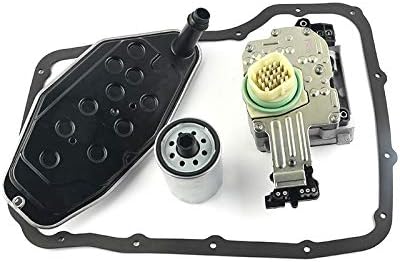
Weak Point 1: Solenoid Switch Valve Bore Wear (P0871)
If there is a single defining failure of the RFE family, this is it. The solenoid switch valve (SSV) lives in the valve body and shares its bore with a pair of shuttle plugs that change position on essentially every shift. Because those plugs are in constant motion under line pressure, the aluminum bore wears oval over time, with the heaviest wear almost always at the bore plug end. Once the clearance opens up, high line pressure bleeds past the valve, partially applies or fails to release the overdrive clutches, and the overdrive pressure switch inside the solenoid pack reports as active at the wrong time. That is what sets a P0871 (OD pressure switch sense circuit) code.
The trap here is that the code points you at the solenoid pack, and the solenoid pack is exactly where the fault is detected -- but not where it originates. Per Sonnax's own P0871 diagnosis write-up, worn valve body bores and outer switch valve plugs are the cause roughly 90 percent of the time -- not a failed solenoid or pressure switch. Shops that reflexively throw a solenoid pack at a P0871 get a car that comes right back. Confirm the direction of the failure before you spend a customer's money.
How the Driver Describes It
Excess heat, sloppy or unpredictable shifts, a car that occasionally drops out of overdrive or flares between gears. On many RFE cars, P0871 is the last clear warning you get before the overdrive clutches themselves cook. Treat it as urgent, not as a nuisance light.
Confirm It With Numbers, Not a Guess
Before anything comes apart, prove the pressure switch circuit is being lied to rather than broken. Sonnax publishes the values: with the switch open you should see 12.6 to 14.4 volts at the controller signal wire, and when hydraulic pressure closes the switch that drops to 25 to 50 millivolts. The switches close at about 22 psi and release at about 11 psi. Run the key-on engine-running test in Reverse with the selector in Reverse: every pressure switch should read open. A switch that reports closed with no pressure behind it, or one that chatters, is the bore bleeding pressure into a circuit that should be dead. For an intermittent, a scope beats a meter -- Sonnax recommends four or more channels with 100V capability.
The Fix
You have three realistic paths. A remanufactured or updated valve body cures it if the rest of the unit is healthy. A precision valve-body repair -- reaming the SSV bore oversize and installing a hardened, correctly sized replacement switch valve -- restores bore integrity and resists re-wear far better than the factory aluminum-on-aluminum arrangement. Or, when the wear is limited to the switch valve area, an in-shop repair kit lets you ream and re-plug the bore on the bench without buying a whole valve body. Sonnax's oversized solenoid switch valve plug kit 92835-18K covers the 45RFE, 545RFE and 68RFE among others, and lists the complaints it corrects as "Low/Reverse switch code, 2nd Gear starts, Erratic TCC apply, No lockup" caused by "solenoid switch valve plugs cocking in the bore and/or bore wear at the switch valves." It is reamed with 92835-RM on the bench or F-92835-TL18 in a VB-FIX fixture. That last option is where the TransGo RFE switch valve kit earns its keep.
TransGo RFE-SV453-WT Solenoid Switch Valve Repair Kit (with Tool)
The purpose-built fix for P0871, P0876, P0841, and related switch-valve codes across the 45RFE, 545RFE, 65RFE, 66RFE, and 68RFE. Includes the oversized switch valve and the reaming tool so you can correct the worn bore on the bench instead of gambling on a used valve body. This is the exact repair that keeps a P0871 from coming back.
View in the Gearbox Insider Store →Weak Point 2: Overdrive Clutch Failure -- Three Places to Look
RFE overdrive clutch failure is not a single fault. It breaks down into three areas, and a proper diagnosis checks all three before the unit gets condemned. Skipping any one of them is how a rebuilt RFE comes back with the same complaint.
1. The solenoid switch valve. Start here, because it is the most common contributor and the cheapest to address. As covered above, a worn SSV bore bleeds overdrive apply pressure and drives the clutches through apply-and-release cycles they were never meant to see. If you rebuild the clutches but leave a worn bore in place, you have built a clutch pack with a stopwatch on it.
2. The stator support and dribbler valve. The stator support feeds the overdrive circuit, and wear in the stator bushing or the dribbler (stator) valve area lets apply oil leak off before it fully seats the clutch. This is easy to overlook because it lives up in the pump/stator assembly rather than in the valve body. On a unit that has cooked overdrive clutches with a clean-looking valve body, the stator is where the leak is hiding.
3. The overdrive clutch pack and conductor plate. The clutches themselves take the abuse from the two leaks above. Separately, the solenoid conductor plate inside the pack is supported on only one side, with connector-seal force pushing on the other. Over years of heat cycling, that plate can warp just enough to let overdrive apply pressure bleed out of the circuit -- another path to the same burnt-clutch outcome. Inspect the plate for flatness whenever the pack is out.
The practical rule: if you pull codes and see only P0871 or P0876 with no gear-ratio or clutch-damage codes, you can usually get away with a valve-body-level repair. If you also see ratio-error or clutch codes such as P0734, P0729, or P0733 sitting alongside it, the clutches are already damaged and you are into a rebuild. Read the whole code set before you quote the job.
Weak Point 3: The Solenoid Pack and Transmission Range Sensor
The RFE solenoid pack integrates the shift solenoids, pressure switches, and the transmission range sensor into one assembly bolted to the valve body. It is a genuine failure point in its own right -- not just the messenger for valve body wear. Debris migrating up from a neglected fluid service can foul a solenoid, and the pressure switches inside the pack do fail electrically. Symptoms range from a no-shift or stuck-in-gear condition to limp mode (locked in a single gear, usually second or third, with the light on).
Before you replace the pack, verify it. Check resistance across each solenoid against spec, and use a bidirectional scan tool to command individual solenoids and watch the transmission respond. A solenoid that reads in-spec on resistance but does not act on a command is failing internally; one that responds but reads out of spec is showing coil wear. Those look identical on a road test and call for different decisions. The transmission range sensor portion is a common cause of erratic shift-position complaints and P0700/P0706-type codes -- confirm it is reporting the correct gear before condemning anything hydraulic.
Fluid Service: The Dual-Filter Job Most Shops Only Half-Finish
The RFE is one of the few transmissions with two filters, and this is where a lot of "I just had it serviced" cars still fail early. Inside the pan there is the primary sump filter. But there is also a second, spin-on cooler-return filter that looks like a small oil filter and lives in the cooler return line circuit. A huge number of quick-service fluid changes replace the sump filter and never touch the cooler-return filter. On a unit that has already shed clutch material, that overlooked filter stays packed with debris and keeps feeding contamination back into the transmission.
The fluid is not negotiable: Chrysler's own component fluids and lubricants sheet for the BR/BE Ram specifies Mopar ATF+4, Type 9602 for the automatic transmission (and for the transfer case). ATF+4 is a licensed specification, not a marketing name, and a universal multi-vehicle ATF in an RFE will change how the overdrive clutches release. Fill volume depends on driveline. Service fill after a filter change is roughly 5.5 quarts for 2WD and 6.5 quarts for 4WD, but a complete fluid-and-converter service on an RFE can take on the order of 10 or more quarts of ATF+4 once you account for the cooler and converter. Fill conservatively, run it up through the gears at temperature, and set the final level against the fluid-temperature window rather than eyeballing it cold. If you are unsure which spec and procedure a given VIN takes, our transmission fluid spec chart is a fast reference for fluid type by application.
Interval: on a truck or SUV that tows, service every 30,000 miles. The RFE runs hot under load, and heat is what kills the fluid's friction properties and, downstream of that, the clutches. When you drop the pan, read it -- clean magnet and dark-but-not-burnt fluid is normal wear; black fluid with a burnt smell and friction material in the pan means the clutches are already going and a fluid service alone will not save it.
Chrysler/Jeep/Dodge Transmission Dipstick (8863B)
Most RFE applications did not ship with a dipstick tube -- level is a shop procedure. This is the correct Chrysler-family checking tool for setting level on the 42RLE, NAG1, 62TE, and RFE-adjacent applications when you need to verify fill after a service. A cheap insurance policy against an overfill-induced shudder complaint.
View in the Gearbox Insider Store →Weak Point 4: Overheating Under Tow
The RFE went into a lot of half-ton trucks and mid-size SUVs that spend their lives towing at the edge of their rating. Sustained high fluid temperature is the common thread behind most of the failures above -- it degrades ATF+4, which lowers clutch friction, which accelerates clutch wear, which drops debris into the circuit and starts the cycle over. Any RFE that tows should have an auxiliary cooler, and any RFE coming in for a rebuild after a burnup needs its cooler and lines flushed before the fresh unit goes in. Reusing a cooler full of the last transmission's debris is one of the most common causes of a comeback. See our guide on flushing a cooler after a failure for the correct procedure.
A Sane Diagnostic Order for an RFE
- Pull every code, not just the first one. The combination tells you valve body vs. rebuild.
- Check and read the fluid. Condition and level frame everything that follows.
- If you see P0871/P0876 alone, suspect the solenoid switch valve bore first -- not the solenoid pack.
- Command the solenoids bidirectionally and verify the range sensor before condemning the pack.
- If ratio or clutch codes are present, plan for a teardown and inspect the SSV bore, stator/dribbler valve, and conductor plate on the way through.
- Whatever the repair, flush the cooler and replace both filters. Every time.
Handled in that order, the RFE is a satisfying transmission to work on. The failures are consistent, the parts are available, and the difference between a $500 valve-body repair and a $3,000 rebuild usually comes down to reading the whole code set and knowing that P0871 points at a worn bore, not a bad solenoid.
For OEM-correct solenoid packs, filters, and sealing kits for the RFE family, our sister store gearboxinsider.com stocks the genuine parts to do the job once.
Need parts for this job?
Rebuild kits, hard parts, solenoids, valve bodies, filters, gaskets and the correct fluid for this unit — shipped fast from the USA on secure checkout.
Shop 45RFE parts →Sources
- Sonnax — "Dodge RFE Pressure Switch Diagnosis & Code P0871" — Backs the root-cause claim that worn valve body bores and outer switch valve plugs are behind P0871 roughly 90 percent of the time, and every electrical value in the confirmation test: 12.6 to 14.4 volts at the controller with a pressure switch open, 25 to 50 millivolts with it closed, switch closing at about 22 psi and releasing at about 11 psi, the key-on engine-running Reverse test in which all pressure switches should read open, and the recommendation to scope an intermittent with four or more channels at 100V capability. sonnax.com – Dodge RFE Pressure Switch Diagnosis & Code P0871
- Sonnax — Oversized Solenoid Switch Valve Plug Kit 92835-18K — Backs the switch-valve repair path: the applications (41TE, 42LE, 42RLE, 45RFE, 545RFE, 62TE, 68RFE), the published complaint list "Low/Reverse switch code, 2nd Gear starts, Erratic TCC apply, No lockup," the stated cause of "solenoid switch valve plugs cocking in the bore and/or bore wear at the switch valves," and the tooling called out for the job — reamer 92835-RM, tool kit F-92835-TL18 and the VB-FIX fixture. sonnax.com – Oversized Solenoid Switch Valve Plug Kit 92835-18K
- Sonnax — "Troubleshooting RFE Overdrive Clutch Failure: Three Key Areas to Check" — Backs the three-part overdrive clutch diagnosis used in this article: the solenoid switch valve and its bore, the stator support and dribbler valve circuit that feeds overdrive apply oil, and the overdrive clutch pack with the one-side-supported solenoid conductor plate that can warp and bleed apply pressure. sonnax.com – Troubleshooting RFE Overdrive Clutch Failure
- Sonnax — "Chrysler RFE Valve Bodies: Understanding Checkball Locations & Function" — Backs the warning that valve body assembly errors, not parts, cause repeat RFE codes: a misplaced checkball produces harsh Neutral-to-Drive engagement and a bind in 4th and 5th because the UD clutch cannot release, with a pressure switch rationality code alongside it. sonnax.com – Chrysler RFE Checkball Locations & Function
- Sonnax — "45RFE, 545RFE, 68RFE Solenoid Identification & Connector Pin Out" — Backs the solenoid pack and pressure switch identification referenced throughout, including which pins carry the pressure switch signals you test during a P0871 diagnosis. sonnax.com – 45RFE, 545RFE, 68RFE Solenoid Identification & Connector Pin Out
- Chrysler (Stellantis) STAR service library — BR/BE Component Fluids, Lubricants and Genuine Parts — Backs the fluid specification: the factory sheet for the BR/BE Ram lists the automatic transmission fluid as Mopar ATF+4, Type 9602, and specifies the same fluid for the transfer case. starparts.chrysler.com – BR/BE component fluids and lubricants (PDF)