A 45RFE that flares between shifts or lets the engine run away under load is telling you something specific. The trick is reading it. This is a clutch-to-clutch unit with no bands, five pressure switches, and two speed sensors, so the controller already knows which clutch is slipping and by how much. Most of the work is getting that information out of it before anyone pulls the pan.
This guide covers the 45RFE and the 545RFE (Ram 1500, Dakota, Durango, Grand Cherokee, Commander, Liberty). It follows Chrysler's own gear-ratio and loss-of-prime diagnostic procedures, ATRA's write-up on how RFE line pressure control really works, and Sonnax's TASC Force notes on why RFE overdrive clutches keep burning. Sources are at the bottom.


Step Zero: Check the Fluid Correctly
Chrysler's fluid level procedure spells out why this comes first. Low fluid lets the pump pull air, and aerated fluid makes pressure "spongy," so it runs low and builds slowly. That is a slip. Overfill does the same thing a different way: the geartrain whips the fluid into foam, and the result is the same low, slow pressure plus overheating and varnish.
Check it the way the manual says. Level ground, engine idling at least one minute, lever in Park (the converter fills in Park and Neutral). At about 180 F the level should sit in the HOT cross-hatched area of the dipstick. At about 70 F it will be near the upper COLD hole. Chrysler also notes that true transmission oil temperature can only be read on a scan tool in Reverse or a forward gear, so do not guess at "warm." If you add fluid, wait at least two minutes for it to drain down the fill tube before rechecking.
Fluid that is dark and smells burnt is not a reason to skip the rest of this guide. It tells you something already slipped. Your job is still to find which clutch, and why.
How the 45RFE Builds Each Gear
Chrysler's road test procedure says it directly: slippage shown as engine flare "usually means clutch, overrunning clutch, or line pressure problems," and you find the slipping clutch by comparing which elements are applied in each range. Here is the application chart from the RFE service information. The 45RFE uses every row except 5th; the 545RFE adds it.
| Range | Applied elements | Ratio |
|---|---|---|
| 1st | UD + L/R* + overrunning clutch | 3.00 |
| 2nd | UD + 2C | 1.67 |
| 2nd prime | UD + 4C | 1.50 |
| 3rd | UD + OD | 1.00 |
| 4th | OD + 4C | 0.75 |
| 5th (545RFE) | OD + 2C | 0.67 |
| Reverse | Reverse + L/R | 3.00 |
| Limp-in (Drive) | UD + OD | 1.00 |
*Per Chrysler, the L/R clutch is only on in Drive 1st with output shaft speed below 150 rpm. Above that the overrunning clutch carries 1st.
Now use it like a truth table:
- Slips in 1st, 2nd and 3rd, but 4th holds: UD clutch. It is the only element common to those three and absent from 4th.
- Slips in 3rd and 4th (runaway on the 3-4): OD clutch. This is the most common 45RFE slip by a wide margin.
- Slips in 2nd prime and 4th: 4C clutch.
- Slips in 2nd only (and 5th on a 545RFE): 2C clutch.
- Slips in Reverse only: the reverse clutch, which shares a piston and bleed orifice arrangement with OD, so inspect both.
- Slips in Reverse and manual Low: L/R clutch.
- Slips in every gear: not a clutch. Think fluid level, filter, pump prime, or line pressure.
Confirm It on the Scan Tool
Chrysler's gear ratio procedures describe how the controller catches slip. The input speed sensor reads 60 teeth on the input clutch hub, the output sensor reads 30 teeth on the park gear, and once the truck is in a gear, a ratio that does not match that gear sets P0731 through P0736 (1st through 5th, plus Reverse). The manual notes these codes can take up to five minutes of fault identification before the check engine light comes on, so a short test drive may not light it.
You can do the same math yourself. Log input rpm and output rpm on a steady cruise in each gear and divide. In 3rd, input should equal output. In 4th, input should be 0.75 times output. If the number drifts high under throttle and snaps back when you lift, that is slip, and the chart above tells you which clutch.
One trap from the same procedure: if the common speed sensor ground is lost, both sensor inputs read the input sensor's pulses at a stop in Neutral, which produces an apparent 1:2 ratio and can set P1794. A bad ground can look like a transmission problem on paper. Check the sensor circuits before you condemn clutches.
Read the event data before you clear anything
Chrysler's P0732, P0733 and P0734 procedures all start the same way. First, if any solenoid, line pressure, speed sensor or loss of prime code is also stored, fix that first, and run the P0944 test before anything else if it is present. Then record the DTC event data and check two numbers:
- Input rpm reads zero: the "slip" is really an input speed sensor or wiring fault. Go to P0715.
- Line pressure more than 10 psi below desired: pull the pan. Check the primary filter for a crack, split or bad install, then check the main regulator valve in the pump. If there is heavy clutch debris, the clutches come next.
If neither is true, run the scan tool clutch test for that gear, keeping an eye on fluid temperature (the manual's caution is not to overheat the transmission). Input speed should stay at zero. Note one blind spot Chrysler calls out in the P0732 procedure: in the 2nd gear clutch test the overrunning clutch will hold even if the 2C clutch is bad, so the test can pass with a failed 2C. It will catch a bad UD clutch.
When It Slips in Every Gear: Loss of Prime and Line Pressure
P0944 (Loss of Hydraulic Pump Prime) is the controller's own test for this. Per Chrysler, when the transmission slips in a forward gear and the pressure switches that should be closed are open, it turns on available elements to see whether the pump still has prime. No switch responds, the code sets. The listed causes are shift lever adjustment, fluid level, a cracked or improperly installed primary filter or seal, a loose cooler return filter, a sticking main regulator valve, and the pump itself. The manual specifically warns about a filter seal installed onto the filter neck instead of into the pump bore, or a filter neck not engaged into the pump. That is a fluid service mistake, and it is why a 45RFE can start slipping a week after a pan drop.
For pressure, Chrysler's hydraulic pressure test says the scan tool line pressure reading should match a mechanical gauge (installed with Line Pressure Adapter 8259) within 10 psi, with the fluid full, at operating temperature and 1500 rpm. The same service information lists the maximum in-gear pressures for the 545RFE in the 2007 Commander:
| Engine | 1st | 2nd / 2nd prime | 3rd | 4th | 5th | Neutral | Reverse |
|---|---|---|---|---|---|---|---|
| 4.7L | 135 | 120 | 120 | 120 | 120 | 120 | 220 |
| 5.7L | 160 | 135 | 135 | 135 | 135 | 120 | 250 |
Values in psi. RFE pressure is closed-loop, so Chrysler notes readings can vary widely but should always follow line pressure. Use the service information for your VIN.
The ATRA article in GEARS Magazine explains why a slipping RFE can show matching actual and desired pressure and still be starved. The pressure control solenoid runs about 5 percent duty cycle for maximum pressure and 62 percent for minimum. Desired pressure is torque-based, pulled down by engine load percentage. If the engine reports low load, desired pressure is low, actual matches it, and the clutches still do not get enough apply force under heavy acceleration. The author ties that directly to failed overdrive clutches with no visible internal cause. The same article gives a leak test you can do from the driver's seat: the controller lowers duty cycle to hold pressure as internal leaks grow, so a duty cycle creeping toward 5 percent to hold ordinary pressure means the unit is losing oil somewhere, often at a worn regulator bore.
So check engine load percentage and the PCS duty cycle alongside actual and desired pressure, on every slip complaint, before you quote a rebuild.
Why the OD Clutch Burns (and Burns Again)
Chrysler's P0734 (4th gear ratio) cause list is a map of the OD circuit: cut OD or 4C piston seals, cut accumulator seals or cracked accumulator pistons, a failed valve body accumulator cover, a missing OD bleed orifice in the main valve body, a missing 4C bleed orifice in the 2C/4C retainer, a broken reaction shaft support seal ring, a loose or missing dribbler orifice in the reaction shaft support, a cracked OD/reverse piston bleed orifice, a worn solenoid switch valve, and burned OD or 4C clutches. Note how many of those are not clutches.
Sonnax's TASC Force, writing in Transmission Digest, narrows repeat OD failures across the whole RFE family to three places:
- Solenoid switch valve. The bore plug strokes on the 2-3 and again on the 3-4 to feed the OD clutch, so the bore wears there first. Their words: it is not a matter of if, but when. Vacuum test it before assembly.
- Stator dribbler. The OD dribbler in the stator pre-charges the OD circuit. Restricted, the OD clutch applies late and drags. Leaking, it holds the clutch partly applied and it drags anyway. Air test it: air should pass from the pump side to the drum, not the other way.
- Clutch clearance. Too tight shortens fill time and can cause a bind-up. Too loose lengthens fill time and lets the clutches drag and overheat. The OE plates are thin and will not survive either for long.
The P0734 procedure adds a note worth knowing on the bench: the OD and 4C circuits both have small bleed orifices, and the OD bleed connects to the reverse clutch cavity, so a small amount of air leakage during an air check is normal. Do not chase it as a cut seal.
One more RFE-family failure that shows up as sudden slip or no-drive: the 4C return spring retaining ring can unseat and pop off. Sonnax released a 4C retaining ring and shim kit (72978-01K) for it, which also adds clearance options for 4C.
Hard Parts That Mimic Clutch Slip
Chrysler lists broken welds in the gear ratio procedures for 2nd, 4th and Reverse: the reverse sun gear weld to the reaction carrier and the reverse carrier hub weld. A broken weld lets a component spin that should be driving, which reads exactly like slip on the scan tool. The P0736 procedure has you compare reaction carrier speed against the drive shell, and depending on the result it sends you either to replace the reaction carrier or to inspect the reverse carrier hub. If the clutches look good and the ratio is still wrong, look here before you rebuild the same clutch pack twice.
For a 1st-gear-only slip (P0731), the list adds the overrunning clutch, the UD piston and accumulator seals, and the reaction shaft support seal ring. A slip in Drive 1st that disappears in manual Low, where L/R is applied, points hard at the overrunning clutch.
Not Slip: Things That Feel Like It
- Converter clutch shudder or slip. Rpm flare at steady cruise with no gear change may be the TCC. Our 45RFE TCC shudder guide covers it.
- Limp mode. A truck stuck in 3rd feels like it will not shift, not like it slips. That is the controller's failsafe. See the 45RFE solenoid guide.
- Engine load or tuning. As ATRA points out, a low reported engine load pulls desired line pressure down. Fix drivability first.
The Fix, and Making It Last
If the slip is fluid, filter or pressure related, fix the cause and change both the sump filter and the spin-on cooler return filter together. If a clutch pack is burned, the unit comes out. A proper repair on a slipping 45RFE covers the burned pack, the seals and bleed orifices on that circuit, a vacuum-tested valve body with attention to the solenoid switch valve, an air-tested stator dribbler, and every clutch clearance set to spec. Replacing frictions alone is how you get the same truck back in a month.
After any repair, run the Quick Learn with a scan tool. Sonnax's TASC Force is blunt that these clutch-to-clutch units need a fast learn after any repair so the controller recalibrates shift timing to the new clutch volumes. Skipping it gives you flares on a fresh rebuild.
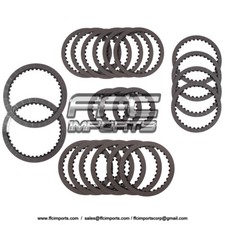
RFE friction clutch kit, 1999-2018, at Core Transmission Parts
A full set of frictions for the RFE family, for when the scan tool and the pan both say a clutch pack is done. Match the kit to your unit and year before ordering.
View the RFE friction clutch kit →45RFE rebuild kits, clutch modules, filter kits and valve bodies, shipped fast from the USA.
Shop 45RFE parts →Related guides
- Chrysler 45RFE and 545RFE Transmission Problems and Fixes
- 45RFE Shift Solenoid Symptoms, Testing and Replacement
- 45RFE / 545RFE Valve Body Problems and Testing
- 545RFE Pressure Testing
- 45RFE Fluid Change: Cost, Filters and Procedure
- 68RFE Slipping: Causes and Fix
FAQ
Why is my 45RFE slipping?
The most common causes are low or overfilled fluid, a cracked or misinstalled primary filter or loose cooler return filter, low line pressure, and a burned overdrive clutch. Chrysler's gear ratio procedures also list cut piston and accumulator seals, missing bleed orifices, a worn solenoid switch valve and broken reaction carrier welds. Which gears slip tells you which clutch to look at.
How do I know which clutch is slipping in a 45RFE?
Compare the gears that slip against the clutch application chart. Slip in 1st, 2nd and 3rd with a good 4th points to the UD clutch. Slip in 3rd and 4th points to the OD clutch, and slip in 2nd prime and 4th points to the 4C clutch. Confirm it by logging input and output rpm and checking the ratio in each gear.
What does P0944 mean on a 45RFE?
P0944 is loss of hydraulic pump prime. Chrysler sets it when the transmission slips in a forward gear, the pressure switches that should be closed are open, and none respond when the controller turns on available elements. Causes include fluid level, a cracked or misinstalled primary filter or seal, a loose cooler return filter, a sticking main regulator valve and the pump.
Can a fluid change fix a slipping 45RFE?
Only if the slip was caused by the fluid itself, such as a low or overfilled level, or by a bad filter. If a clutch is already burned, new fluid will not bring it back. A pan drop done wrong can also cause slip, since Chrysler lists a misinstalled primary filter seal and a loose cooler return filter as causes of P0944.
Sources
- Chrysler 45RFE/545RFE service information: P0731-P0736 Gear Ratio Error procedures (2007 Commander). Ratio monitoring from the 60-tooth input and 30-tooth output tone wheels, up to five minutes before the MIL, the lost-sensor-ground 1:2 ratio (P1794), event data checks (input rpm zero, line pressure more than 10 psi below desired), the 2C/overrunning clutch blind spot, and the per-gear cause lists including broken reaction carrier and reverse carrier hub welds. P0732, P0734, P0736
- Chrysler 45RFE/545RFE service information: P0944 Loss of Hydraulic Pump Prime. How the loss of prime test runs, and the cause list including a cracked or misinstalled primary filter or seal, a loose cooler return filter and a sticking main regulator valve. jeep.automotive-manuals.com
- Chrysler service information: Road Testing and 545RFE Clutch Application Chart. Engine flare means clutch, overrunning clutch or line pressure problems; applied elements for every range including 2nd prime and limp-in; L/R on in 1st only below 150 rpm output speed. jeep.automotive-manuals.com
- Chrysler service information: Hydraulic Pressure Test and Fluid Level Check. Scan tool vs gauge within 10 psi using adapter 8259, test at 1500 rpm and operating temperature, in-gear pressures by engine; fluid level checked in Park after one minute at idle, HOT range at about 180 F, and the effects of low or high fluid. Pressure test, Fluid level check
- GEARS Magazine (ATRA): "Controlling Pressure 2 - Chrysler" (Rob Faucett, March 2024). RFE pressure control solenoid at about 5 percent duty for maximum and 62 percent for minimum line pressure, torque-based desired pressure pulled down by low engine load, the link to OD clutch failures, and duty cycle as a leak indicator. gearsmagazine.com
- Transmission Digest / Sonnax TASC Force: "Troubleshooting RFE overdrive clutch failure: Three key areas to check" (Caleb Perham, July 2023), plus "Chrysler RFE 4C Retaining Ring and Shim Kit" (January 2021). Solenoid switch valve bore plug wear, stator dribbler air test direction, clutch clearance too tight vs too loose, fast learn after repair, and the 4C return spring retaining ring failure with Sonnax kit 72978-01K. OD clutch failure, 4C retaining ring