The 545RFE is one of the few automatics where the scan tool gives you an honest pressure number. Most transmissions display a command — what the computer is telling the EPC solenoid to do — and plenty of techs read that as measured pressure. The RFE family is different: it has a real full-range pressure transducer feeding the PCM, so the scan tool is showing a reading, not a wish. That is exactly why so many 545RFE units get misdiagnosed. The number looks trustworthy, nobody hangs a gauge, and the one failure the transducer cannot see walks right past.
The short version: Warm the unit to 180°F, hook a 0–300 psi gauge to the line pressure tap with Miller adapter 8259, hold the brakes, and run 1500 rpm in Park, Reverse and Drive. The factory wants a steady 85 to 95 psi (585–655 kPa) in every one of those positions, and the scan tool reading should agree with the gauge within 10 psi. Steady is the word that matters. A number inside spec that wanders is a worn pressure regulator bore, and no code will tell you that.
How the 545RFE Decides What Pressure to Make
The PCM runs what Chrysler calls Torque Based Line Pressure: it calculates torque input to the transmission, uses that as the primary input to a desired line pressure figure, then drives the pressure control solenoid (PCS) at whatever duty cycle it takes to hit that target. The line pressure sensor reports back what actually happened. That closed loop is why you cannot raise pressure in an RFE by shimming a spring the way you would in a 4L60E — the module adapts the duty cycle and pulls it back to where it wanted it.
Three numbers from the factory strategy are worth writing on the inside of your toolbox lid:
- PCS duty cycle runs from 5% to 62%. Five percent is maximum pressure. Sixty-two percent is minimum. It is inverse to what most people assume, and if you are watching duty cycle climb while pressure falls, that is normal control, not a fault.
- Line pressure is forced to a preset 120 or 135 psi (827 or 931 kPa) during every shift and any time the unit is in Park or Neutral. This is deliberate: the module wants consistent shift quality regardless of what torque-based math says. If you read pressure in Park and get 130 psi, that is not a high-pressure fault.
- The line pressure sensor operates between 0.35 and 4.75 volts. Outside that band you get a circuit code, not a pressure code.
Sonnax published scan-tool baselines for the same family that fill in the road-load side of the picture. On stock programming, sitting in Drive at a stop, desired and actual line pressure both read 60 to 70 psi with the line pressure duty cycle between 22% and 24%, rising to about 160 psi at stall. If you see 100 to 105 psi in both parameters with duty cycle down at 5.1% while the truck idles in gear, that transmission has aftermarket programming in it. That matters more than it sounds: the same Sonnax work shows raised idle pressure pinches the line-to-lube connection on the pressure regulator valve and drops cooler flow from about 1.3 GPM to 0.5 GPM.
One trap worth naming, because it has burned people: desired line pressure still displays on the scan tool even when actual pressure is zero. A plausible desired figure is not evidence the pump is making anything. Always read both parameters side by side.
The Spec Table
| Condition | Spec | Where it comes from |
|---|---|---|
| Line pressure, 1500 rpm, brakes applied, Park / Reverse / Drive | 585–655 kPa (85–95 psi), steady in each position | Mopar 545RFE hydraulic pressure test |
| Preset pressure during shifts and in Park / Neutral | 827 or 931 kPa (120 or 135 psi) | Mopar P0868 strategy |
| Idle in Drive at a stop, stock calibration | 60–70 psi desired and actual, 22–24% duty cycle | Sonnax RFE scan data |
| Stall, stock calibration | Approximately 160 psi | Sonnax RFE scan data |
| Pressure control solenoid duty cycle range | 5% (max pressure) to 62% (min pressure) | Mopar P0868 strategy |
| Line pressure sensor operating voltage | 0.35–4.75 V | Mopar P0935 chart |
| Scan tool vs. mechanical gauge agreement | Within 10 psi during the pressure test | Mopar hydraulic pressure test |
| Sensor accuracy check vs. gauge | Within 34 kPa (5 psi) | Mopar P0868 chart |
| Transmission simulator vs. scan tool | Within 14 kPa (2.0 psi) | Mopar P0868 chart |
| Clutch circuit tap vs. line pressure | Within 10% — more than that is a circuit leak | Transmission Digest / Sonnax TASC Force |
| Test temperature | 82°C / 180°F | Mopar hydraulic pressure test |
| Fluid | ATF+4 (Chrysler MS-9602) only | Mopar service information |
Tools You Actually Need
You cannot thread a standard gauge fitting into a 545RFE line tap, and the reason goes beyond thread pitch: the line pressure sensor has to stay in the circuit or the PCM drops to failsafe, and you end up testing a transmission that is no longer being commanded normally. The factory adapter gives you a place for the transducer alongside the gauge.
- Miller 8259 — line pressure adapter. This is the piece that makes the whole test possible.
- Miller C-3293-SP — 0–300 psi test gauge. Do not substitute a 0–100 psi gauge because 85–95 psi is the target: you will see 160 psi at stall, more on a tuned truck, and a gauge pegged at full scale is a gauge you are about to replace.
- Miller 8258A — the special pan with access ports and pressure fittings. Every clutch pressure tap on an RFE lives on the valve body itself rather than the case, so you need this pan to reach them.
- Miller 8333 transmission simulator and 8815 PCM connector adapter — for separating a sensor fault from a PCM or wiring fault on an intermittent pressure code.
- A vacuum test stand for the pump body work later in this article.
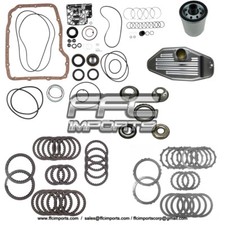
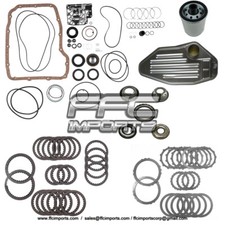
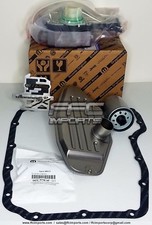
545RFE solenoid pack and filter service kit
The line pressure sensor and the pressure control solenoid both live in the solenoid / TRS assembly. When the sensor checks bad against a mechanical gauge, or the pressure control circuit tests shorted, this is the part that comes off. Kit includes the sump filter so you are not opening the pan twice.
View the solenoid pack kit →The Procedure
Do these in order. Skipping step one is the most common reason a pressure test lies to you.
- Check the fluid level correctly, at temperature. ATF+4 level is read at 180°F, which takes roughly 15 miles of driving to reach — not a few minutes of idling. Low fluid is a listed cause of low line pressure and it is free to rule out. Service fill is 5.2 L (11 pints) on 4x2 and 6.2 L (13 pints) on 4x4.
- Scan for codes first, and record them before you clear anything. Pressure codes travel in packs on this unit, and which ones set together tells you where to look. Note the "starts since set" counter too.
- Install the gauge. Miller 8259 adapter at the line pressure tap, C-3293-SP gauge, transducer still in the loop. Route the hose clear of the exhaust and driveshaft, and if you plan to road test, tape the gauge to the outside of the windshield — a ruptured hose inside the cab is a bad afternoon.
- Warm the transmission to 82°C / 180°F and confirm the temperature on the scan tool rather than guessing.
- Apply the brakes firmly, hold 1500 rpm, and move the shift lever through Park, Reverse and Drive, pausing in each position long enough for the needle to settle. You are looking for a steady value between 85 and 95 psi in all three.
- Compare the gauge to the scan tool at the same instant. They should be within 10 psi. If they are not, you have a sensor problem, not a hydraulic one, and everything you do to the pump from here is wasted.
- Road test with the gauge if the complaint is load-related. A pump that holds pressure in the bay can fall on its face on a grade with a trailer behind it.
Reading the result
- 85–95 psi, steady, in all three ranges. Pump, pressure regulator valve and PCS are doing their jobs. Move on to clutch circuit taps.
- In spec in Park but falling off in Reverse or Drive. The pump is capable; something in the applied circuit is bleeding oil. Reverse loads the L/R and 2C circuits, Drive loads UD, so which range drops tells you which clutch to check first.
- Low everywhere. Fluid level, plugged or cracked primary filter, loose cooler return spin-on, stuck main regulator valve, worn pump — in that order, because the first four are cheap.
- In spec but unsteady. A needle that will not sit still is the signature of pressure regulator valve bore wear. Sonnax lists erratic line pressure, harsh shifts, soft shifts, burnt clutches, restricted converter and lube flow, and broken parts from excessive line pressure as the symptom set for that bore.
- Zero, or close to it, in every range. Think assembly before parts, especially right after a rebuild or a valve body swap. Transmission Digest traced a 45RFE no-move after overhaul to missing pump spacer-plate hold-down screws: one sits beside the pump suction port, and without it a hole of about 0.190 in. opens into the suction circuit so the pump cannot pull oil. The screws torque to 4.5 N·m (40 lb-in) (Transmission Digest, Feb. 2010). In a 2026 case, a 68RFE Ram showed zero line pressure and no forward or reverse after a new dealer valve body, because the pressure test plugs shipped loose in a bag and were never installed (Transmission Digest, Sept. 2026). Our 45RFE no-movement diagnosis guide walks the rest of that tree.
- Gauge and scan tool disagree by more than 10 psi. Suspect the line pressure sensor; the factory tolerance on the sensor accuracy check is 5 psi.
Clutch Taps and the 10 Percent Rule
Line pressure alone will not find a leaking clutch circuit. The line pressure tap is fed by a huge volume of oil straight off the pump or the pressure regulator valve with no restriction ahead of it, while clutch taps sit downstream of the orifice feeding each circuit. Cut a piston lip seal during assembly and that clutch tap reads near zero while the line pressure gauge barely flinches, because the leak is bigger than the feed orifice can pass. Line pressure says the pump is healthy; clutch taps say where the oil is going.
Jeff Parlee of the Sonnax TASC Force put a usable number on it in Transmission Digest: if a clutch circuit reads more than 10% below line pressure, that circuit has a leak. Zero to ten percent is normal, because sealing rings never seal perfectly — the same small leakage you hear escaping during an air check on the bench. The 545RFE gives you taps for the low/reverse, underdrive, second, overdrive and fourth clutches, all on the valve body, which is why the 8258A pan exists.
The Codes, and What Their Set Conditions Really Mean
P0868 — Line Pressure Low
This code sets when actual line pressure runs more than 15 psi below desired line pressure for 3.5 seconds continuously, monitored while driving in a forward gear. Two things follow. It is a comparison code, not a threshold code — 70 psi is fine if the module wanted 70 psi. And 3.5 seconds continuous is a long time in hydraulics, so a unit that dips briefly on every 2-3 shift can misbehave badly without ever setting P0868.
The factory cause list is instructive because it is mostly not the pump: low fluid, a line pressure sensor connection problem, an open or shorted 5-volt supply, a pressure control solenoid circuit shorted to another circuit, a plugged or cracked primary filter, a misinstalled filter O-ring, a loose cooler return spin-on filter, a stuck main regulator valve, then internal damage and the pump. Work it in that order.
The filter entries on that list are not theoretical. Chrysler TSB 21-007-06 (April 2006, superseding 21-016-05) covers 2005-2006 Ram, Durango, Dakota, Liberty, Grand Cherokee and Commander units with a delayed engagement after sitting overnight, and it names P0868 as the most frequent code. The cause was a cooler return filter numbered 04799662AB that could make the sump filter split at its plastic-to-metal crimp. Transmission Digest documented the same failure on a 2006 Durango that set P0868 shortly after a fluid service: gauge and scan data looked normal on the lift, and the pan came off to reveal the sump filter split at the seam. TD's advice is to put gauges on the line pressure tap and the cooler return fitting and confirm pressure drops to zero the moment the engine stops, because residual pressure is what blows the filter. So on a P0868 that showed up after a service, drop the pan and read the number stenciled on the cooler return filter before you order a pump. Raybestos Powertrain lists the current spin-on replacement (crossing 04799662AB, 5179267AC and 5179267AD) with an updated anti-drainback valve.
P0935 — Line Pressure Sensor Circuit High
Sets when sensor voltage reaches or exceeds 4.75 volts for about 0.18 seconds, ignition on and engine running. This is a circuit code — do not chase hydraulics on it. GEARS Magazine's David Chalker notes that on these units the solder and crimp where the wire meets the sensor terminal pin is very often the actual fault, so tug-test the wires at the connector before condemning the sensor. A useful field check from the factory chart: with the engine off, connect the 8333 transmission simulator and step its rotary switch through the three line pressure positions. The scan tool should read within 14 kPa (2.0 psi) of each value on the simulator. If it does, the module and wiring are reading the sensor circuit correctly and the sensor itself is the suspect. Verify the 5-volt supply does not exceed 5.5 volts, and check circuits for shorts below 5.0 ohms and opens above it.
The pack that travels together
Sonnax ties P0841, P0868, P0871, P0988, P1775 and P1776 to solenoid switch valve bore wear in the RFE valve body. If you have a low-pressure complaint arriving with two or three of those codes, stop looking at the pump and go vacuum test the switch valve bores. Bind-up, failsafe mode, burnt overdrive clutch, burnt fourth clutch and second-gear starts with the light on all belong to the same wear pattern.
When the Numbers Say the Pump: Vacuum Test Before You Buy
If line pressure is low or unsteady and the filters, fluid and electrical side check out, the pump body is next — but there is a cheap, quantitative step between suspicion and a parts order. Vacuum testing isolates a valve and its bore and pulls air across the clearance: tight clearance holds vacuum, a worn bore leaks and the reading drops. It is repeatable enough to set a shop pass/fail standard and record it on a data sheet.
Sonnax numbers the RFE pump body valves for their test guide: 201 is the TCC switch valve, 202 the main pressure regulator valve, 203 the TC limit valve, and 204 the TCC control/regulator and accumulator valves. Two of those matter directly to a pressure complaint.
- Main pressure regulator valve (202). Test it with a 0.125 in. shim between the balance end of the valve and the casting. A low reading here backs a diagnosis of erratic or high line pressure, burnt clutches, harsh or soft shifts, and restricted converter and lube flow. The repairs are Sonnax oversized PR valve kit 44912-10K, which requires reaming with F-44912-TL10 and VB-FIX, or the drop-in lube regulated PR valve 44912-17K when you also want to restore lube flow.
- TC limit valve (203). Insert the retaining clip into the balance port while testing. Wear here shows up as delayed engagement, engine stall on engagement, loss of power, low cooler flow, low TCC release pressure and an overheated converter. Repair is 44912-03K, and most shops treat it as an automatic replacement during a pump overhaul because the OE valve is usually loose enough to rock in the bore by hand.
What Prevents the Next One
Line pressure problems on a 545RFE are usually the visible end of a fluid-and-filter history nobody kept. Three habits cut the repeat rate:
- Use ATF+4 (MS-9602) and nothing else. The friction modification is matched to Chrysler clutch material and the adaptive pressure control is calibrated around it. A universal fluid changes the shift the module is compensating for, and it compensates with pressure.
- Replace both filters, every time. The sump filter and the spin-on cooler return filter are separate parts, and both appear on the factory cause list for P0868. Chrysler TSB 21-007-06 says outright to replace them together and never one without the other. Doing one and leaving the other is how a service becomes a comeback.
- Log a baseline pressure reading on every unit you build. Five minutes with a gauge, recorded on the ticket, is what lets you tell a year later whether the unit changed or the customer's memory did.
Solenoid packs and line pressure sensors, valve bodies, filter kits and pans, pump components, torque converters and master rebuild kits for the 545RFE — shipped fast from the USA.
Shop 545RFE parts →Related reading: 545RFE overheating: why it happens and how to prevent it picks up where the pressure regulator valve section leaves off and covers the cooler circuit in detail, and Chrysler 45RFE and 545RFE problems and fixes covers the solenoid switch valve bore wear behind the code cluster above.
Sources
- Chrysler 45RFE/545RFE service information (2010 Jeep Wrangler JK, Section 21), "P0845-2C Hydraulic Pressure Test." Backs the test setup and specification: warming the transmission to 82°C or 180°F, applying the brakes and testing at 1500 rpm in Park, Reverse and Drive, the requirement for a steady value between 585 and 655 kPa (85 and 95 psi) in each position, agreement between the scan tool and the mechanical gauge within 10 psi, the transmission simulator tolerance of 14 kPa (2.0 psi), and the special tool numbers 8259 line pressure adapter, C-3293-SP gauge, 8333 transmission simulator and 8815 PCM connector adapter. Chrysler P0845-2C hydraulic pressure test
- Chrysler 45RFE/545RFE service information (2007 Jeep Commander XK), "P0868-Line Pressure Low." Backs the set condition of actual line pressure more than 15 psi below desired for 3.5 seconds continuously, the Torque Based Line Pressure strategy, the preset of 827 or 931 kPa (120 or 135 psi) during shifts and in Park and Neutral, the pressure control solenoid duty cycle of 5% for maximum pressure and 62% for minimum pressure, the sensor-versus-gauge tolerance of 34 kPa (5 psi), the 5.5 volt supply limit, the 5.0 ohm open threshold, and the possible-cause list including low fluid, a cracked, plugged or mis-installed primary filter, a loose cooler return spin-on filter and a stuck main regulator valve. Chrysler P0868 Line Pressure Low
- Chrysler 45RFE/545RFE service information (2010 Jeep Wrangler JK, Section 21), "P0935-Line Pressure Sensor Circuit High." Backs the sensor operating range of 0.35 to 4.75 volts, the set condition of 4.75 volts or higher for 0.18 seconds with the ignition on and engine running, and the transmission simulator check with the scan tool reading within 14 kPa (2.0 psi) of each simulator position. Chrysler P0935 Line Pressure Sensor Circuit High
- GEARS Magazine (ATRA), David Chalker, "Diagnosing Pressure Trouble Codes," August 2017. Backs the RFE line pressure sensor 5-volt reference and 0.35-4.75 volt signal range, the variable force solenoid running from 5% duty cycle (maximum pressure) toward the mid-60% range (minimum pressure), the 2007 Ram 545RFE scan data of about 60 psi desired in Drive at a stop and about 125 psi in Neutral, and the frequent failure of the solder and crimp at the sensor terminal pins. gearsmagazine.com
- Sonnax — "Resolving Stalling & Overheat Issues After Performance Tuning on RFE Transmissions." Backs the stock scan tool baseline of 60 to 70 psi desired and actual in Drive at a stop with line pressure duty cycle at 22 to 24% and roughly 160 psi at stall, the tuned signature of 100 to 105 psi at 5.1% duty cycle, the cooler flow comparison of 1.3 GPM stock against 0.5 GPM tuned at idle, the pressure regulator valve's regulating points and the line-to-lube connection at regulating point C, and the warning that desired pressure still displays on the scan tool when actual pressure reads zero. sonnax.com/tech_resources/947-resolving-stalling-overheat-issues-after-performance-tuning-on-rfe-transmissions
- Sonnax — "Chrysler 45RFE, 545RFE, 65RFE, 66RFE, 68RFE Vacuum Test Guide" (Critical Wear Areas & Vacuum Test Locations). Backs the pump body valve identification numbers 201 TCC switch valve, 202 main pressure regulator valve, 203 TC limit valve and 204 TCC control/regulator and accumulator valves; the instruction to test the pressure regulator valve with a 0.125 in. shim between the balance end of the valve and the casting and to insert the retaining clip into the balance port when testing the TC limit valve; the pressure regulator valve symptom list of harsh shifts, erratic line pressure, high line pressure, burnt clutches, restricted converter and lube flow and soft shifts; the TC limit valve symptom list of delayed engagement, engine stall, loss of power, low cooler flow, low TCC release pressure and overheated converter; the solenoid switch valve code list P0841, P0868, P0871, P0988, P1775 and P1776; and part numbers 44912-10K, 44912-17K and 44912-03K with their required reaming tools. sonnax.com/tech_resources/618-chrysler-45rfe-545rfe-65rfe-66rfe-68rfe-vacuum-test-guide
- Transmission Digest — Jeff Parlee (Sonnax remanufactured valve body product support manager and Sonnax TASC Force member), "Diagnosis with Pressure Gauges." Backs the 10% rule identifying a clutch circuit leak, the explanation that 0 to 10% leakage is normal because sealing rings do not seal perfectly, the distinction between a commanded pressure and transducer data with the 45RFE and 545RFE named as units that do report real transducer pressure, the reason a leaking clutch circuit reads near zero at its tap while barely moving the line pressure gauge, the instruction to use a gauge rated above the maximum pressure expected, and the guidance to measure during a road test rather than on the lift and to keep the gauge outside the vehicle. transmissiondigest.com/diagnosis-with-pressure-gauges
- Transmission Digest, May 2014 issue — 45RFE delayed garage shift with P0868 after a fluid service (2006 Durango). Backs the split sump filter at the metal/plastic seam, residual positive pressure as the failure mechanism, Chrysler TSBs 21-016-05 and 21-007-06 with the 04799662AB cooler return filter as suspect, and the gauge check at the line pressure tap and cooler return fitting. transmissiondigest.com/may-2014-issue
- Raybestos Powertrain — transmission filter 515489 (45RFE, 545RFE, 65RFE, 66RFE, 68RFE, 1999-on). Backs the spin-on cooler return filter interchange with 04799662AB, 5179267AC and 5179267AD and its updated anti-drainback valve. raybestospowertrain.com/filters/515489
- Transmission Digest — Tech/Talk February 2010: 45RFE No Movement After Overhaul. Backs the missing pump spacer-plate hold-down screws, the roughly 0.190 in. suction leak beside the pump suction port, and the 4.5 N·m (40 lb-in) torque. Transmission Digest, Feb. 2010
- Transmission Digest — RFE Series No Movement After Valve Body Replacement (Sept. 2026). Backs zero line pressure and no forward or reverse on a 2010 Ram 3500 68RFE caused by uninstalled pressure test plugs from a new valve body. Transmission Digest, Sept. 2026