Most overheating 545RFEs arrive with the same story. The truck tows fine for years, then one summer the temperature climbs on every grade, the customer buys a big auxiliary cooler, and it barely helps. That result is diagnostic in itself: if adding cooling area does not fix it, the problem was never cooling area. The fluid was not reaching the cooler, and on an RFE there are three separate places that flow gets choked off before it ever leaves the truck's frame rails.
The short version: Sonnax has documented low cooler flow as a problem in the 45RFE / 545RFE / 68RFE family since the units were introduced in 1999. The two usual suspects are inside the pump — the TC limit valve and the main pressure regulator valve — and the third is the spin-on cooler filter hanging off the case that most services skip. A healthy RFE moves roughly 1.3 GPM through the cooler circuit at idle in Drive. A sick one moves 0.5 GPM or less. Measure that number before you buy a single part.
Where the Heat Is Made, and Where It Is Supposed to Go
The torque converter is the heat source on any automatic, and it makes the most heat when the converter clutch is open and the impeller and turbine are turning at different speeds. Bob Warnke made the point plainly in a recent Transmission Digest piece on towing complaints: any time the torque converter clutch is not applied, it is generating heat, which is why tow/haul modes are calibrated to bring the TCC on earlier.
Getting that heat out depends on one connection inside the pump. The main pressure regulator valve has three regulating points, and the third — Sonnax labels it regulating point C — is the connection from line pressure to the lube and torque converter circuits. Everything the cooler ever sees passes through that one spool position. If the valve sits in the wrong place in its bore, the cooler circuit gets a trickle and the converter cooks itself while line pressure looks perfectly normal on the gauge.
Line pressure and cooler flow are not the same measurement, and on an RFE a truck can have textbook line pressure and almost no cooler flow at the same time.
Cause 1: Pressure Regulator Valve Position
This one has caught the most shops in the last decade, and it usually walks in on a tuned diesel. Sonnax published the numbers in their article on stalling and overheat issues after performance tuning on RFE transmissions, and they turn a vague overheating complaint into a two-minute scan tool check.
| Scan tool reading, in Drive at a stop | Stock programming | Tuned programming |
|---|---|---|
| Desired and actual line pressure | 60–70 psi | 100–105 psi |
| Line pressure duty cycle | 22–24% | 5.1% |
| Pressure at stall | 160 psi | over 160 psi |
| Cooler flow at idle | 1.3 GPM | 0.5 GPM or lower |
The mechanism is geometric, not electrical. With desired pressure raised to around 105 psi at a 700 rpm idle, the pressure regulator valve strokes to a position where regulating point C is only opened by a small undercut on the valve spool. That undercut is all the connection the lube and converter circuits get. Sonnax measured cooler flow dropping to 0.5 GPM in that position, and to 0.3 GPM when line pressure was forced to maximum. In the stock valve position, with the same pump and the same cooler, that connection is far wider and flow measures 1.3 GPM.
The 5.1% duty cycle is the giveaway. That means the pressure control solenoid is asking for nearly everything the pump has, at idle, with no load on the truck. If you see it, you are looking at tuned programming even if the customer never mentioned a tune, and the fix is not a bigger cooler.
For trucks that need to keep the higher line pressure, Sonnax's repair is lube regulated pressure regulator valve 44912-17K, which adds a direct line-to-lube connection instead of relying on the OE spool undercut. Their published figure is a 60% increase in lubrication and cooler flow at maximum line pressure, and the passage closes at shutdown so it does not create a converter drainback problem — which is exactly what happened to shops that tried the shade-tree version and drilled line to lube in the pump casting.
Cause 2: TC Limit Valve Bore Wear
The TC limit valve controls torque converter release pressure, the oil that keeps the converter clutch off the cover. Sonnax's vacuum test guide for the RFE family lists its wear symptoms directly: delayed engagement, engine stall, loss of power, low TCC release pressure, loss of fuel economy, low cooler flow, and overheated converter. On early units the valve is often loose enough in the bore to rock side to side by hand, and most shops now ream the bore and fit oversized valve kit 44912-03K as a matter of course during a pump overhaul.
Do not condemn it by feel alone — vacuum test it. The test seals a circuit, pulls air through the clearance between the spool and bore, and reads the result in inches of mercury, with vacuum loss directly proportional to wear. Sonnax's reference points calibrate your expectations: 29.9 in-Hg is a perfect seal at sea level, an extremely good circuit reads around 22 to 23 in-Hg, and a severely worn bore can read as low as 8 in-Hg.
One procedural note from the RFE vacuum test guide, because a false failure is easy here: the TC limit valve is tested with a 0.125 in. shim between the balance end of the valve and the casting. Test the main pressure regulator valve while you are set up — its wear symptoms include high line pressure, burnt clutches, repeated converter failure and restricted converter and lube flow.
Cause 3: The Cooler Filter Nobody Changes
The RFE family runs two filters: a sump filter inside the pan and a spin-on cooler filter on the case, in the cooler return line. The spin-on gets skipped constantly. It is not in the pan kit, it is not visible during a normal fluid service, and plenty of trucks have never had one replaced.
The wrong replacement is worse than a dirty one. Transmission Digest's technical bulletin on RFE delayed engagements is blunt: never use an OE cooler filter with part number 04799662AB, and on any cooler filter, check that the intake holes in the top are not restricted. A restrictive cooler filter fitted during a service shows up as delayed engagements — longer after the truck has sat overnight — with codes including P0868 line pressure low, P0944 loss of prime, P0731 and P0736 gear ratio errors, P0841 low/reverse pressure switch rationality and P0876 underdrive pressure switch rationality.
The part numbers and torque specs from that same bulletin:
| Item | Chrysler | Filtran |
|---|---|---|
| Spin-on cooler filter | 04799662 | F-374 |
| Sump filter, two-wheel drive | 05015267AD | F-322 |
| Sump filter, four-wheel drive | 05013470AD | F-304 |
- Filter adapter into the filter (when a new adapter is supplied): 165 lb-in. (18.6 Nm), non-threaded end first.
- Filter assembly into the case: 125 lb-in. (14.1 Nm).
Get the pan and sump filter combination right too. Every 4x4 RFE uses the 4x4-style filter; 2x4 applications from 1999 through 2007 used the 2x4-style filter; 2008 two-wheel-drive Dakotas used the 4x4 filter and pan; 2009 was a running change; and from 2010 on, every RFE uses the 4x4-style filter and pan. The spin-on cooler filter is the same regardless of pan style.
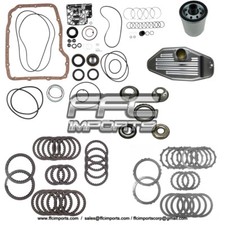
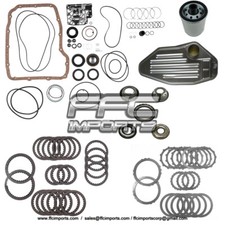
45RFE / 545RFE / 65RFE / 68RFE filter kit, 4WD
Sump filter and pan gasket for the 4x4-style pan. If the truck has never had the spin-on cooler filter replaced, do both in the same visit — changing one and leaving the other is how a service turns into a comeback.
View the filter kit →Cause 4: Everything Outside the Transmission
ATRA's GEARS Magazine ran a diagnostic walkthrough on overheating in the 48RE / 68RFE / AS68RC trucks that applies directly to a 545RFE. Their external-cause checklist, to work once the pump checks out: plugged cooler lines, a plugged cooler, a plugged filter, vehicle overload, engine overheating, and the engine fan clutch. Their flow benchmark works without a flow meter — catch flow at the cooler return in a bucket, and flow should be at least a gallon per minute. Inspect the lines for pinches, kinks, dents and crush marks while you are under there, and trace the whole circuit, because auxiliary coolers get plumbed in and forgotten.
The thermostatic bypass valve
If the lines are clear, the cooler is clear, the engine cooling system checks out and the unit still runs hot at a normal 195 to 200 degree operating temperature, suspect the cooler thermostatic bypass valve. It exists to warm the transmission quickly in cold weather and should be wide open when hot. Two things about it are worth knowing before you quote the job: if the valve is stuck open, a flush machine will not clean the cooler at all — you will run the machine, get flow, and clean nothing. And on the trucks where the valve is integral to the cooler, the repair is replacing the cooler as an assembly, which on a 6.7 means pulling the grille, intercooler and A/C condenser just to see it.
The fan clutch
An electronically controlled viscous fan drive that operates but not to specification will cool part of the system and leave the transmission hot while engine temperature looks fine. GEARS gives a workable test: at operating temperature, park or neutral, parking brake set, A/C and blower off, back-probe pin 1 of the fan drive connector to ground using tool 6801 and confirm DTC P0480 sets. Then hold 2000 rpm and watch fan speed on the scan tool. It should climb to 1850 rpm or more and hold for 30 seconds — be patient, it can take 15 minutes to get there. If it never climbs and the jumper is good, replace the fan drive. If it does climb and the truck still runs hot, go back to the bypass valve.
What the Controller Does When It Gets Hot
The 545RFE does not wait for a failure to react to heat. ATRA Technical Bulletin 990 lists the RFE overheat shift schedule: it kicks in when transmission oil passes 240°F or engine coolant passes 244°F. In that mode the 2-3 upshift is delayed to 28–31 mph, the 3-4 to 41–48 mph, the converter clutch is fully applied in 3rd from 30–48 mph and partially applied in 2nd above 35 mph, and above 25 mph the converter will not unlock unless throttle drops below 2 degrees or the driver kicks down to 1st. The goal is to keep the converter locked, because an open converter is where most of the heat is made.
So a customer who says the truck "holds gears and feels locked up" on a long grade in summer may be describing the overheat schedule working as designed, not a fault. Chrysler's service information adds an informational code for it: P0218 High Temperature Operation Activated sets once the overheat schedule is active with transmission temperature above 260°F. Chrysler's listed causes are worth reading to the customer: a slipping or non-applying converter clutch, driving for an extended period in limp-in mode, and excessive idling in gear. The same procedure says the code is there to help decide whether a cooling system fault exists or whether the truck needs an additional transmission cooler for how it is driven. A stored P0218 is the evidence you want before recommending one, and the limp-in cause is a reminder that a truck driven for weeks stuck in 3rd is cooking its fluid; see our 45RFE and 545RFE limp mode guide.
A Diagnostic Order That Does Not Waste Parts
- Scan tool first, in Drive at a stop. Read desired line pressure, actual line pressure, line pressure duty cycle and transmission temperature. Stock is 60–70 psi at 22–24% duty. Around 105 psi at 5.1% duty means tuned programming and a starved lube circuit. Note that desired pressure still displays even when actual reads 0 psi, so do not take a plausible desired value as proof the unit is healthy.
- Measure cooler flow. Flow meter or bucket, at the cooler return, at idle in Drive. Under 1 GPM is a problem; 1.3 GPM at idle is what a healthy stock RFE gives you.
- Split internal from external. Low flow at the transmission outlet with the cooler circuit disconnected points inside — pump valves, filters, converter. Good flow at the outlet but poor flow through the circuit points at the lines, cooler, aux cooler or bypass valve.
- Pull and cut both filters. A loaded sump filter and a restrictive or wrong spin-on tell you the unit's history better than the customer will.
- Vacuum test the pump body before you decide the pump is fine. TC limit valve with the 0.125 in. shim, then the main pressure regulator valve.
- Then, and only then, talk about cooling capacity. Adding a cooler to a circuit that is already flow-limited adds restriction, not cooling.
Prevention: Fluid, Temperature and Towing Habits
The 545RFE takes ATF+4, Chrysler Material Standard MS-9602. Per the Chrysler Ram Body Builder Guide capacity sheet, service fill is 5.20 L (11.00 pints) on 4x2 and 6.20 L (13.00 pints) on 4x4, against an overhaul fill of 14.00 to 16.00 L (29.00 to 33.00 pints). A pan drop returns roughly a third of what the system holds, which is why one pan-and-filter on a cooked unit does not reset the clock. Our 45RFE and 545RFE fluid and capacity write-up covers the full service math.
On temperature, use the number ATRA publishes rather than a feeling: the ideal maximum transmission temperature is 200°F, and every 20 degrees above that cuts expected life in half — half at 220°F, a quarter at 240°F, an eighth at 260°F. That relationship is why a truck that spends its summers at 230°F and one that lives at 180°F are not on the same service schedule, whatever the maintenance chart says.
The towing advice worth passing to a customer, from Warnke's Transmission Digest interview, is concrete and free:
- Watch the gauge. Most of these trucks will display transmission temperature in the dash menu. Anything in the 200°F range on a grade is getting critical.
- Turn the air conditioning off when it climbs. The condenser sits in front of the transmission cooler and preheats the air going through it.
- Use tow/haul, or hold a gear that keeps the converter clutch applied. An open TCC is a heat generator.
- Keep the load about 20% under the vehicle's rating, and put 10 to 15% of the trailer's weight on the tongue. Gross combined weight includes the people, the coolers and everything in the bed, not just the trailer.
One shop trick from that interview worth adopting on warranty work: temperature-sensitive paint markers on the cooler line. If the truck comes back with the marker melted, you know the unit exceeded its range before the argument starts.
Filter kits and pans, coolers and cooler line fittings, solenoid packs, valve bodies, torque converters and master rebuild kits for the 545RFE — shipped fast from the USA.
Shop 545RFE parts →Related reading: Chrysler 45RFE and 545RFE problems and fixes covers the solenoid switch valve bore wear and overdrive clutch failures that share a cause with heat, and 45RFE TCC shudder diagnosis walks the converter clutch side of the same circuit — useful, because a converter that will not hold lockup is a heat source long before it sets a code.
Sources
- Sonnax — "Resolving Stalling & Overheat Issues After Performance Tuning on RFE Transmissions" (March 11, 2021). Backs the RFE family's documented low cooler flow and stalling history since 1999; the pressure regulator valve's three regulating points and regulating point C as the line-to-lube-and-converter connection; the scan tool comparison of 60–70 psi desired and actual at 22–24% duty cycle with 160 psi at stall on stock programming versus 100–105 psi at 5.1% duty when tuned; cooler flow of 1.3 GPM at idle stock against 0.5 GPM tuned and 0.3 GPM at maximum pressure; the spool undercut as the mechanism; desired pressure still displaying when actual reads 0 psi; TC limit valve bore wear and the 44912-03K repair; and lube regulated PR valve 44912-17K providing a 60% increase in lubrication and cooler flow at maximum line pressure while preventing converter drainback. sonnax.com/tech_resources/947-resolving-stalling-overheat-issues-after-performance-tuning-on-rfe-transmissions
- Sonnax — "Chrysler 45RFE, 545RFE, 65RFE, 66RFE, 68RFE Vacuum Test Guide." Backs the TC limit valve symptom list (delayed engagement, engine stall, loss of power, low TCC release pressure, loss of fuel economy, low cooler flow, overheated converter); the instruction to test the TC limit valve with a 0.125 in. shim between the balance end of the valve and the casting; and the pressure regulator valve symptom list including high line pressure, burnt clutches, repeated converter failure and restricted converter/lube flow. sonnax.com/tech_resources/618-chrysler-45rfe-545rfe-65rfe-66rfe-68rfe-vacuum-test-guide
- Sonnax — "Vacuum Testing for Leakage" (January 22, 2011). Backs the in-Hg reference points used above: 29.9 in-Hg for a perfect vacuum at sea level, roughly 22 to 23 in-Hg for an extremely good circuit, as low as 8 in-Hg for a severely worn bore, and vacuum loss being directly proportional to the amount of wear. sonnax.com/tech_resources/121-vacuum-testing-for-leakage
- Transmission Digest — Transmission TECH/TALK, April 2012 issue, "45RFE/545RFE/68RFE: delayed engagements." Backs the restrictive cooler filter as a cause of delayed engagements after a fluid and filter service; the instruction never to use OE cooler filter 04799662AB and to check that the intake holes in the top of the filter are not restricted; the code list P0868, P0944, P0731, P0736, P0841 and P0876; the adapter torque of 165 lb-in. (18.6 Nm) and filter-to-case torque of 125 lb-in. (14.1 Nm); the pan and filter application history for 1999–2007, 2008, 2009 and 2010-later; and the part numbers 04799662 / Filtran F-374, 05015267AD / F-322 and 05013470AD / F-304. transmissiondigest.com/april-2012-issue
- ATRA / GEARS Magazine — Mike Brown, "48RE/68RFE/AS68RC Transmission Overheating." Backs the six external causes checklist; the minimum one gallon per minute cooler flow benchmark and the bucket test; the 200°F maximum with life expectancy halving every 20 degrees above it; the thermostatic bypass valve discussion including a stuck-open valve defeating a flush machine and the cooler-assembly replacement on the 6.7 requiring grille, intercooler and condenser removal; and the fan clutch test procedure using tool 6801, DTC P0480, 2000 rpm and 1850 rpm fan speed held for 30 seconds. gearsmagazine.com/magazine/48re-68rfe-as68rc-transmission-overheating
- Transmission Digest — Alex Crissey with Bob Warnke, "Educating Customers About Towing-Related Transmission Issues" (August 12, 2026). Backs the statement that an open torque converter clutch generates heat and that tow/haul modes apply the TCC earlier to reduce it; the 200°F range being critical; turning the air conditioning off because the condensers sit ahead of the transmission cooler; gross combined weight including people, coolers and cargo; 10 to 15% tongue weight for stability; keeping towing capacity 20% under the vehicle rating; trailer tire speed and sidewall ratings; and temperature-sensitive paint markers on the cooler line as warranty evidence. transmissiondigest.com/educating-customers-about-towing-related-transmission-issues
- Chrysler / Ram Body Builder Guide — Fluid Capacities sheet. Backs the ATF+4 (MS-9602) specification and the 45RFE and 545RFE capacities quoted above: service fill 5.20 L / 11.00 pints on 4x2, 6.20 L / 13.00 pints on 4x4, and overhaul fill 14.00–16.00 L / 29.00–33.00 pints. rambodybuilder.com/2008/docs/dr/fc.pdf
- ATRA — Technical Bulletin 990, "41TE/42LE/42RLE/45RFE/545RFE Series Module Strategies and Learn Values" (February 2006). Backs the overheat shift schedule trigger of 240°F oil or 244°F coolant, the delayed 2-3 (28–31 mph) and 3-4 (41–48 mph) upshifts, 3rd gear full converter lockup from 30–48 mph, 2nd gear partial lockup above 35 mph, and the converter staying applied above 25 mph unless throttle is under 2 degrees or the driver kicks down to 1st. atracom.blob.core.windows.net/bulletins/2006/feb/atb990.pdf
- Chrysler 45RFE/545RFE service information — P0218 High Temperature Operation Activated. Backs the 260°F (127°C) set condition after the overheat schedule activates, the cause list (converter clutch slipping or not applying, extended limp-in operation, excessive idling in gear), and the code's purpose in deciding between a cooling system fault and an added transmission cooler. jeep.automotive-manuals.com/xk-2007/7c032f26.html