A Dakota, Durango, Grand Cherokee or Ram 1500 comes in with the same story every time: it pulled away from a light like it was in a high gear, would not upshift or downshift, the check engine light came on, and after the driver shut it off and restarted it drove fine again. That is 45RFE limp-in. The controller saw a fault it did not trust, cut power to the solenoids, and let the hydraulics fall back to the one gear they can hold on their own.
Limp mode is not a diagnosis. It is the controller telling you it stored a code. This guide covers how the 45RFE and 545RFE default strategy actually works, which faults trigger it, and the order to test them so the truck is fixed once. Sources, from Chrysler, ATRA and Sonnax, are at the bottom.

What 45RFE Limp Mode Actually Is
The 45RFE has no mechanical shift valves choosing gears. Five clutches (L/R, 2C, 4C, UD and OD) are applied by solenoids in the transmission solenoid/TRS assembly, and every one of those solenoids and all five pressure switches get their power through a single transmission control relay. Chrysler's service information states it plainly: when the relay is off, no power is supplied to the solenoids and pressure switches, and the transmission is in "limp-in" or "default" mode.
With the relay off, each solenoid goes to its power-off state. Some are normally vented and some are normally applied (Sonnax lists the UD and multi-select solenoids as normally applied and the L/R solenoid as normally venting), and Chrysler says the transmission is designed to land in 3rd gear with every solenoid in that state. That gives you the classic complaint:
| Shifter position | Gear in limp-in (relay off) |
|---|---|
| Drive (OD) | 3rd gear only. Sluggish from a stop, no upshift, no kickdown. |
| 2 or L | 2nd gear, per ATRA TB 990 |
| Park, Reverse, Neutral | Still available |
That is the key difference from the 68RFE behind the Cummins, which defaults to 4th. If a 45RFE customer says "it feels like it is starting in third," believe them. It is.
The four shutdown modes
ATRA TB 990 breaks the RFE controller's responses into four levels, and knowing which one you are looking at tells you how serious the fault is:
- Immediate shutdown. The controller de-energizes the relay right away. Default is 3rd gear in Drive, 2nd in 2 or L.
- Orderly shutdown. The fault does not need an instant response, so the transmission holds its current gear with the relay energized until dropping to the default will not overspeed the engine. Then it shuts the relay off and behaves the same as an immediate shutdown.
- Logical shutdown. The relay stays on, but the unit only uses 1st and 3rd in Drive and 2nd in 2 or L, all at a preset line pressure. It resumes normal operation if the fault clears; three recoveries are allowed per key cycle, and after the fourth occurrence it stays in the reduced mode.
- Logical shutdown with recovery. Same as above, but three recoveries in one key cycle escalate to an orderly shutdown.
So a truck that only has 1st and 3rd but still downshifts to 1st at a stop is not in true limp-in yet. The relay is still on. A truck stuck in 3rd from a stop is.
Why a Restart "Fixes" It
At every key-on, the controller runs a relay self-check. Chrysler's P0890 procedure describes the sequence: after a controller reset, it verifies the relay contacts are open by looking for zero voltage on the relay output circuits, checks that there is no voltage on any pressure switch input, and only then energizes the relay. If the fault that caused the shutdown is intermittent, the next key cycle brings the relay back on and the truck drives normally until the fault happens again.
That is why the restart trick works, and why it is a trap. The code is still stored. Pull it before anyone clears it, and note the starts-since-set counter, because Chrysler's own procedures use that counter to separate a current fault from a history fault.
The Codes That Put a 45RFE in Limp
The trigger codes fall into five families. The code you pull tells you which family to start in.
1. Power, ground and relay faults (P0882, P0884, P0890)
These are the cheapest fixes and the most often missed. Chrysler's P0882 TCM power input procedure sets when less than 3.0 volts is present at the relay output circuits while the controller is energizing the relay. The listed causes are an open fused B+ feed, an open or shorted relay output or relay control circuit, an open relay ground, a relay stuck open, or the controller itself. The same page carries an important note: low relay output voltage can also set P0846, P0869, P0871, P0876 or P0988, and those do not indicate an internal transmission or solenoid/TRS problem. Fix the power fault and the pressure switch codes go with it.
P0884 Power Up at Speed is the other telltale. Chrysler says it sets when the controller powers up in a forward gear with output speed above 800 rpm, roughly 20 mph. It does not indicate a transmission problem. It means power or ground to the controller dropped out while driving, and Chrysler says it is critical to investigate if the vehicle is experiencing intermittent 3rd gear operation followed by a return to normal. A rolling restart will also set it, so ask the driver.
P0890 Switched Battery sets when voltage shows up on any pressure switch input before the relay is energized. Causes are a pressure switch sense circuit shorted to voltage, the solenoid/TRS assembly, or the controller.
2. Solenoid circuit faults (P0750, P0755, P0760, P0765, P0770)
The controller checks each solenoid by pulsing it for a few milliseconds and looking for the inductive spike. Per Chrysler, the check runs at power-up and every 10 seconds after, and a code sets after three consecutive failures, or after one failure if the test was triggered by a gear ratio or pressure switch error. The procedure is explicit that these are strictly electrical faults and cannot be caused by any internal failure other than an open in the solenoid/TRS assembly, and that if the assembly needs replacing, you do not replace the valve body.
Before condemning the pack, check for TCM power input codes; Chrysler's P0750 procedure sends you there before anything else. Then ohm the solenoids at the case connector. Sonnax's RFE pin-out gives 1.3 ohms for every shift solenoid and 3.5 ohms for the pressure control solenoid, with L/R on pin 2, pressure control on pin 12, UD on pin 17, 4C on pin 19, 2C on pin 20 and multi-select on pin 21.
3. Speed sensor and ratio faults (P0715, P0720, P0731-P0736)
The controller calculates gear ratio from the input sensor, which reads 60 teeth on the input clutch hub, and the output sensor, which reads 30 teeth on the park gear. Chrysler notes these codes can take up to five minutes of problem identification before the MIL comes on. Two details from the service information save time:
- If the common speed sensor ground is lost, both inputs read the input sensor signal at idle in Neutral. Because of the 60/30 tooth split, that shows as an apparent 1:2 ratio and may set P1794 at a stop. Two sensors reading identical rpm in Neutral means check the shared ground, not two sensors.
- Ratio codes (P0731 through P0736) can be caused by solenoid, line pressure, speed sensor or loss-of-prime codes. Chrysler's instruction is to fix those first, and to run the P0944 test first if it is stored. A ratio code with good sensor signals and no other codes is a slipping clutch.
4. Pressure switch rationality faults (P0841, P0846, P0871, P0876, P0988)
Five pressure switches report whether each clutch circuit actually received oil. The controller compares every switch against a gear table (in 3rd, for example, UD and OD should read closed with the rest open) and sets a rationality code if one reads open or closed at the wrong time. Chrysler's P0841 cause list is a good map of what goes wrong: loss of prime or TCM power input codes, low fluid, low line pressure, a dislodged reverse carrier snap ring, a cracked or mis-installed primary filter or filter seal, a sticking main regulator valve, a cut or damaged No. 1 check ball, wiring, the solenoid/TRS assembly, or the controller.
Sonnax's KOER Reverse test is the fastest screen: engine running, selector in Reverse, and every pressure switch should read open, which shows as 12.6 to 14.4 volts at the controller. A closed switch pulls its signal to 25 to 50 millivolts. Sonnax gives about 22 psi as the closing point. For intermittent OD pressure switch closure, Sonnax says worn valve body bores and solenoid switch valve plugs cause P0871 about 90 percent of the time. Our 45RFE valve body testing guide covers those bores.
5. Line pressure and loss of prime (P0868, P0869, P0932-P0935, P0944)
Chrysler regulates 45RFE line pressure closed-loop: 5 percent pressure control solenoid duty cycle is solenoid off and maximum pressure, 62 percent is solenoid on and minimum, and pressure is preset to 120 or 135 psi during shifts and in Park and Neutral. P0869 sets when actual pressure stays above 120 psi for 3.5 seconds while the duty cycle is at or near the value that should give minimum pressure.
Sonnax describes the classic open pressure control circuit on this family: 150 to 160 psi at idle in Park, Neutral and Drive, 250 psi in Reverse, duty cycle frozen at 38.38 percent and desired pressure parked at a 125 psi default. A low-amp clamp on the PCS ground control wire should show 0.20 to 1.00 amps; no current confirms the open. P0944 Loss of Prime is the other end. Chrysler describes it as a loss of hydraulic pressure that, if sustained, leaves the vehicle unable to move. Its test compares line pressure to desired within plus or minus 5 psi, then sends you to the pan for debris and to the filter seal, which is commonly installed onto the filter neck instead of into the pump bore.
Before you blame the pack for a line pressure code, read the duty cycle. Rob Faucett notes in GEARS Magazine that the controller lowers PCS duty cycle to make up for internal leaks, so a unit that needs a duty cycle close to 5 percent just to hold moderate pressure is losing oil through worn bores or seals. David Chalker, also writing in GEARS, names the line pressure sensor connector and its terminals as the most frequent cause of intermittent pressure codes. Our 45RFE pressure control solenoid guide walks through the full line pressure diagnosis.
Diagnosing 45RFE Limp Mode in Order
- Pull codes with a tool that talks to the transmission controller. Record every current and history code and the starts-since-set counter before clearing anything. Circuit and power codes get fixed first, because they can set pressure switch and ratio codes downstream.
- Check fluid level hot and the fluid type. The 45RFE takes ATF+4; see our 45RFE fluid and capacity guide. Low fluid is on Chrysler's cause list for pressure switch and loss-of-prime codes.
- Load-test controller power, grounds and the relay. Use a test light, not just a meter; Chrysler's procedure requires the light to glow as brightly as a direct battery connection. Check relay output voltage with the relay commanded on (less than 3.0 volts sets P0882). A P0884 in history makes this step mandatory.
- Ohm the solenoids and run the KOER Reverse switch test at the case connector: 1.3 ohms per shift solenoid, 3.5 ohms for pressure control, all switches open in Reverse.
- Compare speed sensor rpm in Neutral. Identical readings point at the shared ground. Chrysler's P0715 test starts by checking whether input speed reads below 400 rpm; a dead reading points at that sensor or its circuit.
- Gauge the line pressure against the scan tool. Chrysler's loss-of-prime test expects actual within 5 psi of desired in every range. A frozen 38 percent duty cycle with 150 psi or more at idle is an open PCS circuit.
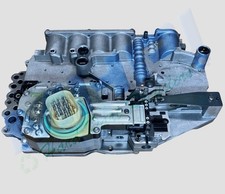
- If electrical checks pass and rationality codes remain, go to the valve body and the pan. Worn switch valve bores, a sticking main regulator, a cut check ball, the filter seal and a dislodged snap ring are all on Chrysler's list.
After any solenoid pack, valve body or internal repair, run the Quick Learn. ATRA TB 990 says it must be done after a transmission repair, because new seals, rings and clutches mean the clutch volume indexes have to be relearned. Skipping it gives harsh or flared shifts that can set new codes. Our 45RFE harsh shift guide covers the drive-learn steps.
The Fix, by Root Cause
- Power, ground or relay fault: repair the circuit or replace the relay. No transmission parts needed, even with pressure switch codes stored alongside.
- Solenoid circuit code with an open solenoid: replace the solenoid/TRS assembly, and per Chrysler, not the valve body.
- Pressure switch rationality with good electrical tests: valve body bore and switch valve repair or a replacement valve body, plus a filter and seal check.
- Ratio codes with burnt fluid and friction material in the pan: the unit comes out. See our 45RFE slipping guide.
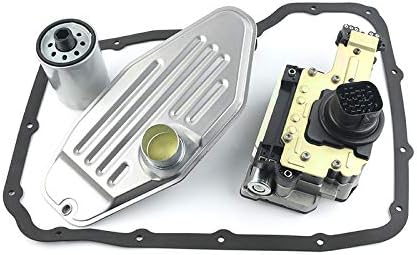
RFE shift solenoid kit, at Core Transmission Parts
For a confirmed open solenoid or failed pressure switch in the solenoid/TRS assembly, the RFE-family 1999-up solenoid kit replaces the part Chrysler's procedure points you to.
View the RFE solenoid kit →45RFE solenoid packs, speed and pressure sensors, valve bodies and rebuild kits, shipped fast from the USA.
Shop 45RFE parts →Related guides
- 45RFE Shift Solenoid Symptoms, Testing and Replacement
- 45RFE / 545RFE Valve Body Problems: Symptoms and Testing
- 45RFE Harsh Shift Causes and Fix
- 45RFE Won't Shift Into Overdrive
- 545RFE Line Pressure Testing: Specs and Procedure
- 68RFE Limp Mode Causes and Fix
FAQ
What gear is a 45RFE in when it goes into limp mode?
With the shifter in Drive, a 45RFE in limp-in is held in 3rd gear, so it feels sluggish from a stop and will not upshift or downshift. Moving the lever to 2 or L gives 2nd gear, and Park, Reverse and Neutral still work. Chrysler says the transmission is designed to land in 3rd gear when every solenoid is in its power-off state.
Why does my 45RFE come out of limp mode after I restart it?
Limp-in happens when the controller turns off the transmission control relay, which removes power from every solenoid and pressure switch. At the next key-on the controller runs its relay self-check and turns the relay back on, so the truck drives normally until the same fault happens again. The code is still stored, so pull it before anyone clears it.
Can a bad relay or ground cause 45RFE pressure switch codes?
Yes. Chrysler's service information notes that inadequate transmission control relay output voltage can set P0846, P0869, P0871, P0876 or P0988, and that those codes then do not indicate an internal transmission or solenoid pack problem. Repair the power fault first and the related codes should clear.
What does P0884 mean on a 45RFE?
P0884 Power Up at Speed sets when the controller powers up while the lever is in a forward gear and output speed is above about 800 rpm, roughly 20 mph. It is not a transmission failure. It means power or ground to the controller dropped out while driving, or the driver did a rolling restart, and Chrysler says to investigate it on any truck with intermittent 3rd gear operation.
What are the 45RFE solenoid resistance specs?
Sonnax lists 1.3 ohms for each shift solenoid and 3.5 ohms for the pressure control solenoid, measured at the transmission case connector. Chrysler's solenoid circuit codes are strictly electrical, and if the solenoid/TRS assembly needs replacing, the valve body does not.
Sources
- ATRA Technical Bulletin 990: "41TE/42LE/42RLE/45RFE/545RFE Series Module Strategies and Learn Values" (February 2006). The four TCM shutdown modes, the 3rd gear RFE fail-safe default with 2nd in 2 or L, logical shutdown using 1st and 3rd at preset line pressure with three recoveries per key cycle, and the Quick Learn requirement after repair. atracom.blob.core.windows.net
- Chrysler 45RFE/545RFE service information: P0882 TCM Power Input Low, P0884 Power Up at Speed and P0890 Switched Battery. Relay off equals limp-in, the 3.0 volt relay output set condition and cause list, relay faults setting false pressure switch codes, 3rd gear with all solenoids in their power-off state, the 20 mph power-up condition, and the key-on relay and pressure switch self-check. P0882, P0884, P0890
- Chrysler 45RFE/545RFE service information: P0750, P0715, P0731, P0944, P0841 and P0869. Solenoid continuity test timing and the strictly-electrical note, the 60/30 tooth speed sensors and P1794 shared-ground signature, the fix-other-codes-first order for ratio codes, the 5 psi pressure check and filter seal inspection, the pressure switch gear table and cause list, and the PCS duty cycle and 120 psi / 3.5 second high-pressure logic. P0750, P0715, P0731, P0944, P0841, P0869
- Sonnax: 45RFE/545RFE/68RFE Solenoid Identification and Connector Pin-Out. 1.3 ohm shift solenoids, 3.5 ohm pressure control solenoid, normally applied and normally venting states and connector pin numbers. sonnax.com
- Sonnax: "Diagnosing Chrysler Transmission Max Line Pressure: P0933, P0869, P1745 Codes." The 150-160 psi idle / 250 psi Reverse signature, 38.38 percent frozen duty cycle, 125 psi default desired pressure and the 0.20-1.00 amp PCS current check, covering the 45RFE and 545RFE. sonnax.com
- Sonnax: "Dodge RFE Pressure Switch Diagnosis, Code P0871." The KOER Reverse test, 12.6-14.4 volt open and 25-50 millivolt closed readings, the roughly 22 psi closing point, and worn bores and switch valve plugs behind about 90 percent of intermittent P0871 cases. sonnax.com
- GEARS Magazine (ATRA): "Controlling Pressure 2: Chrysler" by Rob Faucett, and "Diagnosing Pressure Trouble Codes" by David Chalker. The regulator spring set for high pressure with the PCS working against it, falling duty cycle as a sign of internal leakage, and the line pressure sensor connector as the most common source of intermittent pressure codes. Faucett, Chalker