A 45RFE that comes in stuck in third with a solenoid code is the most over-diagnosed job in the RFE family. Half the time the pack gets replaced when the problem is a connector, and the other half the pack gets replaced when the problem is a worn bore in the valve body a quarter inch away from it. Both mistakes cost the customer about the same amount of money, and neither one fixes the truck.
The 45RFE and its five-speed sibling the 545RFE (Ram 1500, Durango, Dakota, Grand Cherokee, Liberty, Commander) use one solenoid and pressure switch assembly that Chrysler's service manual calls the Transmission Solenoid/TRS Assembly. It carries the shift solenoids, the pressure control solenoid, five pressure switches and the range sensor in one part. That makes it easy to blame and easy to test, if you test it in the right order. This is that order, built from Chrysler's own diagnostic procedures, Sonnax's solenoid identification data and the ATSG write-up on the multi-select solenoid. Sources are listed at the bottom.
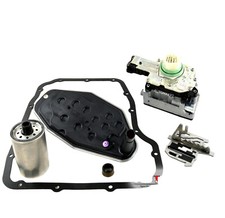
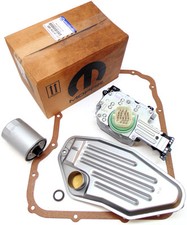
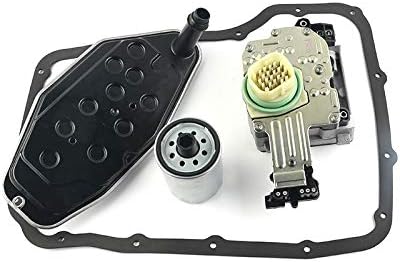
What Is in the 45RFE Solenoid Pack
Chrysler's diagnostic text for the 45RFE/545RFE says the transmission control system uses six electronically controlled shift solenoids to apply fluid to the clutches. Add the pressure control solenoid and you have seven, which matches the count in the ATSG article Transmission Digest published on the multi-select circuit. Sonnax's identification sheet for the 45RFE, 545RFE and 68RFE gives the resistance and default state of each one:
| Solenoid | Default (unpowered) state | Resistance | Circuit DTC |
|---|---|---|---|
| Low/Reverse (L/R, also TCC) | Normally vented | 1.3 ohms | P0750 |
| 2nd clutch (2C) | Normally vented | 1.3 ohms | P0755 |
| Overdrive (OD) | Normally vented | 1.3 ohms | P0760 |
| Underdrive (UD) | Normally applied | 1.3 ohms | P0765 |
| 4th clutch (4C) | Normally vented | 1.3 ohms | P0770 |
| Multi-select (MS) | Normally applied | 1.3 ohms | P2706 |
| Pressure control (PCS) | Duty-cycled | 3.5 ohms | Line pressure DTCs |
The DTC column comes from the 45RFE/545RFE code list in Chrysler's service information. Two notes before you go further. Sonnax points out that the overdrive solenoid was dropped from the later (2010-2018) version of this valve body, so a later pack will not have one to test. And the default states matter more than anything else in the table, because they decide what the truck does when the controller gives up.
Why It Limps in Third
When the controller sees a fault it cannot live with, it drops the transmission control relay and every solenoid loses power. Anything normally vented lets go. Anything normally applied stays on. On the 45RFE that leaves the underdrive solenoid feeding the UD clutch and the multi-select solenoid feeding the OD clutch. UD plus OD is third gear. The ATSG write-up puts it plainly: no-shift failsafe is third gear in Drive and second gear in manual 1 or 2, with Park, Reverse and Neutral still available.
So "stuck in third" is not a symptom of a bad solenoid by itself. It is a symptom of the controller deciding something is wrong. Any solenoid circuit code, any pressure switch rationality code, a line pressure code or a gear ratio code can put it there. The code that set it is what tells you where to look.
Which Clutches, Which Switches, Which Gear
The five pressure switches watch the L/R, 2C, 4C, UD and OD circuits. Chrysler's P0871 procedure prints the state each switch should show in each gear. Here it is, because it doubles as the 45RFE clutch application chart:
| Gear | L/R | 2C | 4C | UD | OD |
|---|---|---|---|---|---|
| Reverse | Open | Open | Open | Open | Open |
| Park/Neutral | Closed* | Open | Open | Open | Open |
| 1st | Closed** | Open | Open | Closed | Open |
| 2nd | Open | Closed | Open | Closed | Open |
| 2nd prime | Open | Open | Closed | Closed | Open |
| 3rd | Open | Open | Open | Closed | Closed |
| 4th | Open | Open | Closed | Open | Closed |
| 5th (545RFE) | Open | Closed | Open | Open | Closed |
*May read open when rolling in Neutral or with cold oil. **Per Chrysler, L/R is closed below 100 rpm output speed in Drive and Manual 2, and always closed in Manual 1.
Read that Reverse row twice. In Reverse every switch should read open. That gives you a free electrical check: engine running, selector in Reverse, scan tool on the pressure switch data. If any switch reads closed in Reverse, you have a wiring or pack problem to fix before you diagnose anything hydraulic. Wiggle the harness at the case connector while you watch. A switch that flickers closed on a wiggle is a connection, not a clutch.
2nd prime is the gear people forget. It is an alternate second ratio built from UD plus 4C instead of UD plus 2C. A complaint that shows up only in 2nd prime points at the 4C circuit, not the 2C circuit.
Circuit Codes vs Rationality Codes
This is the split that saves the pack.
Circuit codes (P0750, P0755, P0760, P0765, P0770, P2706) are electrical
Chrysler's theory of operation for these codes explains the test. The controller pulses each solenoid for a few milliseconds, on if it is inactive and off if it is active, and listens for the inductive spike the coil kicks back. No spike three times in a row sets the code. If the test was triggered by a gear ratio or pressure switch error, one failure sets it. The test runs at power-up and every 10 seconds after.
The manual's note on P0750 is blunt: the code "is strictly an electrical fault," it cannot be caused by an internal transmission failure other than an open in the solenoid/TRS assembly, and if that assembly needs replacing, do not replace the valve body. The possible causes list is the control circuit open, shorted to ground, or shorted to another circuit, the solenoid/TRS assembly, or the controller.
How to run it down:
- Check for TCM power input or relay codes first. Chrysler sends you there before any solenoid test, because a weak feed makes every solenoid look bad at once.
- Unplug the 23-pin connector at the case and meter the pack side. Per Sonnax's pin-out, pin 10 is the transmission control relay output, pin 2 is L/R, pin 7 is OD, pin 12 is the pressure control solenoid, pin 17 is UD, and pins 19 through 21 carry the 4C, 2C and MS controls. GEARS Magazine's Jarad Warren confirms every solenoid is fed from pin 10, so meter from pin 10 to each control pin: Sonnax lists about 1.3 ohms per shift solenoid and 3.5 ohms for the PCS, and GEARS reports about 1.8 and 3.7 ohms. Also check pin 10 to the pressure switch sense pins 11, 14, 15 and 16; each internal resistor should read about 300 ohms. A near-zero reading anywhere is a short that can pull the supply down and set P0882.
- A pack that meters correctly cold but sets the code hot is still a pack. Heat-soak it and meter again before you clear it.
- If the pack meters good, go to the harness. Chrysler's step is a resistance check between the control circuit and every other circuit in the connector. Under 5 ohms to anything means a short to another circuit.
More than one solenoid code at the same time almost never means several solenoids died together. It means their common feed is weak. Look at the relay, the fuse, the feed pin and the connector before the pack.
Rationality codes (P0841, P0846, P0871, P0876, P0988) are usually hydraulic
A pressure switch rationality code means a switch was open or closed at the wrong time for the gear. That is a hydraulic question as often as an electrical one. Chrysler's P0871 (OD pressure switch) cause list includes the sense circuit and the solenoid/TRS assembly, but it also lists low line pressure, a cut or damaged No. 4 or No. 6 check ball, a cut OD/Reverse piston seal, a broken or missing OD/Reverse piston bleed orifice, a broken reaction shaft support seal ring, poor machining on the pump valve body face, a missing dribbler orifice in the reaction shaft support, a cut OD accumulator piston seal, a cracked OD accumulator piston, and a missing OD bleed orifice in the main valve body. A new pack fixes none of those.
The manual also gives you a quick sort. If two or more other switch rationality codes set with it and every switch reads closed in the event data, go to P0882 (TCM power input low). If every switch reads open, check line pressure. Under 40 psi and well below desired means you have a pressure problem, not a switch problem.
Solenoid Switch Valve Codes: P1775 and P1776
The L/R solenoid does two jobs. The solenoid switch valve (SSV) decides where its oil goes. Chrysler's description: in 1st the SSV sits downshifted and routes L/R solenoid oil to the L/R clutch. In 2nd through 5th it sits upshifted and routes the same oil to the converter clutch. TCC apply is modulated by raising the L/R solenoid duty cycle until converter slip is within 60 rpm, then going to full on.
P1776 (SSV latched in L/R position) sets if the L/R pressure switch closes while the controller is running partial or full converter lockup, after two tries. P1775 (SSV latched in TCC position) sets if three attempts to shift the SSV down into 1st fail in one key cycle, confirmed by the L/R switch never closing. Chrysler's causes for both are the SSV sticking, the L/R pressure switch circuit, the solenoid/TRS assembly and the controller. In practice a worn SSV bore is the usual answer on a high-mileage unit, and it is the reason a replacement pack so often does not cure these two codes. If you have P1775 or P1776 with no circuit code, plan on valve body work. Our 45RFE valve body testing guide covers the vacuum test.
The Multi-Select Solenoid Symptoms
The multi-select solenoid is the one most people have never heard of, and it produces the strangest symptoms. Per the ATSG write-up, it is off in Reverse, which lets oil reach the L/R clutch through the manual valve. It is energized in 1st and 2nd to block that circuit, and off again in 3rd and 4th, where it feeds the OD clutch. It also runs a reverse-block failsafe: the controller energizes MS to keep oil out of the L/R circuit when Reverse should not be allowed.
- MS stuck energized (or its circuit stuck on): no Reverse, and the truck falls to neutral on the shift to third. The truck may not move again until a key cycle.
- MS stuck de-energized: Reverse works, but Drive binds up with the UD, L/R and OD clutches applied together. The truck drops to neutral and goes to third once output speed passes about 150 rpm, and it binds again on the next attempt.
A no-reverse complaint with a clean L/R circuit, or a bind-up in Drive that goes away in Reverse, is where the MS circuit belongs on your list. Chrysler notes that P2706 itself is strictly electrical. A solenoid that is electrically fine but sticking mechanically will not set it, so expect only pressure switch or ratio codes in that case.
Replacing the Pack
Pack replacement is a pan-off job, so the filters come out whether you planned on it or not. Clean the mating surface, use the correct spacer gasket for the generation, and do not reuse a sump filter that has been disturbed. Order the pack by connector color: per Sonnax's 2025 RFE solenoid history, the white-connector, six-solenoid pack ran from 2000 to 2009, the 2010 gray-connector pack dropped to five solenoids and cannot back-service earlier units, and the short-lived 1999 black-connector pack is one to avoid. Because the pan is off anyway, change both the sump filter and the spin-on cooler return filter. Our 45RFE fluid and filter service guide covers Chrysler's filter bulletin and torque values.
Then run the Quick Learn. Chrysler lists solenoid pack replacement as one of the jobs that requires it. The conditions: brakes applied, engine above 500 rpm, throttle angle under 3 degrees, lever in Park until the scan tool tells you to shift to Overdrive, then held in Overdrive until it finishes, and calculated oil temperature between 60 and 200 degrees F. Skip it and the truck shifts on old learned values for a new pack, and you get a comeback for harsh or flared shifts. Also note that a battery disconnect clears all DTC event data and resets learned values. Record the event data before anyone unhooks the battery.
After the Quick Learn, drive it. Per ATRA's 45RFE Quick Learn procedure, the Quick Learn only resets the adaptive values to factory presets and exercises the clutches for an approximate clutch volume index (CVI); the controller then refines each CVI during one specific shift with fluid above 110 F. ATRA's normal ranges are L/R 82-134, 2C 25-64, OD 25-64, 4C 30-64 and UD 44-92. A CVI that will not settle into its range after a new pack points at the hydraulics, not the solenoids. ATRA also warns that a misadjusted shifter cable leaving the range sensor in a T3 or T4 code will give a poor 2-3 without setting a code, so check the lever position PID before blaming the new pack. Our 45RFE harsh shift guide has the drive-learn steps for each shift.
RFE solenoid block pack, 1999-2003 (white connector) at Core Transmission Parts
The early RFE pack with the overdrive solenoid, the one that fits 45RFE trucks from the first years. Confirm your connector color and year before ordering.
View the 1999-2003 solenoid pack →45RFE solenoid packs, filter kits, valve bodies and rebuild parts, shipped fast from the USA.
Shop 45RFE parts →Related guides
- Chrysler 45RFE and 545RFE Transmission Problems and Fixes
- 45RFE / 545RFE Valve Body Problems and Testing
- 545RFE Pressure Testing
- 45RFE vs 545RFE Differences
- 68RFE Shift Solenoid Symptoms, Testing and Replacement
FAQ
What are the symptoms of a bad 45RFE shift solenoid?
The common ones are the truck locking in third gear (failsafe) with a check engine light, harsh or missing shifts, no reverse, or a bind-up in Drive. A solenoid circuit code such as P0750, P0755, P0760, P0765, P0770 or P2706 points at the pack or its wiring. A pressure switch code such as P0871 is often hydraulic, so test before you buy a pack.
How do you test a 45RFE solenoid pack?
Unplug the 23-pin connector at the case and meter each solenoid from the pin 10 feed (transmission control relay output) to its control pin. Sonnax lists about 1.3 ohms for the shift solenoids and 3.5 ohms for the pressure control solenoid; GEARS Magazine reports readings around 1.8 and 3.7 ohms. A reading near zero is a shorted solenoid. Then, engine running in Reverse, confirm all five pressure switches read open on the scan tool while you wiggle the harness.
Why is my 45RFE stuck in third gear?
When the controller detects a serious fault it cuts power to the solenoids. The underdrive and multi-select solenoids are normally applied, so the UD and OD clutches stay on and the truck runs in third in Drive, or second in manual 1 or 2. The stored code tells you what caused it.
Do you need to replace the valve body for a 45RFE solenoid code?
Not for a circuit code. Chrysler's procedure says P0750-type solenoid circuit codes are strictly electrical and to replace the solenoid/TRS assembly, not the valve body. Solenoid switch valve codes P1775 and P1776 without a circuit code usually do need valve body work.
Sources
- Chrysler 45RFE/545RFE service information (2007 Commander): P0750 L/R Solenoid Circuit. The six shift solenoids, the inductive-spike continuity test (power-up and every 10 seconds, three failures or one after a ratio/switch error), "strictly an electrical fault," and do not replace the valve body. jeep.automotive-manuals.com
- Chrysler 45RFE/545RFE service information: P0871 OD Pressure Switch Rationality. The pressure switch state chart for every gear including 2nd prime and 5th, the hydraulic cause list (check balls 4/6, OD/Reverse piston seal and bleed orifice, reaction shaft support seal ring, OD accumulator), and the all-closed / all-open / 40 psi triage. jeep.automotive-manuals.com
- Chrysler 45RFE/545RFE service information: P1776 Solenoid Switch Valve Latched in L/R Position. SSV routing of L/R solenoid oil to the L/R clutch in 1st and the TCC in 2nd-5th, EMCC modulation to within 60 rpm slip, and the set conditions and causes for the SSV codes. jeep.automotive-manuals.com
- Chrysler service information: Quick Learn procedure. Solenoid pack replacement requires a Quick Learn, and the entry conditions (brakes applied, over 500 rpm, under 3 degrees throttle, 60-200 F oil). jeep.automotive-manuals.com
- Sonnax: 45RFE, 545RFE, 68RFE Solenoid Identification and Connector Pin-Out. Normally applied vs normally vented states, 1.3-ohm shift solenoids and 3.5-ohm pressure control solenoid, the 23-pin connector pin assignments, and the OD solenoid deletion on 2010-2018 units. sonnax.com
- Transmission Digest: "Operation Multi-Select" (Wayne Colonna, ATSG, December 2006). The seven-solenoid system, multi-select solenoid states by gear, the reverse-block failsafe, third-gear (Drive) and second-gear (manual 1-2) failsafe, and the stuck-energized and stuck-de-energized symptoms. transmissiondigest.com
- ATRA 2002 technical seminar manual, Chrysler 45RFE Quick Learn Procedure (pages 182-187). What Quick Learn does and does not do, the shift conditions that update each clutch volume index above 110 F, the normal CVI ranges, and the misadjusted-shifter T3/T4 cause of poor 2-3 shift quality. atracom.blob.core.windows.net
- GEARS Magazine (ATRA): "An Uncommon Fix for Code P0882" (Jarad Warren, December 2018). All solenoids fed from pin 10, about 1.8-ohm shift solenoids and 3.7-ohm pressure control solenoid, about 300 ohms from pin 10 to pressure switch pins 11, 14, 15 and 16, and a shorted pack pulling the supply below 3 volts to set P0882. gearsmagazine.com
- Sonnax: "Identifying Chrysler RFE Solenoid Changes Through the Years" (Randall Schroeder, February 2025). Black 1999 connector, white 2000-2009 six-solenoid pack, gray 2010 five-solenoid pack that cannot back-service earlier units, and the 2019 blue connector with a separate TCC solenoid. sonnax.com