More 68RFE solenoid packs get replaced than fail. That is not a slogan, it is what the pressure-switch data tells you if you take ten minutes to read it before you order the part. The pack on this transmission is not just a set of solenoids — it also carries the five pressure switches the controller uses to confirm that a clutch actually got oil. When the controller sees a mismatch between what it commanded and what the switch reported, it throws a code that has the word "solenoid" or "pressure switch" in it, and the parts cannon comes out. The mismatch is usually hydraulic, and it usually lives in the valve body casting a quarter inch away from the switch.
This is the diagnostic order that keeps you from buying a $300 pack twice: prove the electrical side with a free key-on test, then prove the hydraulic side with a vacuum gauge on the bench, and only then decide whether the pack itself is the problem.
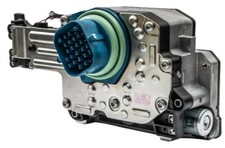
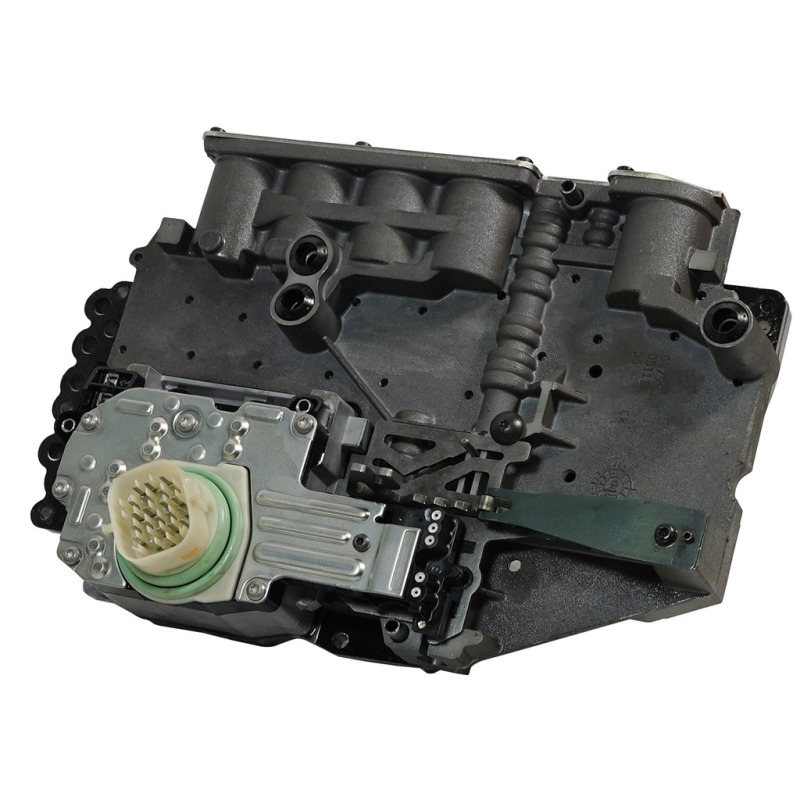
What is actually inside the 68RFE solenoid pack
The RFE family — 45RFE, 545RFE, 65RFE, 66RFE and 68RFE — uses a five-pressure-switch system integrated into the solenoid pack. Per Sonnax's teardown of the RFE pressure switch circuit, each switch has its own individual electrical circuit fed with system voltage, and inside the pack the current is limited to 50mA or less by a 300-ohm resistor on each switch circuit.
Each switch sits naturally open with no hydraulic pressure behind it. It closes at 22 psi and releases back open at 11 psi. Those two numbers matter more than they look: there is 11 psi of hysteresis built in, so a circuit that is bleeding down slowly can hold a switch closed well after you think the clutch released.
| Switch state | Hydraulic condition | Voltage at the controller |
|---|---|---|
| Open | Below 11 psi at the switch | 12.6–14.4V (system voltage) |
| Closed | 22 psi or more at the switch | 25–50mV (pulled to near ground) |
One trap worth memorizing before you go any further: an open signal wire and a wire shorted to ground both read as "closed" at the controller. Any absence of voltage on a pressure switch signal wire is interpreted the same as a hydraulically closed switch. So a chafed harness and a stuck-applied clutch produce identical scan data. You cannot tell them apart from the data list alone.
The KOER Reverse test: the free ten minutes that saves the pack
Chrysler left a gift in this system, whether on purpose or not. With the key on and the engine running, selector in Reverse, all five pressure switches should read open. Every one of them. That single condition proves a lot at once: system voltage is reaching the solenoid pack through the relay in the TIPM, every signal wire is intact, and the controller is seeing all five circuits correctly.
Run it like this:
- Engine running, selector in Reverse, scan tool on the transmission pressure switch data list.
- Confirm all five switches show open. Any switch reading closed here is a fault you must fix before you diagnose anything else.
- While watching that data, gently move the external connector and the harness at the case. A switch that flickers to closed under a wiggle is a connection problem, not a hydraulic one.
Two caveats. The test cannot be run if the truck is in a failsafe condition, because failsafe drops the relay and cuts voltage to the transmission — clear the failsafe first. And the low/reverse switch has its own behavior: the L/R clutch is on (closed) until roughly 150 RPM output shaft speed is reached, and L/R may read open when the truck is rolling in Neutral or when the ATF is still cold.
If everything passes the wiggle test, the odds that you have an electrical solenoid fault just dropped hard. Now go hydraulic.
P0871 and the solenoid switch valve: the 90 percent code
P0871 is the overdrive pressure switch rationality code, and it is the single most misdiagnosed code on this unit. The reference behavior is simple: on a road test in 1st, 2nd and 3rd gear, the OD pressure switch should be open, because the OD clutch is not applied until 4th, 5th and 6th. If you catch an intermittent OD switch closed in 2nd or 3rd gear, the OD circuit is getting pressure it should not have.
Sonnax puts a number on the cause: worn valve body bores and outer solenoid switch valve plugs are behind P0871 about 90 percent of the time. It is common enough that plenty of shops ream and oversize the solenoid switch valve on every 68RFE build as standard practice rather than waiting for the comeback.
The mechanism is worth understanding, because it explains the burnt overdrive clutches you find later. Line pressure pushes through the excess clearance in the worn SSV bore and partially applies the OD clutches, or keeps them from releasing cleanly. That crossleak also drops OD apply pressure when the clutch is supposed to be on, which lowers clutch holding force and lets the pack slip. On a unit whose OE overdrive frictions are single-sided with a steel core only 0.034 in. thick — against 0.080 in. steels in a 4L80-E direct pack — there is very little mass to absorb that heat. The clutches distort, clearance goes out of spec, and they burn.
So P0871 is frequently an early warning of an OD clutch failure that has not happened yet. Treating it as a solenoid pack code throws away that warning.
Vacuum testing the bores: 18 inches or replace it
You cannot judge these bores by eye. Vacuum testing is the call, and the pass/fail number is consistent across the RFE valve body circuits: a result of 18 in-Hg is satisfactory; anything below that is worn and should be replaced. If the gauge drops straight to zero, you have confirmed the leak.
Practical notes from doing it on the 68RFE specifically:
- You have to manually shuttle the valve to each worm track area to get a reading. The valve does not sit where you need it on its own.
- Inspect for erosion and porosity inside the bore, not just wear. The aluminum alloy in these castings is not great, and some solenoid switch valve bores are genuinely beyond repair. Finding that out on the bench beats finding it out after assembly.
- If wear is severe, the fix is to ream the bore and install an oversized valve or plug kit to restore the hydraulic seal. A drop-in kit will not fix a bore that has already gone oversize.
While you have the gauge out, do the low/reverse switch valve too. In the 68RFE that valve acts as a one-way valve for the low/reverse clutch in Reverse and Drive, and it wears because it is heavily side-loaded — the valve's diameter is too close to its total length. Leakage past it exhausts through the manual valve, which drops L/R apply pressure and gives you burnt low/reverse clutches, delayed Reverse, or no Reverse at all. Sonnax addresses it with a checkball sleeve design, drop-in kit 92835-41K and oversized kit 92835-45K for bores with extreme wear.
68RFE / 65RFE / 66RFE Solenoid Block
When testing does point at the pack — a cracked housing, a restricted solenoid, or seal failure inside the assembly — this is the direct replacement block for 545RFE, 65RFE, 66RFE and 68RFE applications.
View the solenoid block →When it really is electrical: put a scope on it
If the KOER Reverse test flagged something, or you have an intermittent that only sets on the road, a meter will not catch it. A scope will.
The single most useful pattern to know comes from a Chrysler solenoid-circuit case Wayne Colonna documented in Transmission Digest. The controller pulses each solenoid and continuously checks circuit integrity by briefly switching it off, which produces an inductive flyback spike typically in the 42-volt range. In that case the technician scoped all four solenoids and found two things at once: the inductive spike was missing entirely, and every solenoid's voltage was half what it should have been.
That is the tell. When all the solenoids misbehave in the same way, they are not all bad — they share a common voltage supply, and that supply is the fault. The diagnosis moved to the relay-side power feed at the connector, not to the solenoid body. The case vehicle was a 41TE, but the logic transfers directly to the 68RFE pack: a full house of solenoid codes points at the common power and ground path, the connector, or the controller, not at five simultaneous solenoid failures.
For intermittent hydraulic-versus-electrical questions on the road, a four-channel scope with a pressure transducer on one channel and the pressure switch signal wire on another settles it. If the transducer shows pressure arriving before the signal wire changes state, the problem is hydraulic in the valve body. If the signal wire drops to low or no voltage with no pressure present, the problem is electrical.
P0740: the code that looks like a TCC solenoid and is not
Worth including because it follows the same pattern. P0740 on the 68RFE sets when the L/R TCC solenoid reaches maximum duty cycle and still cannot pull engine speed within 60 RPM of input speed, or when slip exceeds 100 RPM for 10 seconds in full electronic modulated clutch mode.
In a documented case published in ATRA's Gears magazine — a 2016 Ram 2500 6.7L running hot, climbing from 195°F to 230°F with a vibration at highway speed — the pressure readings told the real story:
| Measurement | Reading | Should be |
|---|---|---|
| TCC release pressure | 20 psi | 5 psi or less |
| TCC apply pressure | 85 psi | Matching line pressure (120 psi) |
| Vacuum test, solenoid switch valve bore | Dropped to zero | 18 in-Hg or better |
The solenoid was doing its job at maximum duty cycle. It could not win because oil was leaking past a worn solenoid switch valve and a worn torque converter accumulator piston in the pump. The repair was the switch valve, the accumulator, a new converter, and a relearn — not a solenoid pack.
Replacement and torque specs
If the pack does need to come out, the specs below come from Sonnax's Transend remanufactured valve body install documentation covering the 45RFE, 545RFE, 65RFE, 66RFE and 68RFE units (part numbers CHR145 without solenoid pack, CHR146 with).
| Fastener | Count | Torque |
|---|---|---|
| Solenoid pack to valve body front plate (Torx) | 15–25 | 53 in-lb |
| Valve body to case, 8mm head bolts | 6 | 105 in-lb |
| Accumulator cover plate retaining screws | All | 40 in-lb |
Two assembly details that cause callbacks:
- Connector color is not cosmetic. These valve bodies will accept a black, white or grey connector solenoid pack, but if you install the black connector pack you must install the striker plate from the original valve body. Sonnax recommends the white connector pack because it is the universal one.
- Verify the three valve body-to-case seals are seated on top of the valve body before the assembly goes back on the case. They are easy to knock loose while you are lining up the pack.
Fluid and relearn
The 68RFE takes ATF+4 (Chrysler material standard MS-9602). Fill to factory spec, then do the relearn properly — skipping it is why so many valve body jobs feel worse than what came off the truck:
- Run the engine to bring fluid temperature up to roughly 185°F.
- Connect a scan tool capable of initiating the quick learn and run it.
- Road test through 10 to 15 upshift and downshift cycles across all available gears.
During that relearn window, downshift clunks, a slight bind on the 3-4 upshift and a 2-3 flare are all normal and typically clear themselves within those 10 to 15 cycles. Tell the customer that before they drive away, or you will get the phone call.
Bench tools worth having
A vacuum test kit is the piece most shops are missing, and it is the difference between guessing at bore wear and knowing. Vacuum test kits for valve body work run well under the cost of one unnecessary solenoid pack.
Need parts for this job?
Solenoid blocks, valve body repair kits, filters, pans, clutch modules and overhaul kits for the 68RFE — the parts that actually fix what the vacuum gauge found.
Shop 68RFE parts →The short version
Run the KOER Reverse pressure switch test before you order anything — it is free and it separates electrical from hydraulic in ten minutes. Treat P0871 as a worn solenoid switch valve until vacuum testing says otherwise, and hold the bore to 18 in-Hg. If every solenoid looks wrong at once, chase the shared power feed, not the pack. And when the pack does come off, torque the Torx bolts to 53 in-lb, the case bolts to 105 in-lb, and finish the job with a real quick learn at 185°F.
Sources
- Sonnax — "Dodge RFE Pressure Switch Diagnosis & Code P0871," Jim Mobley, January 20, 2025. Backs the five-pressure-switch system architecture; the 300-ohm current-limiting resistors and 50mA or less per switch circuit; the 22 psi close and 11 psi release thresholds; the 12.6–14.4V open state and 25–50mV closed state at the controller; the KOER Reverse test procedure and the fact that it cannot be run in a failsafe condition; the L/R clutch remaining closed until 150 RPM output shaft speed and reading open when rolling in Neutral or at low ATF temperature; that an open or shorted-to-ground signal wire is interpreted identically to a closed switch; that the OD pressure switch should read open in 1st, 2nd and 3rd gear; the roughly 90 percent figure for worn bores and outer switch valve plugs causing P0871; the bore erosion and porosity inspection point; and the scope-plus-transducer method for separating hydraulic from electrical faults. sonnax.com
- Sonnax — "Diagnosing 62TE, 68RFE Low/Reverse Switch Valve Issues," Chris Leach, July 14, 2025. Backs the low/reverse switch valve functioning as a one-way valve for the L/R clutch in Reverse and Drive; wear being caused by heavy side-loading because the valve diameter is too close to its total length; the resulting leakage exhausting through the manual valve and causing burnt clutches, delayed Reverse or no Reverse; the requirement to manually shuttle the valve to each worm track to get a reading on the 68RFE; the 18 in-Hg pass/fail vacuum specification; and the Sonnax low/reverse switch checkball sleeve kit part numbers 92835-41K (drop-in) and 92835-45K (oversized). sonnax.com
- Sonnax — "68RFE Overdrive Clutch Failure: What to Check First When Troubleshooting OD Issues," Jason Larochelle, August 18, 2020. Backs the 0.034 in. single-sided OE overdrive clutch steel core thickness and the 0.080 in. comparison to 4L80-E direct clutch steels; the heat distortion mechanism that takes clutch clearance out of specification; the solenoid switch valve plugs being the weakest link in the OD system and their crossleaks into and out of the OD circuit reducing clutch holding force; and the recommendation to ream bores and install oversized valves when vacuum testing shows severe wear. sonnax.com
- ATRA / Gears Magazine — "Solving a 68RFE Mystery Code P0740." Backs the P0740 set criteria (L/R TCC solenoid at maximum duty cycle unable to pull engine speed within 60 RPM of input speed, or slip exceeding 100 RPM for 10 seconds in full electronic modulated clutch mode); the 2016 Ram 2500 6.7L case detail of fluid temperature climbing from 195°F to 230°F with highway vibration; the measured TCC release pressure of 20 psi against a 5 psi or less specification; the TCC apply pressure of 85 psi against 120 psi line pressure; the failed vacuum test dropping to zero rather than holding 18 inches; and the resolution being the solenoid switch valve, torque converter accumulator and converter rather than the solenoid. gearsmagazine.com
- Transmission Digest — "Low/Reverse-Solenoid Circuit Fault Code P0750 (41)," Wayne Colonna, February 1, 2012. Backs the description of the controller pulsing solenoids and checking circuit integrity by briefly switching them off; the resulting inductive flyback spike typically in the 42-volt range; and the documented Chrysler case in which all four solenoids showed missing inductive spikes and half the expected voltage, leading diagnosis to the shared relay-side power supply at the connector rather than to the solenoids themselves. transmissiondigest.com
- Sonnax Transmission Company / Transend — "45RFE, 545RFE, 65RFE, 66RFE, 68RFE Universal Remanufactured Valve Body Tech & Install Tips," part numbers CHR145 and CHR146, revised April 2021. Backs the solenoid pack to valve body front plate torque of 53 in-lb on the 15–25 Torx bolts; the six 8mm valve body-to-case head bolts at 105 in-lb; the accumulator cover plate retaining screws at 40 in-lb; the requirement to verify three valve body-to-case seals are installed; the black, white and grey connector solenoid pack compatibility with the striker plate requirement for the black connector pack and the recommendation of the white connector pack as universal; and the relearn procedure of warming fluid to 185°F, initiating quick learn with a capable scan tool, and road testing 10–15 upshift and downshift cycles, with downshift clunks, a slight 3-4 bind and a 2-3 flare being common until the relearn completes. cdn.transend.us