Most wrong-part returns on a 68RFE job come from one of two mistakes: somebody assumed every Ram 2500 or 3500 with a Cummins has the same transmission, or somebody assumed every 68RFE is the same 68RFE. Neither is true. A heavy-duty Ram from the 6.7L era can have a 68RFE or an Aisin AS69RC behind the engine, and the 68RFE itself went through three distinct solenoid pack and valve body generations between 2007 and today. Order a pack, valve body or pump for the wrong one and you get a truck that binds up, drops into neutral, or will not move at all.
This guide is the checklist I run before ordering anything for one of these units: how to confirm it is a 68RFE, how to read the ID tag, and how to tell a 2007-2009, 2010-2018 and 2019-later unit apart by what you can see with the pan off. If you already know what you have and are chasing a symptom, our 68RFE weak spots and fixes guide is the better starting point.
Step 1: Confirm It Is a 68RFE and Not an Aisin
The 68RFE went in behind the 6.7L Cummins starting with the 2007 1/2 model year in Ram 2500 and 3500 pickups, and GEARS Magazine (ATRA) notes it has stayed fundamentally the same design for most of its life. The name itself tells you what it is. ATSG breaks it down this way: 6 = six forward speeds, 8 = relative torque capacity, R = rear-wheel drive, FE = fully electronic.
The problem is that the same trucks, especially cab-and-chassis and high-output applications, were also built with the Aisin AS69RC. The two units take different fluid, which is the fastest paper check you have. In the 2022 Ram 2500/3500 owner's manual fluids table, Mopar lists the 68RFE as "only use ATF+4" and the AS69RC as Mopar ASRC fluid. The maintenance schedule splits the same way: the AS69RC gets scheduled fluid changes (60,000 and 120,000 miles, with the sump filter at 90,000), while the 68RFE fluid and filter change is called out for police, fleet or frequent-towing use. If the service records, the dipstick tube label or the fluid in the pan says ASRC, stop. You are not working on a 68RFE, and nothing in this guide applies.
Physically, the 68RFE is a member of the RFE family. Sonnax groups it with the 45RFE (four-speed, introduced 1999), the 545RFE and 65RFE (five-speed) and the 66RFE (six-speed), all sharing the same basic case architecture, bottom-mounted valve body and plug-in solenoid pack. That family resemblance is exactly why parts get mixed up. For the detailed side-by-side on the siblings, see 66RFE vs 68RFE and 545RFE vs 68RFE.
Step 2: Read the ID Tag
Chrysler puts a bar code label on the transmission case, and ATSG's 68RFE manual shows that the same ID numbers are also etched into the case at the pan rail. That second location is the one that matters on a high-mileage truck, because the paper label is usually unreadable or gone after a few years of road spray and fluid.
The tag carries three pieces of information: the Mopar part number, a build date code and a serial number. The example ATSG prints shows a part number in the form P52119704AB. The part number is what you give a supplier or a dealer parts counter. The two-letter suffix at the end matters: Chrysler changes suffixes when the assembly changes, so write down the whole string, not just the first eight digits.
Clean the pan rail with brake cleaner and a rag before you try to read it. The etching is shallow. A flashlight held low and to the side, so the light rakes across the surface, will pick it out far better than one pointed straight at it.
Step 3: Know the Ratios and the Clutch Layout
If the tag is gone and you have a unit on the bench, the internals settle it. ATSG's clutch application chart lists these ratios for the 68RFE:
- 1st: 3.23:1
- 2nd: 1.83:1
- 3rd: 1.41:1
- 4th: 1.00:1
- 5th: 0.81:1
- 6th: 0.62:1
- Reverse: 4.44:1
ATSG notes the unit runs three planetary gear sets, all with six-pinion carriers to handle diesel torque, and that those gearsets are what give it the deeper first and reverse ratios than the gas RFE units. The input clutch housing holds the underdrive, overdrive and reverse clutches, with the underdrive and overdrive both single-sided. The holding clutches are the 2nd, 4th and a single-sided low/reverse clutch, plus one freewheel device, the low sprag. Each gear applies a combination of two clutches. In Park and Neutral only the low/reverse clutch is on, and per ATSG it is applied only while output shaft speed is below 150 rpm.
One behavior worth knowing when you road test: ATSG states that upshifts into 5th and 6th are delayed when fluid temperature is below 40 F or above 240 F, and 5th and 6th only come in after the unit has completed the shift into 4th. A cold truck that will not grab overdrive on the first mile is doing what it was programmed to do.
Step 4: Read the Solenoid Pack Connector Color
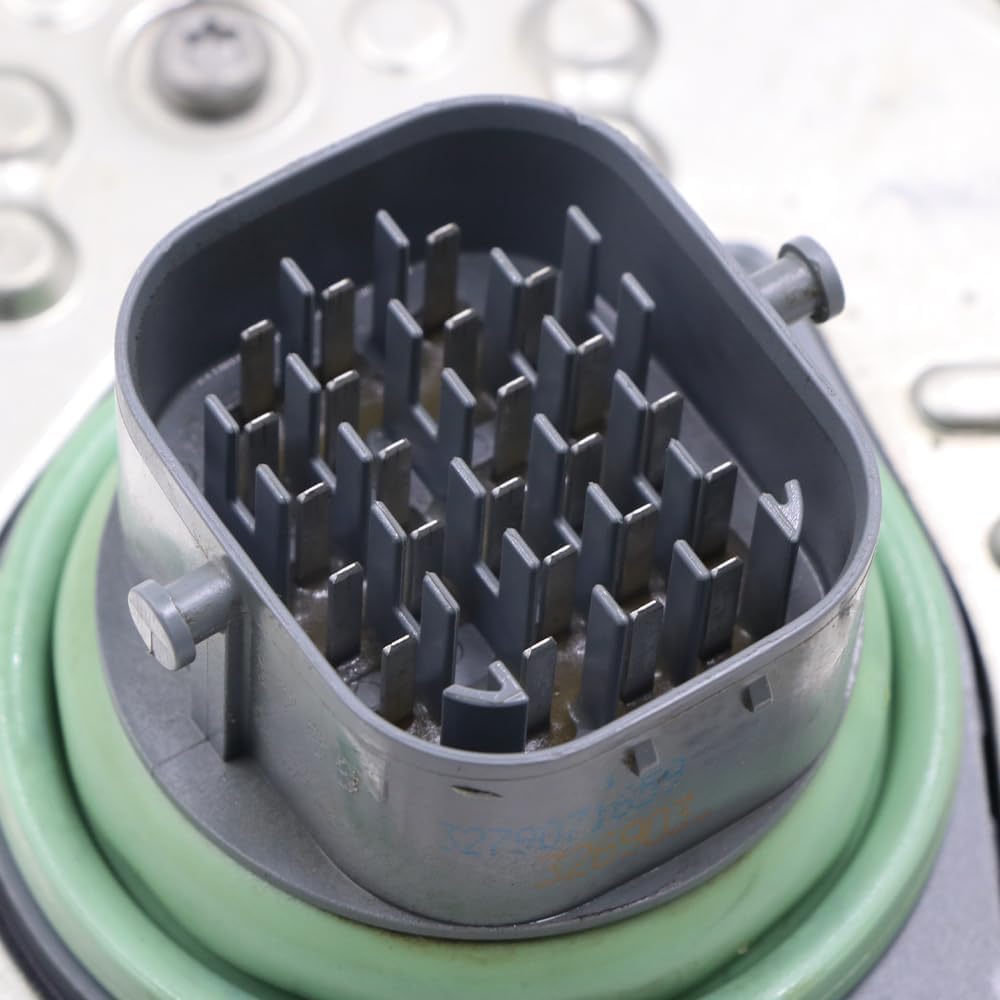
This is the single most useful identification point on the whole transmission, and you can see it from under the truck with the pan still on if you have a light and a mirror. The 23-pin pass-through connector on the solenoid pack changed color every time the pack design changed. Transmission Digest's guide to spotting 68RFE designs lays it out:
- Black connector (pre-2004 RFE units): the older, noisy solenoid pack design, with an overdrive solenoid. This predates the 68RFE, but these packs are still out there on shelves and in core piles.
- White connector (2004-2009): the quieter pack used on 45RFE, 545RFE and early 68RFE units. Still has the overdrive solenoid.
- Gray connector (2010-2018): the overdrive solenoid was eliminated, and the valve body saw running changes through these years.
- Blue connector (2019-up): a separate TCC solenoid was added, mounted on a lower channel plate housing, and a new normally applied reverse clutch solenoid sits where the old OD solenoid used to be. The L/R solenoid no longer doubles as the TCC solenoid.
Sonnax's pin-out for the RFE pack backs up the gray-connector change from the electrical side: the pack uses seven solenoids at 1.3 ohms each, except the pressure control solenoid at 3.5 ohms, and pin 7, overdrive solenoid control, is not used on the 2010-2018 version. The rest of the pinout is the same family: pin 2 L/R, pin 12 pressure control, pin 17 underdrive, pin 19 4C, pin 20 2C, pin 21 multi-select. If you are chasing a solenoid complaint after you know the generation, our 68RFE shift solenoid symptoms guide covers testing.
The gasket trap
Connector color is not just a label. Transmission Digest points out there are two different silicone-beaded solenoid block gaskets. On the older gasket used with gray and white packs, D21 line pressure feeds the second, fourth and OD solenoids. On the newer gasket for the blue pack, D21 feeds only second and fourth, and the reverse solenoid is isolated behind a void pocket. Mix them and you build a problem into a good transmission:
- Old gasket on a blue-connector assembly: the reverse clutch gets pressure in forward ranges and the unit binds up when it tries to move forward.
- New gasket on a white-connector assembly: the OD solenoid is starved, and the unit neutrals out on the shift into third.
Match the gasket to the pack, every time. If the box does not say which one it is, compare it to the one you pulled off before you throw the old one away.
Step 5: Spot a 2019-Later Unit on the Bench
The 2019 changes go well beyond the pack. Sonnax's 2019-later identification article says the changes were made to better control TCC apply and release and to deal with reverse release clunk complaints, and lists what to look for:
- Pump: the easiest tell is that the TCC accumulator retainer, spring and piston are gone. The torque converter regulator valve now uses a bore plug and wire retainer, similar to the ZF 8-speed. The TCC switch valve got a new spring, and the pump plate and pump cover were changed.
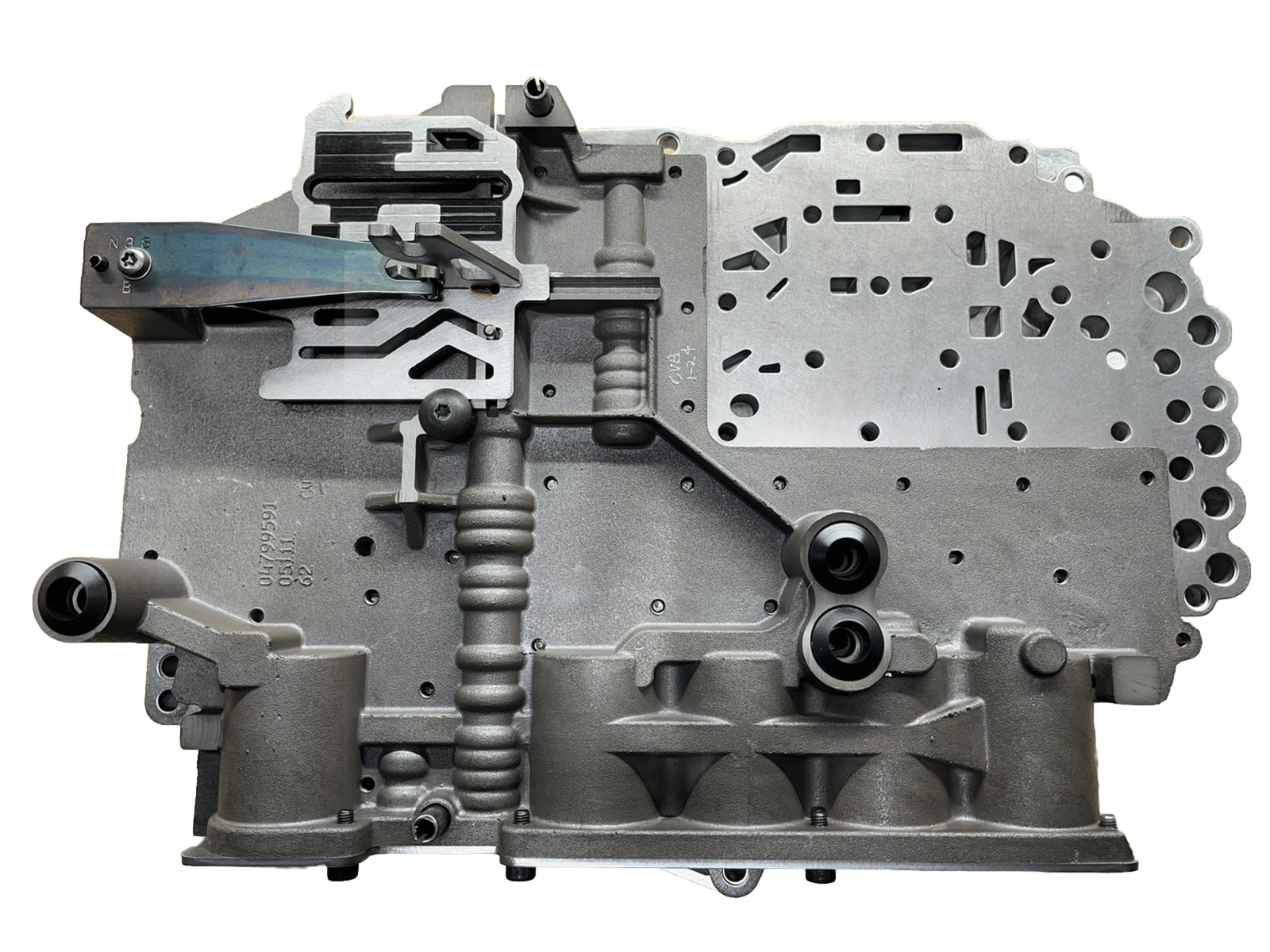
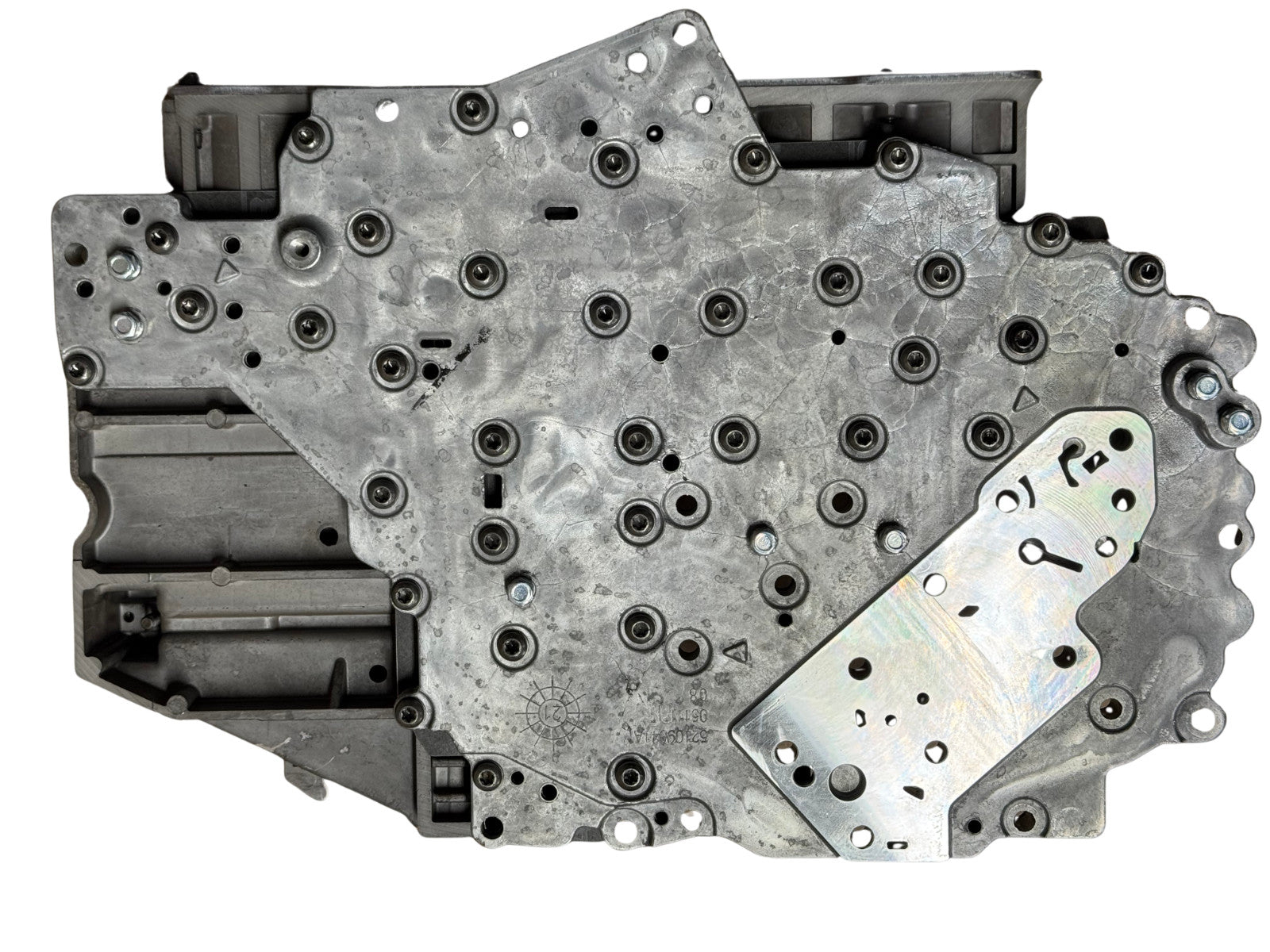
- Valve body: a lower valve body section was added to the channel plate. It houses a new reverse accumulator assembly and the TCC control solenoid. The upper valve body and separator plate were modified to match, and the manual valve reverted to an earlier design.
- Solenoid pack: blue connector instead of gray, with the reverse clutch now on its own control solenoid, which earlier versions did not have.
The practical rule that falls out of all this: a 2019-up pump, valve body and solenoid pack are a matched set. They do not swap onto an earlier unit, and earlier parts do not swap onto a 2019-up unit, without changing the whole hydraulic package.
OEM Mopar 68456067AA Solenoid Pack, Blue Connector (2019-2024)
If your unit has the blue connector, this is the correct factory pack for the 2019-2024 Ram 2500/3500 6.7L 68RFE, with the separate reverse clutch control. Pair it with the matching new-style block gasket.
View the 68456067AA pack →Before You Install a Replacement Valve Body
Identification does not end when the right part shows up. Transmission Digest documented a 2010 Ram 3500 68RFE that had zero line pressure and no movement in forward or reverse after a new dealer valve body went in. The cause was simple: the replacement valve body ships with the clutch pressure test plugs packed separately in the box, and they never got installed. Before the valve body goes up, inventory the box, find the bag and install the plugs.
While you have the pan down, confirm the fluid is ATF+4 and not something a quick-lube topped it off with. ATSG and Mopar both specify ATF+4 for the 68RFE. Our 68RFE fluid type and capacity guide has the fill numbers.
The Identification Checklist
- Fluid: ATF+4 means RFE. ASRC means Aisin AS69RC.
- Tag: read the part number, suffix included, from the bar code label or the pan rail etching.
- Connector color: white 2004-2009, gray 2010-2018, blue 2019-up.
- On the bench: 3.23 first, 4.44 reverse, six-pinion planets. No TCC accumulator piston in the pump means 2019-up.
- Gasket: match the solenoid block gasket to the pack generation.
- Valve body box: find the test plugs before installation.
Shop 68RFE parts →
Frequently Asked Questions
How do I identify a 68RFE transmission?
Check the fluid spec first: the 68RFE uses ATF+4, while the Aisin AS69RC offered in the same Ram heavy-duty trucks uses Mopar ASRC fluid. Then read the part number from the bar code label on the case or the ID numbers etched into the case pan rail. On the bench, a 3.23 first gear, 4.44 reverse and three six-pinion planetary sets confirm it.
Where is the ID tag on a 68RFE?
Chrysler puts a bar code label on the transmission case, and the same ID numbers are etched into the case at the pan rail. The tag carries the Mopar part number, a build date code and a serial number. Clean the pan rail and use a low-angle flashlight to read the etching.
What do the 68RFE solenoid pack connector colors mean?
The connector color identifies the pack generation. White packs are 2004-2009 and still have an overdrive solenoid, gray packs are 2010-2018 with the OD solenoid eliminated, and blue packs are 2019-up with a separate TCC solenoid and a new reverse clutch solenoid. Older black packs predate the 68RFE.
Can I put a 2019 68RFE valve body or solenoid pack on an older truck?
Not by itself. The 2019-up units changed the pump, added a lower valve body section with a reverse accumulator and TCC solenoid, and use a blue-connector pack with a different solenoid block gasket. Those parts work as a matched set, and mixing gaskets between generations can cause bind-up or a neutral on the shift into third.
Sources
- ATSG (Automatic Transmission Service Group) — Dodge Ram Trucks 68RFE Technical Service Information (manual excerpt), 2011. Backs the 6/8/R/FE naming breakdown, the bar code label and ID numbers etched into the case pan rail with part number, build date and serial number, the ratio chart (3.23, 1.83, 1.41, 1.00, 0.81, 0.62, reverse 4.44), the three six-pinion planetary sets, the clutch layout and low sprag, L/R apply below 150 rpm output speed, the 40 F / 240 F delay on 5th and 6th, and ATF+4. atsg.biz (PDF)
- Transmission Digest — "Spotting different 68RFE designs through the years to avoid issues." Backs the black, white, gray and blue pass-through connector generations, the OD solenoid deletion in 2010, the 2019 separate TCC solenoid and normally applied reverse clutch solenoid, the two solenoid block gasket designs and D21 feed differences, and the bind-up and third-gear neutral results of mixing gaskets. transmissiondigest.com
- Sonnax — "Chrysler 68RFE '19-Later Changes & Identification." Backs the missing TCC accumulator retainer, spring and piston in the 2019-up pump, the TC regulator bore plug and wire retainer, the pump plate and cover changes, the lower valve body section on the channel plate with reverse accumulator and TCC solenoid, the reverted manual valve, the gray-to-blue connector change and the stated purpose of the changes. sonnax.com
- Sonnax — "45RFE, 545RFE, 68RFE Solenoid Identification & Connector Pin-Out." Backs the seven solenoids at 1.3 ohms with the pressure control solenoid at 3.5 ohms, the 23-pin pinout, and pin 7 overdrive solenoid control not used on the 2010-2018 version. sonnax.com
- Mopar / Ram — 2022 Ram 2500/3500 Owner's Manual, Chassis Fluids and Lubricants. Backs ATF+4 only for the 68RFE and Mopar ASRC fluid for the AS69RC on 6.7L diesel trucks. vehicleinfo.mopar.com The same manual's diesel maintenance schedule backs the AS69RC-only fluid change intervals and the severe-use 68RFE fluid and filter change. vehicleinfo.mopar.com
- GEARS Magazine (ATRA) — "Fixing the Root Cause of the Problem: Solving Issues with the 68RFE Transmission." Backs the 68RFE pairing with the 6.7L Cummins from 2007 1/2 and up and the design staying fundamentally the same for most of its life. gearsmagazine.com
- Transmission Digest — "RFE Series No Movement After Valve Body Replacement." Backs the 2010 Ram 3500 68RFE zero-pressure, no-movement case caused by clutch pressure test plugs left in a separate package in the valve body box. transmissiondigest.com