Two Ram trucks, same week, both with a 6.7-liter Cummins and a six-speed automatic. One has a 68RFE and one has an Aisin AS69RC, and almost nothing about servicing them is the same. The parts do not cross, the diagnostic strategy does not cross, and the failure modes are different animals.
Ram does not badge these units on the outside of the truck. What decides which one you are looking at is the engine rating.
Which truck gets which unit
Ram's specification sheet for the 2500 and 3500 Heavy Duty draws the line cleanly. The 68RFE is listed behind the 6.7-liter diesel in standard output form, in both 2500 and 3500 trucks. The AS69RC is listed behind the 6.7-liter high output only, in the 3500.
That is not a trim option, it is a different engine calibration. Per the 2024 sheet, the standard output 6.7L makes 370 hp at 2,800 rpm and 850 lb-ft at 1,700 rpm on a 19.0:1 compression ratio, noted with the 68RFE. The high output makes 420 hp at 2,800 rpm and 1,075 lb-ft at 1,800 rpm on 16.2:1, noted with the Aisin.
The honest headline answer to "which is stronger" is settled by the factory before you ever pull a pan: the Aisin is the unit Ram put behind an engine making 26 percent more torque. It also carries the Ram 3500, 4500 and 5500 cab and chassis trucks.
Gear ratios side by side
This is where the two stop resembling each other, and it is the fastest way to confirm what you have by watching ratio math on a scan tool.
- 68RFE: 1st 3.23, 2nd 1.84, 3rd 1.41, 4th 1.00, 5th 0.82, 6th 0.63, reverse 4.44
- AS69RC: 1st 3.75, 2nd 2.00, 3rd 1.34, 4th 1.00, 5th 0.77, 6th 0.63, reverse 3.54
Both land on the same 0.63 top gear, so highway cruise rpm feels similar at the same axle ratio. Everything below is different. The Aisin's first is 16 percent deeper, giving a spread of about 5.95:1 against roughly 5.13:1 for the 68RFE. Deeper first with the same overdrive is what you want in a truck starting a heavy trailer and then settling at 70 mph.
Reverse runs the other way. The 68RFE's 4.44 is considerably deeper than the Aisin's 3.54, so an Aisin truck backing a loaded gooseneck up a ramp genuinely has less mechanical advantage. That is the ratio, not a hydraulic problem.
What is actually inside each one
Ram's sheet describes the 68RFE as three planetary gearsets, one overrunning clutch, full electronic control and an electronically controlled converter clutch. The AS69RC entry lists three planetary gear sets, full electronic control and an electronically controlled converter clutch, with no overrunning clutch called out.
That omission lines up with the 2013 redesign. Chrysler used the AS68RC behind the 6.7L in incomplete chassis trucks from 2007; per Jason Wulff in Transmission Digest, the 2013 revision to the AS69RC reduced the pressure switches to one, simplified the valve body, and carried the clutch application chart over except for eliminating a low one-way clutch. ATRA's GEARS intro still describes an overrunning clutch, so the published sources disagree. Order hard parts off the year and the teardown in front of you, not a summary.
GEARS puts the earlier AS68RC at a 750 lb-ft capacity rating and calls the AS69RC the stronger, more durable replacement. Aisin publishes no input torque number for the AS69RC, so anyone quoting you an exact figure is estimating.
The AS69RC control side, and why the codes lie
The Aisin's electronics are where most shops lose money on these. Per GEARS, the unit uses linear solenoids LS1 through LS5 plus SLT and SLU, all pulse width modulated, plus one on/off solenoid. The resistance checks are straightforward: the pulse width modulated solenoids, small yellow connector and larger black connector alike, measure 4 to 6 ohms, and the green connector on/off solenoid measures 11 to 21 ohms.
Do not interchange solenoid locations. Swapping the large solenoids, or putting the SLT where the SLU goes, produces bind-ups, flares or harsh downshifts. The pins that keep the solenoids from rotating fall out on their own during disassembly, so bag them before you set the valve body down.
Then there is the code naming problem, the single most expensive thing about this transmission. GEARS documented a truck setting P0966, Pressure Control Solenoid 2 Control Circuit Low, where the circuit actually at fault is PCS 1. The conclusion is broader than one code: the linear solenoid codes point at a different physical solenoid than the scan tool name implies.
What follows is predictable. The tech probes the named circuit, finds correct voltage, condemns the TCM, replaces it, and the code returns unchanged. Diagnose from the schematic instead. On that circuit the TCM feeds 12 volts through the dark green with light green wire into the solenoid coil and watches the return on the dark green with tan wire, expecting battery voltage on the linear solenoid negative circuit with the key on.
The 68RFE's known weak point
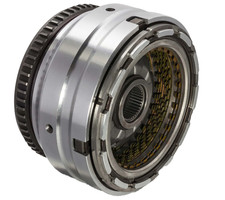
The 68RFE's liability is dimensional and predictable: the overdrive clutch pack. Sonnax calls it the most common failure point of the transmission, with significant weak points from the factory even at stock power.
The number that explains it is the steel. The overdrive clutches are single sided with a steel core measuring only 0.034 in. thick, which Sonnax describes as among the thinnest installed in any transmission. The OE steels in a 4L80-E direct pack are 0.080 in., more than twice as thick. Thin steels cannot carry heat away, so past a certain temperature they distort, that distortion closes up pack clearance, the pack stops releasing fully, and it burns.
The upstream cause is usually hydraulic. The solenoid switch valve plugs cycle constantly and wear the casting, crossleaking pressure out of the overdrive circuit. Lower holding pressure means slip, slip means heat, and heat kills a 0.034 in. steel fast. A 68RFE back with burned overdrive clutches soon after a rebuild is almost never a clutch supply problem.
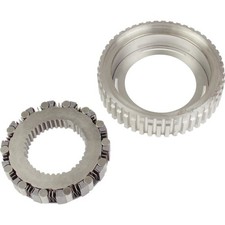
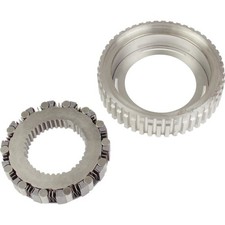
The fix most shops land on is a taller pack in a stronger housing. The Sonnax Smart-Tech overdrive clutch housing holds thicker steels and returns roughly 20 percent more clutch capacity over the factory arrangement.
Sonnax Smart-Tech Overdrive Clutch Housing Kit 72960-18K
Putting the same 0.034 in. steels back into a 68RFE is how you get the truck a second time. This housing takes a taller pack with thicker steels. Fits 2007.5-2019 Ram 2500 and 3500 with the 6.7L Cummins. Sold through our sister store.
See the 72960-18K housing kit →The AS69RC's known weak points
The Aisin does not burn overdrive clutches the way a 68RFE does. Its complaints show up as pressure and converter problems, and they trace to bore wear in specific places.
Secondary pressure regulator plunger valve
Sonnax lists the symptom set for a worn secondary pressure regulator plunger as TCC codes, converter shudder, overheated fluid, bushings and converter, and low SLT pressure. An AS69RC with a shudder complaint and hot fluid gets that circuit checked before you condemn the converter.
The identification trap that goes with it
Here is the gotcha that costs shops a second teardown. The AS66RC is the gas unit and the AS69RC the diesel unit, and per Sonnax the upper and lower valve body casting numbers are the same on both. You cannot tell them apart by casting number. Measure the secondary pressure regulator lineup instead:
- Secondary PR boost sleeve I.D.: 0.257 in. on the AS66RC gas unit, 0.323 in. on the AS69RC diesel unit
- Secondary boost valve O.D.: 0.255 in. gas, 0.321 in. diesel
- Spring free length: 1.59 in. gas, 1.42 in. diesel
- Balance end of secondary valve: 0.382 in. gas, 0.332 in. diesel
The kits split on the same line: Sonnax catalogs 122740-03K for gas units with the 0.255 in. plunger and 122740-05K for diesel units with the 0.321 in. plunger, plus oversized 122740-24K and 122740-28K for bores already worn. Measure the plunger, then order.
Hard parts and endplay
Wulff's teardown of a 150,000-mile AS69RC found wear on the follow shaft, part number 68253817AA, where the bearing rides. The K2 clutch hub that splines into the K3 drum and holds it true had worn about 0.015 in. on the surface riding the ring gear, leaving excess movement. One trap: the bearing on that hub, part number 68253775AA, is bronze colored from the factory. It looks heat damaged when it is not, and the replacement, 68284039AA, arrives bronze too.
The number to write down before closing one up is output shaft endplay: 0.50 to 0.90 mm, or 0.019 to 0.035 in. Selective washers run I at 1.00 mm, J at 1.20 mm, K at 1.40 mm, L at 1.60 mm, M at 1.80 mm and N at 2.00 mm. The B2 brake piston lives in the extension housing with apply legs reaching around the park gear, and the shims on either side of that bearing are easy to mix up if the unit sits apart waiting on parts. Backward gives you a no-endplay condition the moment the housing is torqued down.
Do they interchange?
No, and not in any partial sense either.
Physically they are different castings with different converters and mounting. Electrically the AS69RC runs its own linear-solenoid architecture and control strategy, against the 68RFE's clutch-to-clutch RFE hydraulic family that shares hardware with the 45RFE, 545RFE, 65RFE and 66RFE. Nothing in an RFE valve body has a home in an Aisin.
Calibration is the third wall. The high output 6.7L is only sold with the Aisin and the standard output only with the 68RFE, and the engine tune, shift torque management, transfer case and axle offerings all move as a package. There is no factory path for the swap.
What does carry across is bench discipline. Verify line pressure with a gauge before condemning clutches on either unit. Read the schematic rather than the code name on the Aisin. Measure valves rather than trusting casting numbers on either one.
68RFE rebuild kits, overdrive clutch hardware, valve body components, solenoid packs and filters. Working on the Aisin side instead? Start at the Aisin parts page.
Shop 68RFE parts →So which is stronger, and which would I rather build?
Stronger goes to the AS69RC without much argument. Ram put it behind an engine rated 1,075 lb-ft against the 68RFE's 850, gave it a deeper first gear and a wider spread, and used it in the chassis cab trucks that work for a living.
Easier to own is a different question, and there the 68RFE wins. Its weak point is known, dimensional and cheap to address on the bench, and the aftermarket behind it is deep. The AS69RC's trouble is diagnostic more than mechanical, and it demands schematics and measurement because the scan tool misleads you on solenoid codes.
Build the unit the truck came with. Shopping for a truck that tows near the ceiling, the high output and the Aisin is the harder-working combination. Turning your own wrenches and wanting parts you can source on a Saturday, the 68RFE is friendlier, provided you address the overdrive pack the first time you are in there.
FAQ
Is the Aisin AS69RC better than the 68RFE?
For load capacity, yes. Ram's specification sheet pairs the AS69RC with the 6.7L high output Cummins rated 1,075 lb-ft, while the 68RFE backs the standard output engine rated 850 lb-ft. The Aisin also runs a deeper 3.75 first gear against the 68RFE's 3.23. The trade is service support: the 68RFE has far deeper parts coverage and simpler diagnostics.
Can I swap an AS69RC into a truck that came with a 68RFE?
There is no factory path for it. The two use different cases, converters, mounting and control architecture, and the high output 6.7L the Aisin is calibrated to is not the engine in a 68RFE truck. Even the transfer case differs, BW 44-48 on high output trucks against BW 44-46 or 44-47 elsewhere. Treat it as an engineering project, not a parts swap.
How do I tell an AS66RC from an AS69RC on the bench?
Not by casting number. Sonnax notes the upper and lower valve body castings carry the same numbers on both. Measure the secondary pressure regulator lineup instead: boost sleeve inside diameter 0.257 in. on the AS66RC gas unit against 0.323 in. on the AS69RC diesel, boost valve outside diameter 0.255 in. against 0.321 in., spring free length 1.59 in. against 1.42 in.
Why does my AS69RC set a solenoid code for the wrong solenoid?
Because the code names do not match the actual circuits on this transmission. GEARS documented a P0966 reading as Pressure Control Solenoid 2 Control Circuit Low while the fault sat in the PCS 1 control circuit, and noted the linear solenoid codes generally point at a different physical solenoid than their name implies. Diagnose from the schematic and measure at the connector.
Why do 68RFE overdrive clutches keep burning after a rebuild?
Usually because the hydraulic cause was not addressed. The OE overdrive steels are single sided with a core only 0.034 in. thick, so they distort and burn fast once they see slip. That slip normally comes from worn solenoid switch valve plug bores crossleaking pressure out of the overdrive circuit. Fix the bore wear and use a housing that accepts thicker steels, or the new clutches follow the old ones.
Shop 68RFE parts →
Sources
- Stellantis / Ram — "2024 Ram 2500 & 3500 Heavy Duty Specifications." Manufacturer specification sheet. Backs the 68RFE and AS69RC gear ratios and reverse ratios, the 68RFE being available with the 6.7-liter diesel standard output and the AS69RC with the high output in the 3500, the 370 hp / 850 lb-ft standard output and 420 hp / 1,075 lb-ft high output engine ratings, the 19.0:1 and 16.2:1 compression ratios, the architecture descriptions for both transmissions, the 3.73 and 4.10 axle ratios and the BW 44-48 versus BW 44-46 / 44-47 transfer case split. 2024 Ram HD specification sheet (PDF)
- GEARS Magazine (ATRA) — "Intro to the AS69RC," Rolly Alvarez. Backs the AS68RC's 750 lb-ft torque capacity rating and 2007 introduction on 6.7L diesel trucks, the 2013 switch to the AS69RC as the stronger heavy-duty unit, the three planetary gear sets and overrunning clutch description, the linear solenoid lineup and wire color routing, the 4 to 6 ohm reading on the pulse width modulated solenoids and 11 to 21 ohms on the green connector on/off solenoid, the warning against interchanging solenoid locations and the bind-up, flare and harsh downshift consequences of swapping SLT with SLU. gearsmagazine.com
- GEARS Magazine (ATRA) — "DTC Disarray: The AS69RC Misery." Backs the P0966 naming mismatch where the code reads Pressure Control Solenoid 2 Control Circuit Low while the faulted circuit is PCS 1, the broader finding that the linear solenoid codes refer to a different actual solenoid than their names, the two-wire circuit description with dark green / light green as the feed and dark green / tan as the control return, the TCM expecting battery voltage on the linear solenoid negative circuit with the key on, and the wasted TCM replacement that follows from trusting the code name. gearsmagazine.com
- Transmission Digest — "Shift Pointers: A building alternative for the AS69RC," Jason Wulff. Backs the 2007 AS68RC origin in Dodge incomplete chassis trucks with the 6.7L diesel, the 2013 revision into the AS69RC that reduced the pressure switches to one, simplified the valve body and eliminated a low one-way clutch, the Ram 3500 / 4500 / 5500 cab and chassis application, the B2 brake piston in the extension housing with apply legs around the park gear, the 0.50 to 0.90 mm (0.019 to 0.035 in.) output shaft endplay spec, the I through N selective washer sizes from 1.00 mm to 2.00 mm, and the 150,000-mile teardown findings including follow shaft 68253817AA wear, the roughly 0.015 in. worn K2 hub mating surface and the normally bronze bearing part numbers 68253775AA and 68284039AA. transmissiondigest.com
- Sonnax — "Aisin Seiki AS66RC, AS69RC Identification Guide." Backs the note that upper and lower valve body casting numbers are the same on both units, the secondary pressure regulator dimensional split (boost sleeve I.D. 0.257 in. gas versus 0.323 in. diesel, boost valve O.D. 0.255 in. versus 0.321 in., spring free length 1.59 in. versus 1.42 in., balance end 0.382 in. versus 0.332 in.), the 122740-03K and 122740-05K plunger valve kits with 122740-24K and 122740-28K oversized versions, and the symptom list of TCC codes, converter shudder, overheated fluid, bushings and converter, and low SLT pressure. sonnax.com
- Sonnax — "68RFE Overdrive Clutch Failure: What to Check First When Troubleshooting OD Issues," Jason Larochelle. Backs the overdrive clutches as the most common 68RFE failure point with significant weak points at stock power, the single-sided design with a 0.034 in. steel core described as among the thinnest in any transmission, the 0.080 in. 4L80-E direct clutch pack comparison, the heat distortion and clearance loss mechanism, the leaking solenoid switch valve plugs as the second failure point, and the Smart-Tech overdrive clutch housing delivering roughly 20 percent more clutch capacity. sonnax.com