These two transmissions sit on either side of the biggest dividing line in Ram diesel history. The 48RE closed out the 5.9 Cummins era as the last of the TorqueFlite-derived hydraulic units, and the 68RFE opened the 6.7 era as a fully electronic six-speed with a computer deciding every shift. They are not variants of each other. They share a fluid spec, a truck, and almost nothing else.
That matters because the two units fail differently, get diagnosed differently, and reward completely different build strategies. A tech who is good on 48REs and picks up his first 68RFE will chase the wrong things for a week. This is the builder-to-builder version: what actually changed, what the scan tool tells you on each, real bench specs, and which one you want under your truck.
The Short Version
| Spec | 48RE | 68RFE |
|---|---|---|
| Forward speeds | 4 | 6 |
| Cummins application | 2003–2007, 5.9L | 2007–2020, 6.7L (Ram 2500/3500) |
| Shift control | Hydraulic scheduling, governor pressure | Fully electronic, TCM-commanded |
| Solenoids in unit | 3 (OD, TCC, governor pressure) | Solenoid pack, all shifts |
| 1st gear | 2.45:1 | 3.23:1 |
| 2nd gear | 1.45:1 | 1.83:1 |
| 3rd gear | 1.00:1 | 1.41:1 |
| 4th gear | 0.69:1 | 1.00:1 |
| 5th / 6th | — | 0.81:1 / 0.62:1 |
| Reverse | 2.21:1 | 4.44:1 |
| Bands | Front and rear band | None — clutch-to-clutch |
| Oil pump | Single stage | Dual stage, three gears |
| Fluid | Mopar ATF+4 | Mopar ATF+4 |
| Adaptive learning | No | Yes — Clutch Volume Index |
The 68RFE ratios and reverse figure above come straight off the clutch application chart in the ATSG service literature for the unit (it appears in ATSG's published 68RFE manual preview), which also decodes the name: 6 forward speeds, relative torque capacity index 8, R for rear-wheel drive, FE for fully electronic. That 8 is the same relative torque-capacity index that appears in the 48RE name, which tells you Chrysler considered them roughly peers on paper. On the bench, they are not.
Architecture: Hydraulic Brain vs Electronic Brain
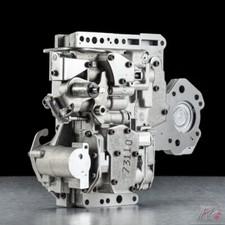
The 48RE still thinks with oil. Shift points come from a balance between governor pressure on one end of the shift valves and throttle pressure on the other, both developed inside the valve body. The computer's role is limited: it drives a governor pressure solenoid to set governor pressure electronically, commands the overdrive and torque converter clutch solenoids, and positions the throttle valve through the TTVA motor. Three solenoids total in the unit, and you can check all three with a meter at the eight-pin case connector. Per the Sonnax 48RE service data, the overdrive solenoid measures 20–40 ohms across pins 6 and 1, the TCC solenoid measures the same 20–40 ohms across pins 7 and 1, and the governor pressure solenoid reads a much lower 4–6 ohms across pins 5 and 1. Pin 4 is the governor pressure sensor signal to the PCM and pin 8 is transmission oil temperature. That is the entire electrical story of a 48RE, and it is why a good hydraulic tech can own one with a pressure gauge and a multimeter.
The 68RFE thinks with a TCM. There is no governor circuit and no throttle valve. Every shift is a clutch-to-clutch event commanded electronically, with no bands anywhere in the unit. It also runs a dual-stage oil pump with one drive gear and two driven gears, where both stages supply fluid at idle and at low engine speeds. Most importantly, the TCM continuously adapts. It compares input and output shaft speed sensors to calculate the actual gear ratio, times how long a ratio change takes after a shift request, and converts that into a Clutch Volume Index for each element. As friction material wears, the volume of fluid required to apply that clutch grows, and the TCM tracks it.
That single difference reorganizes your whole diagnostic approach. On a 48RE, a shift complaint is a pressure problem until proven otherwise. On a 68RFE, a shift complaint is a data problem first: you read what the TCM has learned, then go looking for the leak or the wear that explains it.
Diagnosis: Two Completely Different Playbooks
Reading a 68RFE with CVIs
Clutch Volume Index is the most useful data set on a 68RFE, and it is the thing 48RE guys never think to look at. Pull it up on a capable scan tool before you drop the pan. The ATSG clutch volume chart gives you the in-spec windows and, just as important, the conditions under which each one updates:
- Overdrive: 30 to 100, updated on the 4-5 upshift
- Underdrive: 30 to 100, updated on the 5-4 or 6-4 kickdown
- 2nd clutch: 25 to 85, updated on the 3-4 upshift
- 4th clutch: 30 to 85, updated on the 5-6 upshift
- Low/Reverse: 45 to 134, updated on a 2-1, 3-1 or 4-1 downshift
- Reverse clutch: not monitored
An overdrive CVI climbing toward or past 100 is the unit telling you the OD pack is losing capacity before the customer ever complains about it. Note the update conditions, though: if the truck never sees a 5-4 kickdown on your test loop, the underdrive number on the screen is stale, not good. Drive the shift that updates the number you care about, then read it. Out-of-range CVIs also point at mechanical problems that have nothing to do with worn frictions, including broken return springs, a snap ring out of position, or excessive clutch pack clearance left in from a sloppy build.
Checking pressure on each
On the 48RE you tap the case and read line pressure against the governor pressure signal, and the hydraulics tell you the story. On the 68RFE the line pressure sensor is itself a suspect. Sonnax makes the point that low line pressure can go unnoticed behind a failed sensor, and the answer is OE line pressure adapter tool No. 8259, which installs into the case in place of the line pressure sensor so you can run the sensor and a mechanical gauge at the same time and verify the sensor is telling the truth. That one step separates "the transmission has low pressure" from "the computer thinks it does," and it is worth owning the tool if you see these trucks regularly.
Doing one of these this week?
Filters, solenoid packs, governor solenoids, bushing kits, pistons, and the master kits for both units. Get the right parts the first time instead of pulling the pan twice.
Shop 48RE parts →Where Each One Breaks
48RE: the valve body and the pressure curve
The 48RE's known weak spots are hydraulic. Governor pressure solenoid and sensor failures, throttle bore wear, a worn line pressure plug and sleeve, and worn governor plugs all surface as shift-quality complaints. What makes the 48RE distinctive, and what a lot of people still get wrong, is its pressure strategy. Sonnax documented that in third gear with lockup on, or in fourth, apply pressure from the torque converter and overdrive circuits moves the boost valve so that reduction points A and D at the pressure regulator are exhausted, raising line pressure roughly 22–28 psi. The 46/47RE exhausts only point D under the same conditions and gains about 10–15 psi. That extra clamping is what lets a 48RE hold its converter clutch and overdrive clutch behind a diesel.
The practical consequence: a 46/47RE valve body dropped into a 48RE looks like it works, drives fine on the test loop, and comes back weeks later with a failed torque converter clutch or overdrive clutch. Sonnax says this outright, and it is the most expensive mistake you can make on one of these. Do not interchange them. The 48RE also feeds its TCC solenoid from the manual valve in any drive position, which is why a 48RE can apply lockup in manual second where a 46/47RE cancels it.
68RFE: the overdrive clutch pack, and everything upstream of it
The 68RFE has one dominant failure, and it is the overdrive clutches. The OE frictions are single-sided and the steel cores are only .034 inches thick, which Sonnax calls some of the thinnest clutches installed in any transmission and contrasts against the .080-inch direct clutch steels in a 4L80-E. With that little mass they cannot shed heat, so they distort. Distortion takes clearance out of spec, which keeps them from releasing fully, which burns them. And the OD clutches are applied in fifth and sixth, where the truck spends most of its miles.
The mistake is treating that as a clutch problem. Sonnax lists six more contributors alongside the clutches themselves: leaking solenoid switch valve plugs that cross-leak the OD circuit and frequently set P0871, a flexing OE overdrive housing that lets clearance wander, wear on the inner retainer housing from the clutches themselves, incorrect line pressure in either direction, a warped solenoid conductor plate bleeding OD apply pressure out of the circuit, and tuners or oversized tires simply overloading the pack. Writing in Gears for ATRA, Rob Faucett puts valve body worm track erosion caused by excessive torque from tuned engines at the top of the list of what he actually sees come across the bench.
Vacuum testing the solenoid switch valve bore is the reliable way to locate and rank those leaks before you commit to a repair strategy. Practical version: if you replace 68RFE overdrive clutches without addressing the switch valve bore, the separator plate sealing, and the solenoid block, you are building the same failure again with fresh parts.
48RE Governor Pressure Solenoid Kit (2001–2009, with gaskets)
The governor pressure solenoid is the most common electrical failure on a 48RE and it drives most of the erratic and delayed shift complaints these trucks come in with. This kit includes the gaskets, so you are not improvising on reassembly.
See the 48RE governor solenoid kit →Not the part you need? Browse the full 48RE parts collection.
Bench Specs You Will Actually Need
Both units punish guesswork on clearances, but the 68RFE is far less forgiving. These are the ATSG published specifications, checked with a feeler gauge through the case openings during assembly:
| 68RFE clearance | Specification |
|---|---|
| Overdrive clutch | 0.75–1.61 mm (.030–.063 in) |
| Underdrive clutch | 1.02–1.72 mm (.040–.068 in) |
| 2nd clutch | 0.99–1.65 mm (.039–.065 in) |
| 4th clutch | 0.77–1.39 mm (.030–.055 in) |
| Low/Reverse clutch | 1.18–2.09 mm (.046–.082 in) |
| Reverse clutch | 0.58–1.47 mm (.023–.058 in) |
| Input shaft end play | 0.52–0.74 mm (.020–.029 in) |
| Output shaft end play | 0.25–0.52 mm (.010–.020 in) |
One 68RFE trap worth memorizing: the 2nd clutch backing plate is not selective. If 2nd clutch clearance misses spec, ATSG says the backing plate, all the friction plates and all the steel plates get replaced. There is no shimming your way out of it the way you can on the 4th clutch, which does use a selective backing plate and selective snap rings. Miss that and you will pull the unit back apart.
Torque values, also from the service literature. On the 68RFE, the 24 oil pump body-to-cover screws and the pump spacer plate screws all go to 4.5 N·m (40 in-lb), and the manual shaft retaining pin bolt takes a T30 torx at 28 N·m (20 ft-lb). ATSG flags one specific way to ruin a pump build: leave out the two spacer plate retaining screws and you create a no-engagement condition, which is a long afternoon spent looking for a problem you installed yourself. On the 48RE, Sonnax lists valve body-to-case bolts at 106 in-lb, valve body assembly bolts at 35 in-lb, pump-to-case and pump-to-stator bolts at 15 ft-lb, and OE end play at .034–.084 inches. Notice how much wider the 48RE end play window is than the 68RFE's; that gap alone tells you which unit demands more assembly discipline.
Interchange: Can You Swap One for the Other?
Not usefully. There is no shared bellhousing situation to exploit here: the 48RE lives behind the 5.9 and the 68RFE behind the 6.7, and the two engines came with different case interfaces, different crossmember locations, and different output arrangements. The mechanical side alone is fabrication work.
The real wall is the controls. The 48RE runs on governor pressure and a hydraulic valve body with three solenoids you can ohm out at a single connector. The 68RFE needs a TCM commanding every clutch, both speed sensors, a line pressure sensor, and a calibration matched to the truck. Bringing a 68RFE into a third-gen truck means bringing the entire control system with it, and the adaptive learning has to be correct or the unit will fight you. Most shops that price the job honestly walk the customer back to a built 48RE.
What does cross, usefully: the fluid. Both are ATF+4 units. ATSG lists Mopar ATF+4 as the required fluid for the 68RFE, and Ram's own owner's manual for the 6.7L trucks says to use only ATF+4, warning that other fluid may affect the function or performance of the transmission. Do not substitute a generic multi-vehicle ATF in either one. On the 68RFE especially, the friction properties are what the TCM's adaptive learning is calibrated around, and the wrong fluid will push clutch volume numbers out of range on a mechanically healthy unit and send you chasing a fault that does not exist.
The honest recommendation for a third-gen owner: build the 48RE you have. Fix the valve body wear, put a billet input shaft in it, sort out the cooling, and you own a transmission that is cheap to diagnose and cheap to service for the life of the truck. Swap money is better spent on the unit already in the chassis.
Which Is Stronger?
Stock for stock, the 68RFE drives better and tows better. Its 3.23:1 first gear gets a heavy trailer moving with less converter slip, the ratio steps between gears are tighter, and the 0.81 and 0.62 double overdrive keeps highway rpm down when you are loaded. That is a genuinely better transmission to live with day to day.
Built for built, the 48RE is the more forgiving platform. Its friction elements are fewer and larger, its hydraulics are simple enough to diagnose with a gauge and a meter, and its failure modes are wear items rather than a design compromise. The 68RFE's overdrive pack is a design compromise, and correcting it means an upgraded housing, switch valve bore repair, separator plate sealing, and solenoid block attention before you have a unit that survives real power. That work is well documented and worth doing, but it stops being optional the moment a tuner goes in the truck.
The one-sentence answer most people are looking for: a stock 68RFE beats a stock 48RE on the road, and a built 48RE beats a stock 68RFE everywhere. What nobody should do is put a tuner on a stock 68RFE and expect the overdrive clutches to live through it.
Need parts for this job?
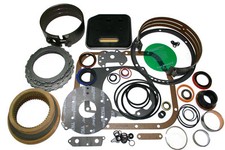
We stock both sides of this comparison — solenoids, filters, bushing kits, pistons, clutch modules, and full rebuild kits. Pick your unit and go.
Shop 48RE parts → Shop 68RFE parts →Get the 68RFE friction clutch module →
FAQ
Is a 68RFE stronger than a 48RE?
Not in the way most people mean. The 68RFE has more gears, a deeper 3.23:1 first and a dual-stage pump, but its overdrive clutch pack is the weakest link in the truck. Sonnax measured the OE 68RFE overdrive steel cores at only .034 inches thick, against .080 inches for the direct clutch steels in a 4L80-E. The 48RE has fewer, larger friction elements and a simpler hydraulic path, so a built 48RE with a billet input shaft is generally the more abuse-tolerant unit. A stock 68RFE will out-drive a stock 48RE on the road; a built 48RE will out-live a stock 68RFE under a tuner.
Can you swap a 68RFE into a 48RE truck?
It is a full powertrain-controls job, not a bolt-in. The 48RE schedules its shifts hydraulically with only three solenoids and a governor pressure circuit, while the 68RFE is a fully electronic unit whose TCM commands every shift and continuously relearns clutch volumes. Swapping in a 68RFE means bringing the TCM, the full wiring harness, the correct crossmember and driveshaft, and a calibration that matches the truck. Most shops that price the job honestly end up recommending a built 48RE instead for a third-gen truck.
Why do 68RFE overdrive clutches keep burning up?
It is rarely just the clutches. Sonnax lists seven contributing failure points, and the one that does the most damage is the solenoid switch valve plug bore wearing and cross-leaking pressure out of the overdrive apply circuit. Gears magazine points at valve body worm track erosion driven by tuner torque as the most common root cause it sees. Add a warped solenoid conductor plate, a flexing OE overdrive housing, and incorrect line pressure, and the thin .034-inch clutch steels distort, drag, and burn. Replacing the clutches without fixing the leak paths just buys you another set.
Do the 48RE and 68RFE use the same transmission fluid?
Yes. Both are Mopar ATF+4 units, and the ATSG service literature for the 68RFE lists ATF Plus 4 as the required fluid. Do not substitute a generic multi-vehicle ATF in either one. The friction modifier package in ATF+4 is what sets shift feel and converter clutch behavior, and the 68RFE in particular relies on consistent friction characteristics for its adaptive clutch volume learning to stay in range.
Which is better for towing, the 48RE or the 68RFE?
For a stock truck, the 68RFE. Its 3.23:1 first gear gets a heavy load moving with less converter slip, and the 0.81 and 0.62 double overdrive keeps engine speed down loaded on the highway. The catch is that fifth and sixth are exactly where the fragile overdrive clutches are applied, so towing heavy is also what kills them. A 48RE with a healthy valve body and a correct cooling package is more forgiving of sustained load, but you give up the ratio spread and pull at higher rpm.
Sources
- Sonnax, Jason Larochelle — "68RFE Overdrive Clutch Failure: What to Check First When Troubleshooting OD Issues." Backs the 68RFE application in 2007–2020 Ram 2500/3500 behind the 6.7L Cummins, the single-sided OE overdrive frictions with .034-inch steel cores versus .080-inch 4L80-E direct steels, the seven failure points including solenoid switch valve plug cross-leaks and the P0871 association, the warped solenoid conductor plate, and OE line pressure adapter tool No. 8259. sonnax.com
- ATSG (Automatic Transmission Service Group) — "Dodge Ram 68RFE" technical service manual. ATSG's own published preview of the manual (linked) shows the clutch application chart with the 68RFE gear ratios and 4.44:1 reverse, the 6/8/R/FE name decode, Mopar ATF+4 as the fluid requirement, and how the TCM uses the Clutch Volume Index. The clutch clearance and end-play specifications, CVI ranges and update conditions, the non-selective 2nd clutch backing plate, and the 40 in-lb pump screw and 20 ft-lb manual shaft bolt torque values are from the full manual, sold by ATSG. atsg.biz (pdf preview)
- Stellantis / Mopar — 2022 Ram 2500/3500 Owner's Manual, Chassis Fluids And Lubricants. Backs the factory requirement to use only ATF+4 in the 68RFE behind the 6.7L diesel, and the warning that other fluid may affect function or performance. vehicleinfo.mopar.com
- Sonnax, Jim Dial — "Dodge 48RE Hydraulic Features Revealed." Backs the 48RE 2003 production start, the pressure regulator exhausting reduction points A and D for a 22–28 psi line pressure rise in lockup and 4th versus 10–15 psi on the 46/47RE, the warning that a 46/47RE valve body installed in a 48RE returns with a failed TCC or overdrive clutch, and the 48RE TCC solenoid feed coming from the manual valve in any drive position. sonnax.com
- Sonnax — Chrysler 48RE Zip Kit installation and testing booklet (part 48RE-ZIP). Backs the 48RE eight-pin case connector pinout, the solenoid resistance checks (OD and TCC solenoids 20–40 ohms, governor pressure solenoid 4–6 ohms), the component application chart, and the assembly torque values: valve body-to-case 106 in-lb, valve body assembly bolts 35 in-lb, pump-to-case and pump-to-stator 15 ft-lb, and OE end play .034–.084 inches. sonnax.com (pdf)
- Gears Magazine (ATRA), Rob Faucett — "68RFE OD Clutch Failure." Backs valve body worm track erosion caused by excessive torque from tuned engines as the most commonly observed root cause of 68RFE overdrive clutch failure, and the circuit-tracing approach of isolating the OD apply circuit from pump to solenoid pack to valve body to piston. gearsmagazine.com
- Transmission Digest — "68RFE Overdrive Clutch Failure." Independent trade-press publication of the 68RFE overdrive failure analysis, corroborating the thin single-sided clutch construction, the solenoid switch valve plug cross-leak mechanism, and vacuum testing of the switch valve bore as the diagnostic method. transmissiondigest.com