A 48RE that slips only when the truck is working is telling you something specific, and it is usually not "the clutches are worn out." Empty, around town, it shifts fine. Hook up a trailer, pull a grade, or roll into it hard from a stop, and the tach flares while the truck does not move any faster. That pattern points at the pressure side, not the friction side: the 48RE raises line pressure as torque demand climbs, and when the parts that do that raising are worn, tired or mis-set, the clutch capacity does not show up when you need it.
This is a hydraulically shifted transmission through the first three gears. Only fourth is electronic. That is good news for you: most of the diagnosis happens with a pressure gauge and a scan tool in the driveway, before anything comes out of the truck.
Start with the OEM pressure test, because it names the part
The Chrysler service procedure for the 48RE has six pressure tests, and the analysis chart at the end converts your gauge readings straight into a suspect. Skip it and you are guessing; run it and you narrow a slip complaint to a circuit in about forty minutes. You need two gauges — a 100 psi gauge (Chrysler tool C-3292) and a 300 psi gauge (C-3293-SP) — and the ports are the accumulator, front servo, rear servo, governor and overdrive clutch. Per the factory procedure, a healthy unit reads:
| Test | Port / condition | Spec |
|---|---|---|
| Manual Low, 1000 rpm | Accumulator (line) | 54-60 psi closed throttle, rising to 90-96 psi as the throttle lever is moved rearward |
| Manual Low, 1000 rpm | Rear servo | Within 3 psi of line pressure |
| 2 range, 1000 rpm | Accumulator (line) | 54-60 psi, rising to 90-96 psi |
| D range third, 1600 rpm | Front servo | Within 3 psi of line pressure up to the kickdown point |
| Reverse | Rear servo | 145-175 psi closed throttle, rising to 230-280 psi |
| Overdrive fourth, road test | Overdrive clutch port | 76-82 psi closed throttle, 100-130 psi at 1/2 to 3/4 throttle, up to about 140 psi at full throttle |
| Governor, D range | Governor port | No more than 3 psi at curb idle with the wheels held; rises roughly 1 psi per 1 mph |
The OEM analysis chart is the useful part. Line pressure fine in Reverse but low in D, 2 and 1 means rear clutch leakage — seal rings or clutch seals. Low specifically in D fourth gear means the overdrive clutch piston seal or a check ball. OK in 1 and 2 but low in D3 and Reverse points at front clutch leakage. Low everywhere means a clogged filter, a stuck regulator valve, a worn pump, or simply low fluid. A truck that slips under load with low overdrive clutch pressure in fourth is a fundamentally different repair from one that reads low across the board.
Cause 1: the throttle valve actuator, on 2005-2007 trucks
Throttle pressure is what raises line pressure with throttle demand on a TorqueFlite-family transmission. On earlier trucks that was a TV cable. Per Sonnax, in 2005 Dodge replaced the TV cable with a transmission throttle valve actuator (TTVA) on the 48RE in diesel 2500 and 3500 Rams. The TTVA sits on the case above the throttle valve shaft and contains a DC motor controlled by the ECM plus two potentiometers feeding back to it. The bottom of the actuator shaft has a D-shaped opening that drops onto the throttle shaft, so the motor mechanically strokes the TV valve.
There is no adjustment on the actuator itself, but it must be initialized whenever it is replaced or even removed and reinstalled: turn the ignition on and leave it there for at least 30 seconds while the ECM runs its internal calibration and finds the current zero position. The ECM repeats that calibration on every key cycle.
Here is where load-sensitive slip gets made. During calibration the ECM is looking for at least 48 degrees of movement from minimum to maximum span. Both the span and the minimum range are affected by the throttle shaft adjustment bolt on the pressure regulator spring retaining bracket. Per Sonnax, the distance between the bracket and the inside edge of the adjustment bolt head should be.905 in. Some cable-activated throttle valve brackets have as little as.820 in. Bolt a cable-type bracket onto a TTVA truck without correcting the adjustment screw and you can set a P1751 or P1752, and more to the point, the throttle valve is not stroking the distance the system expects. Line pressure never rises the way it should under throttle.
The TTVA fault codes worth knowing on this unit:
- P1749 — Transmission Throttle Valve Position Sensor Circuit Low
- P1750 — Transmission Throttle Valve Position Sensor Circuit High
- P1751 — Transmission Throttle Valve Position Minimum Range Performance
- P1752 — Transmission Throttle Valve Span Performance
- P1753 — Transmission Throttle Valve Mechanical Performance
- P1754 — Transmission Throttle Valve Actuator Stuck
- P1755 — Transmission Throttle Valve Control Circuit
A truck that slips under load and has any P175x stored is not a mystery. Fix the throttle valve side first.
Cause 2: the line pressure plug and sleeve, worn
Sonnax documents a specific wear point in the 48RE valve body that produces exactly this complaint set: Reverse slip, poor line pressure control, poor forward and Reverse engagement, poor cooler charge at idle, soft Reverse. The cause is excess wear at the internal diameter of the line pressure sleeve, which allows fluid loss that prevents proper line rise.
Line rise is precisely what keeps a clutch holding when torque climbs. A worn plug and sleeve bleeds off the pressure the regulator is trying to build, so the transmission behaves fine at light loads and gives up when the pressure command goes up. Sonnax's repair is line pressure plug and sleeve kit 22771A-19K, which uses a hardcoat anodized aluminum valve and an O-ringed sleeve to reseal the circuit. If the pressure regulator bore itself is also worn, they point you to 22771A-16K, the oversized lube regulated pressure regulator valve and line/TV pressure plug kit.
Cause 3: lockup boost valve bore wear
The Chrysler 42/46/47/48RH and RE transmissions all carry a lockup boost valve, and Sonnax lists it as prone to wear. Its symptom list reads like a towing complaint written from the driver's seat: TCC slip under load, no line rise during TCC apply in 4th, overheated converter, loss of lube oil, high line pressure with no indication of boost, no lockup, TCC cycling.
The mechanism: excess bore wear reduces oil pressure to the switch valve, so the switch valve only partially strokes, restricting the converter and lube circuits. You lose converter and lubrication flow, the converter cooks, and line rise during lockup or fourth gear disappears. Sonnax's oversized lockup boost valve kit 22771-19K (for 1994-later units with the boost oil delivery tube) restores pressure to the switch valve and the main regulator valve.
Keep these separate in your head: TCC slip under load feels like gear slip to the customer, but the gear ratio math on a scan tool comes back clean, because the gearset is holding fine and the converter is not. Log engine rpm against output shaft speed in locked fourth before you condemn a clutch pack.
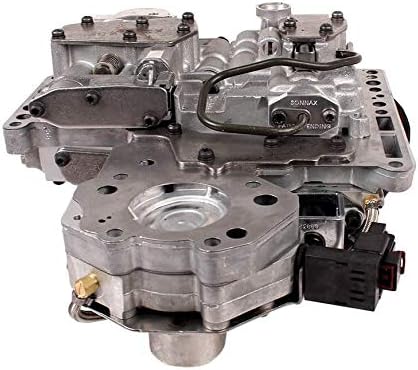
Cause 4: somebody put a 46/47RE valve body in it
The 46/47RE and 48RE valve bodies look nearly identical, and 48RE cores are hard to find, so this swap happens constantly. It works for a while, then the truck comes back with a burnt overdrive clutch or a dead torque converter clutch. Jim Dial of the Sonnax TASC Force laid out the reason in Transmission Digest, and the numbers make it obvious.
On both families, throttle pressure and a set of reduction points position the pressure regulator valve. When the converter clutch applies or the transmission goes to fourth, a boost valve moves and exhausts reduction points, letting line pressure rise to add clamping force. The difference is how much:
- 46/47RE: TC apply and/or overdrive apply oil moves the boost valve and exhausts reduction point D, raising line pressure about 10-15 psi in lockup or fourth.
- 48RE: the same oil exhausts reduction points A and D, raising line pressure about 22-28 psi. With no reducing pressure at point A, the throttle pressure plug also raises line pressure at a quicker rate.
So a 46/47RE valve body in a 48RE gives up roughly half the extra clamping force the overdrive clutch and the TCC were designed to get, exactly where a diesel truck loads them hardest. It will not slip in the shop. It will slip pulling a grade, and it will keep slipping until the clutch is gone.
The TCC feed circuit differs too. On a 46/47RE the TCC solenoid is fed second-gear oil from the 1-2 shift valve; on the 48RE it is fed forward clutch pressure from the manual valve in any drive position, which is what makes lockup possible in manual 2 and manual 1. Wayne Colonna of ATSG documented the diagnostic consequence in Transmission Digest: a restricted 48RE TCC solenoid can fully apply the converter as soon as Drive is selected and stall the engine, which builders on these trucks reflexively blame on a bad pump or a plugged cooler. His shortcut is worth keeping: if it does not stall in Reverse but stalls in Drive, the TCC solenoid is bad mechanically.
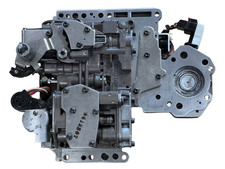
To confirm what you are actually holding: per Sonnax, 48RE valve bodies have a closed casting where the 47RE spring is visible, and the channel plate part number is 52854129AA.
SunCoast 618-DBP billet direct clutch piston — 47RE/48RE
The factory direct clutch piston is cast aluminum and can crack when the drum fills under a diesel load, which dumps apply pressure and takes the pack with it. A billet piston is the standard fix when a load-sensitive slip traces back to the direct clutch. $225.99, shipped from the USA.
View the piston →Cause 5: governor pressure control, when the slip is really a shift problem
Because gears one through three are governor-shifted, a governor pressure fault reads as slipping, flaring or hunting under load. ATRA's GEARS magazine walkthrough of the 42-48RE governor system gives you the numbers to test it properly.
The system is four parts: output speed sensor, governor pressure solenoid, governor pressure transducer, and the computer. The solenoid creates governor pressure from mainline oil. De-energized it sends full mainline to the governor circuit, and as the computer raises duty cycle it exhausts pressure away, so higher duty cycle means lower governor pressure. It is a low-resistance unit at about 3.8 to 4.0 ohms at 70°F. The transducer is a three-wire potentiometer sharing a housing with the transmission oil temperature sensor, reading about 0.60 volts at zero psi and rising to roughly 4.8-4.9 volts at the 100 psi maximum. Above 100 psi the signal exceeds limits and sets a code for a shorted sensor.
It is a closed-loop system, which gives you a clean three-way triage on the scan tool. Compare desired governor pressure, actual governor pressure, and what a mechanical gauge on the governor port actually reads:
- Desired = actual = gauge: the control system works. If pressure is still wrong for the vehicle speed, chase the speed signal or the computer.
- Desired = actual but neither matches the gauge: the control system works and the transducer is out of spec. Check power and ground, then replace the transducer.
- Actual and gauge do not match desired: the control system is not working. Look for a fluid leak letting extra pressure into the governor circuit, a blockage in the governor circuit, or a failed solenoid.
Two more notes from the same source. The computer shuts the governor solenoid off around 40 mph, since the first two shifts are done by then and mainline alone will hold the shift valves over. And any governor or fourth-gear/lockup code drops the computer into failsafe, which shuts the solenoid off and sends governor pressure to maximum, leaving the truck starting and running in third. If it takes off in third gear, pull codes before anything else.
Cause 6: band adjustment and clutch clearance
If the pressure numbers check out, the mechanical side is next, and the bands are the cheapest thing to verify. Per the Chrysler 48RE service procedure:
- Front (kickdown) band: loosen the locknut 3-5 turns and confirm the screw turns freely, tighten the adjusting screw to 8 N·m (72 in. lbs.), then back off 1-3/4 turns on diesel vehicles (1-1/2 turns on V-10). Hold the screw and torque the locknut to 41 N·m (30 ft. lbs.).
- Low/reverse (rear) band: pan off for access, loosen the locknut 5-6 turns, tighten the adjusting screw to 8 N·m (72 in. lbs.), back off 3 turns, and torque the locknut to 34 N·m (25 ft. lbs.). Pan bolts go back to 17 N·m (13 ft. lbs.).
A loose front band shows up as a slip or flare on the 1-2 shift under throttle and nowhere else, a textbook load-sensitive complaint that costs one adjustment screw and no parts. Go the other way and you drag the band, so use the torque wrench, not feel.
Beyond the bands, the direct clutch is the weak point. When a 48RE slips under load, holds pressure fine on the gauge, and the pan magnet is loaded with friction material, the answer is a teardown with a billet direct piston and a proper clutch count, not another valve body.
An order of operations that converges
- Pull codes. Any P175x means throttle valve; a third-gear start means failsafe.
- Check fluid level and condition and the pan magnet. Friction material changes the plan.
- Run all six OEM pressure tests and read the analysis chart. This names your circuit.
- On a 2005-2007 truck, verify the TTVA:.905 in. bracket setting, then key on 30 seconds to initialize.
- Compare desired, actual and gauge governor pressure. Three readings, three distinct conclusions.
- Confirm the valve body is a 48RE: closed casting, channel plate 52854129AA.
- Adjust the bands to spec before assuming the clutches are gone.
- If it is the valve body, vacuum test it and repair the line pressure and lockup boost bores rather than shotgunning a used body.
Two things to have on hand first: a gauge set that covers the range, since the Reverse test can hit 280 psi and a 100 psi gauge tells you nothing there, and ATF+4 on the shelf, because the six-test procedure plus a pan drop for band adjustment will cost you several quarts.
Keeping one alive
The failure chain here is circular and fast. Worn bores drop line rise, low line rise lets the overdrive clutch and TCC slip under load, slip makes heat, heat cooks the converter and the fluid, and the debris off the clutches goes right back through the pump into every bore you were worried about. Fixed at "it flares a little pulling the trailer," it costs a valve body. Ignored, it costs a rebuild and a converter.
Prevention is short: service the fluid and filter on a real interval rather than a mileage number written for an empty half-ton, watch converter-out temperature under load, do not swap a 46/47RE valve body into it for any reason, and treat a load-only flare as the early warning it is. A 48RE that slips only under load still has good clutches most of the time, and that window does not stay open long.
48RE valve body components, billet direct clutch pistons, governor pressure solenoid and transducer kits, deep finned pans, filters, master rebuild kits and coolers — shipped fast from the USA.
Shop 48RE parts →Sources
- Chrysler 48RE Automatic Transmission Service Information — "Diagnosis and Testing: Hydraulic Pressure Tests" and "Adjustments — Bands." Backs the six-test pressure procedure and every spec in the table above: 54-60 psi line at the accumulator port at 1000 rpm rising to 90-96 psi, rear servo within 3 psi of line, front servo within 3 psi of line to the kickdown point, Reverse 145-175 psi rising to 230-280 psi, overdrive clutch 76-82 psi closed throttle and 100-130 psi at 1/2 to 3/4 throttle with about 140 psi at full throttle, governor no more than 3 psi at curb idle rising roughly 1 psi per mph, the pressure test analysis chart, tools C-3292 and C-3293-SP, and the front and rear band adjustment torques and back-off turns. Pressure tests • Band adjustment
- Sonnax — "48RE Transmission Throttle Valve Actuator Codes." Backs the 2005 switch from TV cable to TTVA on diesel 2500 and 3500 Ram trucks, the DC motor and two-potentiometer construction, the D-shaped shaft interface, the 30-second key-on initialization and per-key-cycle recalibration, the 48 degrees of minimum-to-maximum span the ECM looks for, the.905 in. bracket-to-adjustment-bolt-head dimension versus as little as.820 in. on some cable-type brackets, and the P1749 through P1755 code definitions. sonnax.com
- Sonnax — "Line Pressure Plug & Sleeve Kit 22771A-19K." Backs the symptom set for line pressure sleeve wear (Reverse slip, poor line pressure control, poor forward and Reverse engagement, poor cooler charge at idle, soft Reverse), the cause — excess wear at the internal diameter of the line pressure sleeve allowing fluid loss that prevents proper line rise — and the referral to oversized pressure regulator kit 22771A-16K when the PR bore is also worn, which Sonnax lists as curing delayed engagement, pressure regulator buzz, converter drain back and lube failures. sonnax.com
- Sonnax — "Oversized Lockup Boost Valve Kit 22771-19K." Backs lockup boost valve bore wear as a documented failure on Chrysler 42-46-47-48RH/RE units, the symptom list (TCC slip under load, no line rise during TCC apply in 4th, overheated converter, loss of lube oil, high line pressure with no indication of boost, no lockup, TCC cycling), and the mechanism: excess bore wear reduces oil pressure to the switch valve, leaving it partially stroked and restricting the converter and lube circuits. sonnax.com
- Transmission Digest — "Dodge 48RE Hydraulic Features Revealed" (Jim Dial, Sonnax TASC Force) and "A Significant Departure — the 48RE Transmission" (Wayne Colonna, ATSG). The first backs the pressure-curve difference behind the valve body swap failure: the 46/47RE boost valve exhausts reduction point D for about 10-15 psi of line rise in lockup or fourth, while the 48RE exhausts points A and D for about 22-28 psi, plus the faster throttle-pressure-plug rise and the difference in TCC solenoid feed. The second backs the 48RE TCC solenoid being fed with forward clutch pressure rather than second-gear oil from the 1-2 shift valve, the resulting stall-in-Drive from a restricted TCC solenoid, the stalls-in-Drive-but-not-Reverse diagnostic shortcut, and the 2003 changes to the pump stator, torque converter and clutch drum torque capacity. Hydraulic features • A significant departure
- GEARS Magazine (ATRA) — "Getting to Know the 42-48RE Series Transmissions, Part 1," July 2006. Backs the governor pressure system description and every number used above: the four-component system, the inverse duty-cycle-to-pressure relationship at the governor solenoid, solenoid resistance of about 3.8-4.0 ohms at 70°F, transducer output of about 0.60 volts at zero psi rising to about 4.8-4.9 volts at the 100 psi maximum, the code set when pressure exceeds 100 psi, the desired/actual/gauge three-way triage table, the computer shutting the governor solenoid off at about 40 mph, and failsafe operation producing a third-gear start. atracom.blob.core.windows.net (PDF)