If you are shopping a used Ram with a Cummins, or you have a second-gen truck and somebody told you to "just swap in a six-speed," this is the comparison that matters. The 47RE is the heavy-duty four-speed that lived behind the 24-valve 5.9 Cummins until the 48RE took over in 2003. The 68RFE is the fully electronic six-speed that has lived behind the 6.7 since mid-2007. The 48RE sits between them in time, but the jump from the 47RE straight to the 68RFE is the bigger one, because the 47RE still has a throttle valve cable on it.
One is a TorqueFlite-family unit with two bands, a governor circuit and a cable telling it how hard you are pushing the pedal. The other applies two clutches at a time on computer command and keeps a running estimate of how much its frictions have worn. Below is what actually separates them, the factory numbers for each, where each one breaks, and what that means if you are deciding which truck to buy or which unit to build.

The Short Version
| Spec | 47RE | 68RFE |
|---|---|---|
| Forward speeds | 4 | 6 |
| Cummins application | 5.9L, second-gen Ram (replaced by 48RE in 2003) | 6.7L, Ram 2500/3500 from mid-2007 |
| Shift control | Hydraulic valve body, electronic governor, throttle valve cable | TCM-commanded solenoid pack, clutch-to-clutch |
| 1st / 2nd / 3rd | 2.45 / 1.45 / 1.00 | 3.23 / 1.83 / 1.41 |
| 4th / 5th / 6th | 0.69 / — / — | 1.00 / 0.81 / 0.62 |
| Reverse | 2.21:1 | 4.44:1 |
| Bands | Front and rear | None |
| Planetary sets | 2 + overdrive unit | 3, all 6-pinion carriers |
| Factory fluid | Mopar ATF Plus 3 (Type 7176) | ATF+4 only |
| Adaptive learning | No | Yes (Clutch Volume Index) |
The 47RE ratios and the 2.21:1 reverse come from the 1998 Ram truck service manual (Group 21, pages 21-211/212). The 68RFE ratios and 4.44:1 reverse come off the clutch application chart in ATSG's published 68RFE manual preview. Look at first and reverse: the 68RFE starts a trailer in 3.23:1 where the 47RE has 2.45:1, and backs it up in 4.44:1 where the 47RE has 2.21:1. That is most of the "it tows better" reputation right there.
Architecture: Cable and Governor vs TCM and Solenoids
How a 47RE decides to shift
The factory manual describes the 46/47RE as a four-speed with an electronic governor. First through third come from the front and rear clutches, the two bands, the overrunning clutch and the planetary sets. Fourth comes from a separate overdrive unit bolted to the back of the case, with its own overdrive clutch, direct clutch, planetary set and overrunning clutch. The overdrive clutch is applied in fourth only, and the direct clutch is applied in every range except fourth. The converter clutch is applied hydraulically and released when the TCC solenoid vents the circuit, and it engages in fourth, or in third when the O/D switch is off.
Shift timing is a tug-of-war inside the valve body between governor pressure, set by the PCM through the governor pressure solenoid, and throttle pressure, set by a cam on the valve body throttle lever that is pulled by the throttle valve cable from the engine. The manual is blunt that the cable has to move the transmission lever in step with the throttle lever from idle, without leading or lagging. A misadjusted TV cable shows up as a cause in several of the 47RE diagnosis charts, which is why it is the first thing to check on any second-gen shift complaint before you touch the valve body.
What made a 47RE a 47RE
The 47RE is a 46RE with more clutch capacity for diesel torque. Per the 1998 manual's specification page, the 47RE runs 4 front clutch discs where the 46RE runs 3, 5 overdrive clutch discs where the 46RE runs 4, and 10 direct clutch discs where the 46RE runs 8. Band adjustments differ too: after torquing the adjuster to 72 in-lb, the 47RE front band backs off 1-7/8 turns and the rear backs off 3 turns, against 2-7/8 and 2 turns on the 46RE. Converter bolts go to 47 N·m (35 ft-lb) on the 47RE versus 31 N·m (23 ft-lb) on the 46RE. If you are building one, those numbers are not interchangeable.
How a 68RFE decides to shift
The 68RFE has no governor, no throttle valve and no bands. ATSG describes it as working much like the 45RFE: reduction first through third, direct fourth and overdrive fifth and sixth, with fifth and sixth only allowed after the unit has completed the shift into fourth. It gets each ratio by applying a combination of two clutches. The input clutch housing carries the single-sided underdrive and overdrive clutches plus the reverse clutch, and the case carries separate 2nd, 4th and single-sided low/reverse holding clutches, with one low sprag as the only freewheel. Three planetary sets, all with 6-pinion carriers for the diesel, give it the deep first and reverse.
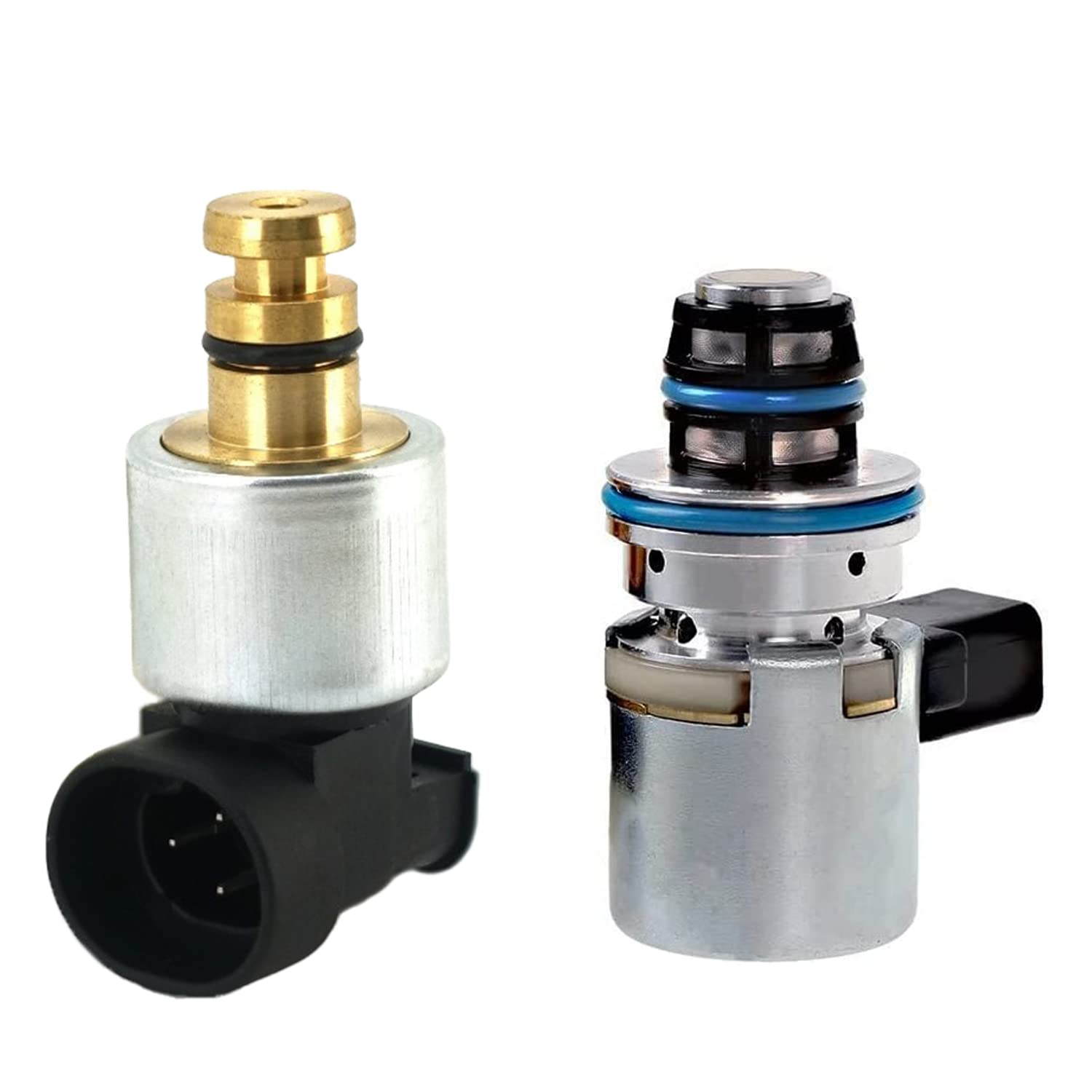
Solenoids control the low/reverse, 2nd, 4th, underdrive and overdrive clutches, and ATSG notes the reverse clutch is applied by the manual valve and line pressure rather than by its own solenoid. The TCM watches input and output speed sensors, times every ratio change and learns how much oil each clutch needs to apply. That learned figure is the Clutch Volume Index, and it is the most useful data on the truck.
Diagnosis: Gauge First vs Scan Tool First
47RE: pressure tells the story
A 47RE is diagnosed with a gauge and the factory charts. The 1998 manual's pressure tests (pages 21-217/218) call for 54-60 psi rising to 90-96 psi in 1, 2 and D at 1000 rpm, and for the reverse test, rear servo pressure of 145-175 psi rising to 230-280 psi at 1600 rpm. A unit that holds those numbers and still shifts badly has a TV cable, governor or valve body problem, not a clutch problem.
Temperature strategy also confuses people on these trucks. The manual says the PCM will not allow overdrive or converter lockup below about 50°F, and above about 260°F it forces a 4-3 downshift and third-gear lockup, returning fourth at about 230°F. A second-gen truck that "will not go into overdrive on cold mornings" may be doing exactly what it was programmed to do. One that drops out of fourth while towing up a long grade is telling you about cooling.
68RFE: read what the TCM learned
On a 68RFE you pull Clutch Volume Index data before you drop the pan, and you drive the shift that updates the number you care about, because a CVI that never updates is stale rather than good. Line pressure gets checked differently too. Sonnax points out that low line pressure can hide behind a failed line pressure sensor, and recommends OE adapter tool No. 8259, which goes into the case in place of the sensor so you can run the sensor and a mechanical gauge at the same time. ATSG also notes that upshifts into fifth and sixth are delayed below 40°F and above 240°F, so a cold truck holding fourth is not automatically a fault.
Where Each One Breaks
47RE: line pressure that runs out of room
The 47RE's weak spot is hydraulic, and Sonnax explains it well in its 48RE valve body article. Around 1996, Dodge added a valve train near the pressure regulator to raise line pressure in lockup or fourth. On the 46/47RE, converter and overdrive apply pressure moves that valve to exhaust only one reduction point on the regulator, gaining roughly 10-15 psi. The later 48RE exhausts two points and gains about 22-28 psi. That extra clamping is a large part of why the 48RE exists.
In practice, a stock-pressure 47RE behind a 5.9 that has been turned up with injectors or a tuner is short on holding pressure in exactly the two places that see the load on the highway: the converter clutch and the overdrive clutch. Slipping lockup and a burnt overdrive pack are the classic second-gen failures, and both are pressure problems before they are friction problems. Fix the pressure curve, the valve body wear and the cooling, or the new clutches go the same way. Sonnax also warns against the reverse mistake: a 46/47RE valve body bolted into a 48RE will drive fine at first and come back with a failed converter clutch or overdrive clutch.
68RFE: the overdrive clutch pack
The 68RFE's dominant failure is its overdrive clutches, which are applied in fifth and sixth where the truck spends most of its life. Sonnax measured the OE overdrive steel cores at only .034 in thick, single-sided frictions with very little mass to absorb heat, compared with .080 in direct clutch steels in a 4L80-E. Heat distorts them, distortion takes clearance away, and a pack that cannot fully release burns.
Sonnax lists six contributors besides the clutches themselves: leaking solenoid switch valve plugs that cross-leak the OD circuit and often set P0871, a flexing OE overdrive housing, wear on the inner retainer, incorrect line pressure in either direction, a warped solenoid conductor plate bleeding OD apply oil, and tuners or oversized tires. Writing for ATRA in Gears, Rob Faucett names valve body worm track erosion from excessive tuned-engine torque as the root cause he sees most often. Replace the frictions without addressing the leak paths and you are building the same failure twice.
68RFE Friction Clutch Module (2007-up)
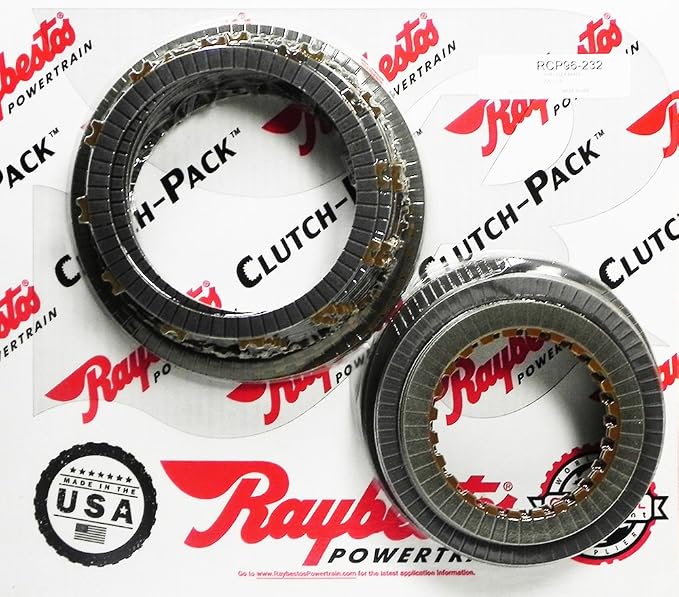
If the 68RFE side of this comparison is the one on your bench with a burnt overdrive pack, the friction clutch module is the part that goes back in. Pair it with switch valve bore and conductor plate checks so it lives.
See the 68RFE friction clutch module →Not the part you need? Browse the full 68RFE parts collection.
47RE Service Numbers From the Factory Manual
| Item | 47RE specification (1998 Ram service manual) |
|---|---|
| Front band | Torque adjuster to 72 in-lb, back off 1-7/8 turns |
| Rear band | Torque adjuster to 72 in-lb, back off 3 turns |
| Front band locknut | 41 N·m (30 ft-lb) in the procedure text; 34 N·m (25 ft-lb) in the spec table |
| Oil pan bolts | 17 N·m (13 ft-lb) |
| Filter screws | 35 in-lb |
| Converter bolts | 47 N·m (35 ft-lb) |
| Input shaft end play | 0.86-2.13 mm (.034-.084 in) |
| Initial fill, pan and filter only | 3 pints (1-1/2 qt), then run, shift through ranges and top up to the dipstick |
| Initial fill, overhaul with converter drained and cooler flushed | 12 pints (6 qt), then run and top up |
Note the front band locknut: the 1998 manual gives 30 ft-lb in the adjustment procedure and 25 ft-lb in the specification table. Either is a long way from loose, and the locknut is what keeps your band adjustment from walking. The 68RFE has no bands to adjust; its clearances are set with selective snap rings and backing plates during assembly, and the TCM's adaptive learning has to be reset and relearned after any rebuild or valve body change.
Fluid: ATF+3 vs ATF+4
The 1998 manual specifies Mopar ATF Plus 3, Type 7176, and warns that Dexron II is not recommended because improper fluid can cause clutch chatter. The 68RFE is stricter still: Ram's 2022 owner's manual says to only use ATF+4 in the 68RFE behind the 6.7 diesel, and that other fluid may affect the function or performance of the transmission. Most shops service both today with Mopar ATF+4. What you should never do in either one is pour in a generic multi-vehicle fluid, and on the 68RFE wrong fluid can push clutch volume numbers out of range on a healthy unit.
Can You Swap a 68RFE Into a 47RE Truck?
Not as a bolt-in, and rarely as a good use of money. The 47RE truck has no TCM to run a 68RFE: its shifting lives in a valve body, a governor circuit and a TV cable, with the PCM handling only the governor pressure solenoid, the overdrive solenoid and the converter clutch. A 68RFE needs a controller commanding every clutch, both speed sensors, a line pressure sensor and a calibration that matches the truck, on top of the crossmember, driveshaft and shifter work. Price it out honestly and it is a controls project, not a transmission swap.
For most second-gen owners the better money is a properly built 47RE: valve body updated for line pressure and worn bores, the TV cable set right, a good cooler, and clutches with clearance checked against the factory numbers. You keep a unit you can diagnose with a gauge and a meter, which is not a small thing at 200,000 miles.
Which Is Stronger?
Stock for stock, the 68RFE drives and tows better. The deeper 3.23:1 first and 4.44:1 reverse make heavy trailers easier to start and back, and the 0.81 and 0.62 overdrives keep highway rpm down. It also has more friction elements sharing the load than a 47RE.
Under added power, the answer changes. A 47RE's limits are well understood and fixable with valve body work and pressure, and a built one is a forgiving unit. The 68RFE's thin, single-sided overdrive pack is a design limit, and it is applied in exactly the gears you tow in. A stock 68RFE behind a tuned 6.7 is a known way to make overdrive clutch failures. The honest one-liner: a stock 68RFE beats a stock 47RE on the road, and a correctly built 47RE outlasts a stock 68RFE behind a turned-up engine.
Need parts for this job?
We stock both sides of this comparison: 47RE master kits, governor solenoids and valve bodies, plus 68RFE clutch modules, solenoid packs and valve bodies. Pick your unit and go.
Shop 47RE parts → Shop 68RFE parts →Get the 68RFE friction clutch module →
FAQ
Is a 68RFE stronger than a 47RE?
Stock for stock, the 68RFE tows better thanks to its 3.23:1 first, 4.44:1 reverse and two overdrives. Under added power it is a different story: Sonnax measured the OE 68RFE overdrive steel cores at only .034 in thick, and that pack is applied in fifth and sixth where you tow. A correctly built 47RE with its line pressure and valve body sorted is generally the more forgiving unit behind a turned-up engine.
Can you put a 68RFE in a second-gen Cummins?
Not as a bolt-in. The 47RE truck shifts with a hydraulic valve body, an electronic governor and a throttle valve cable, and has no TCM to run a clutch-to-clutch six-speed. A 68RFE needs its own controller, wiring, speed and line pressure sensors, a matching calibration, plus crossmember, driveshaft and shifter work, so most owners are better off building the 47RE.
What fluid does a 47RE take compared to a 68RFE?
The 1998 Ram service manual specifies Mopar ATF Plus 3, Type 7176, for the 47RE and warns against Dexron II because it can cause clutch chatter. Ram's owner's manual says to only use ATF+4 in the 68RFE. Most shops service both with Mopar ATF+4 today; never use a generic multi-vehicle ATF in either.
What is the difference between a 46RE and a 47RE?
The 47RE is the diesel version with more clutch capacity. Per the 1998 service manual it uses 4 front clutch discs instead of 3, 5 overdrive clutch discs instead of 4, and 10 direct clutch discs instead of 8, with different band back-off turns and 35 ft-lb converter bolts versus 23 ft-lb on the 46RE.
Sources
- Chrysler — 1998 Dodge Ram Truck Service Manual, Group 21 (46/47RE), archived copy. Backs the 46/47RE description (clutches, bands, overdrive unit, TCC operation), the throttle valve cable adjustment, 47RE disc counts versus 46RE, band adjustment and torque specs, end play, the fill procedure, gear ratios, pressure test values, the temperature-based overdrive and lockup strategy, and the Mopar ATF Plus 3 Type 7176 fluid call-out with the Dexron II warning. archive.org
- ATSG (Automatic Transmission Service Group) — Dodge Ram 68RFE technical service manual preview. Backs the 68RFE gear ratios and 4.44:1 reverse, the two-clutch application strategy, single-sided UD/OD/LR clutches, three 6-pinion planetary sets, the solenoid-controlled elements and manual-valve reverse clutch, the 40°F/240°F 5th-6th delay, and the Mopar ATF+4 requirement. atsg.biz (pdf)
- Stellantis / Mopar — 2022 Ram 2500/3500 Owner's Manual, Chassis Fluids and Lubricants. Backs the factory instruction to only use ATF+4 in the 68RFE behind the 6.7L diesel. vehicleinfo.mopar.com
- Sonnax, Jim Dial — "Dodge 48RE Hydraulic Features Revealed." Backs the 1996 pressure-boost valve train, the 46/47RE single reduction point exhaust and 10-15 psi gain versus 22-28 psi on the 48RE, the 2003 48RE introduction, and the warning about 46/47RE valve bodies in 48RE units. sonnax.com
- Sonnax — "68RFE Overdrive Clutch Failure: What to Check First When Troubleshooting OD Issues." Backs the .034 in single-sided OD steel cores versus .080 in 4L80-E direct steels, the six additional failure contributors including switch valve plug cross-leaks and P0871, and OE line pressure adapter tool No. 8259. sonnax.com
- Gears Magazine (ATRA), Rob Faucett — "68RFE OD Clutch Failure." Backs valve body worm track erosion from tuned-engine torque as the most commonly observed root cause of 68RFE overdrive clutch failure. gearsmagazine.com