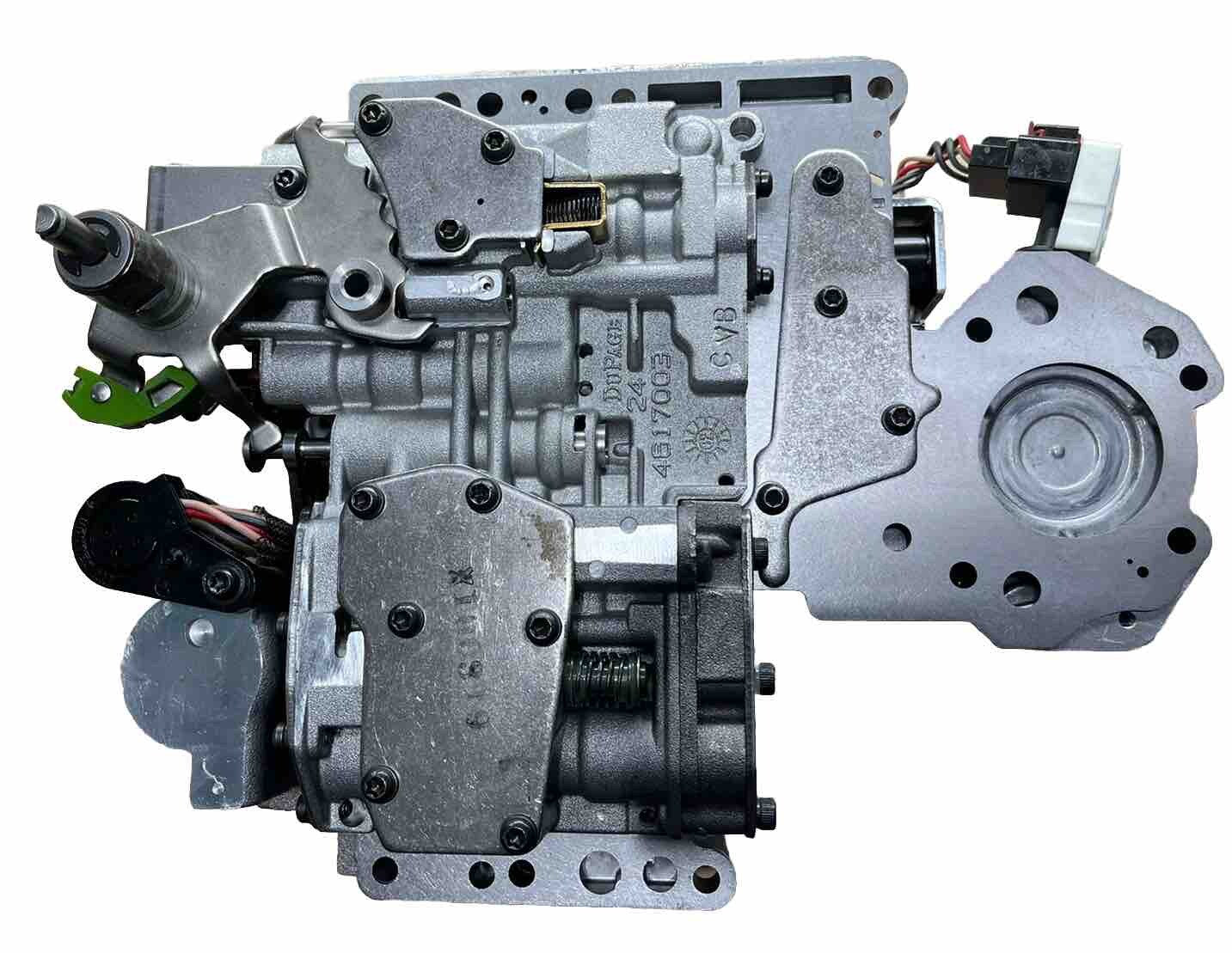
These two get mixed up constantly, and the reason is simple: a 46RE and a 47RE sitting on adjacent stands look like the same transmission. Same A518/A618 architecture, same case profile, same 2.45 / 1.45 / 1.00 / 0.69 gear spread with a 2.20 reverse, same ATF+4, same three solenoids hanging off the valve body. Cores get mislabeled, units get swapped, and somebody finds out the hard way six weeks later.
The differences that matter are inside the overdrive section and in how the computer schedules governor pressure. Neither one is visible from outside the case. Here is what actually separates them, what interchanges, and what to do differently on the bench.

The Short Version
| Spec | 46RE | 47RE |
|---|---|---|
| Base unit | A518 | A618 |
| Engines | 5.2L and 5.9L gas V8, 4.7L V8 | 5.9L Cummins diesel, 8.0L V10 |
| Gear ratios (1-4 / R) | 2.45 / 1.45 / 1.00 / 0.69 / 2.20 | 2.45 / 1.45 / 1.00 / 0.69 / 2.20 |
| OD/direct clutch pack | 8 friction, 7 steel | 10 friction, 9 steel |
| Overdrive brake clutch | 5 friction, 5 steel, flat backing plate | 6 friction, 6 steel, stepped backing plate |
| Front band back-off | 2-7/8 turns | 1-7/8 turns |
| Rear band back-off | 2 turns | 3 turns |
| Governor pressure curve | Tracks road speed about 1:1 | Roughly doubles road speed above 20 mph |
| Fluid | ATF+4 (MS-9602) | ATF+4 (MS-9602) |
| Fill, service / overhaul (2004 Ram chart) | 3.79 L / 8.99-9.46 L | 3.79 L / 13.7-15.61 L |
Same gears, same fluid, same electrical layout. Different clutch capacity, different band setup, and a different shift strategy living in the computer.
Where Each One Came From
The ATSG vehicle application chart for this family draws a clean line. The 46RE went behind the 5.2L and 5.9L gas V8s in Dodge Ram pickups from 1995 to 2002, the Ram Van and Wagon from 1995 to 2003, the 5.9L Dakota from 1998 to 2000, the Durango from 1998 to 2003, and the 4.7L Grand Cherokee in 1998. The 47RE went into Ram pickups from 1995 to 2002 behind two engines: the 5.9L Cummins diesel and the 8.0L V10.
That V10 detail is the one most people miss. The 47RE is not strictly a diesel transmission. It is the heavy-duty version of the same unit, and Chrysler put it behind whichever engine made enough torque to need it. If you are sourcing a core, "it came out of a gas truck" does not tell you which unit you have. Read the bar code label on the left side of the case, or the numbers etched into the pan rail just above the oil pan gasket.
The Hardware That Actually Differs
Pull the overdrive section apart and the split becomes obvious.
Overdrive/direct clutch pack
Per ATSG, the 46RE was introduced in 1995 for the 5.2L and 5.9L gas engines with 8 friction plates and 7 steel plates in the overdrive/direct clutch, all double-sided frictions. The 47RE, introduced the same year for the diesel, got 10 friction plates and 9 steel plates in that same pack. Two extra frictions is a real jump in torque capacity in a clutch that has to hold third gear and carry the truck in overdrive.
Overdrive brake clutch
The overdrive clutch in the case differs too, and this one has an assembly trap in it. Gasoline units use 5 friction and 5 steel plates with a flat backing plate, and they use three different snap rings in three different locations: wire type, waved, and flat. Diesel units use 6 friction and 6 steel plates with a stepped backing plate, and the step faces down. The diesel does not use the waved snap ring at all. ATSG calls installing those snap rings in the wrong location a very common mis-assembly error, and it is, because the waved and flat rings live in the same groove.
Band adjustment
This is the difference that bites people who assume the family is interchangeable. Snug the adjusting screw to 8 Nm (72 in-lb), then back it off:
- Front (kickdown) band: 46RE, 2-7/8 turns. 47RE, 1-7/8 turns.
- Rear (low/reverse) band: 46RE, 2 turns. 47RE, 3 turns.
Hold the screw and torque the locknuts. ATSG lists 34 Nm (25 ft-lb) for both. The 1998 Ram factory service manual agrees on the rear band (34 N·m / 25 ft-lb) but its front band procedure on page 21-308 calls for 41 N·m (30 ft-lb), even though the spec table on the same page lists 25 ft-lb for the front band adjuster locknut (1998 Dodge Ram Truck Service Manual, Group 21). Either value holds the screw; the turn count is what matters. Use the 46RE turn counts on a 47RE and you have set both bands wrong, in opposite directions.
Intermediate shaft
Sonnax lists its heavy-duty intermediate shaft, part 22171B-HD, for 47RE, 47RH, and 48RE units, not the 46RE. That is a useful tell: the heavy-duty side of the family carries its own shaft, and the upgrade path for a gas 46RE is not the same catalog as the diesel units.
What Is Identical, and Why That Matters
Just as important as the differences is the long list of parts that do not change. Both units require ATF+4, which is Chrysler material standard MS-9602, and neither tolerates a Dexron-type fluid. Both share the same three external solenoids, governor pressure, overdrive, and torque converter clutch, all fed 12 volts through terminal 1 at the 8-way case connector, with the controller supplying ground on terminals 5, 6, and 7 respectively. Both use an output speed sensor triggered by the park lugs on the rear planetary ring gear, and both fall back to the ABS module speed signal and store P0720 if that sensor quits.
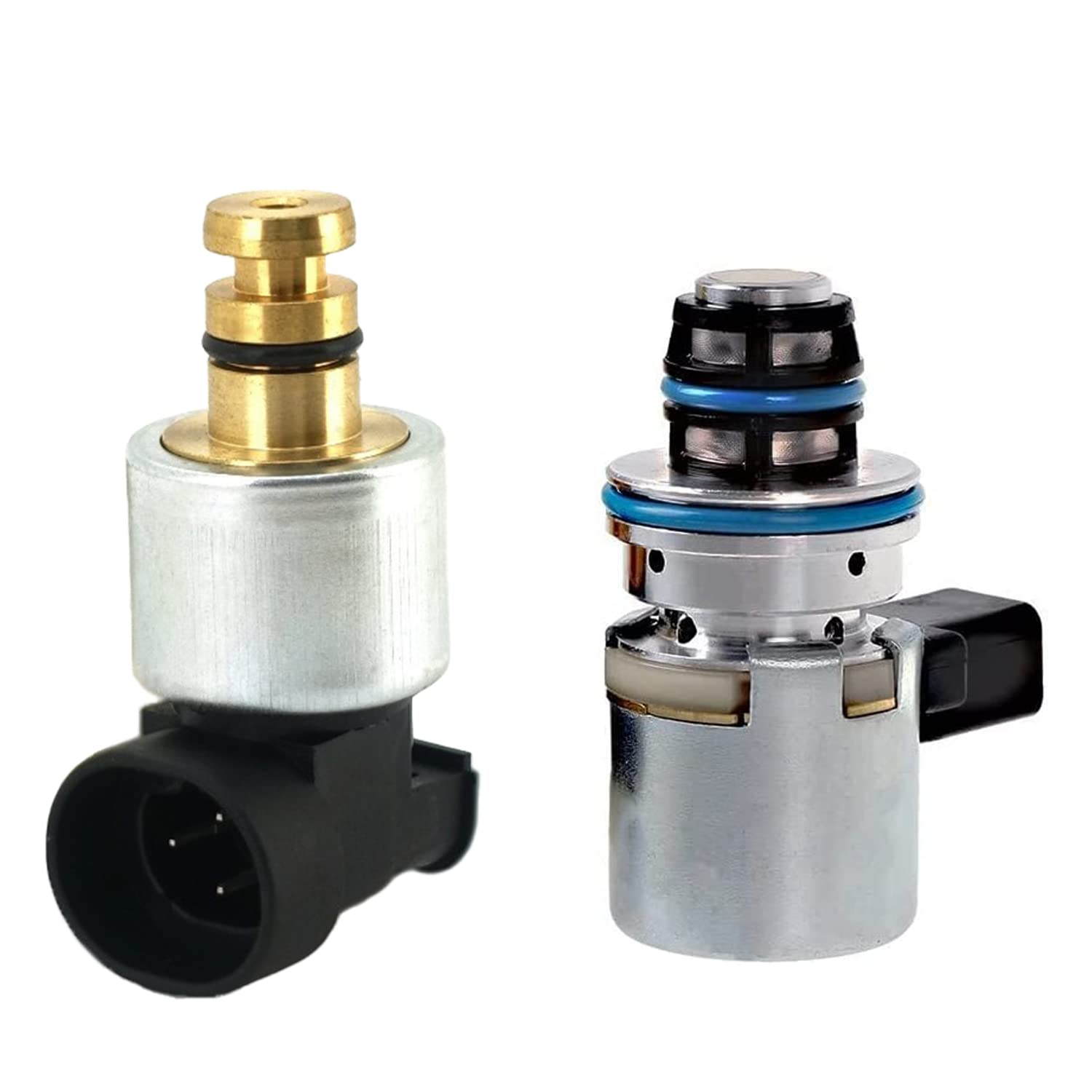
The valve body is shared as well. Sonnax catalogs remanufactured valve bodies for the 46RE and 47RE under the same part numbers, split only by generation: CHR129 and CHR130 for 1999-and-earlier units with the early sensor (small and large pump inlet respectively), CHR131 and CHR132 for 2000-and-later units with the late sensor. The early governor pressure sensor has an oval electrical connector; the late one is rectangular plastic. When you order, the sensor style and the pump inlet size are what matter, not whether the tag says 46 or 47.
Line pressure specs carry over too. In Drive-first, expect 54 to 60 psi at idle and 90 to 96 psi at stall, read at the accumulator port with a 100 psi gauge. In Reverse, expect 145 to 175 psi at idle and 230 to 280 psi at stall, read at the rear servo port with a 300 psi gauge.
Sonnax Piston Retainer Kit 22754N-01K
Excessive clearance between the overdrive piston retainer and the intermediate shaft starves the gear train of lube and takes out the reverse drum, retainer, and planet. The Sonnax retainer adds repositioned I.D. and O.D. grooves at the load areas plus an O-ring that actually seals to the case. One part number covers 46RE, 47RE, and 48RE, so it belongs in either overhaul.
See the Sonnax retainer kit →The Governor Pressure Split Nobody Tells You About
Here is the most useful thing in this article, and it is the reason technicians misdiagnose these units.
Neither transmission has a spinning mechanical governor. A duty-cycle governor pressure solenoid on the valve body regulates line pressure down into governor pressure, and that pressure fights throttle pressure at the shift valves to schedule 1st, 2nd, and 3rd. The 3-4 shift is handled separately by the overdrive solenoid. One amp of current through the solenoid produces zero psi of governor pressure; zero amps sets maximum pressure.
The strategy behind that solenoid is different for gas and diesel. On gas applications, governor pressure tracks road speed roughly one-to-one: 20 mph gives about 20 psi, 30 mph about 30 psi. On diesel applications, governor pressure begins to roughly double road speed above about 20 mph. ATSG publishes the reference table:
| Road speed | Governor psi, gas | Governor psi, diesel | Sensor signal, wire 4 |
|---|---|---|---|
| 0 mph | 0 | 0 | 0.66 V |
| 10 mph | 10 | 8 | 0.90 V |
| 20 mph | 20 | 38 | 1.10 V |
| 30 mph | 30 | 60 | 1.45 V |
| 40 mph | 40 | 65 | 1.80 V |
| 50 mph | 50 | 68 | 2.15 V |
| 60 mph | 60 | 70 | 2.95 V |
The reason for the diesel curve is engine overspeed. Doubling governor pressure early keeps the transmission from dropping a 4-2 or 3-2 kickdown that would spin a 5.9 Cummins past where it wants to live. Put diesel calibration behind a gas engine, or gas calibration behind a diesel, and the shift points will be wrong with nothing mechanically at fault.
Diagnosing the Governor Circuit on Either Unit
The governor pressure solenoid and its sensor are the number one electrical failure on both transmissions. Work it in this order.
- Scan data first. Put the selector in Drive, or the scan tool will not report governor data at all. Compare Governor Pressure Desired against Governor Pressure Actual. They should track each other.
- Confirm with a gauge. Put a 0-100 psi gauge on the governor pressure port. If Desired reads 0 at 0 mph and the gauge shows 20 psi, the solenoid is not regulating and it gets replaced. Do not chase the sensor for that.
- Unplug the case connector. Like any pressure control solenoid, unplugging it drives pressure high. With the connector off and the selector in Drive, governor pressure should reach about 60 psi at idle, fed by rear (forward) clutch oil. If it stays low, the problem is internal: a dead solenoid, a plugged screen on the solenoid inlet port, or a damaged or misinstalled overdrive piston support to case gasket. An A500/518 piston support installed in the wrong unit does the same thing.
- Check resistance. The governor pressure solenoid measures approximately 3 to 5 ohms.
On code P1762, governor sensor offset volts too low or too high, Transmission Digest lists four causes worth working through on 1996-99 42-47RE units: a defective governor pressure solenoid driving pressure high, a defective governor pressure sensor, an open or shorted sensor ground wire, and a charging system overcharge that pushes the sensor's 5-volt reference toward 6 volts. That last one is easy to miss, and it will make signal return read above 0.76 volts in Park or Neutral. The OE governor pressure solenoid is 4617210; the 1996-99 sensor is 56041403-AA.
One related warning: if you raise line pressure to firm up converter clutch apply, governor pressure follows it up, and you can set P1763, governor pressure sensor volts too high. Raise pressure with intent, not as a blanket fix.
Shared Failure Points Worth Knowing
Valve body bore wear. Sonnax's vacuum test guide covers 46RE, 46RH, 47RE, and 47RH together because the wear areas are the same across all of them: the throttle valve (shift timing complaints, throttle buzz, poor kickdown, late 2-3, oversensitive 3-2), the switch valve (no cooler flow in Park, lockup shudder, overheated converter, converter bushing failure, soft TCC apply), the 1-2 and 2-3 governor plugs (1-2 shuttle, oversensitive 2-3 and 3-2, difficulty adjusting shift timing with the TV linkage, early upshifts), and the line pressure plug and sleeve (delayed engagement). ATRA's Gears magazine flags the same four areas and calls out the classic 46RE symptom of a throttle cable you simply cannot dial in, which is throttle bore wear rather than a linkage problem.
Low/reverse band burnout right after overhaul. Transmission Digest documents a cross leak between the spacer plate and channel plate near the No. 3 checkball seat, caused by those two plates being aligned incorrectly during assembly. It bleeds a little third-gear oil into the low/reverse band circuit after the 2-3, the band drags in third and fourth, and it cooks. The fix is to flat-sand the channel plate, use the two alignment holes with bolts started by hand to locate the spacer plate, tension-plate it at 35 in-lb, then torque the valve body bolts to 35 in-lb. Verify with a gauge on the low/reverse port: it must read 0 psi in third and fourth.
Late or no shift into third. On 1989-and-later A518, 46RE, and 47RE units, this often shows up with a delayed reverse engagement when hot. The cause is a front (direct) clutch drum with the inner seal groove cut too deep, letting the seal get swallowed and lose fluid retention, or a worn outer lip seal from a poor drum finish in the contact area. Replace the inner lip seal with a wider-base version and polish the drum where the outer lip rides.
Overdrive piston retainer lube loss. Sonnax notes that many OE supports in these units do not seal well against the case, cutting lube flow to the gear train and consuming pump volume. The result is reverse drum, retainer, and planet failure. That applies equally to the 46RE and the 47RE.
Need parts for this job?
Master rebuild kits, valve bodies matched to the right sensor generation, governor solenoid and transducer kits, bands, and the servo and clutch pieces for both the 46RE and the 47RE.
Shop 46RE parts →Building the diesel side instead? The 47RE parts page carries the heavy-duty pieces for that unit.
Interchange: What Swaps and What Does Not
- Whole unit: A 46RE will bolt where a 47RE was, and it will not survive behind a Cummins or an 8.0 V10. A 47RE behind a gas 5.2 or 5.9 is mechanically fine, but the controller has to run the correct governor pressure curve for that engine or the shift points will be off.
- Valve body: Crosses. Sonnax uses one part number family for both. Match early versus late sensor and small versus large pump inlet.
- Governor solenoid and sensor, OD and TCC solenoids: Cross freely.
- Overdrive clutch packs: Do not cross. Plate counts, backing plate profile, and snap rings all differ. Build the pack the unit calls for.
- Overdrive piston retainer, filters, pans, gaskets: Cross across the family, including the 48RE.
- Intermediate shaft: The heavy-duty aftermarket shaft is a 47RE/47RH/48RE part, not a 46RE part.
- Band adjustment specs: Never cross them. Look up the unit you actually have.
Which Is Stronger, and Which to Build
The 47RE is the stronger unit, and it earned that with clutch area and operating pressure rather than a bigger case. Two extra frictions in the overdrive/direct pack, an extra friction and steel in the overdrive brake clutch, and a tighter band setup add up. It also carries more fluid: the Chrysler 2004 Ram capacity chart lists a 13.7 to 15.61 liter overhaul fill for the 47RE against 8.99 to 9.46 liters for the 46RE, largely because of the bigger diesel converter and cooler circuit. Chrysler never published a single torque number that shops can build to, so judge the 47RE by its clutch counts and band setup, not by a figure off a spec website.
The factory band adjustment procedure matches the ATSG turn counts: per the 1998 Ram service manual (pages 21-308 and 21-309), the adjuster goes to 8 N·m (72 in-lb), the 47RE front band backs off 1-7/8 turns versus 2-7/8 on a 46RE, and the 47RE rear band backs off 3 turns versus 2, with the rear locknut at 34 N·m (25 ft-lb). The same pages call for a new pan gasket and 17 N·m (13 ft-lb) on the pan bolts after the rear band is set. The 47RE's weak link behind a Cummins is not the front clutch pack but the input shaft. Sonnax describes the two-piece OE shaft as prone to spline twist, breakage and clutch hub failure, and lists upgrade shafts (22121B-01, 22121B-02K and the 35-spline 22121B-08K) that fit the 47RH/RE and 48RE. If you are building a 47RE for a Cummins, price the shaft into the job. Our 47RE rebuild cost guide breaks down the rest of the bill.
If you have a choice of cores for anything that tows or makes torque, start with a 47RE. If you are freshening a gas Ram, Dakota, or Durango, the 46RE is the correct unit for the job and there is no reason to reach for a diesel core. Either way the durability wins are the same: set the bands to the spec for that exact unit, repair valve body bore wear instead of adjusting around it, fix the overdrive piston retainer, keep the fluid ATF+4, and keep it cool.
Shop RE family parts →
FAQ
Is a 47RE stronger than a 46RE?
Yes, and the difference is in the clutch packs, not the case. Per ATSG, the 46RE left the factory with 8 friction and 7 steel plates in the overdrive/direct clutch, while the 47RE got 10 friction and 9 steel. The 47RE also uses a 6-friction/6-steel overdrive brake clutch with a stepped backing plate where the 46RE runs 5 and 5 with a flat plate and a waved snap ring. More clutch area plus higher operating pressure is why the 47RE lived behind the 5.9 Cummins and the 8.0 V10 and the 46RE did not.
Will a 46RE bolt in place of a 47RE?
The cases and bellhousings are the same family, so it will physically go in, and that is exactly why people get burned. The 46RE has less clutch capacity in both overdrive packs and its bands are adjusted to a different spec. Behind a Cummins or a V10 it will not last. Going the other direction, a 47RE behind a gas 5.2 or 5.9 is generally fine mechanically, but the computer runs a different governor pressure curve for gas versus diesel, so the calibration has to match the truck or the shift points will be wrong.
Do the 46RE and 47RE use the same valve body?
Effectively yes. Sonnax catalogs remanufactured valve bodies for the 46RE and 47RE under the same part numbers (CHR129 through CHR132), and the split is by year and hardware generation, not by model: early versus late governor pressure sensor, and small versus large pump inlet. The early sensor has an oval metal connector, the late one is rectangular plastic. Match the sensor style and the inlet size, not the badge on the truck.
How many turns do you back off the bands on a 46RE versus a 47RE?
This is the number people get wrong. Per ATSG, you snug the adjusting screw to 8 Nm (72 in-lb), then back off the front (kickdown) band 2-7/8 turns on a 46RE and 1-7/8 turns on a 47RE. The rear (low/reverse) band backs off 2 turns on a 46RE and 3 turns on a 47RE. Torque both the front and rear locknuts to 34 Nm (25 ft-lb). Using the wrong count is a common cause of a burned band right after an overhaul.
What fluid do the 46RE and 47RE take?
Both require ATF+4, which is the Chrysler MS-9602 material standard. It is not interchangeable with Dexron. Chrysler's 2004 Ram fluid capacity chart lists a 47RE overhaul fill of 13.7 to 15.61 liters (about 14.5 to 16.5 quarts, varying with cooler and line length) and a 3.79 liter (about 4 quart) service fill. The 46RE overhaul fill is 8.99 to 9.46 liters, about 9.5 to 10 quarts, with the same 4 quart service fill. Fill it, run it through the gears, and set the level hot on the dipstick rather than trusting the dry-fill number.
Sources
- ATSG (Automatic Transmission Service Group) — "46RE / 47RE / 48RE TechTran Technical Service Information," 1st printing April 2011. Backs the vehicle application chart (46RE behind the 5.2L/5.9L/4.7L gas V8s, 47RE behind the 5.9L Cummins and 8.0L V10), the 2.45 / 1.45 / 1.00 / 0.69 ratios with 2.20 reverse, the overdrive/direct clutch counts (8 friction and 7 steel on the 46RE versus 10 and 9 on the 47RE), the overdrive brake clutch counts and backing-plate and snap-ring differences (5/5 flat plate with waved ring on gas, 6/6 stepped plate with no waved ring on diesel), the front and rear band back-off turns and locknut torques, the ATF+4 requirement, the line pressure specifications, the gas-versus-diesel governor pressure table, and the governor solenoid resistance and unplugged-connector test values. atsgbookstore.com
- Sonnax — "Chrysler 42RE, 46RE, 47RE Valve Body Identification." Backs the shared 46RE/47RE remanufactured valve body part numbers CHR129, CHR130, CHR131 and CHR132, and the fact that the split is by early versus late governor pressure sensor and small versus large pump inlet rather than by transmission model. Also backs the oval-metal versus rectangular-plastic sensor identification. sonnax.com
- Transmission Digest — Transmission TECH/TALK, February 2003 issue. Backs the P1762 governor-sensor-offset cause list for 1996-99 42-47RE units including the charging-system overcharge and the 0.76-volt signal-return check, the OE part numbers (governor pressure solenoid 4617210, 1996-99 sensor 56041403-AA), the P1763 risk when raising line pressure, the low/reverse band burnout caused by spacer-plate to channel-plate misalignment at the No. 3 checkball with the 35 in-lb assembly torques and 0 psi verification, and the late/no shift into third caused by an over-deep inner seal groove in the front (direct) clutch drum. transmissiondigest.com
- Sonnax — Piston Retainer Kit 22754N-01K product and instruction page. Backs the overdrive piston retainer failure mode (excessive clearance between the retainer and intermediate shaft reduces lube flow to the gear train, causing reverse drum, retainer and planet failure), the kit's coverage of 46RH/46RE, 47RH/47RE and 48RE, and the listing of the heavy-duty intermediate shaft 22171B-HD for 47RE/47RH/48RE only. sonnax.com
- Sonnax — "Chrysler 46RE, 46RH, 47RE, 47RH Vacuum Test Guide." Backs the shared critical wear areas and their symptoms across all four units: throttle valve, switch valve, 1-2 and 2-3 governor plugs, and line pressure plug and sleeve. sonnax.com
- Gears Magazine (ATRA), Keith Clark — "Bringing it Back to Life: A Logical Approach to the RE Valve Body." Backs the four RE valve body wear areas and their symptom sets, and the 46RE throttle cable that cannot be dialed in as a sign of throttle bore wear rather than a linkage fault. gearsmagazine.com
- Chrysler / Ram Body Builder Guide — "Ram Fluid Capacities," 2004 DR (Ram 1500-3500). Backs the 46RE service fill of 3.79 L and overhaul fill of 8.99-9.46 L, the 47RE service fill of 3.79 L and overhaul fill of 13.7-15.61 L, and the note that dry fill varies with internal cooler, cooler line length and auxiliary coolers. rambodybuilder.com (PDF)
- Chrysler Corporation — 1998 Dodge Ram Truck Service Manual, Group 21 (Transmission and Transfer Case), pages 21-308 and 21-309, “Band Adjustment.” Backs the 8 N·m (72 in-lb) adjuster torque, the 46RE front band back-off of 2-7/8 turns versus 1-7/8 on the 47RE, the rear band back-off of 2 turns (46RE) versus 3 turns (47RE), the 34 N·m (25 ft-lb) rear locknut, the 41 N·m (30 ft-lb) front locknut in the procedure text, and the 17 N·m (13 ft-lb) pan bolt torque. archive.org — 1998 Dodge Ram Truck Service Manual
- Sonnax — "Dodge Diesel Input Shaft Upgrades for Every Performance Level." Backs the OE two-piece input shaft failure modes and the 22121B-01, 22121B-02K and 22121B-08K upgrades for 47RH/RE and 48RE, including the 35-spline turbine hub requirement. sonnax.com