The 47RE is the heavy-duty four-speed behind the 5.9L Cummins and 8.0L V10 in 1996-2002 Ram 2500 and 3500 trucks, and it is less forgiving about fluid than people think. It is mostly a hydraulic transmission with two adjustable bands, a lockup converter and a separate overdrive unit, and every one of those parts depends on the fluid having the right friction properties and being at the right level. A lot of the 47REs we tear down with glazed bands and a varnished valve body were not killed by towing alone. They were run low, overfilled until the fluid foamed, or topped off with a universal jug.
This page gives the factory numbers: fluid type, service and overhaul fill capacities, the initial fill amounts, the two level-check procedures, service intervals, and the pan, filter and band specs you need while the pan is down. The capacities and procedures come from Chrysler's 2001 Dodge Ram Truck service manual. The fluid chemistry comes from Chrysler's ATF+4 usage bulletin and Transmission Digest, the cooler checks and flow spec come from Sonnax, ATRA's GEARS magazine and NHTSA. Sources are listed at the end.


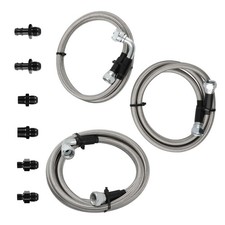
47RE Fluid Type: ATF+4, Type 9602
Chrysler's 47RE service manual calls for Mopar ATF+4, Type 9602, everywhere it mentions fluid: topping off after a level check, the initial fill after a filter change, and the refill after a rear band adjustment. Type 9602 refers to Chrysler Material Standard MS-9602. Whatever brand you buy, the label should say it meets or is licensed to MS-9602.
Some history helps with older trucks. As Transmission Digest's technical editor Mike Riley put it in a 2014 article on ATF, Chrysler moved from Dexron to its own Type 7176 and then Type 9602 fluids, which became ATF+3 and ATF+4. So an early 47RE may have an ATF+3 sticker. That is not a problem. Chrysler's service bulletin 21-014-07 (A/T - ATF+4 Fluid Usage/Applications, October 2007) says ATF+4 is backward compatible with ATF+3, ATF+2 and ATF+, and that where one of those older fluids was specified, ATF+4 is now the recommended fluid. It does not work the other way, though. Do not put ATF+3 in a unit that calls for ATF+4.
ATF+4 is a Chrysler-specific fluid and does not belong in a transmission that calls for Ford Mercon or GM Dexron. The reverse is also true: Dexron or Mercon does not belong in a 47RE, and the service manual lists incorrect fluid as the first cause of contamination.
What wrong fluid does to a 47RE
The service manual is direct about it. Under fluid contamination it lists adding incorrect fluid first, and says non-recommended fluids cause erratic shifts, slippage, abnormal wear and eventual failure from fluid breakdown and sludge. Transmission Digest describes how it usually plays out: the transmission may shift and lock up fine at first, then apply worse and worse over time until it fails. On the 47RE it tends to show up at the kickdown band and as a converter clutch shudder at cruise. If you get a truck with a lockup shudder and nobody knows what fluid is in it, change the fluid to ATF+4 before you condemn the converter.
47RE Fluid Capacity
The fluid capacity table in Chrysler's 2001 Ram service manual lists two numbers for the 47RE:
| Fill type | Liters | US measure |
|---|---|---|
| Service fill (pan and filter) | 3.8 | 4.0 quarts |
| Overhaul (dry) fill | 14 - 16 | 29 - 33 pints (about 14.5 - 16.5 quarts) |
The dry fill is a range because, as the manual's footnote says, it depends on the type and size of the cooler, the length and inside diameter of the cooler lines, and whether there is an auxiliary cooler. For comparison, the same table lists the gas 46RE at 9-9.5 L (19-20 pints) dry. The 47RE holds 5 to 7 liters more, mostly in its bigger converter and cooler circuit. Chrysler's 1998 Ram service manual lists the same 14-16 L (29-33 pint) 47RE dry fill with the same cooler footnote [source], so the number held across the whole 47RE run.
What that means for a pan service
Do the math: 4 quarts out of a system that holds 14.5 to 16.5 quarts is only about a quarter of the fluid. The rest stays in the converter, cooler and lines. Two or three pan services a few hundred miles apart, or an exchange through the cooler line, gets most of the old fluid out. As a shopping rule, buy at least 5 quarts for a pan and filter job so you are not short when topping off, and about 17 quarts for a rebuild with a flushed cooler, more if the truck has a large auxiliary cooler or a deep pan.
How to Fill a 47RE Without Overfilling It
The service manual gives a specific fill procedure meant to prevent overfilling. It does not tell you to pour in the capacity number. It tells you to start low and finish by the dipstick:
- Put a clean funnel in the fill tube.
- Add the initial quantity of ATF+4: 3 pints (1-1/2 quarts) if only the fluid and filter were changed, or 12 pints (6 quarts) if the transmission was overhauled, the converter was replaced or drained, and the cooler was flushed.
- Set the parking brake, start the engine and let it idle.
- Apply the service brakes, move the selector through every range, then return to Neutral.
- Check the dipstick. If it is low, add fluid to the MIN mark. If one side of the dipstick reads noticeably higher than the other, it picked up oil from the tube. Let it drain and recheck.
- Drive until the fluid is at normal operating temperature, then check again at idle in Neutral with the parking brake set, and bring it up to the MAX arrow.
Yes, only 3 pints after pulling 4 quarts out. The rest goes in a little at a time in steps 5 and 6, by the stick.
How to Check 47RE Fluid Level
The 47RE is checked hot, engine running, in Neutral, not in Park. The dipstick is on the right side of the engine. Chrysler gives two methods.
Procedure one: by the dipstick, hot
- Bring the fluid to normal hot operating temperature, which the manual gives as 82 C (180 F). Drive the truck if you have to.
- Park on level ground, start the engine and let it run at curb idle for at least one minute. Set the parking brake.
- Shift momentarily through all ranges, then back to Neutral.
- Wipe the top of the fill tube and the dipstick cap before pulling the stick, so dirt does not drop into the transmission.
- Read it: in the crosshatch area is acceptable, at the MAX arrow is the correct maximum, and at or below the MIN line is low. Add only enough ATF+4 to restore the level.
Procedure two: by fluid temperature
If the fluid is not fully hot, Chrysler's second method uses a scan tool. Start the engine, set the brake, shift into Drive for about 2 seconds and Reverse for about 2 seconds, then into Park. Read the transmission temperature on the scan tool (the manual names the DRB), and set the dipstick level to the mark the 47RE fill graph gives for that temperature. With either method, after adding fluid, wait at least 2 minutes for oil to drain down the fill tube before you recheck. Skipping that wait is the most common way these get overfilled.
Why the level matters so much
Chrysler's description of an incorrect level applies in both directions. Low fluid lets the pump take in air, so pressures are low and build slowly, and the clutches and bands slip. Too much fluid lets the geartrain churn it into foam, which does the same thing. Either way the air bubbles lead to overheating, oxidation and varnish that interfere with valve, clutch and accumulator operation. Foamed fluid can also push out of the vent, which looks like a leak. Check the condition too. The manual says fluid that smells burned and is contaminated with metal or friction material means the transmission needs a full recondition, not a fluid change.
47RE Fluid Change Intervals
The 2001 Ram service manual's maintenance schedules call for changing the automatic transmission fluid and filter and adjusting the bands as one job:
- Light Duty Schedule A (normal use): at 100,000 miles.
- Light Duty Schedule B: every 30,000 miles (30k, 60k, 90k, 120k). Schedule B is for trucks used for trailer towing, frequent short trips or dusty conditions, among other severe-use conditions.
- Medium Duty schedule (California 8.0L 2500 and 3500): drain and refill the fluid, replace the filter and adjust the bands every 24,000 miles or 24 months.
- Diesel (Cummins) trucks: the 1998 Ram service manual has a separate Diesel Engine Vehicles schedule that calls for the fluid, filter and band service every 24,000 miles or 24 months on Schedule A, and every 12,000 miles on Schedule B (frequent towing, extensive idling, sustained high speed above 90 F, short trips or dust) [source]. The same manual says to check the level monthly, or weekly on a truck used for towing. Our Ram 2500 Cummins 47RE fluid change guide walks through the diesel-side service.
A 47RE that tows is Schedule B by Chrysler's own definition. We run 30,000 miles on any 47RE that tows, and sooner if the fluid looks dark or smells burnt.
Pan, Filter and Band Specs
Chrysler bundles the band adjustment into the fluid service for a reason: the rear band adjuster is inside the pan. From the 47RE sections of the 2001 manual:
| Item | Spec |
|---|---|
| Fluid pan bolts | 17 N·m (13 ft-lb) |
| Filter screws | 4 N·m (35 in-lb) |
| Front (kickdown) band adjusting screw | 8 N·m (72 in-lb), then back off 1-7/8 turns |
| Front band locknut | 41 N·m (30 ft-lb) |
| Rear (low/reverse) band adjusting screw | 8 N·m (72 in-lb), then back off 3 turns |
| Rear band locknut | 34 N·m (25 ft-lb) |
| Cooler line fitting at transmission | 18 N·m (13 ft-lb) |
Some notes from the procedure. Back the front locknut off 3-5 turns and make sure the screw turns freely before you torque it. If you need Adapter C-3705 to reach it, the manual says to tighten to only 5 N·m (47-50 in-lb), because the adapter changes the effective torque. On the rear band, loosen the locknut 5-6 turns, torque the screw, back it off exactly 3 turns, and hold the screw still while you tighten the locknut so the setting does not move. Use a new pan gasket.
The back-off counts are specific to the 47RE. The gas 46RE uses different numbers, and mixing them up is a common cause of a burned band or a harsh shift right after service. Our 46RE vs 47RE guide lays out both.
Burnt Fluid Usually Means a Cooler Problem
When 47RE fluid comes out dark and burnt, the manual names two main causes. The first is restricted flow through the main or auxiliary cooler, usually from a bad or wrongly installed drainback valve, a damaged main cooler, or debris or kinked lines. The second is heavy-duty use in a truck that is not equipped for it. The manual says trucks used for towing should have an auxiliary transmission cooler, a heavy-duty cooling system, and an engine and axle ratio suited to the load.
Sonnax's write-up on 46/47RH-RE cooler and converter flow calls cooler restriction "by far the most common issue" in this family. Two quick checks before you blame the transmission:
- Bypass test. Loop the cooler lines to bypass the cooler temporarily and see if the heat, lockup slip or stalling goes away. Sonnax and ATRA's GEARS magazine both use this as a first step.
- Air check. In its 2022 article "A Dead Stop!", GEARS says to blow no more than 40 psi of air into the rear cooler fitting. It should take air with little resistance. A restricted return inside the transmission acts just like a plugged cooler.
- Flow test. Sonnax's instruction sheet for its 22771A-01 switch valve, which covers the 47RE, sets the minimum at 1 quart in 20 seconds (0.8 gpm) from the return line at the rear of the case, in Drive at idle. With a flow meter, it lists 0.7 to 0.9 gpm at idle in Drive, about 1.8 gpm at 45 mph with the converter clutch off, and 2.1 to 2.2 gpm once it applies.
On 1996 and 1997 trucks, also look at the cooler line connectors at the case. NHTSA recall 97V084000 covered about 960,000 1994-1997 Dodge Ram trucks because the connector holding the line to the transmission could melt under high-load fluid temperatures, let the line come off, and spray fluid on the exhaust manifold. The remedy was a connector with a stainless steel retainer on the hot side. Our 47RE cooler line replacement guide covers the lines and fittings in detail.
After a failure
If a failure left sludge or debris in the fluid, the manual says to reverse flush the cooler and lines, including any auxiliary cooler, and to replace the converter, because normal converter flushing will not get all the contaminants out. If engine coolant got into the fluid, the manual's fix is to replace the radiator, since the cooler inside it cannot be serviced, and to overhaul the transmission. Our 47RE overheating guide covers cooler sizing and flow testing in more detail.
When a Fluid Service Does Not Fix It
Fresh ATF+4 at the right level fixes complaints caused by old or aerated fluid, not worn hard parts. If the shift complaint is still there after a proper service and band adjustment, put gauges on it. Two numbers from the 47RE pressure test chart in the manual are especially useful. Line pressure at the accumulator should read 54-60 psi at closed throttle. Governor pressure should respond smoothly to road speed and drop back to 0-1.5 psi at a stop in D, 2 or 1. The manual notes that more than 1.5 psi at a standstill keeps the transmission from downshifting. From there, our 47RE common problems guide walks through governor, converter and valve body faults.
47RE Filter Kit with Pan Gasket (OEM 52118789)
The filter and pan gasket for a 1998-2002 47RE fluid service, from CoreTransmissionParts. Pair it with ATF+4 and do the band adjustment while the pan is down.
View the filter kit →Shop the RE filter and gasket kit →
Frequently Asked Questions
What transmission fluid does a 47RE take?
The 47RE takes Mopar ATF+4, Type 9602, or any fluid licensed to Chrysler's MS-9602 standard. Chrysler's service manual specifies ATF+4 for every fill. Early trucks labeled for ATF+3 can use ATF+4, but do not use ATF+3, Dexron, Mercon or a universal fluid.
How much transmission fluid does a 47RE hold?
Chrysler's 2001 Ram service manual lists a 47RE service fill of 3.8 liters (4.0 quarts) after a pan and filter change, and an overhaul dry fill of 14 to 16 liters (29 to 33 pints). The dry fill varies with cooler size, line length and any auxiliary cooler, so always finish by the dipstick.
How much fluid do I add after a 47RE filter change?
Chrysler says to start with 3 pints (1-1/2 quarts) of ATF+4 after a fluid and filter change, or 12 pints (6 quarts) after an overhaul with a new or drained converter and flushed cooler. Then run the engine, shift through the ranges, and add fluid in small amounts until the dipstick reads correctly hot.
Do you check 47RE fluid in Park or Neutral?
Neutral. Chrysler's procedure is to bring the fluid to about 180 F, park on level ground, idle for at least a minute with the parking brake set, shift through all ranges, return to Neutral, and read the dipstick. After adding fluid, wait at least two minutes before rechecking.
How often should 47RE fluid be changed?
The 2001 Ram service manual calls for changing the fluid and filter and adjusting the bands at 100,000 miles under normal use, and every 30,000 miles under Schedule B, which covers trailer towing and other severe use. The California 8.0L medium-duty schedule is every 24,000 miles or 24 months.
Sources
- Chrysler — 2001 Dodge Ram Truck (BR/BE) Service Manual, Lubrication and Maintenance: Fluid Capacities (page 0-6). Backs the 47RE service fill of 3.8 L (4.0 qt) and overhaul fill of 14-16 L (29-33 pints), the 46RE overhaul fill of 9-9.5 L (19-20 pints), and the footnote that dry fill varies with cooler type and size, cooler line length and diameter, and auxiliary coolers. Cited by page number from the factory manual; the ManualsLib scan previously linked here no longer resolves for ordinary browser traffic (Cloudflare bot challenge, confirmed October 2026) pending a working public mirror.
- Chrysler — 2001 Dodge Ram Truck Service Manual, 47RE Fluid and Filter (pages 21-715 to 21-718). Backs the Mopar ATF+4 Type 9602 requirement, the effects of incorrect level, the causes of burnt fluid and contamination, the cooler reverse-flush and converter replacement guidance, the hot Neutral dipstick check at 82 C (180 F), the scan-tool temperature method, the 2-minute drain-down wait, the 3.8 L service fill, and the 3-pint and 12-pint initial fills. Same ManualsLib availability note as above.
- Chrysler — 2001 Dodge Ram Truck Service Manual, 47RE Specifications and Bands (pages 21-703 and 21-709 to 21-710). Backs the pan bolt, filter screw and cooler fitting torques, the front and rear band adjustment (72 in-lb, 1-7/8 and 3 turns, 30 and 25 ft-lb locknuts, the C-3705 adapter note), the 54-60 psi line pressure and the 0-1.5 psi governor pressure at a stop. Same ManualsLib availability note as above.
- Chrysler — 2001 Dodge Ram Truck Service Manual, Maintenance Schedules (pages 0-7 to 0-13). Backs the transmission fluid, filter and band service at 100,000 miles on Light Duty Schedule A, every 30,000 miles on Schedule B with its towing and severe-use conditions, and every 24,000 miles or 24 months on the Medium Duty schedule. Same ManualsLib availability note as above.
- Chrysler Corporation — 1998 Ram Truck 1500-3500 Service Manual (BR), Group 0 Lubrication and Maintenance and Group 21 46/47RE Transmission. Publicly viewable factory manual that independently backs the 47RE dry fill of 14-16 L (29-33 pints) and its cooler footnote, the 3-pint and 12-pint initial fills, the 82 C (180 F) Neutral level check, the 47RE band specs (72 in-lb, back off 1-7/8 turns front and 3 turns rear, 41 and 34 N·m locknuts), the Diesel Engine Vehicles schedule (24,000 miles/24 months Schedule A, 12,000 miles Schedule B), and the monthly or weekly-when-towing level check. On 1998 trucks the factory fill was Mopar ATF Plus 3, Type 7176, which ATF+4 supersedes. archive.org
- Chrysler — Service Bulletin 21-014-07, "A/T - ATF+4 Fluid Usage/Applications" (October 16, 2007, supersedes 21-010-06). Backs ATF+4 being backward compatible with ATF+3, ATF+2 and ATF+, and its recommendation to use ATF+4 where those fluids were specified. Dealer service bulletin; no stable public link from Stellantis.
- Sonnax — 4-Spool Switch Valve 22771A-01 instructions (42RE through 48RE), section 7 "Critical Pump & Cooler Flow Quality Adjustments." Backs the minimum cooler flow of 1 quart in 20 seconds (0.8 gpm) at the rear return line in Drive at idle and the 0.7-0.9 / 1.8 / 2.1-2.2 gpm flow readings. Sonnax instructions (PDF)
- NHTSA — Recall campaign 97V084000 (Chrysler, 1994-1997 Dodge Ram). Backs the cooler line connector melting under high-load fluid temperatures, fluid spraying on the exhaust manifold, about 960,000 affected vehicles, and the stainless steel retainer remedy. NHTSA recall record
- Transmission Digest — Mike Riley, "Automatic-Transmission Fluid: What is today's reality?" (March 2014). Backs Chrysler's move from Dexron to Type 7176 (ATF+3) and Type 9602 (ATF+4), and the way incorrect fluid causes shift and lockup quality to get worse over time until failure. transmissiondigest.com
- Sonnax — "46-47RH/RE Cooler and Converter Flow." Backs cooler restriction as the most common issue in this family, its effect on the switch valve, and the cooler bypass test. sonnax.com
- ATRA GEARS Magazine — "A Dead Stop! A Typical Dodge 47RE Problem With an Unexpected Solution" (2022). Backs the cooler bypass step and the check of blowing no more than 40 psi of air into the rear cooler fitting to find a restricted return. gearsmagazine.com
Shop 47RE filters and pans, ATF+4, coolers and band struts — shipped fast from the USA.
Shop 47RE parts →