A 45RFE that bangs into gear or slams a 2-3 is not always a transmission that needs to come out. This unit has no mechanical shift valves deciding shift feel. The controller times every clutch apply by learning how much oil each piston needs, and it holds line pressure with a closed-loop sensor. So a harsh shift can be a learning problem, a software problem, a sensor problem, a worn valve body bore or a worn clutch pack, and they all feel about the same from the driver's seat.
This guide covers the 45RFE (Ram 1500, Dakota, Durango, Grand Cherokee, Liberty, Commander) and the 545RFE. It is built from ATRA's 45RFE learn procedures and Technical Bulletin 990, Chrysler's line pressure diagnostics, and Sonnax and GEARS on RFE pressure control. Sources are at the bottom.

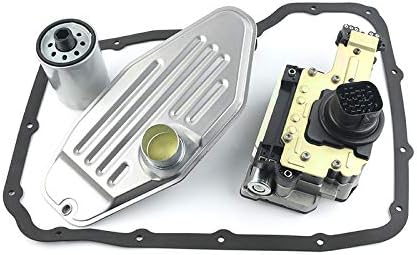
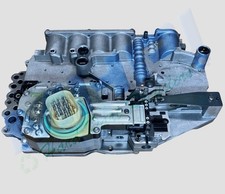
How the 45RFE Controls Shift Feel
Two systems decide how a shift feels, and you need both working before you blame hard parts.
Clutch volume index (CVI)
ATRA's 45RFE procedure defines the clutch volume index as the volume of fluid needed to stroke the clutch piston against its return spring. The controller watches how long each clutch takes to fill. If a shift runs longer or shorter than normal, it adjusts the solenoid duty cycle to compensate, which is how it keeps shift feel consistent as the clutches wear. Each CVI is only updated during one particular shift, with fluid above 110 F:
| Clutch | Updated on | ATRA normal range |
|---|---|---|
| L/R | 2-1 or 3-1 manual downshift, throttle below 5 degrees | 82-134 |
| 2C | 3-2 kickdown, throttle 24-54 degrees | 25-64 |
| OD | 2-3 upshift | 25-64 |
| 4C | 3-4 upshift, throttle 5-54 degrees | 30-64 |
| UD | 4-3 kickdown, throttle 20-54 degrees | 44-92 |
These numbers are your first clue. A CVI that sits high is telling you that clutch takes more oil than normal to apply, which means extra clearance or a leak somewhere in that circuit. A CVI that runs very low means the piston strokes almost immediately. Chrysler's inadequate element volume codes (P2704 for 4C, for example) set when a CVI drops too low, and the listed causes start with mechanical faults like a broken return spring or a dislodged snap ring. Either way, a CVI outside its range points you at one clutch, and the controller can only compensate so far.
Closed-loop line pressure
Chrysler's P0868 procedure lays out how pressure is managed. The line pressure sensor reads actual pressure, and the controller sets it by changing the pressure control solenoid duty cycle: 5 percent is solenoid off and maximum pressure, 62 percent is solenoid on and minimum pressure. Desired pressure is calculated mostly from engine torque (Chrysler calls this Torque Based Line Pressure), and during shifts and in Park and Neutral it is set to a preset 120 or 135 psi for consistent shift quality.
That closed loop is why a bad sensor can cause a harsh shift. The controller believes its sensor. If the sensor reads low, the controller raises real pressure to match what it thinks it needs, and every shift gets firmer.
Cause 1: Unlearned or Wrong Learned Values
Any time the solenoid/TRS assembly, the valve body, the clutches or the controller have been touched, the learned values no longer match the hardware. ATRA TB 990 says a Quick Learn must be done after a transmission repair, because new seals, rings and clutches mean shift qualities have to be relearned and CVIs reset to base values, and the truck still has to be driven to fine tune them.
Here is the trap. ATRA's 45RFE procedure also says Quick Learn should not be used as a remedy for shift quality complaints. It resets more than 70 learned parameters to preset values, and it is intended only after the transmission has been replaced or overhauled, or the controller replaced or flashed. On a truck that was fine yesterday and is harsh today, a Quick Learn throws away good data. The better move is the drive learn for the specific shift that feels wrong.
Drive learn procedures, by complaint
- Harsh or delayed first shift into Drive after sitting. After 10 minutes or more with the engine off, air can get trapped in the UD clutch, and the controller keeps a separate "1st N-1 UD CVI" for that shift. With fluid at 80-110 F, start the engine after a 10 minute off period, shift Neutral to Drive with the brake applied, and record the value. Repeat until it stabilizes.
- Harsh Neutral to Drive after the first shift. Fluid at 80-110 F. Drive to at least 10 mph, stop, then do repeated N-D shifts, pausing in Neutral 2-3 seconds each time, until the UD CVI stabilizes.
- Harsh first 2-3 after a restart or a shift to Reverse. Fluid above 80 F. Hold Reverse for over 2 seconds, then accelerate from a stop at a steady 15 degrees of throttle through the 2-3, noting the "1st 2-3 OD CVI." Repeat until it stabilizes.
- Harsh 2-3 and 3-4. Fluid above 110 F. Repeated 1-2, 2-3 and 3-4 upshifts at a steady 15 degrees of throttle until the OD and 4C CVIs settle.
- Harsh 4-3 coastdown or part-throttle kickdown. Fluid above 110 F. Repeated 4-3 kickdowns at 40-60 mph until the UD volume settles.
- Harsh 3-2 kickdown. Fluid above 110 F. Repeated 3-2 kickdowns in 3rd below 20 mph (TB 990) until the 2C CVI settles.
- Harsh manual 2-1 or Neutral to Reverse. Fluid above 110 F. Manual pulldowns from 2nd to Low at 25-30 mph, closed throttle, to learn L/R. Then repeated N-R shifts at a stop; ATRA notes an unlearned N-R may be harsh or give a double bump.
ATRA's closing line on these procedures is the one that matters: if a shift is still not smooth after the clutch volume stabilizes, an internal transmission problem may be present. Always confirm the controller has the latest software.
Cause 2: Shifter Cable and the T3/T4 Codes
This is the cheapest harsh shift fix on the truck, and it is missed all the time. The range sensor reports lever position as switch codes, including transitional "Temp" positions between gears. ATRA's 45RFE procedure says a misadjusted shifter will not set the CHECK PRNDL fault but will cause poor 2-3 shift quality, and that a T3 or T4 code with the lever in the OD gate is the most likely cause of a consistently poor 2-3. TB 990 adds that transitional range signals cause erratic shift concerns that will not set a code.
With the lever in OD, the scan tool must read OD. If it shows T3 or T4, or flickers there when you nudge the lever, adjust the cable before anything else. Chrysler's quick check: the engine must start in both Park and Neutral. Our 45RFE no-overdrive guide covers the range sensor codes in more detail.
Cause 3: Old Controller Software
Chrysler released shift quality updates early in the 45RFE's life. Transmission Digest summarized one: 2000-2001 Dakota and Durango and 1999-2001 Grand Cherokee with the 45RFE or 545RFE and the 4.7L could show a harsh 2-3 upshift with a clunk or shudder on acceleration, or (2001 Jeep only) a harsh 4-5 upshift or 5-4 downshift. The fix was a "Shift Quality Enhancement" software update to the TCM or PCM, with Grand Cherokee TCM part number 05019701AC listed for 1999-2001. On any early truck with a shift quality complaint, check the calibration against current bulletins before you open the pan. After a flash, a Quick Learn is correct, since the controller was reprogrammed.
Cause 4: Line Pressure Sensor and Pressure Control
Harsh shifts across every gear, not just one, point at pressure. Chrysler's P0868 procedure gives two checks that work on any RFE with a harsh complaint, code or not:
- Connector check. With the engine off, push on the line pressure sensor connector and watch the scan tool. If line pressure jumps to about 30 psi, you have a connection problem: disconnect, reconnect and repair the terminals.
- Gauge versus scan tool. Install a gauge and compare. Chrysler's spec is that the gauge must read within 5 psi of the scan tool. If it does not, replace the line pressure sensor. A sensor that reads low makes the controller drive real pressure high, and you get firm shifts everywhere.
P0868 itself sets when actual pressure is more than 15 psi below desired for 3.5 seconds, and the causes include low fluid, a cracked or plugged primary filter, a loose cooler return filter, and a stuck main regulator valve.
Watch the pressure control solenoid duty cycle too. Rob Faucett, writing in GEARS, points out that as internal leaks develop the controller reduces duty cycle to hold desired pressure, and the closer it has to get to 5 percent to maintain normal pressure, the bigger the leaks inside the transmission. A truck that is near the bottom of that range at idle has little margin left, and shift feel starts to wander.
Cause 5: Pressure Regulator Valve Bore Wear
The main regulator valve in the RFE valve body wears its bore. Sonnax lists the symptoms for its oversized pressure regulator valve kit (44912-10K, fitting the 45RFE, 545RFE, 65RFE, 66RFE and 68RFE): harsh shifts, erratic line pressure, high line pressure, soft shifts, burnt clutches, broken parts from excessive line pressure, and restricted converter and lube flow. The cause, in Sonnax's words, is excess bore wear allowing fluid loss that prevents normal line pressure control.
The tell is a truck with a good sensor (gauge and scan tool agree) whose pressure still overshoots or swings while the duty cycle hunts. That is a valve body repair: ream the bore and install the oversized valve, or replace the valve body. Chrysler's own cause list for P0868 includes a stuck or sticking main regulator valve, which is the same failure from the other side. Our 45RFE valve body testing guide covers bore and switch valve checks.
Cause 6: It Really Is Internal
When the cable reads right, the software is current, the sensor agrees with the gauge and the CVIs still will not settle into range, the problem is hard parts. A CVI that climbs high points at a leaking seal, a cut check ball or excess clearance in that one circuit. A CVI stuck very low points at a broken return spring or a snap ring out of place. A pan full of friction material settles it. Our 45RFE slipping guide covers the OD and 4C failure patterns.
A Diagnostic Order That Works
- Check fluid level at temperature and confirm the correct fluid. The 45RFE takes ATF+4; see our 45RFE fluid guide.
- Pull codes. Fix any line pressure, sensor or pressure switch codes first.
- Confirm the lever position reads OD in the OD gate, not T3 or T4.
- Check the controller calibration against current bulletins.
- Push-test the line pressure sensor connector, then compare the gauge to the scan tool (within 5 psi).
- Read the CVIs warm and compare to ATRA's ranges. Run the drive learn for the specific harsh shift.
- If shifts are still harsh after the CVIs settle, go inside: regulator bore, seals, check balls and clutch clearances.
Sonnax oversized pressure regulator valve kit 44912-10K, at Core Transmission Parts
For RFE valve bodies with a worn regulator bore causing harsh shifts and erratic or high line pressure. Fits 45RFE, 545RFE and 68RFE; requires reaming the bore.
View the Sonnax 44912-10K kit →45RFE pressure sensors, solenoid packs, valve bodies and rebuild kits, shipped fast from the USA.
Shop 45RFE parts →Related guides
- 45RFE / 545RFE Valve Body Problems: Symptoms and Testing
- 45RFE Shift Solenoid Symptoms, Testing and Replacement
- 45RFE Won't Shift Into Overdrive
- 45RFE Slipping: Causes and Fix
- 545RFE Line Pressure Testing: Specs and Procedure
- 68RFE Harsh Shift Causes
FAQ
What causes a 45RFE to shift hard?
The most common causes are clutch volume indexes that have not been learned, a shifter cable that leaves the range sensor reading a transitional T3 or T4 code, outdated TCM software, and line pressure problems such as a bad line pressure sensor or a worn pressure regulator valve bore. If a shift is still harsh after the clutch volumes stabilize, ATRA says an internal problem may be present.
Will a Quick Learn fix a 45RFE harsh shift?
Usually not. ATRA's 45RFE procedure says Quick Learn should not be used as a remedy for shift quality complaints. It resets more than 70 learned parameters to preset values and is meant for use after an overhaul, a transmission replacement, or a TCM replacement or flash. For a single bad shift, use the drive-learn procedure for that shift instead.
Why is my 45RFE harsh only on the first shift into Drive in the morning?
After the engine has been off for 10 minutes or more, air can get trapped in the underdrive clutch circuit. The TCM keeps a separate first N-1 UD CVI value to account for it. ATRA's procedure is to relearn that value with fluid between 80 and 110 F, repeating Neutral to Drive shifts after 10 minute engine-off periods until the value stabilizes.
What are normal 45RFE clutch volume index values?
ATRA lists these ranges for the 45RFE: L/R 82-134, 2C 25-64, OD 25-64, 4C 30-64 and UD 44-92. Each value is only updated during a specific shift with fluid above 110 F, so read them warm and after the matching shift has been performed.
Sources
- ATRA Technical Bulletin 990: "41TE/42LE/42RLE/45RFE/545RFE Series Module Strategies and Learn Values" (February 2006). Quick Learn required after repair and resetting more than 70 parameters, the RFE drive learn procedures with their fluid temperature windows, the T3/T4 transitional range warning, and the "internal problem may be present" and latest-software notes. atracom.blob.core.windows.net
- ATRA 2002 technical seminar manual, Chrysler 45RFE Quick Learn Procedure (pages 182-187). The clutch volume index definition, the shift and throttle conditions that update each CVI, the normal ranges (L/R 82-134, 2C 25-64, OD 25-64, 4C 30-64, UD 44-92), Quick Learn not to be used for shift quality complaints, and the misadjusted shifter causing poor 2-3 quality without code 28. atracom.blob.core.windows.net
- Chrysler 45RFE/545RFE service information: P0868 Line Pressure Low and P2704 Inadequate Element Volume 4C. Torque Based Line Pressure, the 120/135 psi preset during shifts, 5 and 62 percent PCS duty cycle limits, the 15 psi / 3.5 second set condition, the 30 psi connector push check, the 5 psi gauge-to-scan-tool spec and cause list and the low-CVI mechanical causes. P0868, P2704
- Transmission Digest: "Dodge/Jeep Trucks with 45RFE/545RFE Transmissions: Harsh Shifts" (February 2006 issue). The harsh 2-3 with clunk or shudder and 2001 Jeep harsh 4-5 and 5-4 complaints on 4.7L vehicles, and the Shift Quality Enhancement software update with controller part numbers. transmissiondigest.com
- Sonnax: Oversized Pressure Regulator Valve Kit 44912-10K. Harsh shifts, erratic and high line pressure, burnt clutches and restricted converter and lube flow from regulator bore wear on the 45RFE, 545RFE, 65RFE, 66RFE and 68RFE. sonnax.com
- GEARS Magazine (ATRA): "Controlling Pressure, Part 2: Chrysler" by Rob Faucett (March 2024). RFE pressure control solenoid duty cycle from 5 to 62 percent, closed-loop compensation for internal leaks, and duty cycle near 5 percent as a sign of internal leakage. gearsmagazine.com