A 68RFE that bangs into gear is one of the easier complaints to misdiagnose, because the same feel can come from four very different places. It can be software the truck never got. It can be adaptive values that were wiped by a battery disconnect or a flash and never relearned. It can be a pressure problem, stock or tuned. Or it can be hardware: a worn bore in the valve body, a converter regulator valve that no longer holds pressure steady, or a clutch pack a rebuilder set too tight. Only the last group needs parts, and it is usually the last one you should check.
This is the order I work a harsh shift on the 68RFE behind the 6.7L Cummins in 2007.5-and-later Ram 2500, 3500 and cab chassis trucks. The clutch and adaptive logic comes from ATSG. The software fixes come from Ram service bulletins filed with NHTSA. The pressure and wear data comes from GEARS magazine and Sonnax. The full list is at the bottom.

First, Pin Down Which Shift Is Harsh
"It shifts hard" is not a diagnosis. The 68RFE applies two clutches in every range, per ATSG, and each shift is one clutch releasing while another applies. If you know which shift is harsh, you know which two clutches and which solenoids are involved:
| Gear | Ratio | Applied clutches |
|---|---|---|
| Reverse | 4.44:1 | Reverse + L/R |
| 1st | 3.23:1 | UD + L/R (L/R only below 150 rpm output) or low sprag |
| 2nd | 1.83:1 | UD + 2C |
| 3rd | 1.41:1 | UD + 4C |
| 4th | 1.00:1 | UD + OD |
| 5th | 0.81:1 | OD + 4C |
| 6th | 0.62:1 | OD + 2C |
Solenoids control the L/R, 2C, 4C, UD and OD clutches. ATSG notes that the Reverse clutch is different: it is applied by the manual valve and line pressure, not a solenoid. That matters. A harsh Neutral-to-Reverse engagement does not have the same cause as a harsh 1-2, and a solenoid pack alone rarely fixes a Reverse bang.
Road test with a scan tool. Log commanded gear, input and output speed, line pressure (commanded and actual), trans temperature and TCC slip. Write down which shift is harsh, whether it happens cold or hot, and whether it is on upshifts, coast downshifts or garage shifts. Harsh only when cold and fine when warm points at adaptives and fluid. Harsh on every shift points at pressure. One harsh shift points at one circuit.
Step 1: Check for a Software Update
Before you touch the transmission, find out if the truck has current software. Ram has released several flashes that specifically list 68RFE shift quality as a fix.
- Service bulletin 18-037-16 Rev. A (April 2016) covers 2015 Ram 2500 and 3500 pickups with the 6.7L Cummins (sales code ETK). Along with a list of emissions codes, the reflash includes "68RFE Transmission overall shift quality improvements."
- Service bulletin 18-066-23 (May 2023) covers 2019 Ram 2500 and 3500 pickups with the 6.7L Cummins and HO Cummins. It lists transmission upshift quality enhancements (68RFE only), overall shift schedule improvements, improved shift quality in 4LO, and a fix for a harsh downshift clunk during exhaust brake deceleration. It also covers 68RFE codes P0868 (line pressure low) and P0870 (hydraulic pressure test).
Note the repair procedure in 18-066-23. After flashing the PCM, the bulletin asks one question: is the truck equipped with the 68RFE? If yes, perform the transmission Quicklearn procedure before clearing codes. It also calls for a battery charger during the flash to keep voltage between 13.2 and 13.5 volts. A flash done without the quick learn is a common reason a truck comes back shifting worse than it left.
One caution. Plenty of Ram bulletins mention "harsh 2-3 and 3-4 shift" on Cummins trucks, but some of those apply only to the Aisin six-speed in the 3500 and cab chassis trucks. Check the sales code in the bulletin before you promise a customer a flash will fix it.
Step 2: Reset and Relearn the Adaptives
The 68RFE learns how to shift. Per ATSG, the TCM uses adaptive learning to change the clutch apply rate as the friction elements wear. It adjusts the duty cycle of the shift solenoids to get the smoothest upshifts and downshifts, and it updates a clutch volume index (CVI) on each shift to set clutch-to-clutch timing. The CVI is basically how much fluid it takes to fill a clutch. As the clutch wears, the number grows and the TCM compensates.
That system causes its own harsh shifts in three situations:
- After a battery disconnect or module flash. The learned values reset, and the truck shifts hard until it relearns them or someone runs the quick learn.
- After a rebuild or valve body swap. The TCM is still using values learned on the old, worn clutches. New clutches fill faster, so the old timing makes the shift overlap and bang. Sonnax says a fast learn should be done after any RFE repair so the transmission is recalibrated for correct function.
- When the adaptives have run out of range. If a clutch is worn or leaking badly, the TCM keeps adding fill time until it cannot add more. Then the shift quality falls apart. The CVI on that clutch will look high compared to the others.
Run the quick learn with a scan tool that supports it, with the fluid at operating temperature and the level correct. Then road test through every gear several times at light throttle so the TCM can finish learning. If the harsh shift goes away, you are done. If it comes right back, look at the CVI for the clutch involved in that shift and move to hardware.
Step 3: Check Line Pressure
The 68RFE uses a line pressure sensor and a pressure control solenoid, so the TCM knows actual pressure and commands what it wants. On the scan tool, compare commanded and actual line pressure and watch the duty cycle.
GEARS magazine gives the stock numbers: about 60 to 70 psi commanded at idle, with a 22 to 24 percent duty cycle. A healthy unit shows 18 percent or higher at idle. Under 10 percent is a problem. If the duty cycle sits near 5 percent and actual pressure is still under commanded, the transmission is asking for more than the pump can give.
That is where tuning comes in. GEARS reports that aggressive programming commands pressure the pump cannot keep up with. You get firm, banging shifts, less cooler flow and more heat. Oversized tires on stock axle gearing do something similar. They keep the unit at high pressure all the time, and the extra heat hurts the clutches. If the truck is tuned and shifts harsh, put the stock calibration back in before you blame the transmission.
Sonnax measured the same thing from the other side. On stock programming, desired and actual line pressure at a stop in Drive both read 60 to 70 psi with a 22 to 24 percent duty cycle, then about 160 psi at stall. A typical tune shows 100 to 105 psi desired and actual at idle, with the duty cycle down at 5.1 percent, per Sonnax's RFE tuning article. Sonnax also warns that the desired value still displays normally even when actual is zero, so always read both. If the harsh shift comes with slow engagement into Drive or Reverse, see our 68RFE delayed engagement guide.
If pressure reads right and matches commanded, the harsh shift is further downstream, in the valve body or the clutch pack.
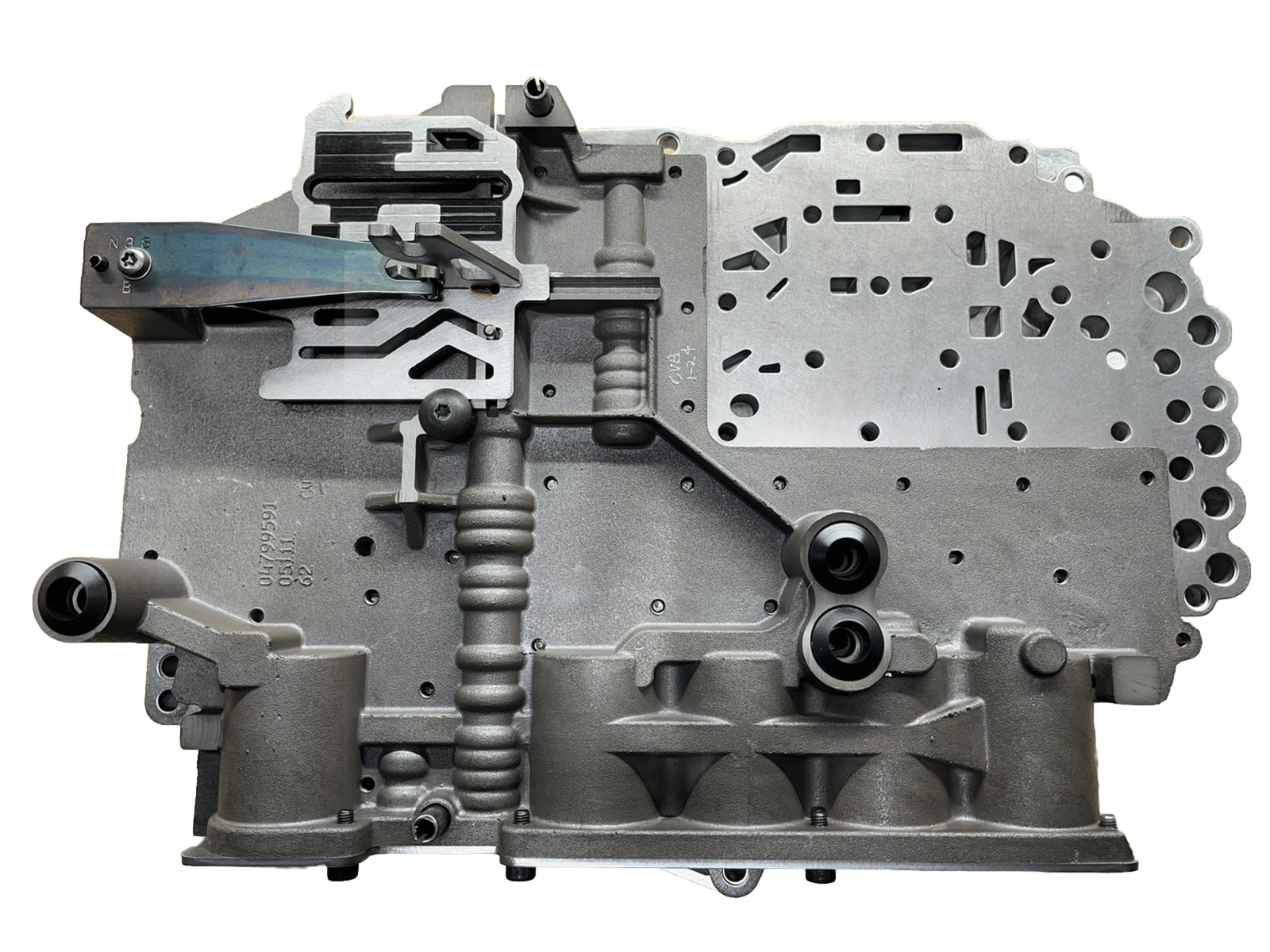
Step 4: Valve Body Wear
Solenoid switch valve bore
The solenoid switch valve (SSV) and its bore plug work on every shift in the lower gears. Sonnax lays out the cycle: the plug strokes to feed the 2C clutch on the 1-2, strokes against the switch valve on the 2-3, and strokes back to feed the OD clutch on the 3-4. That constant movement wears the aluminum bore. When it wears, apply oil leaks across circuits and shift timing goes wrong. GEARS ties SSV wear to P0871 codes, burnt OD clutches, second-gear starts and binding shifts. A bind-up is a harsh shift where two clutches are briefly applied together.
Vacuum test the SSV bore and plug. Sonnax calls it a quick, effective check. If it fails, the bore gets reamed and an oversized valve and plug go in. A new solenoid pack will not fix a worn bore.
Torque converter regulator valve and TCC
A lot of "harsh shifts" on these trucks are really converter clutch events. GEARS explains that the torque converter regulator valve controls converter clutch apply pressure. When its bore wears, you get rough TCC apply and release, engine stall at a stop, and extra converter slip that is often mistaken for a 4-5 flare. A TCC that releases hard just before a downshift feels like a harsh downshift. Watch TCC slip and TCC duty cycle on the road test. If the bump lines up with converter apply or release, look at the regulator valve before you look at the clutches.
Pressure regulator valve bore
If every shift is firm, hot or cold, and actual line pressure runs above commanded or wanders while commanded is steady, look at the pressure regulator valve before the clutches. Per Sonnax, excess wear in the OE pressure regulator bore lets fluid escape around the valve, so it can no longer hold line pressure where the TCM wants it. Sonnax lists harsh shifts, soft shifts, high or erratic line pressure, burnt clutches and restricted converter and lube flow as the result. The fix is reaming the bore for an oversized valve, such as Sonnax 44912-10K, which fits the 45RFE, 545RFE, 65RFE, 66RFE and 68RFE and requires the F-44912-TL10 tool kit.
TCC accumulator spring (2018 and earlier)
On pre-2019 units, a bump at cruise with no gear change can be a harsh converter clutch apply. Sonnax ties harsh TCC apply to the OE TCC accumulator spring in the pump, which it says is overstressed in this application and fatigues or breaks; its 44912-01 replacement fits the 68RFE through 2018. Sonnax also notes that once the TCC fully applies, apply pressure equals line pressure, about 160 psi on a stock unit in forward ranges, so a tune that raises line pressure makes every lockup harder.
What changed in 2019
Sonnax documents a big hydraulic redesign for 2019 and later 68RFEs. The pump lost its TCC accumulator, and the converter regulator valve and TCC switch valve were changed. A new lower valve body section adds a Reverse accumulator and a dedicated TCC control solenoid. On earlier units the L/R solenoid controlled both the L/R clutch and the TCC. On 2019 and later it controls the L/R clutch only. The solenoid pack connector went from gray to blue. Sonnax says the changes were made to improve TCC apply and release control and to deal with Reverse release clunk complaints. Two takeaways: a harsh Reverse or TCC event on a pre-2019 truck is a known weakness of the design, and 2019-up valve bodies and solenoid packs do not swap with earlier ones.
Step 5: Clutch Clearance After a Rebuild
If the truck shifted fine before a rebuild and harsh after, and a fast learn does not fix it, check the clutch clearances. Sonnax explains that setting clearance too tight shortens fill time and makes the clutch apply faster, which can cause a bind-up. The opposite mistake, setting it too loose, lengthens fill time and lets the thin OE frictions drag and overheat. Neither one is fixed by software. Set every pack to the spec in the service information, not by feel.
Also check the pressure switches if you get codes along with the harsh shift. ATSG says the five switches in the solenoid block (L/R, 2C, 4C, UD and OD) close at 23 psi and open at 11 psi and only report whether pressure exists. A pressure switch code with a harsh shift usually means a circuit is applying when it should not, or not releasing on time.
Quick Diagnostic Order
- Identify the exact shift: garage shift, a specific upshift, coast downshift, or TCC apply.
- Check fluid level hot and trans temperature.
- Check for a TCM or PCM flash (18-037-16, 18-066-23 and later) for the truck's year and engine.
- Run the quick learn and road test. Check the CVI on the clutch involved.
- Compare commanded and actual line pressure and the duty cycle. Put a tuned truck back to stock.
- Vacuum test the solenoid switch valve bore. Check converter regulator valve wear if the bump lines up with TCC apply or release.
- After a rebuild, verify clutch clearances. After any repair, run the fast learn again.
Sonnax Sure Cure kit SC-RFE-453-19 at Core Transmission Parts
Sonnax's kit for 2019-and-later 68RFEs, built to repair the areas most prone to TCC problems and other shift quality issues. For 2007.5-2018 units, the SSV plug kits cover the most common worn bore.
View the Sure Cure kit →68RFE valve bodies, solenoid kits, accumulator pistons and rebuild kits — shipped fast from the USA.
Shop 68RFE parts →Related guides
- 68RFE P0868 Line Pressure Low Fix
- 68RFE Slipping: Causes and Fix
- 68RFE Valve Body Problems and Testing
- 68RFE Shift Solenoid Symptoms
- 68RFE Won't Shift Into Overdrive
- 68RFE Delayed Engagement: Causes and Fix
- 66RFE Harsh Shift Causes and Fix
FAQ
Why does my 68RFE shift hard?
The most common causes are software and adaptives, not hard parts. Ram released TCM and PCM flashes that list 68RFE shift quality and upshift quality improvements, and every repair or flash needs a quick learn afterward. If the truck still shifts hard after that, check line pressure, solenoid switch valve bore wear, torque converter regulator valve wear and clutch clearance.
Will a relearn fix a 68RFE harsh shift?
It fixes the harsh shifts that come from bad or reset adaptive values. Per ATSG, the TCM uses the clutch volume index to adjust solenoid duty cycle as the clutches wear, and a battery disconnect, flash or rebuild throws those values off until the quick learn is run. It will not fix a worn valve body bore or a clutch pack set too tight.
Is there a TSB for 68RFE harsh shifts?
Yes, as flash updates. Service bulletin 18-037-16 for 2015 Ram 2500/3500 6.7L trucks includes 68RFE overall shift quality improvements, and bulletin 18-066-23 for 2019 Ram 2500/3500 Cummins trucks includes 68RFE upshift quality enhancements, a fix for a harsh downshift clunk under exhaust brake, and a required quick learn after the flash.
What causes a 68RFE to clunk going into reverse?
The Reverse clutch is applied by the manual valve and line pressure, not a solenoid, so check fluid level, line pressure and software first. Sonnax notes that on 2019 and later 68RFEs Chrysler added a Reverse accumulator in a new lower valve body section and a dedicated TCC solenoid, partly to deal with Reverse release clunk complaints on the earlier design.
Can a tuner cause harsh shifts on a 68RFE?
Yes. GEARS magazine reports that stock idle line pressure is about 60 to 70 psi commanded with a 22 to 24 percent duty cycle, and aggressive tunes can command more pressure than the pump can supply. That makes shifts firm, cuts cooler flow and adds heat. Big tires on stock gearing load the unit the same way.
Sources
- ATSG — Dodge Ram Trucks 68RFE Transmission, Technical Service Information (2011). Clutch and ratio chart, L/R on only below 150 rpm output speed, solenoid control of L/R, 2C, 4C, UD and OD with Reverse applied by the manual valve and line pressure, adaptive learning and the clutch volume index, and pressure switches closing at 23 psi and opening at 11 psi. atsg.biz (PDF)
- FCA US / NHTSA — Service Bulletin 18-066-23, Flash: Powertrain Control Module Updates (May 2023). 2019 Ram 2500/3500 Cummins: 68RFE upshift quality enhancements, harsh downshift clunk during exhaust brake deceleration, P0868 and P0870, the 13.2-13.5 V charger requirement and the Quicklearn step for 68RFE trucks. static.nhtsa.gov (PDF)
- FCA US / NHTSA — Service Bulletin 18-037-16 Rev. A, Flash: 6.7L Diagnostic and System Improvements (April 2016). 2015 Ram 2500/3500 6.7L Cummins reflash including 68RFE overall shift quality improvements. static.nhtsa.gov (PDF)
- ATRA / GEARS Magazine — "Fixing the Root Cause of the Problem: Solving Issues with the 68RFE Transmission." Stock idle line pressure of 60-70 psi at 22-24% duty cycle, the 18% healthy and under-10% warning values, tunes exceeding pump capacity, oversized tires, TC regulator valve wear causing rough TCC apply and release, and SSV wear causing binding shifts. gearsmagazine.com
- Sonnax — "Troubleshooting RFE Overdrive Clutch Failure: Three Key Areas to Check." SSV bore plug travel on the 1-2, 2-3 and 3-4 shifts, vacuum testing the SSV, tight clearance causing bind-up and loose clearance causing drag, and the fast learn after any RFE repair. sonnax.com
- Sonnax — "Resolving Stalling & Overheat Issues After Performance Tuning on RFE Transmissions" (March 11, 2021). Stock 60-70 psi desired and actual line pressure at a stop in Drive with 22-24% duty cycle and 160 psi at stall, tuned 100-105 psi at 5.1% duty cycle, and the caution that desired pressure still displays when actual is 0 psi. sonnax.com
- Sonnax — "Chrysler 68RFE '19-Later Changes & Identification." Removal of the pump TCC accumulator, new lower valve body with Reverse accumulator and dedicated TCC solenoid, L/R solenoid controlling only the L/R clutch, gray-to-blue connector change, and the Reverse release clunk fix. sonnax.com
- Sonnax — Oversized Pressure Regulator Valve Kit 44912-10K. Pressure regulator bore wear causing fluid loss and loss of line pressure control, with harsh shifts, soft shifts, high or erratic line pressure and burnt clutches; RFE applications and F-44912-TL10 tooling. sonnax.com
- Sonnax — TCC Accumulator Spring 44912-01, and "Prevent RFE Converter Failure: Maintain Proper TCC Apply Pressure." Harsh TCC apply from a fatigued or broken OE pump TCC accumulator spring ('18-earlier 68RFE), full TCC apply equaling line pressure and about 160 psi stock. sonnax.com • TCC apply article