A 68RFE that slips is almost never "just slipping." It is one or two specific clutches losing their grip, and the transmission tells you which ones if you know how it builds its gears. The mistake I see over and over is a truck that comes in with a flare into 5th, gets a fluid service and a tune reset, and is back in a month with the overdrive pack cooked.
This is how I chase slip on the 68RFE behind the 6.7L Cummins in 2007.5-and-later Ram 2500 and 3500 trucks: use the gear it slips in to name the clutch, confirm it on the scan tool, then find out why that clutch lost apply before anybody orders frictions. The mechanical and hydraulic facts come from ATSG, Sonnax, ATRA's GEARS magazine and Ram's own owner's manual. The full list is at the bottom.


Step Zero: Fluid Level, Checked Hot
Rule out the cheap answer first. Ram's fluid level procedure for this 6-speed has you check with the fluid at normal operating temperature, 158-176 F (70-80 C), reading between the HOT reference holes on the dipstick. Earlier Ram literature splits the two six-speeds: the 2017 Ram Diesel Supplement lists 170-180 F (77-82 C) for the 68RFE and 158-176 F for the Aisin AS69RC, so on an older 68RFE truck let it get fully up to temperature before you read the stick. The same supplement puts trucks used for frequent trailer towing on a 60,000-mile fluid and filter change instead of 120,000, and on a working truck that slips, a skipped towing service is one of the first things I ask about. Cold, the level reads low and people overfill. Low, the pump draws air on hard stops and turns, and you get a slip that comes and goes with the fluid sloshing in the pan.
While the dipstick is out, smell it and look at it. Burnt fluid with black flecks on the stick means a clutch has already been slipping hard enough to shed material. The fluid is now a symptom, and changing it does not fix anything. The owner's manual calls for ATF+4 in this unit. If somebody has topped it off with a universal jug, the friction characteristics are not what the TCM's adaptives were learned on.
How the 68RFE Builds Its Gears
Per ATSG, the 68RFE applies two clutches at a time in every range. The input clutch housing carries the underdrive (UD), overdrive (OD) and reverse clutches. The case holds the 2nd (2C), 4th (4C) and low/reverse (L/R) clutches, plus one freewheel, the low sprag. Solenoids control L/R, 2C, 4C, UD and OD. The reverse clutch is fed by the manual valve and line pressure, not by a solenoid.
| Range | Ratio (ATSG) | Applied clutches |
|---|---|---|
| Reverse | 4.44:1 | Reverse + L/R |
| 1st | 3.23:1 | UD + L/R (L/R only below 150 rpm output in Drive; low sprag holds above that) |
| 2nd | 1.83:1 | UD + 2C |
| 3rd | 1.41:1 | UD + 4C |
| 4th | 1.00:1 | UD + OD |
| 5th | 0.81:1 | OD + 4C |
| 6th | 0.62:1 | OD + 2C |
That table is the whole diagnosis. Every clutch shows up in more than one gear, so the pattern of good gears and bad gears points at the common element:
- Slips in 4th, 5th and 6th, fine in 1st through 3rd: the OD clutch. This is the big one on this unit.
- Slips in 1st through 4th, 5th and 6th feel fine: the UD clutch.
- Slips in 2nd and 6th: the 2C clutch.
- Slips in 3rd and 5th: the 4C clutch.
- Reverse only: the reverse clutch or its manual-valve feed. Reverse and a slipping launch in manual 1st: L/R.
- Slips everywhere, including reverse: stop looking at clutches. Think line pressure, pump, filter, fluid level or the converter.
Confirm It on the Scan Tool
The TCM compares input and output shaft speed to calculate gear ratio, catch ratio errors, update clutch volume index (CVI) and measure converter clutch slip. You can do the same thing. Log input speed, output speed, gear commanded, TCC slip and trans temp on a road test, then divide input rpm by output rpm in each gear and compare it to the table above. A healthy 4th reads right at 1.00. A 4th that drifts to 1.05, 1.10 and climbs under throttle is a clutch letting go, and the TCM will eventually log a ratio code for it (the P0731-P0736 family).
Do not mistake converter slip for a clutch flare
GEARS magazine calls this out directly: a worn torque converter regulator valve can cause excessive TCC slip that is easy to mistake for a flare on the 4-5 shift. The same wear shows up as stalling at stops and harsh TCC apply and release. So when you see a flare around 4-5, look at engine rpm against input shaft speed as well as input against output. If input and output hold the correct ratio and the engine is the one running away from the input shaft, the clutches are fine. It is a converter clutch control problem.
Line pressure and duty cycle
Pull up desired line pressure, actual line pressure and the line pressure duty cycle in Drive at idle. GEARS gives a healthy stock unit as about 60 to 70 psi commanded and actual with the duty cycle at 22 to 24 percent. It says anything under 10% is unsuitable, and a duty cycle parked at 5% signals a pressure problem. That is also what you see on a lot of tuned trucks, where the program commands so much pressure the regulator strokes past the circuit that feeds the converter and lube. If the scan tool reading looks suspect, Sonnax points to the OE line pressure adapter, tool No. 8259. It installs in place of the line pressure sensor so you can check real line pressure against what the sensor reports.
Pressure switch codes are a clue, not a verdict
Per ATSG, the solenoid pack has five pressure switches, one each on the L/R, 2C, 4C, UD and OD circuits. They close at 23 psi and open at 11 psi. They only tell the TCM that pressure exists, not how much. A clutch can slip with its switch reading closed. Sonnax ties P0871 (the OD pressure switch rationality code), plus P0841, P0868 and P0988, to solenoid switch valve problems. When one of those shows up next to OD slip, it points you at the valve body before the clutch pack. We have a separate breakdown in the 68RFE P0871 guide.
Why the OD Clutch Is the Usual Victim
The OD clutch is on in 4th, 5th and 6th, which means it carries the truck at highway speed and while towing. It is also the weakest pack in the box. Sonnax measures the OE OD steels at 0.034 in. with single-sided frictions, against 0.080 in. steels in a 4L80-E direct clutch. Thin steels do not have the mass to soak up heat. They warp, the pack stops releasing cleanly, it drags, and a dragging pack burns up. Here is what does it, roughly in the order I check.
1. Solenoid switch valve bore plug wear
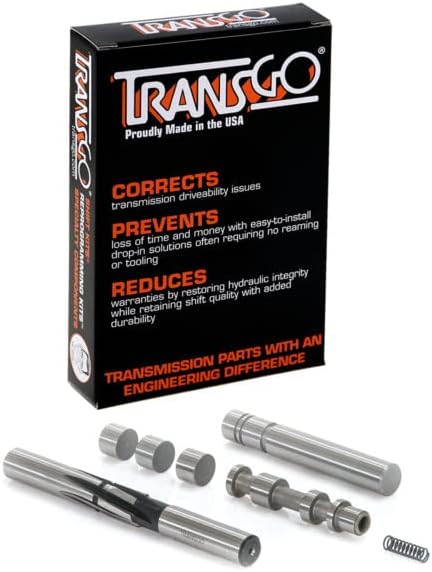
The solenoid switch valve (SSV) strokes on the 1-2, 2-3 and 3-4 shifts, and Sonnax says the bore plug area takes the heaviest wear. The worn bore cross-leaks OD apply oil, so the pack gets less holding force than the TCC thinks it is commanding. GEARS lists the fallout of SSV wear: burnt 4C and OD clutches, second-gear starts, bind-ups and stalling from improper lockup. Vacuum test the SSV bore and plugs. If the bore is worn, ream it and fit an oversized valve and plug set. New frictions on a leaking SSV bore will fail the same way.
2. Line pressure wrong in either direction
Sonnax describes both failure modes. Too low, and the OD pack does not have the apply force to hold torque, so it slips and heats. Too high, and oil forces its way past a worn SSV bore and partially applies the clutch when it should be released, or stops it releasing at all. Either way the OD pack ends up slipping in some gear and cooking itself.
3. OD housing flex
Sonnax found that the top of the OE OD clutch housing is unsupported and flexes under apply. That opens up the effective clearance and heats the frictions early. This is why the common permanent fix for OD burn-up on a working truck is an upgraded OD housing that holds a taller pack with thicker steels. Sonnax rates its Smart-Tech housing kit at 20% more clutch capacity.
4. Solenoid conductor plate warp
The conductor plate on the solenoid pack is unsupported, and Sonnax reports it can warp under the connector seal force and bleed off OD apply pressure. On a unit with repeat OD failures, check the pack seating and flatness, not just the solenoids electrically.
5. Dribbler valve and the OD/reverse piston orifice
GEARS explains that the dribbler valves let a small amount of fluid into the drum to keep the circuit pre-charged. There is also a small orifice inside the OD/reverse piston that gives controlled leakage. If the orifice is restricted, the dribbler oil builds pressure and partially applies the clutch, and you get a failure that looks exactly like the one you just fixed. Sonnax's check for the stator dribbler valve is to apply air and confirm it flows from pump to drum only, not in reverse.
The Other Clutches
UD slip (1st-4th): UD is the other single-sided pack in the input housing, and it takes full engine torque on every launch. Check the input clutch retainer seal surfaces and stator support bushings on teardown. GEARS notes worn bushings chew up the internal hubs and lead to seal failure, and that shows up as UD or OD apply leaking off.
2C and 4C slip: these are holding clutches in the case, and each one works in two gears. Before blaming the frictions, look at the valve body. GEARS reports valve body track erosion as the most common valve body problem on this unit, along with warp, cracks and accumulator seal or bore wear, and it recommends aluminum accumulator pistons over the plastic ones that crack with heat. A leaking 4C accumulator gives you a 3rd and 5th slip that no clutch pack will cure.
Not Slip: Things That Feel Like It
- No 5th or 6th when cold or very hot. ATSG notes upshifts into 5th and 6th are delayed below 40 F (4.5 C) and above 240 F (115 C). That is strategy, not a failure. The truck also has to complete the shift into 4th before it will go to 5th.
- Stuck in 4th, or in 2nd with the lever in 2 or L. That is limp mode. Per ATSG, when the TCM sees a fault that could damage the unit, it cuts power to the transmission control relay and the hydraulics default to 4th in Drive and 2nd in manual 2/L. Trucks with Electronic Range Select do not get the 2nd gear limp. Read the codes, because a clutch is not necessarily bad.
- RPM flare that is really the converter. See the TCC slip note above.
The Repair, and What Makes It Last
If the scan data and the pattern say a pack is burnt, it is coming apart. When it does:
- Fix the cause in the valve body first. Vacuum test the SSV bore and plugs, the pressure regulator bores and the TC regulator. Check the valve body and case mating surfaces with a straightedge. GEARS lists flat-sanding with a bonded separator plate, or a billet channel plate, as fixes for track erosion.
- Set every clearance to spec, not tighter. Sonnax warns that tight clearance shortens fill time and risks a bind-up, while loose clearance stretches fill and overheats the thin OE frictions. GEARS adds that going below spec can cause a bind-up during the shift because the programming is not expecting it.
- On a tuned, towing or big-tire truck, upgrade the OD. GEARS and Transmission Digest both list tuning, emissions deletes, oversized tires and heavy towing as contributors. A stock pack in a housing that flexes is going to fail again under that load.
- Run a fast learn. Sonnax calls it mandatory after any RFE repair. The TCM's adaptive learning adjusts clutch apply through CVI as the frictions wear. New frictions on old adaptives will shift badly and can slip or bind until the learn is done.
If the unit is past saving, a full rebuild with frictions and steels is usually cheaper than chasing one pack at a time on a high-mile, hot-running truck. Our 68RFE rebuild guide walks through the teardown.
Sonnax Smart-Tech 68RFE overdrive clutch housing kit at Core Transmission Parts
The fix for repeat OD burn-up: a housing that does not flex, holding a taller pack with thicker steels. For 2007.5-2019 6.7L Cummins trucks.
View the Smart-Tech OD housing kit →68RFE rebuild kits, clutch packs, switch valve kits, valve bodies and solenoid packs — shipped fast from the USA.
Shop 68RFE parts →Related guides
- 68RFE P0871 OD Pressure Switch Fix
- 68RFE P0733 3rd Gear Ratio Fix
- 68RFE Valve Body Wear and Fix
- Dodge 68RFE Weak Spots and Fixes
- 68RFE Rebuild Guide for the Ram Cummins
FAQ
Why is my 68RFE slipping?
Usually one clutch pack is losing apply, most often the overdrive clutch that works in 4th, 5th and 6th. The root cause is typically in the valve body, such as a worn solenoid switch valve bore that cross-leaks apply oil, or line pressure that is too low or too high. Low or cold-checked fluid is the first thing to rule out.
How do I tell which 68RFE clutch is slipping?
The 68RFE applies two clutches in every gear, so match the gears that slip to the common clutch. Slip in 4th through 6th points to OD, 1st through 4th to UD, 2nd and 6th to 2C, and 3rd and 5th to 4C. Confirm it by dividing input shaft speed by output shaft speed on a scan tool and comparing it to the gear ratio.
Can TCC slip feel like the 68RFE is slipping?
Yes. GEARS magazine notes that a worn torque converter regulator valve can cause excessive TCC slip that is easy to mistake for a flare on the 4-5 shift. If input and output shaft speeds hold the correct ratio while engine rpm runs away from input speed, the problem is converter clutch control, not a clutch pack.
Will a fluid change fix a slipping 68RFE?
Only if the level was low or the fluid was wrong. If the fluid is burnt and has friction material in it, a clutch has already been damaged and new fluid will not bring it back. Check the level hot at 158-176 F on the dipstick before anything else.
What should be done after repairing a slipping 68RFE?
Run a fast learn. Sonnax calls it mandatory after any RFE repair because the TCM adjusts clutch apply through its learned clutch volume index, and new frictions on old adaptives can shift badly, slip or bind until it relearns.
Sources
- ATSG — Dodge Ram Trucks 68RFE Transmission, Technical Service Information (2011). Clutch and ratio chart (R 4.44, 1st 3.23, 2nd 1.83, 3rd 1.41, 4th 1.00, 5th 0.81, 6th 0.62), two clutches applied per range, solenoid-controlled elements, pressure switches closing at 23 psi and opening at 11 psi, the 40 F / 240 F 5th-6th delay, limp mode in 4th and 2nd, and CVI adaptive learning. atsg.biz (PDF)
- Sonnax — "68RFE Overdrive Clutch Failure: What to Check First." 0.034 in. OE steels vs 0.080 in. 4L80-E, SSV plug wear and codes 841/868/871/988, low and high line pressure failure modes, OD housing flex, conductor plate warp, OE line pressure adapter No. 8259, Smart-Tech housing's 20% capacity gain. sonnax.com
- Sonnax — "Troubleshooting RFE Overdrive Clutch Failure: Three Key Areas to Check." SSV bore plug wear on the 1-2, 2-3 and 3-4 shifts, the stator dribbler valve air check, tight vs loose clutch clearance effects, and the mandatory fast learn after RFE repair. sonnax.com
- ATRA / GEARS Magazine — "Fixing the Root Cause of the Problem: Solving Issues with the 68RFE Transmission." TCC slip mistaken for a 4-5 flare, TC regulator valve wear symptoms, 60-70 psi and 22-24% line pressure duty cycle at idle, the under-10% and 5% warning values, and SSV wear leading to burnt 4C/OD clutches and second-gear starts. gearsmagazine.com
- ATRA / GEARS Magazine — "68RFE OD Clutch Failure: Part 2." Dribbler valve pre-charge, the OD/reverse piston orifice, pump and stator support inspection, input retainer seal surfaces, and the bind-up risk of clearance set below spec. gearsmagazine.com
- Stellantis / Mopar — 2022 Ram 2500/3500 Owner's Manual, Fluid Level Check — 6-Speed Transmission. The 158-176 F (70-80 C) check temperature and HOT reference holes on the dipstick. vehicleinfo.mopar.com
- FCA US LLC — 2017 Ram 1500/2500/3500/4500/5500 Diesel Supplement (owner information). The 170-180 F (77-82 C) 68RFE fluid level check temperature versus 158-176 F for the AS69RC, and the 60,000/120,000-mile 68RFE fluid and filter change for frequent trailer towing. vehicleinfo.mopar.com (PDF)