A 66RFE that bangs into gear gets blamed on the transmission almost every time, and about half the time the transmission is not the problem. This is the six-speed Ram put behind the 5.7L HEMI in the 2500 and 3500 starting in 2013, and behind the 6.4L HEMI, which Ram rated at 370 hp and 429 lb-ft in the 2014 Chassis Cab 3500. Those trucks also run cylinder deactivation, a lot of PTO and plow duty, and a converter clutch that locks hard. Any of those can make a truck feel like it slammed a gear when no shift happened at all.
The order I work a harsh-shift 66RFE: confirm which event is harsh, check software and adaptives, read line pressure, then go into the valve body and pump for the worn bores and tired springs that cause real hydraulic harsh shifts. The 66RFE shares its solenoid pack, pressure switches and most of its valve body with the 545RFE and 68RFE, so the RFE service procedures and Sonnax data below apply directly. Sources are listed at the bottom.
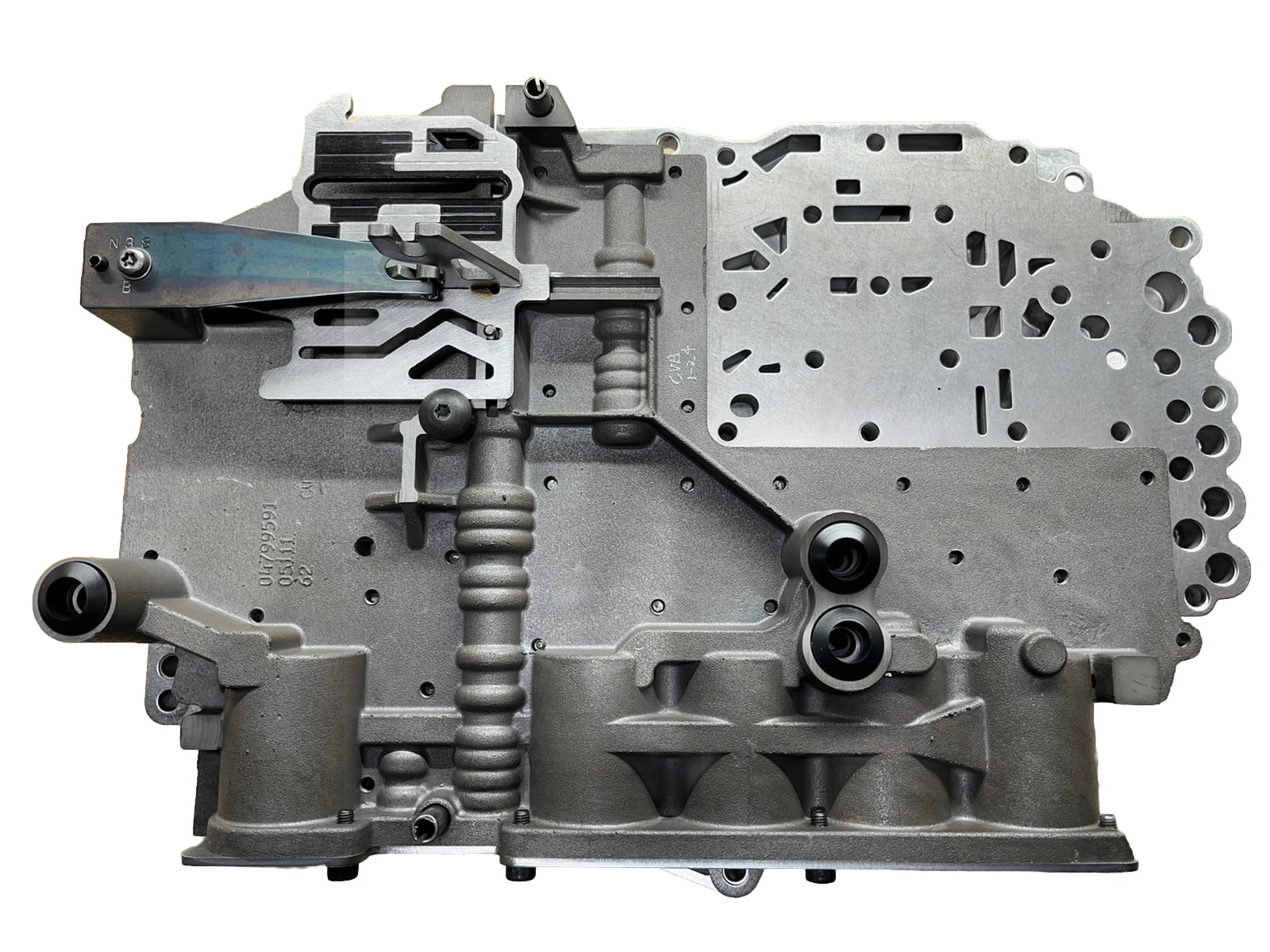

Step 1: Figure Out What Is Actually Harsh
Every 66RFE gear is two clutches, and every shift is one releasing while another applies. Per the RFE apply chart Sonnax prints in its CHR145/CHR146 valve body instructions: 1st is UD plus L/R, 2nd is UD plus 2C, 3rd is UD plus 4C, 4th is UD plus OD, 5th is OD plus 4C, 6th is OD plus 2C, and Reverse is the Reverse clutch plus L/R. Knowing which shift bangs tells you which two circuits and which accumulators to look at.
Road test with a scan tool and log commanded gear, input and output speed, commanded and actual line pressure, trans temperature, TCC state and TCC slip. Then sort the complaint:
- Garage shift (Park or Neutral into Drive or Reverse): line pressure, engagement accumulators, and on a tuned truck, the calibration.
- One specific upshift every time: one circuit. Look at that shift's clutch, accumulator and valve.
- Every shift firm, hot or cold: line pressure is too high. Start with the pressure regulator valve.
- A bump with no gear change on the display: converter clutch apply or release, or a cylinder deactivation transition. Neither is a shift.
- Harsh only right after a battery job, flash or rebuild: adaptives. Relearn before you buy anything.
Step 2: Rule Out the Engine Side on 6.4L Trucks
The 6.4L HEMI uses MDS cylinder deactivation, and the PCM software that runs it has been updated for exactly the kind of feel owners call a "bad shift." FCA service bulletin 18-096-16 (August 2016), which superseded 18-042-15, covers 2014 Ram 2500, 3500 Pickup, 3500 Cab Chassis and 4500/5500 Cab Chassis trucks with the 6.4L (sales codes ESA or ESB). It adds an optional calibration for customers who complain of drone, shudder, pulsation or vibration under light throttle in MDS/ECO mode, described in the bulletin as a surge or shudder at 40 to 80 mph on smooth roads. The same flash enables cruise over-speed downshifts and raises the 4x4 Low minimum engine speed from 725 to 800 rpm.
That bulletin is not a transmission fix, and it says the shudder software is optional and should only be used when the customer specifically complains of that condition. But a light-throttle surge at highway speed with no gear change is the most common "harsh shift" I see on a 6.4L that turns out not to be the transmission. Watch the MDS status PID on the road test. If the bump lines up with MDS switching, you are chasing engine software, not a valve body.
Also check the year before quoting parts. The 66RFE is a 2018-and-earlier unit in the heavy-duty gas trucks. FCA bulletin 18-056-19 Rev. A for 2019 Ram 2500/3500 6.4L trucks lists those vehicles with the 8-speed 8HP75-LCV (sales code DFX), and it covers a powertrain bump at 10 to 15 mph that "may be reported as rough or harsh transmission shifting." On a 2019, none of the 66RFE information here applies.
Step 3: Software and the Quick Learn
The RFE controller adapts clutch fill and apply to wear. That is why a 66RFE can shift fine for years, then bang on every shift the day after someone disconnected the battery or flashed the PCM. The learned values are gone, or they are still set for old clutches.
Chrysler's RFE transmission verification test is explicit: if the PCM has been replaced or flashed, or the transmission has been repaired or replaced, perform a Quick Learn with the scan tool. Then bring the fluid to hot and drive it to let the adaptives settle. The factory procedure calls for fifteen to twenty 1-2, 2-3, 3-4 and 4-5 upshifts from a standing start at a steady 20 to 25 degrees of throttle up to 60 mph, followed by five to eight wide-open-throttle kickdowns to 1st below 25 mph, with at least five seconds in 2nd and 3rd between each kickdown.
Do that before you replace anything. If the harsh shift goes away and stays gone, the hardware was fine. If it comes right back, or only one shift stays harsh after the learn, move on to pressure.
If only the garage shift is harsh
A bang going into Drive or Reverse with smooth upshifts is usually a learning problem, not a pressure problem. ATRA Technical Bulletin 990 explains that the RFE controller learns a separate value for the Neutral-to-Drive shift, the N-1 UD CVI, and gives a dedicated procedure for it: fluid between 80 and 110°F, drive to at least 10 mph and stop, then repeat Neutral-to-Drive shifts at a stop with a 2 to 3 second pause in Neutral until the UD CVI stabilizes. For Reverse, the bulletin calls for fluid above 110°F and repeated Neutral-to-Reverse shifts at a stop, and notes that an unlearned Neutral-to-Reverse shift may be harsh or show a double bump. ATRA also warns that if a shift is still not smooth once the clutch volume stabilizes, an internal problem may be present.
If the garage shift went harsh right after someone had the valve body apart, count the checkballs. Per Sonnax's Jim Mobley in Transmission Digest, a missing #2 checkball, which supplies the underdrive clutch, causes harsh Neutral-to-Drive engagements, and a missing #3 ball, which routes Reverse oil through an orifice on 2006-2018 units, causes firm Reverse engagements. The opposite complaint, a truck that is slow to engage, is covered in our 66RFE delayed engagement guide.
Step 4: Read Commanded and Actual Line Pressure
The RFE family reads line pressure with a sensor and controls it with a pressure control solenoid, so the scan tool tells you both what the controller wants and what it is getting. Sonnax published stock RFE numbers in its article on stalling and overheating after tuning: desired and actual line pressure at a stop in Drive both around 60 to 70 psi with a 22 to 24 percent duty cycle, and about 160 psi at stall. A typical tuned calibration in the same article showed 100 to 105 psi desired and actual at idle with the duty cycle down at 5.1 percent.
Two things to take from that. First, if the truck is tuned and shifts hard, put the stock calibration back before you condemn hard parts; more pressure means firmer shifts by design. Second, Sonnax notes that desired pressure still displays normally even when actual is zero, so always read both. If actual tracks desired and both are in range, line pressure is not your harsh shift. If actual runs above desired, or swings while desired is steady, the regulator is not controlling it.
Step 5: The Pressure Regulator Valve Bore
This is the most common hydraulic cause of a 66RFE that is harsh on every shift. Sonnax's 66RFE unit listing ties harsh shifts, soft shifts, high line pressure and burnt clutches to the same item: wear in the OE pressure regulator valve bore. Per Sonnax, excess bore wear lets fluid escape around the valve, so the valve can no longer hold its balance position and line pressure is no longer regulated. The result can go either way, harsh shifts from high or erratic pressure or soft shifts and burnt clutches from low pressure, and it can also restrict converter and lube flow.
A new solenoid pack does not fix this. The cure is to ream the bore and install an oversized valve. Sonnax's 44912-10K fits the 45RFE, 545RFE, 65RFE, 66RFE and 68RFE, uses a hard-anodized aluminum valve with annular grooves to center it and cut side-load wear, comes with a green spring for OE pressure, and requires the F-44912-TL10 tool kit. Vacuum test the bore before and after. If the casting has other worn bores, a remanufactured valve body is often less labor than chasing them one at a time.
Accumulator springs after a valve body swap
Watch this one on a truck that went harsh right after someone replaced the valve body. Sonnax's CHR145/CHR146 universal valve body ships set up for the 45RFE and 545RFE. For a 65RFE, 66RFE or 68RFE, the instructions say to pull the accumulator cover plate, swap the 2nd accumulator inner and outer springs for the supplied orange inner and plain outer springs, and replace the OD accumulator spring with the white/pink spring. Skip that, and the 2nd and OD accumulators cushion the apply with the wrong spring rate. That changes the feel of every shift those clutches are part of. Check the springs and the accumulator pistons and cover plate for cracks while you are in there.
Step 6: Harsh Converter Clutch Apply
A lot of 66RFE "harsh shift" complaints at 35 to 50 mph are really the converter clutch locking. Sonnax lists harsh TCC apply as a 66RFE symptom and pins it on the TCC accumulator spring in the pump. Per Sonnax, the OE spring is overstressed in this application and fatigues or breaks, and its upgraded 44912-01 spring fits the 45RFE, 545RFE, 65RFE, 66RFE, and the 68RFE through 2018.
Sonnax also explains why tuning makes it worse. The RFE TCC regulator valve only controls pressure during partial apply. Once the converter goes into full apply, apply pressure equals line pressure, which tops out around 160 psi in forward ranges on a stock unit. Performance calibrations can push line pressure past 220 psi, and the TCC apply follows it, which Sonnax links to converter ballooning, flexplate damage and pump failures. If the bump lines up with TCC apply on the log, look at the pump TCC accumulator and the calibration before the clutch packs.
Step 7: Clutch Clearance After a Rebuild
If the truck shifted fine before an overhaul and harsh after, and the quick learn did not help, check clutch clearances. Sonnax's RFE overdrive clutch troubleshooting article explains that clearance set too tight shortens fill time and applies the clutch faster, which can cause a bind-up where two clutches are briefly holding at once. Too loose goes the other way, with long fill times and dragging frictions that overheat. No software fixes a pack set wrong. Measure every pack to the service spec.
Quick Diagnostic Order
- Identify the event: garage shift, one specific upshift, every shift, or a bump with no gear change.
- On a 6.4L, log MDS status. If the bump matches MDS transitions, check the PCM calibration level (18-096-16 for 2014 trucks).
- Confirm it is a 2018 or earlier 66RFE, not a 2019-up 8HP75.
- Fluid level hot. Run the Quick Learn and the factory adaptive drive cycle.
- Compare desired and actual line pressure against roughly 60 to 70 psi at a stop in Drive. Put a tuned truck back to stock.
- Vacuum test the pressure regulator valve bore. Ream and oversize, or replace the valve body.
- After any valve body swap, verify the 66RFE accumulator spring combination.
- If the bump matches TCC apply, inspect the pump TCC accumulator spring.
- After a rebuild, verify clutch clearances, then quick learn again.
View the PR valve kit →
FAQ
Why does my 66RFE shift hard?
Start with software and adaptives: a battery disconnect, PCM flash or repair wipes or invalidates the learned shift values, and Chrysler calls for a Quick Learn afterward. If it still shifts hard, compare desired and actual line pressure, about 60 to 70 psi at a stop in Drive stock. Harsh on every shift with good software usually means a worn pressure regulator valve bore.
Will a quick learn fix a 66RFE harsh shift?
It fixes harsh shifts caused by reset or outdated adaptive values, which is common after a flash, battery job or rebuild. Run it with hot fluid and no codes, then do the factory drive cycle of repeated light-throttle upshifts and a few kickdowns. It will not fix a worn valve body bore, wrong accumulator springs or clutch packs set too tight.
Can a worn valve body cause harsh shifts on a 66RFE?
Yes. Sonnax lists pressure regulator valve bore wear as a cause of harsh shifts, soft shifts, high or erratic line pressure and burnt clutches on the 66RFE. Fluid leaks past the worn bore, so the valve cannot regulate line pressure. The fix is reaming the bore for an oversized valve such as Sonnax 44912-10K, or a remanufactured valve body.
Why does my 6.4L Ram surge or shudder at highway speed?
If there is no gear change on the display, it is often not the transmission. FCA bulletin 18-096-16 adds an optional PCM calibration for 2014 6.4L trucks with drone, shudder or pulsation at 40 to 80 mph under light throttle in MDS/ECO mode. Log MDS status and TCC state to see which event lines up with the bump.
What does a harsh torque converter clutch apply feel like on a 66RFE?
It feels like a firm shift at cruising speed with no gear change, usually between about 35 and 50 mph when the converter locks. Sonnax ties harsh TCC apply on the RFE family to a fatigued or broken TCC accumulator spring in the pump, and notes that once the TCC fully applies its pressure equals line pressure, so a tuned truck makes it worse.
Sources
- Stellantis Media (Ram Truck) — "2014 Ram Chassis Cab Offers All-new 6.4-liter HEMI V-8." Backs the 6.4L HEMI ratings of 370 hp and 429 lb-ft and the pairing with the 66RFE six-speed (with the Aisin AS66RC optional). media.stellantisnorthamerica.com
- FCA US / NHTSA — Service Bulletin 18-096-16, Flash: 6.4L Diagnostic and System Improvements (August 19, 2016). Backs the 2014 6.4L (ESA/ESB) applications, the optional MDS/ECO drone and shudder calibration at 40-80 mph, cruise over-speed downshifts, and the 725 to 800 rpm 4x4 Low change. static.nhtsa.gov (PDF) Also 18-056-19 Rev. A for the 2019 6.4L with the 8HP75-LCV and the 10-15 mph bump: static.nhtsa.gov (PDF)
- Chrysler Service Information — 45RFE/545RFE Transmission Verification Test. Backs the Quick Learn requirement after a PCM flash or transmission repair and the adaptive drive cycle (15-20 upshifts at 20-25 degrees throttle to 60 mph, 5-8 WOT kickdowns below 25 mph). Chrysler service information
- Sonnax — Oversized Pressure Regulator Valve Kit 44912-10K, and the Chrysler 66RFE unit page. Backs PR bore wear causing harsh shifts, soft shifts, erratic and high line pressure and burnt clutches, the RFE applications, valve design and the F-44912-TL10 tooling. sonnax.com • 66RFE unit page
- Sonnax — TCC Accumulator Spring 44912-01 and "Prevent RFE Converter Failure: Maintain Proper TCC Apply Pressure." Backs harsh TCC apply from a fatigued OE spring, the applications, full TCC apply equaling line pressure, about 160 psi stock and over 220 psi tuned. sonnax.com • TCC apply article
- Sonnax — RFE tuning, overdrive clutch troubleshooting, and CHR145/CHR146 instructions. Backs the stock 60-70 psi at 22-24% duty and 160 psi stall figures, tuned 100-105 psi at 5.1%, desired pressure displaying at 0 psi actual, the clearance and bind-up explanation, the apply chart, and the 66RFE accumulator spring swap. tuning article • OD clutch article • CHR145 instructions (PDF)
- ATRA — Technical Bulletin 990, 41TE/42LE/42RLE/45RFE/545RFE Module Strategies and Learn Values (February 2006). Backs the separate N-1 UD CVI for garage shifts, the 80-110 F Neutral-to-Drive learn with the 10 mph stop and 2-3 second Neutral pause, the above-110 F Neutral-to-Reverse learn, the harsh or double-bump unlearned Reverse engagement, and the internal-problem warning. atracom (PDF)
- Transmission Digest — Jim Mobley (Sonnax), "Chrysler RFE valve body checkball locations and function." Backs the #2 checkball supplying the UD clutch (missing = harsh Neutral-to-Drive) and the #3 Reverse engagement orifice ball on 2006-2018 units (missing = firm Reverse). transmissiondigest.com