A 66RFE that comes in with a "solenoid" code has a better than even chance of leaving with a perfectly good solenoid pack still bolted to the valve body. The pack gets blamed because it is the part named in the code description and because it is easy to get to: drop the pan, pull the valve body, and it is right there. But on this transmission the controller does not watch the solenoids directly so much as it watches what the clutches do after it fires them. A leaking bore, a loose pin at the case connector, or a tired relay feed can all produce the same complaint.
The 66RFE is the six-speed Ram bolted behind the gas HEMI in its heavy-duty and chassis cab trucks. Its solenoid pack, connector and valve body logic are shared with the 545RFE, 65RFE and 68RFE, so the numbers below come from RFE-family references and apply directly. Here is how the pack works, what each solenoid failure looks like from the driver's seat, and the order I test in before I spend a few hundred dollars on a new block.

What the 66RFE Solenoid Pack Actually Controls
The RFE is clutch-to-clutch. There are no bands. Each forward gear is two clutches applied together, and each clutch is fed by its own solenoid through the valve body. Sonnax's universal valve body tech sheet (CHR145/CHR146) prints the 65/66/68RFE apply chart, and it is the single most useful table you can have when you are chasing a shift complaint:
- 1st (3.23:1): Underdrive (UD) plus Low/Reverse. The L/R clutch is only on with output shaft speed below 150 rpm; after launch the low overrun sprag holds.
- 2nd (1.83:1): UD plus 2nd clutch (2C).
- 3rd (1.41:1): UD plus 4th clutch (4C).
- 4th (1.00:1): UD plus Overdrive (OD).
- 5th (0.81:1): OD plus 4C.
- 6th (0.62:1): OD plus 2C.
- Reverse (4.44:1): Reverse clutch plus L/R.
Read that chart as a symptom map. Every clutch shows up in more than one gear, so a weak circuit gives itself away by the gears it ruins. A 2C problem slips or flares in 2nd and 6th. A 4C problem shows up in 3rd and 5th. A UD problem affects 1st through 4th but leaves 5th and 6th alone. An OD problem hits 4th, 5th and 6th. If a customer says "it only slips in 3rd and 5th," you are already looking at the 4C circuit, its solenoid, its switch valve plugs and its piston seal, not a random parts list.
Normally applied versus normally vented
Per Sonnax's RFE solenoid identification and pin-out page, the UD and Multi-Select (MS) solenoids are normally applied, and the L/R, OD, 2C and 4C solenoids are normally venting. That matters when the controller drops the transmission relay and goes into failsafe: power comes off the whole pack, and the normally applied circuits decide which gear the truck limps in. Sonnax's 66RFE unit page lists "2nd gear starts w/MIL on" as a symptom for exactly this reason. A truck that suddenly takes off in a higher gear with the check-engine light lit is usually in failsafe, not suffering from one dead solenoid.
Know Which Pack You Have
Before you test, look at the color of the pass-through connector. Sonnax's history of the RFE packs lays it out:
- White connector (2000-2009): six solenoids, including a dedicated overdrive solenoid. Sonnax calls it highly reliable, and notes it can service '09-later units when a gray pack is not available.
- Gray connector (2010-2018): five solenoids. The OD solenoid was eliminated along with two checkballs, and the Multi-Select solenoid took over the overdrive function. A gray pack cannot back-service an earlier valve body.
- Blue connector (2019-later): six solenoids again, with a Reverse solenoid in the old OD position, plus a separate external TCC solenoid on the opposite side of the valve body.
Most 66RFE trucks that cross the bench run the gray pack, and that one detail trips up a lot of diagnosis. On a gray-connector unit there is no OD solenoid on pin 7 to test, and lockup on pre-2019 units runs through the L/R solenoid by way of the solenoid switch valve. Sonnax also warns that the filter screens differ between year ranges and are not interchangeable even though they physically fit.
Symptoms That Point at the Solenoid Circuits
Sonnax groups the 66RFE solenoid-related complaints as poor shift quality, shift codes, switch codes, intermittent solenoid codes, solenoid electrical circuit faults, and gear ratio codes. In the shop, that turns into:
- Failsafe and a fixed gear with the MIL on, often clearing after a key cycle and coming back once the fluid is hot.
- Gear ratio codes where the controller commanded a gear and the input/output speed math did not match. A slipping clutch and a sticking solenoid look identical here.
- Solenoid circuit codes in the P075x/P076x family. Chrysler names these by clutch circuit; Transmission Digest's P0750 write-up covers the Low/Reverse solenoid circuit, for example.
- Pressure switch rationality codes. Sonnax lists codes 841, 846, 868, 871, 876 and 988 against 66RFE switch valve and solenoid spacer repairs.
- Harsh, flared or late shifts into the gears that share one clutch, per the chart above.
- Wrong gear starts and a burned 4th clutch, which Sonnax files under multi-select and switch valve problems rather than the solenoids themselves.
Step 1: Prove the Electrical Side
Resistance at the case connector
Unplug the 23-pin connector and measure from pin 10 (transmission control relay output, the common feed) to each solenoid control pin. Sonnax's chart lists every shift solenoid at 1.3 ohms at room temperature:
- Pin 10 to pin 2: Low/Reverse (and TCC on pre-2019 units)
- Pin 10 to pin 7: Overdrive (white-connector packs only; not used 2010-2018)
- Pin 10 to pin 17: Underdrive
- Pin 10 to pin 20: 2nd clutch
- Pin 10 to pin 19: 4th clutch
- Pin 10 to pin 21: Multi-Select
- Pin 10 to pin 12: Pressure control (line pressure) solenoid. Sonnax's pin-out page lists 3.5 ohms and its CHR145 sheet lists 4.3 ohms, so treat a reading in that window as normal and an open or dead short as a failure.
The pressure switches report on their own pins: 14 (L/R), 15 (2C), 11 (4C), 16 (OD) and 18 (UD). Pin 22 is sensor ground and pin 23 is the transmission temperature signal. A solenoid that reads open or shorted at the case is a real electrical fault, but check the case connector and its internal pass-through before you condemn the pack. That is a plug-and-pin joint living in hot ATF, and it fails too.
The KOER Reverse test
Sonnax's pressure switch article gives the free test that saves the most packs. Each switch is normally open, sees 12.6 to 14.4 volts on its signal wire, closes at 22 psi and reopens at 11 psi. A closed switch pulls the signal down to 25 to 50 millivolts. With the engine running and the selector in Reverse, every pressure switch should read open on the scan tool. If they do, the feed and signal wiring are good right now. Wiggle the harness at the case while you watch the data; a switch that flickers closed is a connection fault, not a hydraulic one.
Chrysler's own service information backs up why a switch code is not automatically a bad pack. Per the factory P0871 procedure, the controller checks all five pressure switches against the state each should be in for the commanded gear, and its cause list for an OD switch code runs well past the solenoid/TRS assembly: low line pressure, a cut or damaged No. 4 or No. 6 check ball, a cut OD/Reverse piston seal, a broken reaction shaft support seal ring, poor machining on the pump valve body face, and a cut OD accumulator seal or cracked accumulator piston. The companion P0870 test is active: above 1000 rpm the controller briefly pressurizes unapplied circuits and, if a switch fails to close twice, sets the code and drops the unit into its shutdown routine. It also wants line pressure holding steady at 85 to 95 psi during that check, so prove pressure before you buy a pack.
Two traps from the same source. An open signal wire and a wire shorted to ground both read as a closed switch, so the data list alone cannot separate a chafed harness from a stuck-applied clutch. And the test will not run if the truck is in failsafe, because failsafe has already cut voltage to the transmission.
Scope the circuits for intermittents
A meter will not catch a code that only sets on the road. Transmission Digest's P0750 case explains how the controller judges a solenoid circuit: it pulses the solenoid, and when it switches it off the coil throws an inductive spike. On the older 60-way controllers that spike is about 42 volts; on the GPEC controllers it is about 45 volts. If the spike is too high or too low, the code sets. In that case, all four solenoids showed no spike and roughly half the expected voltage. Because they shared one feed, the fault was a single connector terminal upstream, and the fix took 30 minutes. When more than one solenoid circuit misbehaves at once, chase the common feed (pin 10 and the relay) before you buy a pack.
Step 2: Prove the Hydraulic Side
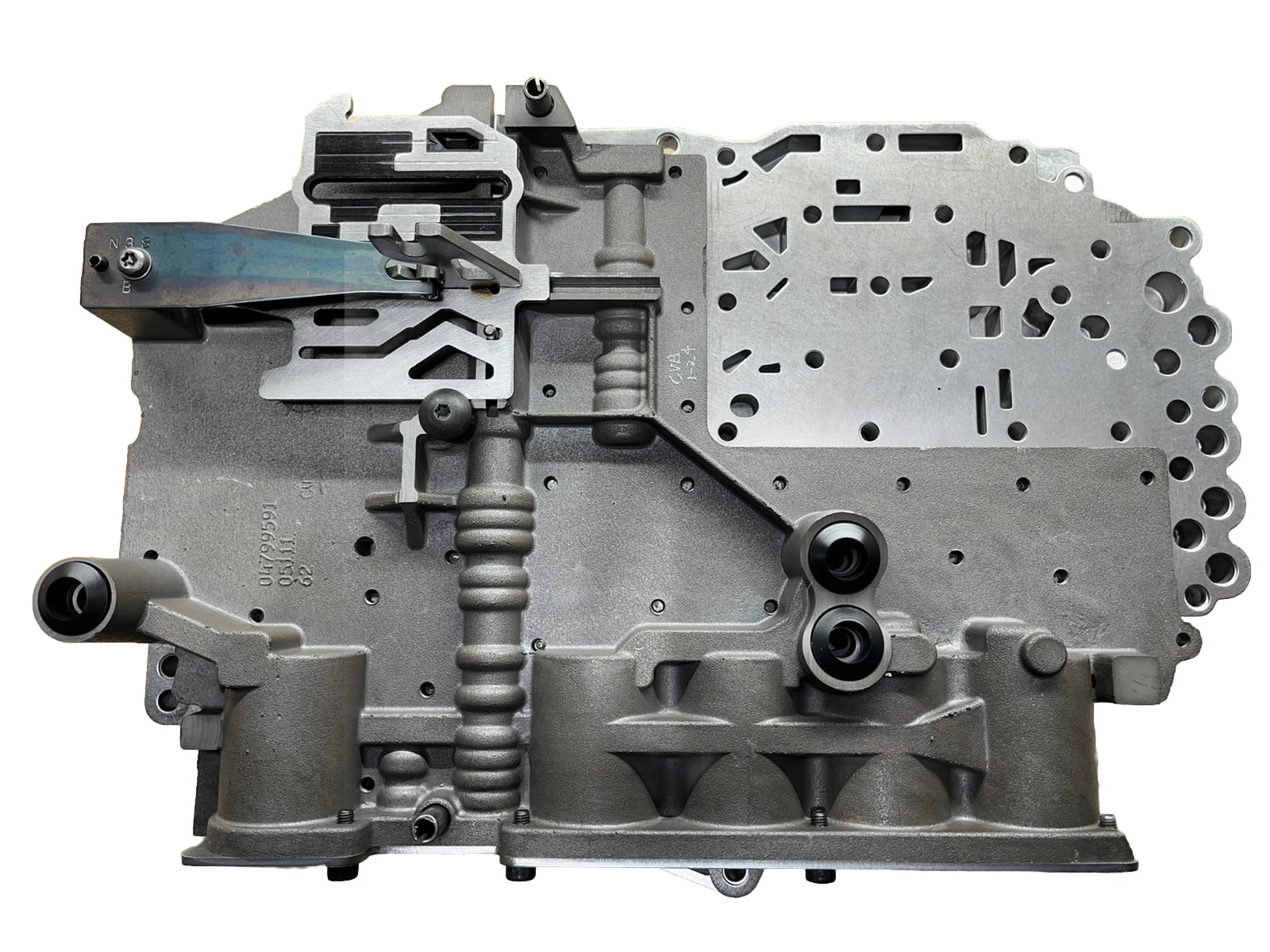
If the wiring passes and the pack ohms out, the problem is almost always in the aluminum next to the pack. The 66RFE solenoid switch valve shuttles the L/R solenoid's output between the L/R clutch and the converter clutch, and its plugs cycle on nearly every shift. Sonnax puts worn valve body bores and outer switch valve plugs behind about 90 percent of P0871 cases once the electrical side checks out. The resulting cross-leaks set pressure switch codes, bind the unit up, cause wrong-gear starts and burn the OD or 4th clutches, and the controller reports every one of them as a solenoid or switch fault.
Vacuum test the switch valve bore and plugs on the bench. Sonnax's RFE-family vacuum test guide, which covers the 66RFE, rates 18 in-Hg or better as good, and you have to shuttle the switch valve by hand into each port you test. Keith Clark's May 2024 Gears Magazine piece on the 68RFE adds two checks: wiggle test the valve and record the lowest reading, because side-loaded bores wear egg-shaped, and check both valve body halves for warpage, which causes the same cross-leaks and is cured by flat sanding or gaskets.
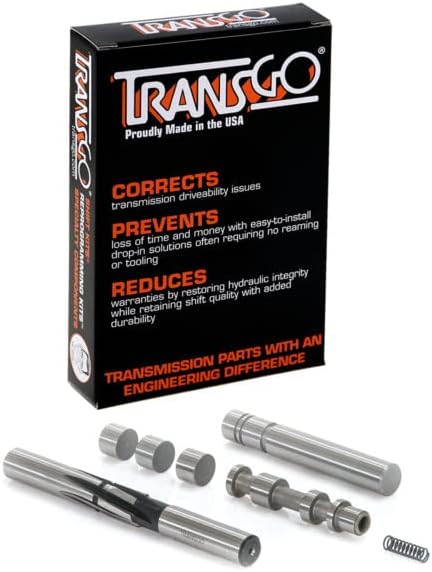
Then measure the large spool before you order anything: Sonnax's Tory Royce documents that the RFE group moved from a .420 in. large spool to a .453 in. spool in 2010, and Sonnax lists 66RFE repairs for both OE spool sizes (oversized kits 92835-31K and 92835-32K, plug kits 92835-02K and 92835-39K), and the reamer has to match your bore. The solenoid spacer and service kit, 44836-02K, appears on the same symptom lines for pressure switch codes and failsafe.
Step 3: When It Really Is the Pack
If a solenoid reads out of spec at the pack itself (not just at the case connector), a pressure switch will not change state when its circuit gets pressure, or the housing is cracked, replace the block. Sonnax's remanufactured blocks are split by generation: 44836A-RRP fits '18-earlier 45RFE, 545RFE, 65RFE, 66RFE and 68RFE, and 44836B-RRP fits 65RFE, 66RFE and '09-'18 545RFE/68RFE. Match the connector color you pulled off, and use the gasket for that generation.
Install details from the Sonnax CHR145 sheet:
- Solenoid pack to valve body: Torx bolts, 53 in-lb.
- Confirm the three valve body-to-case seals are on top of the valve body before it goes up.
- Valve body to case: six 8 mm head bolts, 105 in-lb.
- Fill with ATF+4, warm the fluid to about 185°F, run a quick learn with a capable scan tool, then road test through 10 to 15 upshift and downshift cycles.
Sonnax notes that downshift clunks, a slight bind on the 3-4 upshift and a 2-3 flare are common during the relearn and normally settle within those 10 to 15 cycles. Do not hand the truck back after one lap around the block and call those a bad pack. The same sheet makes one more point worth repeating: stalling and converter clutch engagement concerns are not valve body related. Those parts live in the pump, and a worn torque converter limit valve is a common cause.
The Short Version
Use the apply chart to name the circuit, ohm the pack at the case connector, run the KOER Reverse test, scope anything intermittent, and vacuum test the switch valve before you buy a solenoid block. On a 66RFE the pack is usually the messenger. When it really is the problem, match the connector generation, torque it right and give the relearn its full cycle count.
FAQ
What are the symptoms of a bad 66RFE shift solenoid?
Expect failsafe with a fixed gear and the MIL on, gear ratio codes, solenoid circuit codes, and harsh or slipping shifts in the gears that share one clutch. Because each clutch works in two or more gears, a 2C fault shows in 2nd and 6th and a 4C fault in 3rd and 5th. Those same symptoms also come from worn switch valve bores, so test before replacing the pack.
What should 66RFE solenoids read in ohms?
Sonnax lists each shift solenoid at 1.3 ohms at room temperature, measured from pin 10 (the relay output) to the solenoid's control pin at the 23-pin case connector. The pressure control solenoid on pin 12 reads higher, listed at 3.5 ohms on one Sonnax reference and 4.3 ohms on another. An open circuit or dead short is a failure.
Does the 66RFE have an overdrive solenoid?
Only with the white-connector pack used through 2009. Sonnax notes the 2010-2018 gray-connector pack eliminated the OD solenoid and two checkballs, with the Multi-Select solenoid taking over the overdrive function. The 2019-later blue pack puts a Reverse solenoid in that position and adds an external TCC solenoid.
Can I replace just the 66RFE solenoid pack without pulling the transmission?
Yes. The pack bolts to the valve body, which comes out through the pan with the transmission in the truck. Sonnax's install sheet calls for 53 in-lb on the pack Torx bolts and 105 in-lb on the six 8 mm valve body bolts, followed by a quick learn and 10 to 15 shift cycles. Match the replacement to your connector color.
Why does my 66RFE still throw codes after a new solenoid pack?
Usually because the pack was not the problem. Sonnax attributes about 90 percent of P0871 cases to worn valve body bores and switch valve plugs once the electrical side checks out, and a shared power-feed or connector fault can set codes on several solenoid circuits at once. Vacuum test the switch valve and check the pin 10 feed.
Sources
- Sonnax — "45RFE, 545RFE, 68RFE Solenoid Identification & Connector Pin Out." Backs the 1.3-ohm shift solenoid spec, the 3.5-ohm pressure control spec, normally applied (UD, MS) versus normally venting (L/R, OD, 2C, 4C) solenoids, the full 23-pin connector assignments, and that the OD solenoid was eliminated in 2010-2018 valve bodies. sonnax.com
- Sonnax — "Identifying Chrysler RFE Solenoid Changes Through the Years." Backs the white (2000-2009, six solenoids), gray (2010-2018, five solenoids, OD solenoid and two checkballs removed, MS takes over the OD function, no back-service) and blue (2019-later, Reverse solenoid plus external TCC solenoid) generations, and the non-interchangeable filter screens. sonnax.com
- Sonnax — CHR145/CHR146 Universal Remanufactured Valve Body Tech & Install Tips (PDF). Backs the 65/66/68RFE clutch apply chart and gear ratios, the 150 rpm L/R note, the resistance chart by pin (including 4.3 ohms for line pressure), the 53 in-lb solenoid pack and 105 in-lb valve body bolt torques, the 185°F quick learn and 10-15 cycle road test, normal relearn behavior, and that stalling and TCC engagement concerns originate in the pump. cdn.transend.us
- Sonnax — Chrysler 66RFE unit page. Backs the 66RFE solenoid symptom list, the "2nd gear starts w/MIL on" and failsafe entries, codes 841, 846, 868, 871, 876 and 988, the .420 in. and .453 in. switch valve kits (92835-31K, 92835-32K, 92835-02K, 92835-39K), spacer kit 44836-02K, and remanufactured blocks 44836A-RRP and 44836B-RRP. sonnax.com
- Sonnax — "Dodge RFE Pressure Switch Diagnosis & Code P0871," Jim Mobley. Backs the 12.6-14.4 V signal voltage, 22 psi close and 11 psi release points, 25-50 mV closed reading, the KOER Reverse test and its failsafe limitation, the open-wire/short-to-ground trap, and the roughly 90 percent bore-wear cause of P0871. sonnax.com
- Transmission Digest — "Low/Reverse-Solenoid Circuit Fault Code P0750 (41)." Backs how the Chrysler controller judges solenoid circuits by inductive spike (about 42 V on 60-way controllers, about 45 V on GPEC), and the case where a single shared-feed connector fault took out all four solenoid circuits. transmissiondigest.com
- Chrysler Service Information — P0871 OD Pressure Switch Rationality (RFE). Backs the five-switch, per-gear state check and the OD switch cause list (line pressure, No. 4/6 check balls, OD/Reverse piston seal, reaction shaft support seal ring, pump valve body face, OD accumulator). jeep.automotive-manuals.com
- Chrysler Service Information — P0870 OD Hydraulic Pressure Test (RFE). Backs the active switch test above 1000 rpm, the two-failure shutdown, and the steady 85-95 psi line pressure check. jeep.automotive-manuals.com
- Sonnax — Tory Royce, "All in the Family: Identification & Repair of Chrysler Solenoid Switch Valve Problems." Backs the switch valve directing oil between the L/R clutch and TCC, vacuum testing as the deciding test, and the 2010 change from a .420 in. to a .453 in. large spool in the 45RFE group. sonnax.com
- Sonnax — "Critical Wear Areas & Vacuum Test Locations, Chrysler 45RFE, 545RFE, 65RFE, 66RFE, 68RFE" (PDF). Backs the 66RFE coverage, the switch valve and plug symptom lists, and testing valves in position. sonnax.com (PDF)
- Gears Magazine (ATRA) — Keith Clark, "Fixing the Root Cause of the Problem: Solving Issues with the 68RFE Transmission" (May 2024). Backs switch valve leakage reaching the pressure switches, P0871 and burnt OD clutches, the vacuum plus wiggle test using the lowest reading, and valve body warpage. gearsmagazine.com