The 66RFE is the six-speed Ram put behind the gas HEMI in its heavy-duty trucks. It does not get the attention the Cummins-backed 68RFE does, because it lives behind half the torque and rarely sees a tuner. But it shares almost all of the 68RFE's hydraulics, so it shares almost all of the 68RFE's failures, just on a slower clock. When one comes in, the complaint is nearly always one of five things, and four of them start in the valve body or the pump, not the clutch pack.
This is the list I work from, in the order the failures actually show up, with the tests that separate one from another before anything comes out of the truck.
Where the 66RFE Lives, and Why That Matters
Ram's own press material for the 2013 Heavy Duty line spells out the pairing: the 5.7-liter HEMI, at 383 horsepower and 400 lb-ft, is mated to the 66RFE. For 2014 the Chassis Cab 3500 got the 6.4-liter HEMI at 410 horsepower and 429 lb-ft, also on the 66RFE. So this unit spends its life behind a gas V-8 that makes its torque high in the rev range, in trucks that tow, plow and haul. That is a heat-and-duty-cycle life, not a peak-torque life, and the failure list reflects it.
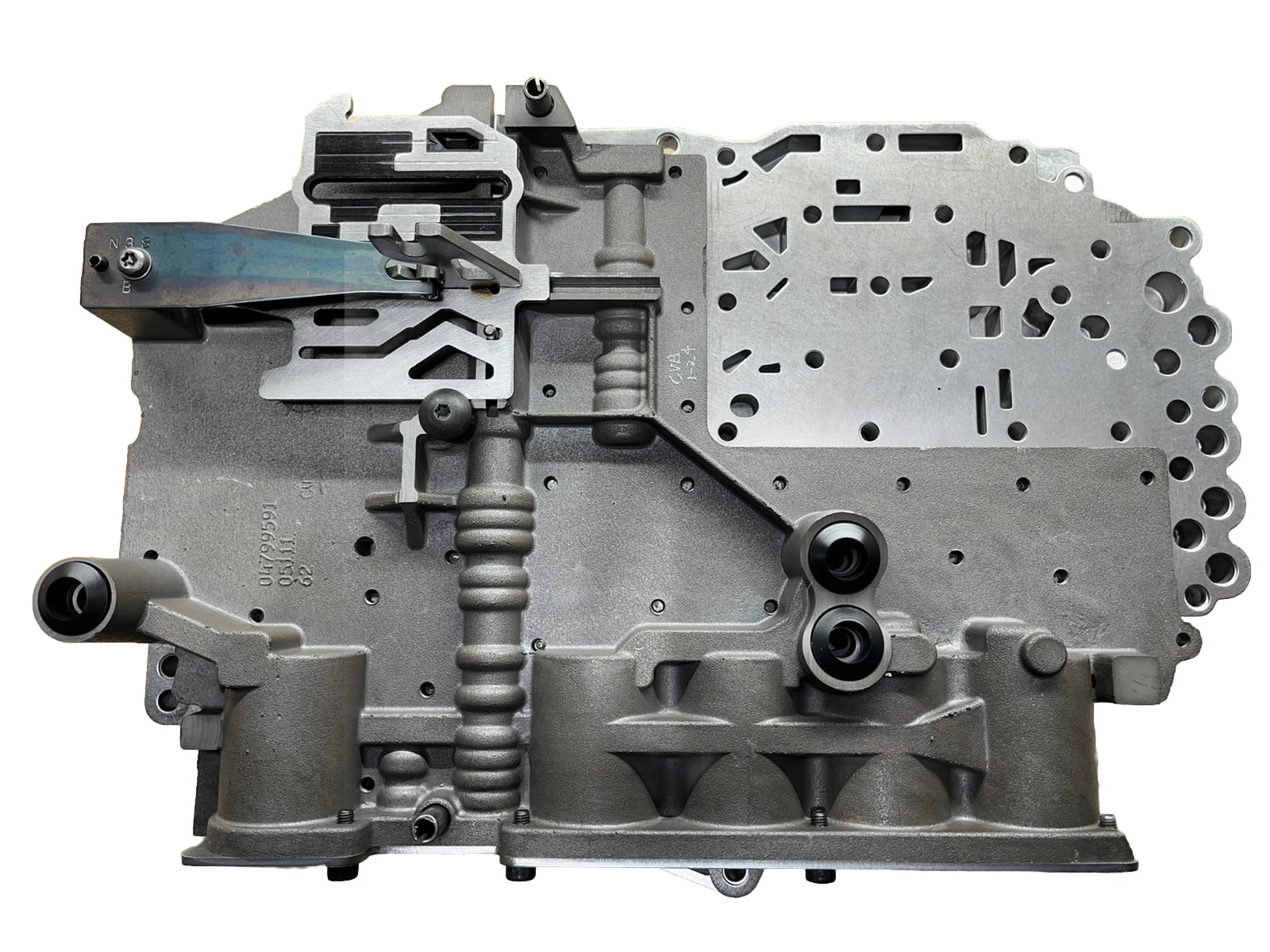
Mechanically it is a member of the RFE family: clutch-to-clutch, no bands, no governor, a solenoid pack feeding individual clutch circuits through switch valves and accumulators. Sonnax sells the same vacuum test guide, the same solenoid switch valve repairs and the same thermal bypass kit for the 45RFE, 545RFE, 65RFE, 66RFE and 68RFE. When I say a 68RFE bulletin applies here, that is why.
1. Burned Overdrive (and 4th) Clutches
This is the headline failure for the whole family, and Sonnax's 66RFE unit page lists both "OD clutch burned" and "4th clutch burned" against the same repair: the solenoid switch valve and its plugs. The clutch pack is the part that looks bad in the pan. It is rarely the part that started it.
Per Sonnax's overdrive clutch failure write-up, the OE overdrive frictions are single-sided on a steel core only .034 in. thick, some of the thinnest clutches in any production transmission. They do not shed heat, they warp once they get hot, and a warped pack loses its running clearance and drags until it burns. But Sonnax is explicit that distorted clutches are the first visible symptom, not the root cause. The weakest link is the solenoid switch valve plugs. They cycle on nearly every shift, wear the aluminum casting, and create cross-leaks into and out of the OD circuit. Lower OD apply pressure means lower holding force, the pack slips, and the heat does the rest.
Two other contributors from the same article are worth checking on any repeat failure:
- Solenoid conductor plate warp. The plate is unsupported on one side while the connector seal pushes on it. Over time it warps and bleeds OD apply pressure out of the circuit. It also causes intermittent pressure switch codes.
- Wrong line pressure, either direction. Low line pressure starves the OD apply. High line pressure pushes through a worn switch valve bore and partially applies the OD clutch, usually setting P0871. Do not trust the line pressure sensor blindly: OE adapter tool No. 8259 installs in the sensor port so you can run a mechanical gauge and the sensor side by side. Line pressure that sits flat at 150 to 160 psi at idle and about 250 psi in Reverse is the signature of an open pressure control solenoid circuit, per Sonnax’s Jim Mobley, and Chrysler has no dedicated code for it, so it shows up as P0869 or P0933 instead. Per Gears Magazine, the line pressure solenoid is a variable force solenoid inside the solenoid pack: low duty cycle means high pressure and high duty cycle means low pressure, so a flat duty cycle with no pressure response points at the circuit, not the pump. The full test sequence is in our 66RFE pressure control solenoid guide.
The repair is a vacuum test of the switch valve bore and plugs, then an oversized valve and plug kit if it fails. Measure first: Sonnax's 66RFE listings split by OE switch valve large-spool diameter, .420 in. or .453 in., and the kit has to match the bore you have.
2. P0871 and Other Pressure Switch Codes
The RFE uses five pressure switches, one per clutch circuit, and they generate more "transmission problem" diagnoses than anything else on this unit. Sonnax's pressure switch diagnosis article gives the numbers you need. Each switch is normally open, sees system voltage of 12.6 to 14.4 V on its signal wire, closes when clutch pressure reaches 22 psi and reopens at 11 psi. A closed switch pulls the signal to 25 to 50 mV at the controller.
The fastest electrical check is the KOER Reverse test. Engine running, selector in Reverse, and every pressure switch should read open on the scan tool. If they do, the wiring and connections are good right now, and you can wiggle the harness while watching the data to catch an intermittent. One important note from Sonnax: an open signal wire or a signal wire shorted to ground reads the same as a closed switch. And the test cannot run if the unit is in failsafe, because the relay has cut voltage to the transmission.
If the electrical side passes, Sonnax puts worn valve body bores and outer switch valve plugs at the cause of P0871 about 90 percent of the time. That is common enough that many shops ream and oversize the switch valve on every RFE build. The rest are assembly mistakes, and they are specific:
- A number 6 checkball installed in a five-ball valve body will cause P0871.
- A missing number 4 checkball brings the TCC on in Drive and can also set P0871.
- Wrong separator plates, aftermarket valve body gaskets on the wrong side of the plate, and the wrong solenoid pack gasket all set pressure switch codes.
On a 2017 6.4L truck, check software before hardware. FCA bulletin 18-040-17 Rev. A reflashes the PCM on 2017 Ram 2500 through 5500 trucks with the 6.4L and 66RFE built on or before May 22, 2017, and lists P0870 (OD hydraulic pressure test) as a 66RFE-only code the update addresses. An OD pressure code on an un-flashed truck in that window gets the flash first.
3. TCC Slip, Shudder and P0740
Converter complaints on the 66RFE usually arrive as a highway vibration, rising temperature, or a P0740 (TCC out of range). ATRA's Gears Magazine walked through one on a 68RFE Ram 2500, and the diagnosis carries straight over because the pump and valve body architecture are shared. The code logic, per the article: in partial-apply (EMCC) mode with input speed above 1750 rpm, the L/R-TCC solenoid reaches maximum duty cycle and cannot pull engine speed within 60 rpm of input speed; or in full-apply (FEMCC) mode, slip exceeds 100 rpm for 10 seconds. It can take up to five minutes to set.
The pressure readings are what make this case useful. With gauges on the damper ports, TCC release pressure read 20 psi when it should be 5 psi or lower, and TCC apply read 85 psi when it should match actual line pressure, which was 120 psi. The causes turned out to be a worn solenoid switch valve in the valve body and a worn torque converter accumulator piston in the pump. The vacuum test on the worn bore would not hold and dropped to zero; the target is a minimum of 18 in. of vacuum.
If you are replacing converters repeatedly on a 66RFE, look at the TCC apply limit switch valve too. Sonnax's 66RFE page lists that valve (44912-36K, or 44912-41K oversized) for repeated converter failure, excess converter pressure and TCC slip, and the TCC switch valve (44912-08K) for no lockup, TCC slip and overheating.
4. Burnt Low/Reverse Clutch, Delayed or No Reverse
Sonnax's 66RFE listings include "Burnt Low/Reverse clutch" as its own symptom, fixed with a low/reverse switch checkball sleeve kit. The mechanism is described in Sonnax's low/reverse switch valve article: the L/R switch valve acts as a one-way valve for the Low/Reverse clutch in Reverse and Drive. The valve is heavily side-loaded, likely because its diameter is too close to its length, so it wears the bore. Leakage past it exhausts through the manual valve, apply pressure drops, and you get burnt clutches and delayed, or no, Reverse or first gear.
Testing takes patience because you have to shuttle the valve by hand to each worm track port you are checking. Sonnax's pass mark is 18 in.-Hg; anything lower is worn and the valve should be replaced with a sleeve repair. On a unit that came in with a low/reverse complaint, do this before you order frictions.
One Reverse complaint is not a hydraulic failure at all. FCA bulletin 18-097-16 (August 20, 2016) reflashes the PCM on 2015 Ram 2500, 3500 and cab chassis trucks with the 6.4L, and one of its listed enhancements is to prevent shudder in Reverse when backing up a grade, for sales code DFP (the 66RFE) only. If a 2015 truck engages Reverse cleanly and only shudders backing up an incline, check the calibration level before you pull the pan. The full no-Reverse workup is in our 66RFE no Reverse guide.
5. Heat, and the Thermal Bypass Valve
A gas truck working hard at low rpm is exactly where RFE cooler flow suffers, and heat accelerates every failure above. The specific 66RFE weak point is the thermal bypass valve in the cooler block, which can stick in recirculation and cut the cooler out of the circuit. Sonnax's thermal bypass eliminator identification guide sorts the fix by OE block part number: kit 72760-01K covers blocks 52014762AA and 68186711AB (among others), and 72760-02K covers 55111005AC. They are not interchangeable, so read the number on your block. On the pump side, Sonnax's lube regulated pressure regulator valve (44912-17K) is listed on the 66RFE page for low cooler flow at idle and overheated fluid. The full heat workup, including cooler flow and fan clutch tests, is in our 66RFE overheating guide.
The Diagnostic Order I Use
- Codes and data first. Pull codes, record the DTC event data, and check the pinion factor against the actual tire size before you clear anything; Chrysler's RFE pre-diagnostic procedure warns that a battery disconnect wipes the event data and every learned transmission value. Then run the KOER Reverse pressure switch test. Fix any electrical discrepancy before touching hydraulics.
- Line pressure, verified mechanically. Gauge on the 8259 adapter alongside the sensor; per Chrysler's RFE hydraulic pressure test, the scan tool reading should match the gauge within plus or minus 10 psi at operating temperature and 1500 rpm. P0868 sets when actual line pressure runs more than 15 psi below desired for 3.5 seconds. Ask whether the truck has ever had a programmer.
- Temperature and cooler flow. A hot unit points you toward the bypass block, the PR valve and the TCC circuit.
- Drop the pan and read the debris. Converter material and friction material tell you how far along it is.
- Vacuum test on the bench. Solenoid switch valve and plugs, L/R switch valve, TC limit and PR valves in the pump. Repair bores before replacing clutches.
- Relearn. Per the Sonnax TASC Force piece in Transmission Digest, every RFE needs a fast learn after any repair so the adaptives recalibrate to the parts you installed.
Fluid and Fill Notes
The 66RFE takes ATF+4 (Chrysler MS-9602). Do not substitute a multi-vehicle fluid; clutch-to-clutch shift timing and the adaptive tables are built around that friction profile. See our fluid spec chart for the full spec breakdown.
If you are installing a replacement unit, read FCA's fluid fill chart before the truck leaves. It lists new and "RL" 45/545/65/66RFE units as "Rolls Ready," meaning fluid added only to allow testing at the assembly plant, and remanufactured "R" units as residual fill. Both must be topped off after installation. A reman 66RFE driven away on its shipping fill is a comeback.
The Short Version
The 66RFE is not a weak transmission. It is a valve-body-limited one. The clutches burn because the switch valve bores leak, the pressure switch codes set because the bores leak or the checkballs are wrong, and the converter slips because the TCC circuit is leaking in the pump or valve body. Vacuum test before you buy parts, fix the bores, set clearances right, fill it correctly, and relearn it. Do those five things and most 66RFE rebuilds stay done.
FAQ
What is the most common 66RFE problem?
Burned overdrive and 4th clutches, and the usual root cause is not the clutch pack. The solenoid switch valve plugs cycle on nearly every shift and wear the aluminum valve body bore, which cross-leaks OD apply pressure so the thin OE clutches slip and overheat. Sonnax lists both OD and 4th clutch burn on the 66RFE against the switch valve repair.
What causes P0871 on a 66RFE?
Sonnax puts worn valve body bores and outer solenoid switch valve plugs at about 90 percent of P0871 cases once the electrical side checks out. Run the KOER Reverse test first: with the engine running in Reverse, all five pressure switches should read open. Checkball mistakes, such as a number 6 ball in a five-ball valve body, also set it.
What should TCC release and apply pressure read on an RFE?
In the Gears Magazine P0740 case, TCC release pressure should be 5 psi or lower and TCC apply pressure should match actual line pressure. The failing truck read 20 psi release and 85 psi apply against 120 psi line, which traced to a worn solenoid switch valve and a worn converter accumulator piston in the pump.
What fluid does the 66RFE use?
ATF+4, Chrysler specification MS-9602. It is a clutch-to-clutch transmission whose shift timing and adaptive learning are built around that fluid's friction properties, so a universal fluid is not a good substitute. After installing a new or reman unit, top it off: FCA ships these units Rolls Ready or with residual fill only.
Do I need to do a relearn after repairing a 66RFE?
Yes. The Sonnax TASC Force guidance published in Transmission Digest says every RFE needs a fast learn after any repair so the controller recalibrates clutch fill to the parts you just installed. Skipping it leaves the adaptives tuned to the worn transmission you took apart.
Sources
- Stellantis Media (Ram Truck) — "Ram’s 2013 Heavy Duty Lineup Features Best-in-class Capability, New Technology and New Features." Backs the factory pairing of the 5.7-liter HEMI (383 hp, 400 lb-ft) with the 66RFE six-speed automatic. media.stellantisnorthamerica.com
- Stellantis Media (Ram Truck) — "2014 Ram Chassis Cab Offers All-new 6.4-liter HEMI V-8." Backs the 6.4-liter HEMI (410 hp, 429 lb-ft) mated to the 66RFE in the Ram Chassis Cab 3500. media.stellantisnorthamerica.com
- Sonnax — Chrysler 66RFE unit page. Backs the 66RFE symptom list (OD clutch burned, 4th clutch burned, burnt Low/Reverse clutch, codes 841, 868, 871, 988, 1775, 1776), the .420 in. and .453 in. switch valve spool sizes, and the pump valve kits 44912-17K, 44912-36K, 44912-41K and 44912-08K with the symptoms each addresses. sonnax.com
- Sonnax — "68RFE Overdrive Clutch Failure: What to Check First When Troubleshooting OD Issues." Backs the .034 in. single-sided OE overdrive clutches, solenoid switch valve plug wear as the weakest link, conductor plate warp, the effects of low and high line pressure, and OE line pressure adapter tool No. 8259. sonnax.com
- Sonnax — "Dodge RFE Pressure Switch Diagnosis & Code P0871," Jim Mobley. Backs the five-switch system, 12.6-14.4 V signal voltage, 22 psi close and 11 psi release points, 25-50 mV closed state, the KOER Reverse test, the roughly 90 percent bore-wear cause of P0871, and the checkball errors that set it. sonnax.com
- Gears Magazine (ATRA) — "Solving a 68RFE Mystery Code P0740." Backs the P0740 set conditions (EMCC above 1750 rpm and 60 rpm slip target; FEMCC over 100 rpm slip for 10 seconds), the TCC release (5 psi or lower) and apply (equal to line) pressure specs, the switch valve and converter accumulator wear found, and the 18 in. vacuum minimum. gearsmagazine.com
- Sonnax — "Diagnosing 62TE & 68RFE Low/Reverse Switch Valve Issues," Chris Leach. Backs the L/R switch valve's one-way function, side-load bore wear, leakage through the manual valve causing burnt clutches and delayed or no Reverse or first, and the 18 in.-Hg vacuum pass mark. sonnax.com
- Sonnax — "Sonnax Thermal Bypass Eliminator Kit Identification Guide." Backs the kit-to-block mapping: 72760-01K for OE blocks including 52014762AA and 68186711AB, and 72760-02K for 55111005AC. sonnax.com
- Transmission Digest — "Troubleshooting RFE overdrive clutch failure: Three key areas to check," Sonnax TASC Force. Backs that the overdrive failure pattern runs across the 45RFE, 545RFE, 65RFE, 66RFE and 68RFE, and that a fast learn is required after any RFE repair. transmissiondigest.com
- FCA / Mopar — Automatic Transmission Fluid Fill Information chart (PDF). Backs the Rolls Ready fill for new and RL 45/545/65/66RFE units, residual fill for remanufactured R units, and the installer's responsibility to top off after installation. moparrepairconnect.ca
- Chrysler/Jeep Service Information — 45RFE/545RFE Pre-Diagnostic Troubleshooting Procedure. Backs recording DTC event data, the pinion factor check and the battery-disconnect warning that resets learned transmission values. jeep.automotive-manuals.com
- FCA US / NHTSA — Service Bulletin 18-097-16, "Flash: Diagnostic And System Enhancements" (August 20, 2016). Backs the 2015 Ram 2500, 3500 and cab chassis 6.4L coverage with the 66RFE (sales code DFP) and the enhancement to prevent shudder in Reverse when backing up a grade, DFP only. static.nhtsa.gov (PDF)
- FCA US / NHTSA — Service Bulletin 18-040-17 Rev. A, "Flash: 6.4L Powertrain Diagnostic and System Enhancements" (June 24, 2017). Backs the 2017 Ram 2500-5500 6.4L coverage with the 66RFE (DFP) built on or before May 22, 2017, and P0870 OD Hydraulic Pressure Test listed as a 66RFE-only DTC addressed by the reflash. static.nhtsa.gov (PDF)
- Chrysler/Jeep Service Information — 545RFE Hydraulic Pressure Test and P0868 Line Pressure Low. Backs the 8259 adapter gauge-versus-sensor check within plus or minus 10 psi at 1500 rpm, and the 15 psi / 3.5 second P0868 set condition. jeep.automotive-manuals.com and P0868 page
- Sonnax — Jim Mobley, "Diagnosing Chrysler Transmission Max Line Pressure & P0933, P0869, P1745 Codes." Backs the 150-160 psi idle and 250 psi Reverse open-circuit pressure on the PCS line pressure solenoid and that Chrysler has no code for a PCS circuit fault. sonnax.com
- Gears Magazine (ATRA) — David Chalker, "Diagnosing Pressure Trouble Codes." Backs the line pressure solenoid as a variable force solenoid integral to the solenoid pack and the inverse duty cycle to pressure relationship. gearsmagazine.com