A 68RFE that shudders at light throttle around 45 to 60 mph gets blamed on the torque converter almost every time. Sometimes that is right. But the converter is only the part that shakes. The thing deciding how hard it clamps sits in the valve body and the pump, and on this unit those valves wear their bores in a very predictable way. Swap a converter onto a truck with a worn TCC regulator or solenoid switch valve and the new converter shudders too, usually within a few thousand miles.
This guide covers Ram 2500 and 3500 trucks with the 6.7L Cummins and the 68RFE six-speed. It walks through how the converter clutch is actually controlled, how to tell real shudder from a driveline or engine complaint, what to look at on the scan tool and pressure gauges, and the order to fix it in so you only pay for the converter once. For the bigger picture on this unit, start with our 68RFE weak spots and fixes guide.

How the 68RFE Converter Clutch Is Built
The 68RFE converter is not a warmed-over 48RE part. When Sonnax tore down the early units, they found the single-plate lockup clutch of the 47RE/48RE converter had been replaced with a dual-plate clutch, the turbine damper went from single-stage to dual-stage, and the whole assembly weighs roughly 65 lb against about 52 lb for the 48RE unit (per Sonnax, "Rebuilding the Chrysler 68RFE Torque Converter"). The impeller hub is AISI 4140 chrome-moly with an o-ring groove and four drive flats for the pump gear, and the wall at that o-ring groove is only about .070 in. thick. Sonnax also notes the 68RFE converter runs higher pressure than the 48RE design, with pressure maintained during lockup for better holding.
Two clutch surfaces give it more holding capacity than the old single plate, but it also means two surfaces that can glaze. Once the friction glazes or the fluid loses its friction modifiers, the clutch stops slipping smoothly under partial apply and starts grabbing and releasing many times a second. That grab-release cycle is the shudder you feel. It feels like driving over rumble strips, and it goes away the moment you lift or push harder, because both of those change the lockup command.
How the TCM Controls Lockup
This is where most misdiagnosis starts. The 68RFE does not have a dedicated TCC solenoid. Lockup is run by the L/R-TCC solenoid, the same solenoid that applies the low/reverse clutch in first gear. A solenoid switch valve in the valve body decides where that solenoid's oil goes: to the L/R clutch or to the converter clutch. Sonnax describes the switch valve's job as directing fluid between the L/R clutch and the TCC, and lists torque converter apply and release problems, loss of lockup and engine stall among the symptoms of a worn switch valve bore ("All in the Family: Identification & Repair of Chrysler Solenoid Switch Valve Problems").
Once the switch valve routes oil to the converter, the TCM runs the clutch in two modes, per the GEARS Magazine (ATRA) case study on a 68RFE P0740:
- EMCC (Electronically Modulated Converter Clutch): the L/R-TCC solenoid is pulsed so the clutch slips on purpose, holding engine speed within about 60 rpm of input shaft speed. This is partial lockup, and it is where shudder lives.
- FEMCC (Fully Energized): the solenoid goes to 100% duty cycle for full lockup, and the TCM watches slip to confirm the clutch has enough capacity.
Between the solenoid and the converter, two more valves shape that pressure. The TCC regulator valve controls how hard the clutch is applied during partial apply. Sonnax points out that it only regulates during partial apply: once the TCC goes to full apply, apply pressure equals line pressure, which is about 160 psi maximum in forward ranges on a stock RFE ("Prevent RFE, RH/RE Converter Failure: Maintain Proper TCC Apply Pressure"). The TCC accumulator valve in the pump smooths out the pulses from the solenoid's pulse width modulation so the clutch sees a steady pressure instead of a hammer.
Every one of those valves strokes constantly in an aluminum bore. When the bores wear, the pressure the converter sees stops matching what the TCM commanded. The TCM keeps chasing its slip target, and the clutch chatters.
Confirm It Is Actually Converter Shudder
Before any parts come off the truck, prove the shake is the converter clutch. A driveline vibration, a bad U-joint or carrier bearing, or an engine misfire all show up in the same speed range.
- Watch the TCC state and slip on the scan tool. Log commanded TCC mode, engine rpm and input shaft speed. Converter shudder happens while the TCM is in partial (EMCC) lockup and the slip value is oscillating instead of settling.
- Hold speed and tap the brake. The brake switch drops lockup. If the shake disappears instantly with the converter unlocked at the same road speed, the driveline is off the hook.
- Change load, not speed. Real TCC shudder gets worse with a light, steady throttle climb and goes away with a firm push or a lift. A driveline vibration tracks road speed no matter what the throttle does.
- Check for codes. P0740 and P0741 family codes point at converter clutch performance. On the 68RFE the TCM sets its TCC performance fault when, in EMCC above 1,750 rpm input speed, the solenoid is at maximum duty cycle and still cannot pull engine speed within 60 rpm of input, or when slip exceeds 100 rpm for 10 seconds in full lockup (GEARS Magazine P0740 case study). Shudder with no code is common.
Check the Fluid First
Converter clutch friction is tuned to the fluid. The 68RFE is specified for Mopar ATF+4, Chrysler material standard MS-9602, and FCA's own recall service instructions for this unit call for ATF+4 on refill (Safety Recall W03, NHTSA 20V-043). A "universal" multi-vehicle ATF, a Dexron top-off, or fluid that is simply worn out and burnt changes how the clutch grips under partial apply, and shudder is the classic result.
Pull the dipstick and look for dark, burnt-smelling fluid and for clutch material or fine metal in the pan. If the fluid is wrong or cooked but the pan is clean, a fluid and filter service with correct ATF+4 is the cheapest real test. Set the level hot; the W03 instructions specify fluid at a minimum of 160 F when checking level. If the shudder fades after a fresh fill and some driving, you caught it early. If the pan has friction debris, the converter clutch is already damaged and fluid alone will not fix it. Our 68RFE fluid type and capacity guide covers the fill quantities.
Pressure and Vacuum Testing: Where the Real Answer Is
The GEARS P0740 case on a 2016 Ram 2500 6.7L is the best published example of doing this right. The tech put gauges on the converter circuits and found:
- TCC release pressure: 20 psi with the clutch applied. Spec is 5 psi or less. Oil was leaking into the release side and fighting the apply.
- TCC apply pressure: 85 psi. It should have matched line pressure, about 120 psi in that test condition. Apply oil was leaking away.
- Transmission temperature climbing from 195 F to 230 F on the highway, even with cooler flow above the 1 gallon per minute minimum. A converter clutch that slips instead of locking makes heat fast.
The leaks traced back to a worn solenoid switch valve bore in the valve body and a worn torque converter accumulator piston in the pump. Vacuum testing the switch valve bore would not hold the 18 in-Hg minimum and dropped to zero. Line pressure is worth checking at the same time: GEARS gives healthy stock idle numbers of 60 to 70 psi commanded and actual with line pressure duty cycle at 22 to 24% ("Fixing the Root Cause of the Problem: Solving Issues with the 68RFE Transmission"). A duty cycle pinned near 5% with actual pressure below commanded means the pump cannot keep up, and the converter will never see proper apply pressure no matter what you replace downstream.
The same GEARS article lists the two valve body and pump bores to go after when the complaint is lockup quality:
- TC regulator valve bore wear: harsh TCC engagement or release, excessive TCC slip that can pass for a 4-5 shift flare, and engine stall coming to a stop.
- TCC accumulator valve bore wear: the bore goes egg-shaped. The plunger can cock in the bore and fool a plain vacuum test, so GEARS calls for a wiggle test: move the valve to the most worn spot and record the lowest reading.
Sonnax Oversized TCC Regulator and Accumulator Valve Kit 44912-12K
If the wiggle test or vacuum test fails at the TC regulator or TCC accumulator bore, this is the kit that restores the circuit that controls lockup quality on the 68RFE. Ream the bore, install the oversized valves, and the converter sees the pressure the TCM is commanding again.
View the 44912-12K kit →Tuned Trucks: Too Much Pressure Kills Converters Too
Shudder and converter failure are not only a low-pressure story. Because full lockup applies at line pressure, anything that raises line pressure raises converter apply pressure right along with it. Sonnax notes that aggressive tuning and some performance valve body kits can push RFE line pressure past 220 psi, and at that point the converter is being overpressurized. The damage list includes converter ballooning, flex plate damage, and pump and crankshaft stress. Their fix is a TCC apply limit switch valve (44912-36K drop-in, 44912-41K oversized) that caps converter apply at 150 psi without touching line pressure. On a tuned truck that has already eaten one converter, that valve belongs in the rebuild before the replacement converter goes in.
The Fix, In Order
- Verify the complaint on the scan tool: shudder during partial lockup, gone with the brake tap. Rule out driveline and misfire.
- Check fluid type, condition and level hot. Service with ATF+4 and a new filter if the fluid is wrong or burnt and the pan is clean. Drive it and recheck.
- Gauge the TCC apply and release circuits and line pressure if the shudder stays. Release above 5 psi or apply well below line pressure means a leak in the control circuit, not a bad converter.
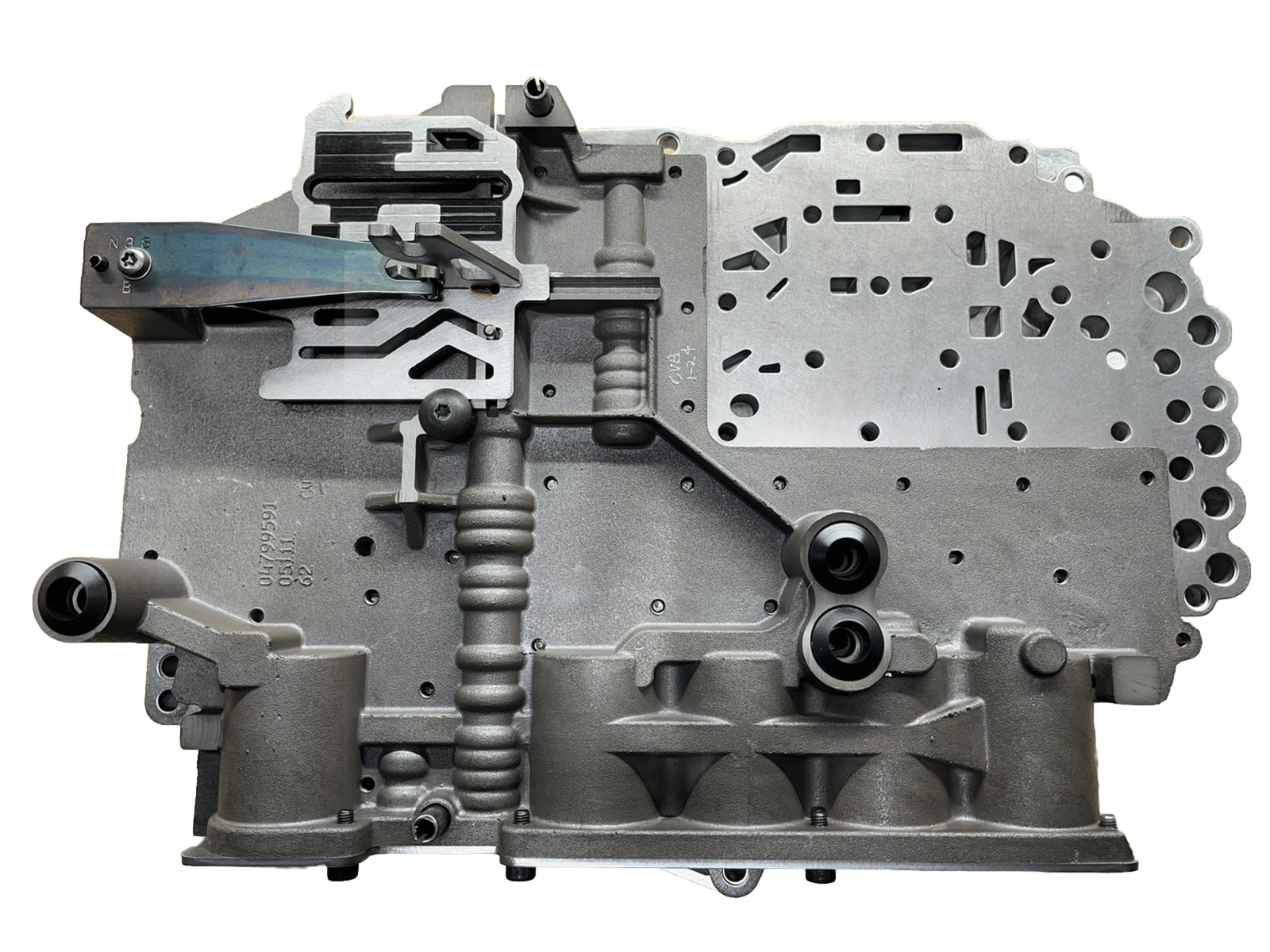
- Pull the valve body and vacuum test the solenoid switch valve, TC regulator and TCC accumulator bores, using the wiggle method. Repair worn bores with oversized valve kits, or replace the valve body if the wear is widespread.
- Replace the converter if the pan showed friction material, the TCM set a slip code, or the shudder survived the fluid and valve body work. Do the valve body repair at the same time so the new converter does not get the same treatment.
- Add a TCC apply limit valve on any tuned truck.
- Run the transmission Quicklearn after valve body or solenoid work so the TCM relearns clutch fill with the repaired hydraulics.
Shop 68RFE parts →
Keeping It From Coming Back
Most repeat shudder comes from heat and fluid. Change ATF+4 and the filter on a schedule that fits the work the truck does; a truck towing heavy should be serviced well before the light-duty interval. Keep the cooler circuit healthy, because a converter that runs hot glazes its friction faster. And do not drive on a known shudder: every mile of chatter polishes the clutch and sends friction debris through the same valve bores.
Frequently Asked Questions
What causes torque converter shudder on a 68RFE?
Shudder happens when the dual-plate converter clutch grabs and releases rapidly during partial (EMCC) lockup. The usual causes are wrong or worn-out fluid that has lost its friction properties, a glazed converter clutch, or wear in the valve body and pump bores that control lockup pressure, mainly the solenoid switch valve, the TC regulator valve and the TCC accumulator valve.
Will a new torque converter fix 68RFE shudder?
Only if the converter is the sole problem. If the TCC apply and release circuits are leaking because of worn valve bores, a new converter sees the same bad pressure and can shudder again within a few thousand miles. Gauge the circuits and vacuum test the valve body before, or at the same time as, replacing the converter.
What fluid does the 68RFE need to prevent shudder?
Mopar ATF+4, Chrysler material standard MS-9602, is the specified fluid. The converter clutch friction is matched to it, so a universal ATF or a Dexron top-off can cause shudder. Check the level hot, with fluid at a minimum of 160 F.
What are normal TCC pressures on a 68RFE?
In the GEARS Magazine P0740 case study, TCC release pressure with the clutch applied should be 5 psi or less, and TCC apply pressure should match line pressure, about 120 psi in that test. Healthy stock idle line pressure is 60 to 70 psi at a 22 to 24 percent duty cycle, and stock full-apply converter pressure tops out around 160 psi in forward ranges.
Sources
- Sonnax — "Prevent RFE, RH/RE Converter Failure: Maintain Proper TCC Apply Pressure," Jim Dial, October 16, 2024. Backs the TCC regulator valve functioning only during partial apply, full-apply TCC pressure equaling line pressure, the roughly 160 psi stock maximum in forward ranges, the 220 psi-plus pressure possible with performance kits, the converter ballooning, flex plate, pump and crankshaft damage list, and the 44912-36K / 44912-41K apply limit valve kits capping apply at 150 psi. sonnax.com
- Sonnax — "Rebuilding the Chrysler 68RFE Torque Converter," Ed Lee. Backs the dual-plate lockup clutch replacing the 47/48RE single plate, the dual-stage turbine damper, the roughly 65 lb weight against 52.3 lb for the 48RE converter, the 4140 impeller hub with o-ring groove and four drive flats, the approximately .070 in. wall at the o-ring groove, and the higher operating pressure held during lockup. sonnax.com
- Sonnax — "All in the Family: Identification & Repair of Chrysler Solenoid Switch Valve Problems." Backs the solenoid switch valve directing oil between the L/R clutch and the TCC, the symptom list of converter apply and release problems, loss of lockup, stall, failsafe and bind-up from bore wear, and vacuum testing as the way to decide on repair. sonnax.com
- GEARS Magazine (ATRA) — "Solving a 68RFE Mystery Code P0740." Backs the L/R-TCC solenoid control of lockup, EMCC and FEMCC modes, the 60 rpm slip target, the 1,750 rpm and 100 rpm / 10 second code set conditions, the measured 20 psi release (spec 5 psi or less) and 85 psi apply (spec about 120 psi) readings, the 18 in-Hg vacuum minimum, the 195 F to 230 F temperature rise, the 1 GPM cooler flow minimum, and the switch valve, converter accumulator and converter repair. gearsmagazine.com
- GEARS Magazine (ATRA) — "Fixing the Root Cause of the Problem: Solving Issues with the 68RFE Transmission." Backs the 60 to 70 psi idle line pressure at 22 to 24% duty cycle, the 5% duty cycle signature of a pump that cannot meet commanded pressure, TC regulator valve bore wear causing harsh TCC apply and release, excess slip and stall, and the egg-shaped TCC accumulator bore with the wiggle test method. gearsmagazine.com
- FCA US LLC / NHTSA — Dealer Service Instructions, Safety Recall W03 / NHTSA 20V-043, "Transmission Valve Body." Backs Mopar ATF+4 (MS-9602) as the specified fill for the 68RFE and the 160 F minimum fluid temperature for checking level. static.nhtsa.gov (PDF)