The pressure control solenoid is the one part in a 66RFE that touches every shift, every engagement and every clutch apply, and it does not have a code of its own. Chrysler gives the line pressure sensor two circuit codes. It gives the pressure control solenoid none. So when the PCS circuit fails, the truck sets P0869, P0933 or P0868 and sends you after the sensor or the pump. That is how a wiring repair turns into a solenoid pack, a sensor and a valve body on the same invoice.
The pressure control solenoid is also called the line pressure solenoid or LP VFS. The 66RFE is the six-speed behind the 6.4L HEMI in 2013-2018 Ram 2500, 3500 and cab chassis trucks. It shares its solenoid pack, line pressure strategy and pump-mounted pressure regulator with the 45RFE, 545RFE, 65RFE and 68RFE, so the numbers below come from that family's factory and Sonnax data.
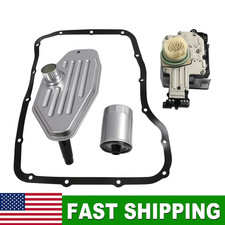
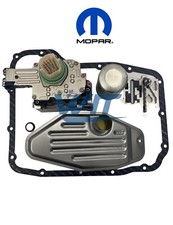
What the Pressure Control Solenoid Actually Does
Line pressure on the RFE is a closed loop with two parts. The line pressure sensor reports what the pump is actually making. The pressure control solenoid changes it. Per David Chalker's Gears Magazine write-up on RFE pressure codes, the line pressure solenoid is a variable force solenoid built into the solenoid pack, and it feeds oil to the end land of the pressure regulator valve in the pump. There is no solenoid oil on the spring side.
That layout explains the whole failure pattern, so it is worth getting straight:
- High duty cycle = low line pressure. More solenoid oil on the end of the regulator valve pushes it over and dumps more line pressure.
- Low duty cycle = high line pressure. With the solenoid off, nothing pushes against the regulator spring and the pump goes to maximum.
Chrysler's service information for the RFE puts numbers on it: 5% duty cycle is solenoid off and maximum line pressure, 62% is solenoid on and minimum line pressure. Chalker's article gives the top of the range as about 65%. Either way, the point is the same. The solenoid fails safe to high pressure, so the truck keeps clutches clamped instead of burning them.
The controller does not run a fixed pressure. Chrysler calls it Torque Based Line Pressure: the module calculates torque into the transmission and sets desired pressure from it, then holds a preset 120 or 135 psi during shifts and in Park and Neutral for consistent shift feel. It compares desired against actual the whole time it is driving.
Symptoms of a Bad 66RFE Pressure Control Solenoid
The symptoms split into two groups depending on which way the circuit failed. Knowing which group you are in tells you where to look.
Stuck high (open circuit, solenoid off)
- Hard, banging engagements into Drive and Reverse, and firm upshifts at light throttle
- Line pressure flatlined at about 150 to 160 psi at idle in Park, Neutral and Drive, and about 250 psi in Reverse, per Sonnax's Jim Mobley
- Codes P0869 (line pressure high) and P0933 (pressure sensor performance)
- Check engine light, and on a hard fault, the controller drops into limp mode
Stuck low (short to ground, solenoid always on)
- Soft, slipping or flared shifts, and a delayed engagement
- Code P0868 (line pressure low)
- Pressure switch codes such as P0871, because the clutch circuits do not reach the switch closing point
- Burned clutches if it is driven that way
The first group is far more common. Mobley singles out the open PCS ground control circuit as a frequent fault on the RFE and notes it can be intermittent or constant. The low group is rarer and harder to spot, because low pressure from a shorted PCS circuit looks almost identical to low pressure from a worn pump or regulator bore.
The Codes, and Why They Mislead
Per Gears Magazine's list of the set conditions for the RFE family:
- P0868, Line Pressure Low. Monitored continuously in all forward gears. Sets when actual line pressure is more than 10 psi below desired. The Chrysler service information for the 45RFE/545RFE version states it as 15 psi below desired for 3.5 seconds, so check the calibration for your truck.
- P0869, Line Pressure High. Sets when actual pressure is higher than the highest desired pressure ever used in the current gear while the PCS duty cycle is at or near maximum, which should be giving minimum pressure.
- P0933, Hydraulic Pressure Sensor Range/Performance. Sets when actual pressure is more than 25 psi (172.4 kPa) above desired, but below the highest pressure ever used in the gear.
- P0934 and P0935, Line Pressure Sensor Circuit Low and High. Sensor voltage at or below 0.35 V, or at or above 4.75 V, for 0.18 seconds.
Here is the trap. Mobley's Sonnax article states plainly that there is no Chrysler code for a circuit fault on the PCS line pressure solenoid. A max pressure condition sets P0933, and the name of that code sends you to the line pressure sensor. It is the wrong part. P0869 is the better clue because its description does include a possible open circuit on the PCS. If you see P0933 or P0869 with no P0934 or P0935, the sensor circuit is electrically in range. That makes the solenoid side the first suspect.
Read the Scan Data First
Pull up desired line pressure, actual line pressure, LP solenoid duty cycle and line pressure sensor voltage. Chalker's known-good baseline came from a 2007 Ram 5.7L with a 545RFE. In Neutral at idle it showed 124.97 psi desired against 128.97 psi actual at 19.03% duty. In Drive at a stop it showed 59.98 psi desired, 62.98 psi actual, 27.8% duty. In 3rd gear on the road it showed 119.97 psi desired and actual. Sonnax gives normal OE line pressure for the family as 60 psi minimum and 150 to 160 psi maximum at stall. Two things should always track each other: desired against actual, and solenoid voltage against sensor voltage.
Now compare against the open-circuit capture Mobley published: 38.38% duty cycle, 160 psi actual, desired stuck at a default 125 psi, with no activity at all. The controller is commanding the solenoid, but the pressure does not respond because no current is flowing. If your scan tool supports bidirectional control of the PCS, command it and watch actual pressure. If nothing moves, the solenoid is not in the circuit.
One thing to rule out: a tuned truck. Mobley notes that aftermarket tuning can be mistaken for a max pressure fault. The difference is that a tune may run above 160 psi but the pressure still moves with throttle and gear. A circuit fault is a flat line.
How to Test the PCS Circuit
1. Fluid and filter
The 66RFE takes ATF+4 only. Check the level hot. Chrysler's P0868 cause list includes low fluid level, a cracked, plugged or wrongly installed primary oil filter, and a loose cooler-return spin-on filter. If the code showed up right after a pan service, check your own filter seal before you check anything else.
2. Amp clamp the ground control wire
Mobley's test is non-invasive and quick. On his 2013 Ram 6.7L 68RFE reference truck, the PCS ground control is wire #12 to PCM connector C1, terminal pin 29. Open the conduit, put a low-current clamp on that wire, clear codes and watch it key on, engine running, in Park or Drive. Normal current flow varies from 0.20 to 1.00 amps. Current flowing proves the circuit is not open. A circuit shorted to ground also flows current, but the result is low pressure. So read the clamp and the pressure together. Pin numbers vary by year and model, so pull the wiring diagram for the VIN before you probe. Chrysler's procedures also warn against probing PCM connector terminals directly. Use the breakout tool (Miller 8815) so you do not spread a pin and create a new intermittent.
Two quick cross-checks from the same article: if the other solenoids work and there is no P0882 (low voltage supply), the power side of the circuit is usually fine. That points you at the ground control side.
3. Ohm the solenoid at the pack
On the 2010-2018 gray connector pack, Sonnax's 2025 pin chart identifies pin 12 as LP VFS control and pin 10 as the transmission control relay output feeding the pack. The published resistance for the line pressure solenoid is 3.5 ohms on the Valve Body Xpress identification sheet and 4.3 ohms on the Sonnax CHR145/CHR146 install sheet, measured at room temperature. Treat a reading in that range as a good coil. Open (OL) or near zero is a failed solenoid, which means a solenoid pack, since Gears describes the PCS as an integral part of the pack.
4. Confirm with a mechanical gauge
Chrysler's adapter tool 8259 threads into the case in place of the line pressure sensor and takes both the sensor and a mechanical gauge. In the factory P0868 test, the gauge should agree with the scan tool within 5 psi. If it does not, the sensor is lying and the solenoid may be fine. That one setup checks both halves of the loop.
5. Wiggle the line pressure sensor connector
Chalker calls the solder and crimp joints at the line pressure sensor terminals one of the most common sources of intermittent pressure codes on these units. Chrysler's procedure has a matching check: engine off, push the sensor connector in and watch for the line pressure reading to jump to about 30 psi. If it jumps, the connector is the fault. For a code that comes and goes, Chalker recommends recording a scan tool movie when it sets.
Solenoid, Wiring or Hydraulics?
- Flat high pressure, no amp draw on the ground wire, coil reads open: solenoid pack.
- Flat high pressure, no amp draw, coil reads good at the pack: wiring or connector between the pack and the PCM, or the PCM itself.
- Low pressure, current flowing, wiring shows a short to ground: repair the harness.
- Low pressure, circuit and coil good, gauge agrees with the sensor: hydraulic. Look at the pressure regulator valve bore and the pump.
That last case is where people waste a solenoid pack. Sonnax lists harsh shifts, soft shifts, high line pressure, erratic line pressure and burnt clutches against a worn pressure regulator valve bore on the 66RFE. A worn bore leaks the oil the solenoid acts against, and a new solenoid will not fix that. Vacuum test the pressure regulator bore in the pump. The fix is a reamed bore and the oversized valve in Sonnax kit 44912-10K, or a replacement pump.
Check for the FCA T15 Campaign First
If the truck is a 2016 or 2017 Ram with the 65/66RFE, run the VIN before you buy a solenoid pack. FCA Customer Satisfaction Notification T15 covers trucks whose solenoid coil terminals were built out of specification. The resulting intermittent connection can limit the transmission to one gear and 30 to 45 mph with the MIL on. The dealer replaces the solenoid pack at no charge, in about two hours. An intermittent PCS fault on a T15 truck may be exactly this.
Replacing the Solenoid Pack
- Match the connector. Per Sonnax, 2010-2018 packs use a gray 23-pin connector and five solenoids. The 2019-up blue connector pack is different and does not interchange. The 66RFE ended in 2018, so a 66RFE takes the gray pack.
- Torque. The Sonnax CHR145/CHR146 sheet calls for 53 in-lb on the solenoid pack to valve body torx bolts.
- Relearn. Warm the fluid to about 185°F, run the quick learn with a scan tool, then drive 10 to 15 upshift and downshift cycles. Some clunks and flares during the relearn are normal.
FAQ
What are the symptoms of a bad 66RFE pressure control solenoid?
It depends on how it failed. An open circuit leaves the solenoid off, which drives line pressure to maximum: hard engagements, firm shifts, about 150 to 160 psi at idle and 250 psi in Reverse, and codes P0869 or P0933. A short to ground does the opposite and gives low pressure, soft or slipping shifts and P0868.
Is there a trouble code for the 66RFE pressure control solenoid?
No. Sonnax notes that Chrysler has no code for a circuit fault on the PCS line pressure solenoid. The fault shows up as P0869 line pressure high, P0933 pressure sensor performance or P0868 line pressure low. P0933 often sends techs to the line pressure sensor when the real fault is the PCS circuit.
How do you test the pressure control solenoid on a 66RFE?
Compare desired and actual line pressure on the scan tool, then put a low-current amp clamp on the PCS ground control wire with the engine running. Sonnax gives 0.20 to 1.00 amps as normal. Ohm the line pressure solenoid at the pack, where Sonnax sheets list 3.5 to 4.3 ohms, and confirm actual pressure with a mechanical gauge on adapter tool 8259.
Can I replace just the pressure control solenoid on a 66RFE?
On the RFE family the line pressure solenoid is an integral part of the solenoid pack, so the normal repair is a complete solenoid pack. A 66RFE uses the 2010-2018 gray connector pack. Check 2016 and 2017 trucks for FCA campaign T15 first, which replaces the pack free.
What should 66RFE line pressure be?
Sonnax gives normal OE line pressure for the RFE family as 60 psi minimum and 150 to 160 psi maximum at stall. A known-good truck in Drive at a stop shows about 60 psi desired and actual. Desired and actual should always track within a few psi of each other.
Sources
- Sonnax — Jim Mobley, "Diagnosing Chrysler Transmission Max Line Pressure & P0933, P0869, P1745 Codes" (Jan 2023). Backs no Chrysler code for a PCS circuit fault, the 150-160 psi idle and 250 psi Reverse open-circuit pressure, the 38.38% duty, 160 psi actual and 125 psi default desired scan capture, 60 psi minimum and 150-160 psi stall pressure, the wire #12 / C1 pin 29 amp clamp test at 0.20-1.00 A, short to ground giving low pressure, the P0882 cross-check, tuning versus circuit fault, and the 44912-10K pressure regulator kit symptoms. sonnax.com
- Gears Magazine (ATRA) — David Chalker, "Diagnosing Pressure Trouble Codes" (Aug 2017). Backs the line pressure solenoid as a variable force solenoid in the solenoid pack acting on the end land of the pressure regulator valve, duty cycle direction, the P0868, P0869, P0933, P0934 and P0935 set conditions, the 545RFE known-good scan data, line pressure sensor connector solder and crimp faults, and recording a movie for intermittent codes. gearsmagazine.com
- Chrysler service information — 45RFE/545RFE DTC P0868 Line Pressure Low. Backs 5% duty for maximum and 62% duty for minimum line pressure, Torque Based Line Pressure, the 120/135 psi shift and Park/Neutral levels, the 15 psi for 3.5 seconds set condition, the cause list (low fluid, filter, cooler-return filter, main regulator valve, PCS control circuit), the 30 psi connector push test, the 5 psi gauge agreement check and the Miller 8815 warning. jeep.automotive-manuals.com
- Sonnax — Randall Schroeder, "Identifying Chrysler RFE Solenoid Changes Through the Years" (Feb 2025). Backs the black, white, gray (2010) and blue (2019) connector history, five solenoids in the gray pack, the 66RFE in the RFE family, and the pin chart with pin 12 as LP VFS control and pin 10 as the transmission control output. sonnax.com
- Sonnax / Valve Body Xpress — "45RFE, 545RFE, 68RFE Solenoid Identification & Connector Pin Out." Backs the 3.5 ohm pressure control solenoid resistance and pin 12 as the pressure control solenoid control. sonnax.com
- Sonnax — CHR145/CHR146 Universal Remanufactured Valve Body Tech & Install Tips (PDF). Backs the 4.3 ohm line pressure solenoid resistance, the 53 in-lb solenoid pack torque, and the 185°F quick learn with a 10-15 cycle road test. cdn.transend.us (PDF)
- FCA US — Customer Satisfaction Notification T15. Backs the 2016-2017 Ram 65/66RFE solenoid coil terminal defect, the one-gear 30-45 mph limit with MIL, and the free two-hour solenoid pack replacement. chrysler.com (PDF)