A 66RFE that drives fine in every forward gear and does nothing in Reverse sends a lot of owners straight to a rebuild quote. Sometimes that is where it ends up. But Reverse on this transmission uses only two clutches, one of them is applied with no solenoid at all on most trucks, and the most common cause is a worn valve in the valve body that a vacuum gauge can find in ten minutes. Knowing how Reverse is built is what keeps you from replacing the wrong half of the transmission.
The 66RFE is the six-speed RFE behind the gas HEMI in Ram 2500, 3500 and cab chassis trucks. FCA's own bulletins list it as sales code DFP behind the 6.4L (sales codes ESA and ESB). It shares its clutch layout, valve body logic and Reverse circuit with the 545RFE and 68RFE, so the RFE-family service information applies directly. Here is how Reverse works, the causes in the order I find them, the bench tests that separate them, and what each fix costs you in labor.
How Reverse Works on the 66RFE
Per ATSG's RFE technical service information, the transmission applies two friction elements in every range. In Reverse those are the Reverse clutch and the Low/Reverse (L/R) clutch, for a 4.44:1 ratio. The Reverse clutch drives the gear train. The L/R clutch is the holding member at the back of the case. In Park and Neutral, only the L/R clutch is on, and in 1st gear the L/R clutch is used only while output shaft speed is below 150 rpm.
ATSG states the detail that matters most for diagnosis plainly: solenoids control the L/R, 2C, 4C, UD and OD elements, but the Reverse clutch is controlled by the manual valve in the valve body and line pressure. The same document notes that the hydraulic system with no electronic assist still gives the transmission Park, Reverse, Neutral and 4th. That is why a 66RFE in limp mode still backs up.
Three practical conclusions come out of that layout:
- No Reverse in limp mode is hydraulic or mechanical. With the transmission relay off and no solenoid power, Reverse should still be there. If it is not, the solenoid pack is not your first suspect.
- The TCM cannot see the Reverse clutch directly. The five pressure switches watch L/R, 2C, 4C, UD and OD. There is no Reverse switch. The controller only learns about a Reverse problem by comparing input and output speed, which is how P0736 (gear ratio error in Reverse) sets.
- The L/R clutch is shared; the Reverse clutch is not. A problem in the L/R circuit usually shows up somewhere else too. A problem in the Reverse clutch circuit shows up only in Reverse.
Step 1: Split the Problem Between the Two Clutches
The fastest diagnosis is finding out which of the two clutches is missing.
Test manual low. In Drive, 1st gear can be carried by the low sprag, so a weak L/R clutch can hide. Select the lowest range on the ERS buttons or shifter and coast down a grade. Engine braking in low 1st requires the L/R clutch. No engine braking in low plus no Reverse points at the L/R side. Manual low holds, Drive engages clean, and Reverse is still dead? Now you are looking at the Reverse clutch circuit: the manual valve feed, the Reverse clutch pack, or the OD/Reverse piston and its seals in the input clutch housing.
Then read the scan data. Shift to Reverse with your foot on the brake and watch the PRNDL position the TCM reports, line pressure desired versus actual, and input and output speed. If the TCM does not show R with the lever in R, you have a shift cable or range sensor problem, not a clutch problem. If it shows R, pressure matches, and input speed is pulled to zero with the brake held, the clutches are applying. If input speed climbs freely with the truck stopped, something in the power path is not holding.
Step 2: Fluid, Cable and the Easy Stuff
- Fluid level, hot. The 66RFE takes Mopar ATF+4, which ATSG lists as the RFE fluid requirement. Low fluid is the first item on Chrysler's P0736 cause list for this family. Low fluid aerates and Reverse, which needs full line pressure through the manual valve, is often the first range to go, especially parked nose-up on a slope.
- Fluid condition. Black fluid with friction material in the pan says the clutches are already burnt. That moves you past a valve body repair before you start.
- Shift cable and manual valve position. A stretched or misadjusted cable can leave the manual valve between Reverse and Neutral in the R detent. Pop the cable off at the transmission and move the lever by hand. If it backs up that way, the transmission is fine and the cable is the job.
Step 3: The Low/Reverse Switch Valve Bore
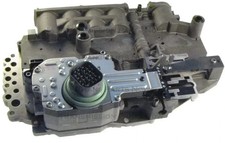
This is the most common hydraulic cause on high-mileage RFE units, and Sonnax lists both "Delayed Reverse" and "No Reverse" on its 66RFE unit page. The L/R switch valve acts as a one-way valve for the L/R clutch in both Reverse and Drive, letting oil move in only one direction through an orifice. Sonnax product line manager Chris Leach explains that the valve gets heavily side-loaded because its diameter is too close to its total length. As the valve and bore wear, oil leaks past the one-way valve and exhausts through the manual valve. The result is low apply pressure at the L/R clutch, which shows up as burnt clutches, delayed or no Reverse, or 1st and 2nd gear problems.
How to test it: pull the valve body and vacuum test the bore on the bench. Move the valve by hand to each worm track area you are testing. Sonnax's spec is 18 in-Hg or better; anything lower means the bore is worn. Sonnax notes that if the first test port leaks badly, the second one almost always does too.
The fix: Sonnax's drop-in Low/Reverse switch checkball sleeve kit 92835-41K, or the oversized 92835-45K for a bore that is too far gone, is listed for the 45RFE, 545RFE, 65RFE, 66RFE and 68RFE. The kit replaces the worn valve with steel sleeves and a checkball that run in an unworn bore. If the L/R clutch is not burnt yet, this is a valve body repair, not a teardown. If you do not want to sleeve it yourself, a complete remanufactured valve body for the correct year does the same job.
Step 4: Recent Valve Body Work? Check This First
If Reverse disappeared right after a valve body or solenoid pack job, look at the installation before anything else.
- Pressure test plugs. Transmission Digest's Wayne Colonna documented an RFE truck with no forward or Reverse and zero line pressure after a dealer valve body install. The clutch pressure test plugs were shipped in a separate bag and never installed, so apply oil dumped out the test ports.
- Checkballs. Per Sonnax's Jim Mobley, 2006-2010 RFE valve bodies used seven checkballs and 2011-2018 units use five. The #3 ball sends Reverse oil through an orifice to soften garage shifts, so leaving it out gives a firm Reverse, not a missing one. The #1 ball keeps the L/R clutch from applying after the L/R solenoid turns off in 1st; leave it out and you get a 2nd gear bind and possibly P0841. A wrong ball count usually means the wrong plate or valve body for the year.
- Separator plate, gasket and valve body-to-case seals. Chrysler's RFE P0736 cause list includes a cut L/R tower seal on the main valve body, a cut L/R accumulator piston seal and a cracked L/R accumulator piston. All three sit on the valve body and are easy to damage on reinstall.
Step 5: Air Check the Circuits
With the valve body off, air check the Reverse and L/R apply passages at the case with regulated shop air. You want a clean thump on apply and release with no loud hiss. Chrysler's service information gives one note that keeps people from condemning good parts: both circuits have a small bleed orifice, and the Reverse circuit bleed connects to the OD clutch cavity, so a small amount of air leaking into the OD circuit while you air Reverse is normal.
A big leak on the Reverse circuit points at the OD/Reverse piston seals or a broken or missing OD/Reverse bleed orifice in the piston. A big leak on the L/R circuit points at cut L/R piston seals or a broken or missing bleed orifice in the L/R clutch retainer. Either way, the transmission is coming out.
Step 6: The Hard Parts Behind P0736
Chrysler's procedure for P0736 on this family sets the code when the input-to-output ratio does not match the commanded gear, and it can take up to five minutes of fault detection before the MIL comes on. If the clutch test fails in Reverse, the next check is mechanical: is the reaction carrier turning faster than the drive shell? If it is not, the reverse sun gear weld to the reaction carrier has broken and the carrier gets replaced. The same cause list includes a broken reverse carrier hub weld. If both pass, the procedure sends you into the input clutch assembly to check the Reverse clutch reaction plate snap ring, the OD and Reverse clutch seals and discs, the bleed orifice in the OD/Reverse piston, and the Reverse hub and shaft.
One more teardown item. Transmission Digest notes the L/R clutch piston return spring retainer clips on the 45, 545, 65, 66 and 68RFE can get damaged or lost, and they are hard to source through OEM channels. If you find the L/R return spring loose during an overhaul, check the clips before reassembly.
Shudder Backing Up a Hill: Check the Calibration First
Not every Reverse complaint is a failed part. FCA bulletin 18-097-16 (August 20, 2016) reflashes the PCM on 2015 Ram 2500, 3500 and cab chassis trucks with the 6.4L, and its list of enhancements includes one aimed at "shudder in reverse when backing up a grade," for sales code DFP (the 66RFE) only. If a 2015 truck engages Reverse fine and only shudders backing up an incline with a trailer, confirm the calibration level before you pull the pan.
2019-Up Units Are Different
Everything above assumes the 2018-and-earlier hydraulic design, where the manual valve applies the Reverse clutch. Sonnax documents a 2019-up RFE redesign that added a lower valve body section with a Reverse accumulator and gave the Reverse clutch its own control solenoid, with a blue solenoid pack connector. On a 2019-up unit, a solenoid or circuit fault can take Reverse away, and Sonnax warns that 2019-up valve bodies, solenoid packs and gaskets do not interchange with earlier parts. Check the connector color before ordering anything.
Quick Diagnostic Order
- Confirm the TCM sees R on the range input and actual line pressure matches desired in Reverse.
- Check fluid level hot and fluid condition. Check the shift cable.
- Test manual low engine braking to split the L/R clutch from the Reverse clutch.
- If the valve body was just serviced, check test plugs, checkballs, plate, gasket and the L/R tower seal first.
- Vacuum test the L/R switch valve bore. Below 18 in-Hg, sleeve it or replace the valve body.
- Air check the Reverse and L/R circuits. A big leak means a teardown.
- In the teardown, check the reverse sun gear weld, reverse carrier hub, OD/Reverse piston and orifice, and the L/R return spring clips.
- After any repair, run the quick learn. ATSG notes the RFE uses adaptive learning to set clutch apply timing, and new parts will not shift right on the old learned values.
FAQ
Why does my 66RFE have Drive but no Reverse?
Reverse uses only the Reverse clutch and the Low/Reverse clutch, and the Reverse clutch is used in no other range. If every forward gear works, the fault is in the Reverse clutch circuit or the L/R clutch. Check fluid level and the shift cable first, then test engine braking in manual low to tell the two clutches apart.
Can a bad solenoid cause no Reverse on a 66RFE?
On 2018 and earlier units, rarely. Per ATSG, the Reverse clutch on the RFE family is applied by the manual valve and line pressure with no solenoid, and the hydraulic system alone provides Park, Reverse, Neutral and 4th. On 2019-up RFE designs the Reverse clutch has its own solenoid, so an electrical fault can take Reverse away.
Will a 66RFE still go into Reverse in limp mode?
It should. ATSG states the hydraulic control system gives the RFE Park, Reverse, Neutral and 4th gear with no electronic assist, which is how a limping truck can still back up. If a pre-2019 truck has no Reverse even in limp mode, the cause is hydraulic or mechanical, not electrical.
How do I fix a worn 66RFE low/reverse switch valve?
Vacuum test the bore with the valve body on the bench; Sonnax rates 18 in-Hg or better as good. A worn bore takes Sonnax drop-in sleeve kit 92835-41K or oversized kit 92835-45K, both listed for the 66RFE, or a remanufactured valve body for the correct year. If the L/R clutch is already burnt, the transmission needs an overhaul as well.
Sources
- ATSG — Dodge Ram Trucks 68RFE Transmission, Technical Service Information (2011, PDF). Backs the RFE clutch application chart with Reverse and L/R clutches in Reverse at 4.44:1, the L/R clutch alone in Park and Neutral and in 1st only below 150 rpm output speed, solenoid control of L/R, 2C, 4C, UD and OD with the Reverse clutch controlled by the manual valve and line pressure, hydraulic Park, Reverse, Neutral and 4th with no electronics, Mopar ATF+4, and adaptive learning. atsg.biz (PDF)
- FCA US / NHTSA — Service Bulletin 18-097-16, "Flash: Diagnostic And System Enhancements" (August 20, 2016). Backs the 2015 Ram 2500, 3500 and cab chassis 6.4L (ESA/ESB) with 66RFE sales code DFP coverage and the enhancement to prevent shudder in Reverse when backing up a grade, DFP only. static.nhtsa.gov (PDF)
- Chrysler 45RFE/545RFE service information — P0736 Gear Ratio Error in Reverse. Backs the set condition and five-minute detection note, the cause list (low fluid, L/R tower seal, L/R and OD/Reverse piston seals and bleed orifices, L/R accumulator piston, reverse carrier hub weld, reverse sun gear weld), the normal Reverse-to-OD bleed air leak, and the reaction carrier versus drive shell check. jeep.automotive-manuals.com
- Sonnax — Chris Leach, "Diagnosing 62TE, 68RFE Low/Reverse Switch Valve Issues." Backs the L/R switch valve as a one-way valve in Reverse and Drive, side-loading wear, leakage exhausting through the manual valve, burnt clutches and delayed or no Reverse, and the 18 in-Hg vacuum test spec. sonnax.com
- Sonnax — Low/Reverse Switch Checkball Sleeve Kit 92835-41K. Backs fitment to the 45RFE, 545RFE, 65RFE, 66RFE and 68RFE, the burnt L/R clutch, delayed Reverse and no Reverse symptoms, and side-loading bore wear causing loss of apply pressure. sonnax.com
- Transmission Digest — Jim Mobley (Sonnax), "Chrysler RFE valve body checkball locations and function" (August 21, 2024). Backs seven checkballs on 2006-2010 and five on 2011-2018 RFE valve bodies including the 66RFE, the #3 ball softening Reverse engagement, and the #1 ball preventing L/R apply after the L/R solenoid turns off with a 2nd gear bind and P0841 if missing. transmissiondigest.com
- Transmission Digest — Wayne Colonna, "RFE Series No Movement After Valve Body Replacement." Backs the no forward or Reverse, zero line pressure case caused by clutch pressure test plugs left in a separate bag. transmissiondigest.com
- Transmission Digest — "RFE Clips" (March 24, 2021). Backs damaged or lost L/R clutch piston return spring retainer clips on the 45, 545, 65, 66 and 68RFE. transmissiondigest.com
- Sonnax — "Chrysler 68RFE '19-Later Changes & Identification." Backs the 2019-up lower valve body with a Reverse accumulator, the Reverse clutch gaining its own control solenoid, the blue connector, and non-interchangeable 2019-up valve bodies, solenoid packs and gaskets. sonnax.com