A 68RFE that pulls through every forward gear and does nothing in Reverse is a narrower problem than it looks. Reverse on this unit uses only two friction elements, and on the 2007.5 to 2018 trucks one of them is not controlled by a solenoid at all. Once you know which clutch is missing and how it is fed, you can usually tell from the driver's seat whether you are looking at a valve body job or a teardown.
This is how I work a no-reverse or delayed-reverse complaint on the 68RFE behind the 6.7L Cummins in Ram 2500, 3500 and cab chassis trucks. The clutch logic comes from ATSG. The valve body wear data comes from Sonnax. The 2019 design changes and the valve body install trap come from Transmission Digest, and the input clutch housing failure points come from GEARS magazine. Full list at the bottom.
How Reverse Works on the 68RFE
Per ATSG, the 68RFE applies two clutches at a time in every range. In Reverse those are the Reverse clutch and the Low/Reverse (L/R) clutch, for a 4.44:1 ratio. The Reverse clutch drives the gear train. The L/R clutch is the holding member.
| Element | Where it lives | How it is applied (2007.5-2018) | Also used in |
|---|---|---|---|
| Reverse clutch | Input clutch housing, with the UD and OD clutches | Manual valve and line pressure, no solenoid | Reverse only |
| L/R clutch | Rear of case, single-sided pack | L/R solenoid, through the L/R switch valve | Park, Neutral, and 1st below 150 rpm output speed |
ATSG spells out the part that matters most for diagnosis: solenoids control the L/R, 2C, 4C, UD and OD clutches, but the Reverse clutch is controlled by the manual valve in the valve body and line pressure. ATSG also notes that the hydraulic system alone, with no electronic help, gives the 68RFE Park, Reverse, Neutral and 4th gear. That is what lets a truck in limp-in mode still back up.
Two things follow from that on a 2007.5 to 2018 truck:
- A truck in limp mode that still has no Reverse has a hydraulic or mechanical problem. With the transmission relay off, Reverse comes from the manual valve and line pressure. If it is not there, the solenoid pack is not your first suspect.
- The TCM cannot see the Reverse clutch directly. ATSG lists five pressure switches in the solenoid body: L/R, 2C, 4C, UD and OD. There is no Reverse clutch switch. The TCM only knows Reverse is failing by comparing input and output speed, which is how you end up with P0736, Reverse incorrect gear ratio. A no-reverse truck with no codes is normal if nobody has tried to drive it in Reverse with the engine loaded.
2019 and later trucks are different
Sonnax documents a hydraulic redesign for 2019-up 68RFEs. A new lower valve body section adds a Reverse accumulator and a dedicated TCC solenoid, and the manual valve reverted to an earlier design to go with the new Reverse clutch control. Sonnax states the Reverse clutch now has its own control solenoid, which earlier units never had, and the L/R solenoid now controls only the L/R clutch. Transmission Digest's Wayne Colonna describes it as a Normally Applied Reverse clutch solenoid mounted where the old OD solenoid sat, and notes the solenoid pack connector is blue on these units. On a 2019-up truck, an electrical or solenoid fault can take Reverse away. On earlier trucks it generally cannot.
Step 1: Split It Between the Two Clutches
Because Reverse needs both clutches, the fastest diagnosis is to find out which one is missing. The L/R clutch is shared with other ranges. The Reverse clutch is not.
- Check manual low. With the selector in 1 (or the lowest ERS range), the truck should hold engine braking in 1st on a coast. In Drive, 1st can be carried by the low sprag, but engine braking in low needs the L/R clutch. If you get no engine braking in low and no Reverse, the L/R side is the common thread.
- If manual low holds and Drive engages clean, but Reverse is dead, the problem is on the Reverse clutch side: the manual valve feed, the Reverse clutch pack, or the piston and seals in the input clutch housing.
Then look at the scan data. Put it in Reverse, hold the brake, and watch commanded gear, the PRNDL position the TCM sees, line pressure (commanded and actual) and input and output speed. If the TCM does not show R when the lever is in R, you have a shifter cable or range sensor problem, not a clutch problem. If it shows R, line pressure is where it should be and the input speed sensor shows the input shaft being held down with the brake on, the clutches are applying. If the input shaft spins up freely with the output stopped, something in the power path is not holding.
Step 2: Fluid, Linkage and the Obvious
- Fluid level, hot. The 68RFE takes Mopar ATF+4. The Reverse clutch sees full line pressure through the manual valve, and a unit that is a few quarts low can aerate and lose Reverse first, especially on a slope. Look at the fluid too. Dark fluid with friction material says you are already past a valve body fix.
- Shift cable and manual valve position. If the cable is stretched or out of adjustment, the manual valve may sit between Reverse and Neutral in the R detent. Pull the cable at the transmission and move the lever by hand. If it backs up that way, adjust or replace the cable.
- Tune and tire size. Aggressive tunes and oversized tires already load the pump on these trucks. That does not directly cause no Reverse, but it cooks the clutches that do.
Step 3: After a Valve Body Job, Check the Test Plugs
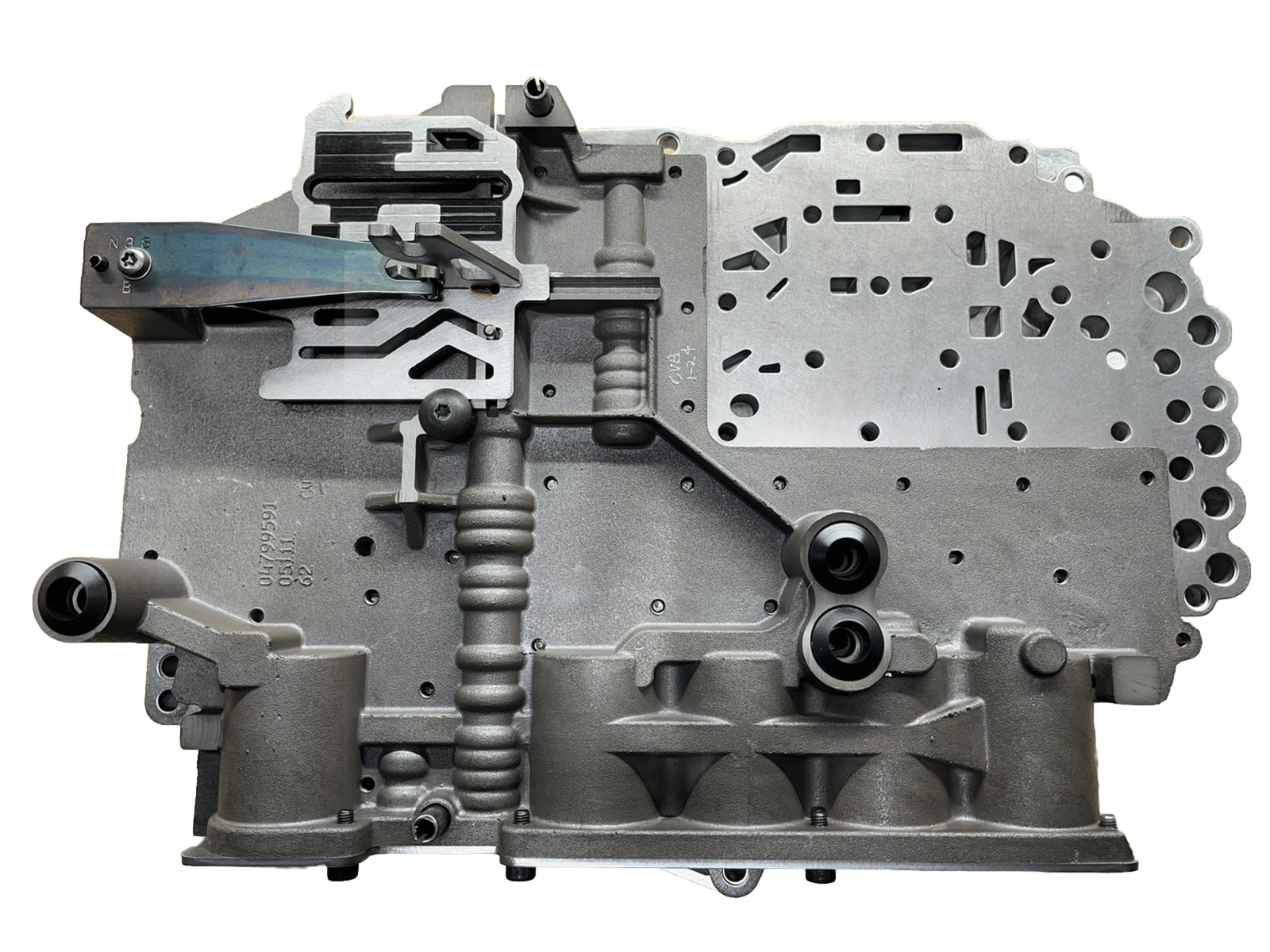
This one catches good techs. Transmission Digest ran a case from Wayne Colonna on a 2010 Ram 3500 68RFE that would not move in forward or reverse after a new dealer valve body was installed. The line pressure check showed zero pressure. The cause: the new valve body shipped with the clutch pressure test plugs in a separate bag in the box, and nobody noticed. Without the plugs, apply oil dumps straight out of the test ports.
A missing checkball after valve body work changes Reverse too, but in the other direction. Sonnax's RFE checkball article says the #3 ball routes Reverse oil through an orifice to soften garage shifts, so leaving it out gives a firm Reverse engagement rather than no Reverse. A harsh Reverse after a valve body job points at the #3 ball; no Reverse points at the test plugs and the L/R circuit.
Any time a 68RFE loses Reverse, or everything, right after valve body or solenoid pack work, pull the pan and check the test plugs, the checkballs, the separator plate and the gasket orientation before you touch anything else.
On 2019-up units there is a second install trap. Transmission Digest reports that an older gasket used on a 2019-up blue-connector assembly lets D21 line pressure feed the Normally Applied Reverse clutch solenoid in Drive, and the truck binds going forward. The reverse mistake, a new gasket on an older white-connector assembly, blocks OD solenoid pressure and gives a neutral shift into 3rd. Sonnax confirms 2019-up valve bodies, solenoid packs and gaskets do not interchange with earlier versions. Match the parts to the year.
Step 4: The L/R Switch Valve Bore
If the complaint is delayed Reverse, or Reverse that slips and then catches, and manual low is also soft, look at the L/R switch valve before you tear the unit down. Sonnax explains that this valve acts as a one-way valve for the L/R clutch in both Reverse and Drive. When the valve and its bore wear, oil leaks past it and exhausts through the manual valve. The result is low apply pressure at the L/R clutch, which Sonnax ties directly to burnt clutches and delayed or no Reverse, or 1st and 2nd gear problems.
You do not have to guess. Vacuum test the bore. On the 68RFE you manually move the valve to each worm track area you are testing. Sonnax's spec is 18 in-Hg or better is good; anything below is worn. For a worn bore Sonnax lists drop-in L/R switch checkball sleeve kit 92835-41K and oversized kit 92835-45K for the 68RFE. If the L/R clutch is not burnt yet, this is a valve body repair, not a rebuild.
Step 5: Inside the Input Clutch Housing
If manual low holds, Drive is clean, pressure is right, the valve body checks out, and Reverse is still gone, the problem is in the input clutch housing. ATSG notes the housing holds the single-sided UD clutch, the single-sided OD clutch and the Reverse clutch, laid out much like the 41TE but larger. GEARS calls the piston that works the OD and Reverse clutches the overdrive/reverse piston.
GEARS author Rob Faucett points to three failure areas in that housing:
- Surface damage on the input clutch retainer. Scored or worn sealing surfaces inside the drum lead to seal damage and early clutch failure. A new seal kit on a damaged retainer will not hold.
- The orifice in the overdrive/reverse piston. It is meant to be a controlled leak. If it is restricted, oil from the dribbler valves builds pressure and partly applies the clutch it should not, which burns frictions and brings the truck back.
- The dribbler valves and feed path in the stator support. Each has an orifice, checkball and spring, and they keep the circuit pre-charged. GEARS says air should pass from pump to drum but not from drum to pump. A restricted or leaking feed path hurts apply timing and lube.
With the valve body off, air check the Reverse and L/R apply circuits at the case. You should hear a clean thump as each clutch applies and releases, with no loud hiss. A big leak on the Reverse circuit points at the piston seals, the input shaft sealing rings or the retainer surfaces. A big leak on the L/R circuit points at the L/R piston seals or the valve body to case seals. Either way, the unit is coming out.
What Chrysler's RFE P0736 procedure adds
Chrysler's service information for the 45RFE and 545RFE, which share this Reverse and L/R layout with the 68RFE, adds three checks worth borrowing. First, the Reverse circuit bleed orifice connects to the OD clutch cavity, so a small amount of air leaking into the OD circuit while you air Reverse is normal and is not a failed seal. Second, if the scan tool clutch test fails in Reverse, Chrysler has you compare the reaction carrier to the drive shell: if the carrier is not turning faster than the shell, the reverse sun gear weld to the reaction carrier has broken and the carrier gets replaced. Third, the cause list includes a cut L/R tower seal and a cracked L/R accumulator piston on the main valve body, both easy to miss when you are focused on the clutch packs. The full walk-through is in our 45RFE no Reverse guide.
Quick Diagnostic Order
- Confirm the TCM sees R on the range input and line pressure matches commanded in Reverse.
- Check fluid level hot and fluid condition. Check the shift cable and manual valve position.
- Test manual low engine braking and Drive engagement to split L/R from the Reverse clutch.
- If the valve body was just replaced, check the pressure test plugs, checkballs, plate and gasket first. Match 2019-up and earlier parts.
- Vacuum test the L/R switch valve bore. Below 18 in-Hg, sleeve it.
- On 2019-up trucks, test the Reverse solenoid and circuit.
- Air check the Reverse and L/R circuits. A leak means a teardown: piston seals, retainer surfaces, the OD/reverse piston orifice and the feed path.
The Fix
- Worn L/R switch valve bore, clutches still good: sleeve the bore (92835-41K or 92835-45K), or replace the valve body with the correct year.
- Missing test plugs or valve body assembly error: install the plugs, correct the checkballs, plate and gasket.
- Burnt Reverse or L/R clutch, leaking pistons: overhaul. Replace the frictions and steels, all piston seals, and the L/R piston if it is a bonded piece. Inspect the input clutch retainer and replace it if the sealing surfaces are damaged. Clean and check the OD/reverse piston orifice and the dribbler valves.
- 2019-up Reverse solenoid fault: replace the 2019-up solenoid pack. Do not mix gray or white connector parts into a blue-connector unit.
After any repair, run the quick learn. Per ATSG, the TCM uses adaptive learning and a clutch volume index to set apply timing for each clutch, and new frictions will not shift right on the old learned values.
68RFE Low/Reverse clutch piston (bonded) at Core Transmission Parts
If the air check shows the L/R piston leaking, this is the bonded Low/Reverse clutch piston for 2005-up units. Replace it in the same overhaul as the frictions.
View the L/R clutch piston →68RFE overhaul kits, friction modules, valve bodies and solenoid packs — shipped fast from the USA.
Shop 68RFE parts →Related guides
- 68RFE P0736: Reverse Incorrect Gear Ratio
- 45RFE No Reverse: Diagnosis and Fix
- 68RFE Slipping: Causes and Fix
- 68RFE Valve Body Problems and Testing
- 68RFE Limp Mode Causes
- 68RFE Rebuild Guide for Ram Cummins
FAQ
Why does my 68RFE have Drive but no Reverse?
Reverse uses only two clutches, the Reverse clutch and the Low/Reverse clutch, and the Reverse clutch is used in no other range. If every forward gear works, the problem is in the Reverse clutch circuit or the L/R clutch. Check fluid level and the shift cable first, then split the two clutches by testing engine braking in manual low.
Can a bad solenoid cause no Reverse on a 68RFE?
On 2007.5 to 2018 trucks, rarely. Per ATSG, the Reverse clutch on those units is applied by the manual valve and line pressure with no solenoid, and the hydraulic system alone provides Park, Reverse, Neutral and 4th. On 2019 and later trucks, Sonnax notes the Reverse clutch has its own control solenoid, so a solenoid or circuit fault can take Reverse away.
Will a 68RFE go into Reverse in limp mode?
Yes. ATSG states the hydraulic control system gives the 68RFE Park, Reverse, Neutral and 4th gear with no electronic assist, which is how a truck in limp-in mode can still be driven. If a pre-2019 truck has no Reverse even in limp mode, the cause is hydraulic or mechanical.
Why is there no Reverse after a 68RFE valve body replacement?
Check the pressure test plugs first. Transmission Digest documented a 2010 Ram 3500 with no forward or reverse and zero line pressure after a dealer valve body install, because the clutch pressure test plugs came in a separate bag and were never installed. Also confirm the checkballs, separator plate, gasket and connector color match the year.
How do I test the 68RFE low/reverse switch valve?
Vacuum test the bore with the valve body on the bench, moving the valve by hand to each worm track area you test. Sonnax rates 18 in-Hg or better as good and anything lower as worn. A worn bore can be repaired with Sonnax drop-in kit 92835-41K or oversized kit 92835-45K.
Sources
- ATSG — Dodge Ram Trucks 68RFE Transmission, Technical Service Information (2011). Reverse and L/R clutch application and the 4.44:1 Reverse ratio, only the L/R clutch applied in Park and Neutral, L/R on only below 150 rpm output speed in 1st, the input clutch housing holding the UD, OD and Reverse clutches, solenoid control of L/R, 2C, 4C, UD and OD with the Reverse clutch controlled by the manual valve and line pressure, hydraulic Park, Reverse, Neutral and 4th with no electronics, the five pressure switches, Mopar ATF+4, and adaptive learning. atsg.biz (PDF)
- Sonnax — "Diagnosing 62TE, 68RFE Low/Reverse Switch Valve Issues." The L/R switch valve as a one-way valve for the L/R clutch in Reverse and Drive, bore wear exhausting through the manual valve and causing low apply pressure, burnt clutches and delayed or no Reverse, the 18 in-Hg vacuum test spec, and kits 92835-41K and 92835-45K. sonnax.com
- Sonnax — "Chrysler 68RFE '19-Later Changes & Identification." New lower valve body with a Reverse accumulator and TCC solenoid, the manual valve reverting to an earlier design for the new Reverse clutch control, the Reverse clutch getting its own control solenoid, the L/R solenoid controlling only the L/R clutch, the gray-to-blue connector change, and non-interchangeable 2019-up parts. sonnax.com
- Transmission Digest — Wayne Colonna, "Spotting Different 68RFE Designs Through the Years to Avoid Issues." The 2019 Normally Applied Reverse clutch solenoid in the former OD solenoid location, the blue connector, the old-gasket-on-2019 forward bind from D21 pressure, and the new-gasket-on-older-unit neutral shift into 3rd. transmissiondigest.com
- Transmission Digest — Wayne Colonna, "RFE Series No Movement After Valve Body Replacement." 2010 Ram 3500 68RFE with no forward or reverse and zero line pressure after a dealer valve body install, caused by clutch pressure test plugs left in a separate bag. transmissiondigest.com
- ATRA / GEARS Magazine — Rob Faucett, "68RFE OD Clutch Failure: Part 2." The overdrive/reverse piston and its orifice, dribbler valves in the stator support with orifice, checkball and spring, input clutch retainer surface damage causing seal damage, and the pump-to-drum air check. gearsmagazine.com
- Chrysler 45RFE/545RFE service information: P0736 Gear Ratio Error in Reverse. The Reverse circuit bleed orifice connecting to the OD clutch cavity (small air leak into OD normal), the reaction carrier versus drive shell check for a broken reverse sun gear weld, and the RFE cause list including the L/R tower seal and L/R accumulator piston. jeep.automotive-manuals.com
- Sonnax: "Chrysler RFE Valve Bodies: Understanding Checkball Locations & Function." The #3 checkball routing Reverse oil through an orifice to soften garage shifts, with a firm Reverse engagement if it is missing. sonnax.com