You pull the shifter into Drive or Reverse, the engine note drops, and nothing happens. One second. Two. Sometimes five. Then the truck lurches into gear with a thump. On a 66RFE that complaint has a short list of causes, and the order you check them in matters, because the cheapest fix (fluid level and a relearn) and the most expensive one (a burnt clutch pack) can feel identical from the driver's seat.
The 66RFE is the gas six-speed behind the 5.7L and 6.4L HEMI in the Ram 2500 and 3500. FCA's 2018 Ram 2500 Heavy Duty specification sheet lists it with first gear at 3.23:1 and Reverse at 4.44:1. It shares its clutch layout, valve body and adaptive strategy with the 45RFE, 545RFE and 68RFE, which is why the ATSG, ATRA and Sonnax data below applies straight across. This guide covers how engagement actually works in this unit, the questions that split the causes apart, the scan data to read, and the fix for each one.
What Has to Happen for the Truck to Engage
Engagement on an RFE is not a band slamming on. It is a clutch fill controlled by a solenoid and learned by the computer. ATSG's 68RFE clutch application chart lays it out:
- Park and Neutral: only the low/reverse (L/R) clutch is applied.
- Drive, first gear: the underdrive (UD) clutch applies and the low sprag holds. The L/R clutch is on in first only while output shaft speed is below 150 RPM, which means it is already applied when you are sitting still.
- Reverse: the reverse clutch and the L/R clutch, for the 4.44:1 ratio.
So a Neutral-to-Drive shift on a 66RFE is really one event: filling the UD clutch. A Neutral-to-Reverse shift is filling the reverse clutch while L/R stays on. That tells you where to look. Delay in Drive only points at the UD circuit. Delay in Reverse only points at the reverse clutch, its orifice, or the L/R clutch losing pressure. Delay in both points at something they share: fluid level, pump output, line pressure, or a drained converter.
The controller times that fill with a learned value called the Clutch Volume Index (CVI). ATRA Technical Bulletin 990 explains that on the RFE units the garage shift uses its own learned value, the N-1 UD CVI, which is separate from the UD volume used for 4-3 coastdowns and kickdowns. If that learned volume is wrong, the clutch is either underfilled (late, then a bang) or overfilled (harsh), even with healthy hardware.
Three Questions That Narrow It Down
- Is it only the first shift after the truck sits? If the delay happens on the first engagement after an overnight or a few hours parked and every engagement after that is normal, you are looking at fluid draining out of the converter or cooler circuit, or air in the UD clutch. ATRA TB 990 calls this out by name: the first N-1 UD CVI exists to account for air entrapment in the UD clutch after the engine has been off.
- Is it Drive, Reverse, or both? See the clutch logic above.
- Does it get worse hot? A delay that grows as the fluid warms is leakage. Hot ATF+4 is thinner, so worn valve bores, pump clearances and piston seals bleed off more pressure. That is a hardware problem, and no relearn will fix it.
Cause 1: Fluid Level, the Free Check Everyone Skips
Chrysler's RFE service information is blunt about low fluid: the pump pulls in air along with the fluid, and air bubbles make the fluid spongy, so pressures will be low and build up slowly. Slow pressure build at engagement is the definition of a delayed engagement. The same section warns that overfilling causes the geartrain to churn up foam, which produces the same symptoms as low fluid.
Two details trip people up on these trucks. First, the converter fills in both Park and Neutral, so the level must be read in Park after the engine has idled at least a minute, on level ground. Second, it has to be hot. The 2018 Ram owner's manual calls for checking the six-speed at 170 to 180°F after about 15 miles of driving. A cold check reads low and invites an overfill. Use ATF+4 only. Ram's manual warns that the wrong fluid can cause poor shift quality and converter shudder, and it says not to use additives, sealers or chemical flushes.
If the level is low, find the leak. Cooler lines, the pan gasket, the spin-on cooler return filter and the speed sensor O-rings are the usual suspects on the 545RFE-type case the 66RFE uses.
Cause 2: Drainback After Sitting
If the delay is only on the first shift of the day, fluid is leaving places it should stay. The RFE cooler return circuit uses a spin-on filter, and Raybestos lists its 515489 replacement for the 45RFE, 545RFE, 65RFE, 66RFE and 68RFE with the updated OE anti-drainback valve design, superseding the earlier 5179267AC and 4799662 part numbers. A cheap or old filter with a weak check valve lets the cooler and converter drain while the truck sits. The first engagement then waits for the pump to refill them.
This is also where tuners get bitten. Sonnax's RFE tuning article lists torque converter drainback and delayed engagement among the symptoms that show up after performance programming raises idle line pressure, along with stalling at idle and low cooler flow. Sonnax also notes that the old trick of drilling a line-to-lube passage in the pump casting causes converter drainback and delayed engagements, because the hole leaks with the engine off. Its 44912-17K Lube Regulated Pressure Regulator Valve was built to feed the lube circuit while sealing that path at shutdown.
Fix: service the pan filter and the spin-on cooler return filter with the correct part, set the level hot, and ask the owner whether the truck has been tuned or the pump has been drilled.
Cause 3: Learned Values That Are Wrong
A battery that went dead, a controller flash, or a valve body or solenoid pack that was replaced without a Quick Learn can all leave the garage shift learned wrong. ATRA TB 990 notes that Quick Learn resets more than 70 learn parameters to their base values, and that the truck still has to be driven to fine-tune them. It also gives a specific procedure for each garage-shift complaint:
Delayed or harsh first engagement after sitting
- Transmission oil temperature between 80 and 110°F (27 to 43°C).
- Start the engine only after the engine and ignition have been off for at least 10 minutes.
- At a stop with the brake applied, shift Neutral to Drive and record the UD CVI. During the shift the scan tool briefly shows a different value. That is the first N-1 UD CVI.
- Repeat until that recorded value stabilizes. If the fluid gets hotter than the window, let it cool before continuing.
Delayed or harsh Neutral-to-Drive after the first shift
- Same 80 to 110°F window. Drive forward to at least 10 mph, stop.
- Repeat Neutral-to-Drive shifts at a stop, pausing in Neutral for 2 to 3 seconds each time, and watch UD CVI until it stabilizes.
Neutral-to-Reverse
- Fluid above 110°F (43°C). Vehicle stopped, repeat Neutral-to-Reverse shifts until the shift is smooth. ATRA notes an unlearned Neutral-to-Reverse shift may be harsh or show a double bump.
Two warnings from the same bulletin. If the shift linkage is out of adjustment, the range sensor can send transitional signals that cause erratic shifts without setting a code, and when the selector is in Drive the scan tool should show OD, not a temporary T3 or T4 reading. And if a shift is still not smooth after the clutch volume stabilizes, an internal transmission problem may be present. A relearn fixes a learning problem. It does not fix a leak.
Cause 4: Valve Body Wear
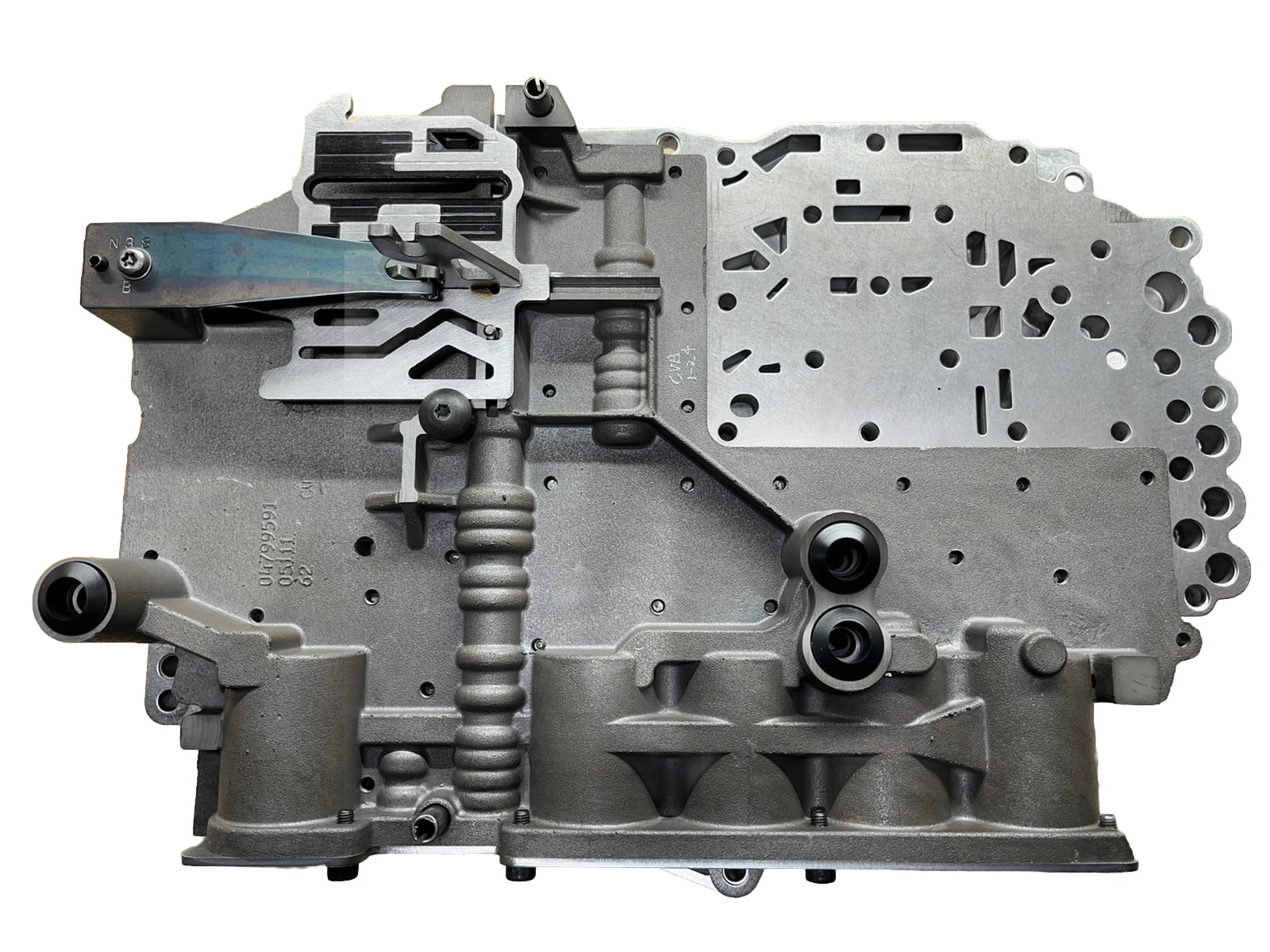
The RFE valve body has a few well-documented wear points that cost engagement pressure. Sonnax's RFE vacuum test guide covers the 45RFE, 545RFE, 65RFE, 66RFE and 68RFE and lists delayed engagement as a symptom cured by three parts:
- TC limit valve (Sonnax 44912-03K oversized kit) and its spring (44912-02). A worn TC limit valve bore also shows up as engine stall when the truck is put in gear and low cooler flow.
- Pressure regulator valve (44912-17K), for the drainback and low lube issues described above.
If the delay is mainly in Reverse, look hard at the low/reverse switch valve. Sonnax's Chris Leach explains that it acts as a one-way valve for the L/R clutch in Reverse and Drive, and that it wears because it is heavily side-loaded. Leakage past it causes low apply pressure that leads to burnt clutches and delayed or even no Reverse. The Sonnax vacuum spec is 18 in-Hg; anything below is worn. The fix kits for the RFE are 92835-41K, or the oversized 92835-45K.
Checkballs matter too. Per Sonnax's Jim Mobley, writing in Transmission Digest, 2006-2010 RFE valve bodies use seven checkballs and 2011-2018 units use five. The #3 ball routes Reverse oil through an orifice for a softer garage shift, and the #2 ball supplies the UD clutch. A missing #2 ball causes harsh Neutral-to-Drive engagements, and a missing #3 ball causes firm Reverse. If someone has been in the valve body and the engagement changed afterward, count the balls.
Cause 5: Clutch, Seal and Pump Wear
When level, filters, learn values and the valve body all check out, the leak is inside. A worn UD or reverse piston seal, a leaking sealing ring on the input shaft, or a pump with excess clearance all take longer to build apply pressure, and they get worse hot. Watch the scan data: if the UD CVI keeps climbing over repeated learns and never settles, the controller is compensating for a clutch that needs more and more oil to apply. That is a clutch pack with excess clearance or a piston leaking, and it is time to pull the unit.
Sonnax's tuning article gives a useful pressure baseline for RFE units: stock programming shows 60 to 70 psi desired and actual line pressure at a stop in Drive, at a 22 to 24 percent duty cycle, and 160 psi at stall. If actual line pressure at idle in gear falls well short of desired, or takes a long time to come up after the shift, the pump or a major leak is the problem. If the numbers match and the delay persists, the leak is downstream in the clutch circuit.
Diagnostic Order That Saves Money
- Check level hot, in Park, after a minute at idle. ATF+4 only.
- Pull codes. A stored solenoid, pressure sensor or range sensor code changes the whole diagnosis.
- Watch desired and actual line pressure and UD CVI during the delayed shift.
- Confirm the shifter reads OD in Drive and the linkage is not sitting between detents.
- Service both filters with the anti-drainback spin-on filter.
- Quick Learn, then the ATRA garage-shift learns at the right temperatures.
- Still delayed? Vacuum-test the TC limit and L/R switch valve bores, or install a valve body built with those fixes.
- CVI climbing and won't settle, or the pan shows heavy friction material: overhaul.
FAQ
Why does my 66RFE take a few seconds to go into gear?
The most common causes are low or overfilled fluid, the converter or cooler draining back while the truck sits, and a learned clutch volume that is wrong after a battery disconnect or repair. Worn valve body bores, especially the TC limit valve and the low/reverse switch valve, and leaking clutch piston seals cause delays that get worse as the fluid gets hot.
Why is my Ram slow to engage only in the morning?
A delay only on the first shift after sitting points at fluid draining out of the converter or cooler circuit, or air in the underdrive clutch. ATRA notes the RFE controller learns a separate first N-1 UD CVI value to account for air entrapment after the engine has been off. Replace the spin-on cooler return filter with one that has the updated anti-drainback valve, set the level hot, and perform the first-shift learn.
How do I relearn the 66RFE Neutral to Drive engagement?
Run a Quick Learn with a capable scan tool, then perform the garage-shift learn. With fluid between 80 and 110 F and the engine off at least 10 minutes, shift Neutral to Drive at a stop and watch the first N-1 UD CVI until it stabilizes. For later engagements, drive to 10 mph, stop, and repeat Neutral to Drive shifts with a 2 to 3 second pause in Neutral.
Can low fluid cause delayed engagement on a 66RFE?
Yes. Chrysler's service information says low fluid lets the pump draw in air, which makes the fluid spongy so pressure is low and builds slowly. Overfilling causes foaming with the same result. Check the level hot at 170 to 180 F, in Park with the engine idling, and use only ATF+4.
What causes delayed reverse only on a 66RFE?
Reverse uses the reverse clutch plus the low/reverse clutch, so a Reverse-only delay usually traces to that path. A worn low/reverse switch valve bore is a known cause and leads to burnt clutches and delayed or no Reverse. A missing reverse orifice checkball changes Reverse feel as well, and an unlearned L/R volume can make the shift harsh or double-bump.
Sources
- ATRA — Technical Bulletin 990, 41TE/42LE/42RLE/45RFE/545RFE Module Strategies and Learn Values (February 2006). Backs the separate N-1 UD CVI used for garage shifts, the first N-1 UD CVI accounting for air entrapment after engine-off, the 80-110 F window and 10-minute engine-off first-shift learn, the 10 mph and 2-3 second Neutral-pause garage-shift learn, the above-110 F Neutral-to-Reverse learn and double-bump note, Quick Learn resetting more than 70 parameters, the range sensor transitional-signal and OD/T3/T4 warning, and the internal-problem warning. atracom (PDF)
- ATSG (Automatic Transmission Service Group) — Dodge Ram Trucks 68RFE technical manual (preview, 2011). Backs the RFE clutch application chart: L/R clutch only in Park and Neutral, UD clutch with low sprag in first, L/R on in first only below 150 RPM output speed, and reverse plus L/R clutches at 4.44:1. atsg.biz (PDF)
- Chrysler service information — RFE Fluid Level Check. Backs low fluid letting the pump draw air so pressure is low and builds slowly, overfill foaming with the same effect, the converter filling in Park and Neutral, and the Park, one-minute idle, level-ground check. jeep.automotive-manuals.com
- Stellantis / Mopar — 2018 Ram Owner’s Manual (PDF). Backs ATF+4 only for the gas six-speed, the warning that wrong fluid causes poor shift quality and converter shudder, no additives, sealers or flushes, and the 170-180 F level check after about 15 miles. vehicleinfo.mopar.com (PDF)
- FCA US — 2018 Ram 2500 Heavy Duty Specifications. Backs the 66RFE behind the 5.7L and 6.4L HEMI with a 3.23:1 first gear and 4.44:1 Reverse. FCA media (PDF)
- Sonnax — “Resolving Stalling & Overheat Issues After Performance Tuning on RFE Transmissions.” Backs the stock 60-70 psi desired and actual line pressure at a stop in Drive, 22-24% duty cycle and 160 psi at stall, and converter drainback and delayed engagement as symptoms of tuned idle pressure. sonnax.com
- Sonnax — “Line to Lube Converter: A Balancing Act, PR Valve Position Is Key.” Backs drilled line-to-lube passages causing converter drainback and delayed engagement, and the 44912-17K valve sealing that path with the engine off. sonnax.com
- Sonnax — Chrysler 45RFE/545RFE/65RFE/66RFE/68RFE Vacuum Test Guide. Backs the 44912-03K TC limit valve kit, 44912-02 TC limit spring and 44912-17K PR valve as cures for delayed engagement on the 66RFE. sonnax.com
- Sonnax — Chris Leach, “Diagnosing 62TE, 68RFE Low/Reverse Switch Valve Issues.” Backs the L/R switch valve as a one-way valve in Reverse and Drive, side-load wear, burnt clutches and delayed or no Reverse, the 18 in-Hg vacuum spec, and kits 92835-41K and 92835-45K. sonnax.com
- Transmission Digest — Jim Mobley (Sonnax), “Chrysler RFE valve body checkball locations and function.” Backs seven checkballs on 2006-2010 and five on 2011-2018 RFE valve bodies, the #2 ball supplying the UD clutch (missing = harsh Neutral-to-Drive), and the #3 reverse engagement orifice ball (missing = firm Reverse). transmissiondigest.com
- Raybestos Powertrain — filter 515489. Backs the spin-on cooler return filter fitting the 45/545/65/66/68RFE, superseding 5179267AC and 4799662 numbers, with the updated OE anti-drainback valve design. raybestospowertrain.com