A customer's Durango sits in the lot overnight. In the morning they start it, pull the lever into Reverse, and nothing happens for two or three seconds. Then it clunks in and backs up like nothing was wrong. The rest of the day it is fine. By the time it reaches my bay it has been doing this for months, and they want to know if the transmission is about to die.
Usually it is not. But "delayed engagement" on a 45RFE or 545RFE covers several different problems, and some of them do end in a burnt clutch pack. The trick is noticing when the delay happens: only on the first shift of the day, every shift, only in Reverse, or worse once the fluid is hot. Each pattern points somewhere different. This is how I sort them out, with the specs from Chrysler service information, ATRA and Sonnax. Sources are at the bottom.

What Has to Happen Before the Truck Moves
When you pull the lever from Park or Neutral into Drive, the TCM applies the underdrive (UD) clutch; the low/reverse clutch is already on in Park and Neutral and holds for first. In Reverse, the reverse clutch applies with the low/reverse clutch. Either way, the pump has to fill an empty clutch piston cavity and build apply pressure before anything grabs. ATRA's bulletin on Chrysler module strategies calls the TCM's learned fill volume for that Neutral-to-first shift the "N-1 UD CVI" (clutch volume index) and tells you to watch it on a scan tool while diagnosing engagement complaints (ATRA Technical Bulletin 990).
The RFE pump is a dual-stage design with electronic output control. Chrysler says the primary stage runs all the time, the second stage is bypassed when demand is low, and the system raises pressure when it sees clutch slip (Chrysler 545RFE Operation). At idle in a garage shift, with the engine barely turning, that pump has the least spare flow it will ever have. Anything that steals flow or lets air into the circuit shows up here first as a delay.
Pattern 1: Delay Only on the First Shift After Sitting
This is the classic RFE complaint, and it has two main causes.
Converter drainback and TSB 21-015-05
The RFE has two filters: the main sump filter and a cooler return filter that Chrysler added to protect the pump and other components (Chrysler 545RFE Operation). Chrysler service bulletin 21-015-05 (September 2005) covers a delayed first engagement in Drive or Reverse after the vehicle sits, usually overnight, that shows up after the cooler return filter has been replaced. The bulletin names cooler return filter part number 04799662AB as suspect: it can let fluid drain back out of the torque converter while the engine is off. On the next start, the pump has to refill the converter before full pressure reaches the clutches, so the first shift waits. The fix in the bulletin is to replace the AB filter with a 04799662 filter that has no suffix or any suffix other than AB (bulletin text via ALLDATA). It applies to vehicles with sales code DG4 (45RFE) or DGQ (545RFE), including the 2003-2006 Ram, 2000-2004 Dakota, 2000-2003 and 2004-2006 Durango, 1999-2006 Grand Cherokee, 2002-2006 Liberty and 2006 Commander. Chrysler also notes the condition is not detrimental to the transmission.
If the delay started right after a fluid and filter service, look at that filter first. Many aftermarket filter kits still list 04799662AB as the cross-reference, so check what was installed. When I service one of these, I read the part number off the cooler return filter before it goes in. Some replacement filters come with a separate threaded adapter stud; the bulletin procedure torques the stud into the filter at 165 in-lb (18.6 N-m) and the assembled filter to the case at 125 in-lb (14.1 N-m) (ALLDATA / Underhood Service).
Air in the underdrive clutch circuit
Even with a good filter, some fluid bleeds out of the apply circuits while the truck sits. ATRA's bulletin says the TCM has a separate learned value for the first Neutral-to-Drive shift after the engine has been off, and that this first N-1 UD CVI "accounts for air entrapment in the UD clutch" (ATRA Technical Bulletin 990). If the adaptive values are wrong, from a battery disconnect, a new TCM, or a rebuild that was never relearned, the first shift of the day can be slow or harsh even though the hardware is fine.
ATRA's procedure for this: let the vehicle sit with the engine off for at least 10 minutes, with transmission oil between 80F and 110F. Start it, hold the brake, and record the UD CVI during a Neutral-to-Drive shift. During the shift the scan tool will briefly show a different number, which is the first N-1 UD CVI. Repeat until that value stabilizes. ATRA stresses doing it inside that temperature window and letting it cool if it is too hot, and notes the shift keeps improving as the owner drives (ATRA Technical Bulletin 990).
Pattern 2: Delay on Every Shift
Check the fluid level the Chrysler way
Before you touch the valve body, check the fluid. Chrysler says low fluid lets the pump draw in air along with the fluid, and air bubbles make the fluid spongy, "therefore, pressures will be low and build up slowly." Overfilling does the same thing: the geartrain churns the fluid into foam (Chrysler Fluid Level Check). Both give you slow engagements.
Chrysler's procedure: selector in Park, engine idling for at least one minute, vehicle on level ground. The converter fills in Park and Neutral, so check in Park. At normal operating temperature, about 180F, the level should be in the HOT crosshatched area; at 70F it will sit near the upper COLD hole. Chrysler also notes the true oil temperature can only be read by a scan tool in Reverse or a forward gear (Chrysler Fluid Level Check). For reference, Ram lists a 45RFE/545RFE service fill of 5.2 liters (11 pints) for 4x2 and 6.2 liters (13 pints) for 4x4, and an overhaul fill of 14 to 16 liters (Ram Body Builder 2008 fluid capacities).
Use ATF+4 only. Chrysler specifies Mopar ATF+4 and recommends against additives and sealers (Chrysler ATF specification). The wrong fluid will not usually cause a delay by itself, but I have seen "universal" fluids and seal swellers make adaptive shifts worse.
Run the learn before you condemn anything
If the level is right and the delay happens every time, run ATRA's standard Neutral-to-Drive learn. With oil between 80F and 110F, drive to at least 10 mph and stop. Then do repeated N-D shifts at a stop, pausing in Neutral 2 to 3 seconds each time, and watch UD CVI until it settles. ATRA notes the value changes during the N-D shift, which is normal, because the N-1 value is different from the normal UD value used for 4-3 coastdowns and kickdowns (ATRA Technical Bulletin 990). After any repair, ATRA says to do a quick learn, which resets more than 70 learn parameters to their base values (ATRA Technical Bulletin 990).
Shift linkage and the range sensor
ATRA includes a warning that catches people: if the shift linkage is out of adjustment and the range sensor sends transitional signals, you get erratic shift complaints that do not set a code (ATRA Technical Bulletin 990). If the scan tool shows the range bouncing or showing a temporary position when the lever is firmly in gear, adjust the cable before you chase hydraulics.
Pattern 3: Delay That Gets Worse When Hot, or Only in Reverse
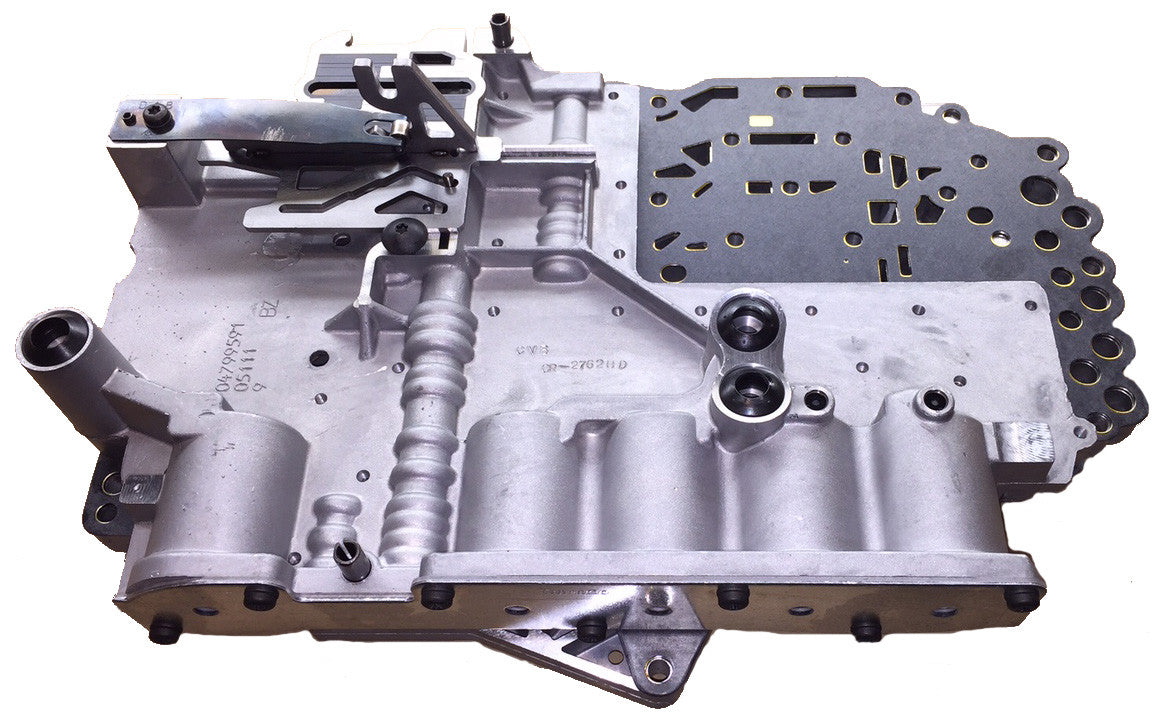
Hot fluid is thinner, so worn valve bores leak more. A delay that is fine cold and bad after a highway drive is almost always internal leakage. Two valves are known for it.
Torque converter limit valve
Sonnax's RFE wear guide lists delayed engagement first on the cure list for the TC limit valve, along with engine stall, loss of power, low cooler flow, low TCC release pressure, loss of fuel economy and an overheated converter. The fix is the oversized TC limit valve kit, Sonnax 44912-03K, which requires reaming the bore. A broken TC limit valve spring shows up the same way, with engine stall on engagement and delayed engagement listed for Sonnax part 44912-02 (Sonnax RFE Vacuum Test Guide). If the complaint includes the engine nearly stalling when you drop it into gear, this valve moves to the top of the list.
Low/reverse switch valve
This is the one that kills the low/reverse clutch. Sonnax explains that the low/reverse switch valve is side-loaded because its length is too close to its diameter, so it wears its bore. The worn bore lets apply oil cross-leak and the low/reverse clutch loses pressure. Sonnax lists the result as a burnt low/reverse clutch, delayed Reverse and no Reverse, and its fix is the 92835-41K checkball sleeve kit, with an oversized version for worse wear (Sonnax 92835-41K). Sonnax's wear guide also lists delayed engagement and low/reverse clutch failure for this valve (Sonnax RFE Vacuum Test Guide). Because the low/reverse clutch is also on in first, a worn bore can delay Drive as well as Reverse.
The way to confirm either valve is a vacuum test on the bench. Sonnax's guide shows the test locations for each bore; a low reading means wear. Sonnax notes the valves should be tested in their rest position unless the guide says otherwise (Sonnax RFE Vacuum Test Guide).
Checkballs after a valve body job
If the delay or a harsh engagement showed up right after someone had the valve body apart, count the checkballs. Sonnax's RFE checkball guide explains that the underdrive bypass ball routes full line pressure to the UD clutch and that leaving it out causes harsh Neutral-to-Drive engagements, while the reverse engagement ball feeds reverse oil through an orifice and leaving it out gives firm reverse engagements (Sonnax RFE checkball guide). A ball in the wrong pocket can change engagement feel in either direction.
My Diagnostic Order
- Pin down the pattern. First shift only, every shift, hot only, or Reverse only.
- Check level and condition using Chrysler's Park, idle, level-ground procedure. Smell it and look at it. Burnt fluid means clutch damage is already done.
- Read codes and data. Look at the range position, oil temperature and UD CVI on the scan tool.
- First-shift-only delay: check the cooler return filter part number against TSB 21-015-05, then run the 10-minute engine-off first-shift learn.
- Every-shift delay: run the standard N-D learn in the 80F-110F window and check the shift cable adjustment.
- Worse hot, or Reverse only: pull the valve body and vacuum test the TC limit valve and low/reverse switch valve bores. Check the checkballs while it is apart.
- After any repair: quick learn, then drive it so the TCM can fine-tune.
If the pan has heavy friction material and the unit slips in gear as well as engaging late, the valve body fix alone will not save it. That is a rebuild, with the valve body corrected at the same time so the new clutches do not burn up the same way.
Sonnax Torque Converter Limit Valve Kit 44912-03K
The oversized TC limit valve Sonnax lists for RFE delayed engagement, engine stall and low cooler flow. Needs the Sonnax reamer. Stocked by our sister store.
View the Sonnax 44912-03K →Shop RFE transmission parts →
Frequently Asked Questions
Why does my 45RFE take a few seconds to go into gear after sitting overnight?
The most common cause is fluid draining out of the torque converter while the truck sits, so the pump has to refill it before the clutch can apply. Chrysler bulletin 21-015-05 tied this to cooler return filter part number 04799662AB, which can let fluid drain back; the fix is a replacement filter with a different suffix. Low fluid and air in the underdrive clutch circuit cause the same first-shift delay.
Is a 45RFE delayed engagement harmful?
A short drainback delay on the first shift of the day is mostly a comfort complaint, and Chrysler's bulletin treats it as a filter fix rather than a hard-parts failure. A delay that happens every shift, or gets longer as the fluid warms up, is different: that points to low apply pressure from worn valve body bores or leaking seals, and it will burn clutches if it is ignored.
Can low fluid cause delayed engagement on a 45RFE?
Yes. Chrysler says low fluid lets the pump take in air, which makes the fluid spongy so pressures are low and build up slowly. Check the level in Park with the engine idling for at least a minute on level ground; at about 180F it should be in the HOT region of the dipstick.
What is the 45RFE neutral to drive learn procedure?
ATRA Technical Bulletin 990 describes it. With transmission oil between 80F and 110F, drive the vehicle to at least 10 mph and stop, then repeat Neutral to Drive shifts at a stop while pausing in Neutral for 2 to 3 seconds, and watch the UD CVI on a scan tool until it stabilizes. For a delay only on the first shift after sitting, ATRA gives a separate procedure that starts after the engine has been off for at least 10 minutes.
Sources
- Chrysler — Fluid Level Check (2007 Jeep Commander 45RFE/545RFE service information). Backs low fluid causing air intake, spongy fluid and slow pressure build-up, overfill foaming, the converter filling in Park and Neutral, the Park/idle/level-ground check procedure, the 180F HOT and 70F COLD marks, and true temperature read by scan tool. Chrysler Fluid Level Check
- Chrysler — 545RFE Operation. Backs the dual-stage pump with electronic output control, the dual filters with a cooler return filter added to the sump filter, and the independent lube and cooler circuits. Chrysler 545RFE Operation
- ATRA — Technical Bulletin 990, 41TE/42LE/42RLE/45RFE/545RFE Module Strategies and Learn Values (2006). Backs the N-1 UD CVI learn, the 80F-110F temperature window, the 10-minute engine-off first-shift procedure and air entrapment in the UD clutch, the range sensor transitional-signal warning, and quick learn resetting more than 70 parameters. ATRA Technical Bulletin 990
- Sonnax — Chrysler 45RFE, 545RFE, 65RFE, 66RFE, 68RFE Critical Wear Areas and Vacuum Test Locations. Backs the TC limit valve and TC limit valve spring cure lists including delayed engagement, the low/reverse switch valve cure list, and parts 44912-03K and 44912-02. Sonnax RFE Vacuum Test Guide
- Sonnax — Low/Reverse Switch Checkball Sleeve Kit 92835-41K. Backs low/reverse switch valve bore wear from side loading, cross-leak and loss of apply pressure, and the burnt low/reverse clutch, delayed reverse and no reverse symptoms. Sonnax 92835-41K
- Sonnax — Chrysler RFE Valve Bodies: Understanding Checkball Locations and Function. Backs the checkball functions for the low/reverse, underdrive bypass and reverse orifice circuits and the engagement complaints a missing ball causes. Sonnax RFE checkball guide
- Chrysler — Automatic Transmission Fluid. Backs Mopar ATF+4 as the specified fluid and the recommendation against additives and sealers. Chrysler ATF specification
- Ram Body Builder — 2008 Ram Fluid Capacities. Backs the 45RFE/545RFE service fill of 5.2 L 4x2 and 6.2 L 4x4 and the 14-16 L overhaul fill. Ram Body Builder 2008 fluid capacities
- Chrysler service bulletin 21-015-05, 45RFE/545RFE delayed shift engagement (ALLDATA, via Underhood Service). Backs the 04799662AB cooler return filter drain-back cause, the replacement part number rule, the DG4/DGQ sales codes and vehicle application list, the not-detrimental statement, and the 165 in-lb stud and 125 in-lb filter torques. underhoodservice.com