Every 45RFE I have pulled out of a truck that towed for a living died the same way. The clutches did not wear out from miles. They cooked. The fluid went dark and thin, the overdrive and 2-4 clutches glazed, and the converter clutch started slipping, which made more heat, which finished the job. The owner almost always said the same thing: "It never gave me a warning." It did. The computer was changing how the truck shifted to protect itself, and nobody knew what that felt like.
This is how I set up a 45RFE, or its five-speed 545RFE sibling, for towing. It starts with what Chrysler's own software does when the fluid gets hot, then covers how the RFE actually moves fluid to the cooler (it is not what most people assume), the tuning trap that quietly cuts cooler flow, and the short list of upgrades that are worth the money. The specs come from Chrysler service information, ATRA, Sonnax and Ram's body builder data. Sources are at the bottom.


What the TCM Does When the Fluid Gets Hot
The RFE is a fully electronic transmission, and Chrysler built heat protection into the software. Chrysler's operation description says the electronic shift and converter clutch controls help protect the transmission from damage due to high temperatures under severe operating conditions, and that by altering shift schedules, line pressure and converter clutch control, they reduce heat generation and increase cooling (Chrysler 545RFE Operation).
ATRA's Technical Bulletin 990 lays out what those schedules actually are for the 41TE, 42LE, 42RLE, 45RFE and 545RFE family. Between 80F and 240F the unit runs the Hot schedule: normal upshifts, kickdowns and converter clutch operation. Above 240F fluid temperature, or above 244F engine coolant temperature, it switches to the Overheat schedule. ATRA lists what changes: the 2-3 upshift is delayed to 28-31 mph, the 3-4 upshift is delayed to 41-48 mph, the converter clutch is fully applied in third from 30-48 mph and partially applied in second above 35 mph, and above 25 mph the converter will not unlock unless throttle is nearly closed or you kick down to first (ATRA Technical Bulletin 990).
That list is the warning owners miss. If your truck suddenly holds second and third much longer than normal and the converter feels locked everywhere, the transmission is not broken. It is hot, and it is doing exactly what it was programmed to do: keep the converter locked, because a slipping converter is the biggest heat source in the unit, and keep engine rpm up so the pump moves more fluid.
P0218 is the code that tells you
Chrysler's 45RFE/545RFE diagnostic for P0218, High Temperature Operation Activated, sets immediately after the overheat shift schedule activates with transmission temperature above 127C (260F). Chrysler calls it an informational code and says it exists to help the technician decide whether a cooling system fault has occurred or whether "an additional transmission air to oil cooler is needed" to support how the customer drives. The listed causes are high temperature operation, a slipping or non-applying converter clutch, extended driving in limp-in, and excessive idling in gear (Chrysler P0218 diagnostic).
Note the thresholds differ: ATRA's 2006 bulletin puts the overheat schedule at 240F, while Chrysler's 2007 P0218 procedure sets the code at 260F, because calibrations changed over the years. The practical line for towing is the same: past 240F, something in the setup needs to change.
How the RFE Moves Fluid to the Cooler
Most people assume cooler flow goes up when the truck gets hot or goes faster. On the RFE family it does not work that way. Sonnax's technical article on RFE overheating explains that cooler flow is a function of where the pressure regulator valve is sitting, not how hot the fluid is or how fast the vehicle is moving. With stock programming, Sonnax measured cooler flow of 1.3 GPM at idle (Sonnax).
The RFE pump is a dual-stage design with electronic output control. Chrysler says the primary stage works continuously, the second stage is bypassed when demand is low, and the system monitors input torque and adjusts pump pressure accordingly. Chrysler also notes that independent lubrication and cooler circuits keep enough pressure for normal operation even if the cooler is obstructed (Chrysler 545RFE Operation). That last point is a double-edged sword: the transmission will keep shifting with a plugged cooler, so the first sign is often heat, not a shift complaint.
Run a cooler flow check before you add anything
Sonnax's 1.3 GPM idle figure works out to roughly a quart every 11 to 12 seconds. You can check it the old-fashioned way: disconnect the cooler return line, route it into a marked container, idle in Park and time a quart. A reading far below that points to a restricted cooler, a kinked line, debris in the cooler return filter, or a pressure regulator problem, and no amount of extra cooler capacity fixes a flow problem. Top the fluid back up immediately after; you are pumping it out of the sump.
The Tuning Trap
This is the one that catches towing trucks the most, because firmer shifts sound like exactly what a tow rig needs. Sonnax documents that 45RFE, 545RFE, 65RFE, 66RFE and 68RFE vehicles can develop low cooler flow at idle and overheated fluid after aftermarket re-programming for heavy-duty use. The mechanism is the pressure regulator valve: with stock programming, desired and actual line pressure sit between 60 and 70 psi with a 22 to 24 percent line pressure duty cycle. Tuned programs typically command 100 to 105 psi, with a duty cycle around 5.1 percent, meaning the pump is almost at maximum output (Sonnax).
At that valve position, the passage feeding the lube and converter circuits shrinks to a small undercut on the spool. Sonnax measured cooler flow falling from 1.3 GPM to about 0.5 GPM or lower at idle, and to about 0.3 GPM at maximum pressure. The result is fluid overheating and, on some trucks, converter-related stalling at idle (Sonnax). In plain terms: the tune made the shifts firmer and cut cooler flow by more than half.
If a truck is going to run a tune, Sonnax's fix is its lube-regulated pressure regulator valve, part 44912-17K, which restores the connection to the converter circuit at idle and uses an internal check valve to keep converter and lube flow under high commanded pressure. Sonnax says it delivers a 60 percent increase over stock lube and cooler flow at maximum line pressure. Sonnax also offers the 44912-03K converter limit valve kit (Sonnax). If the truck is stock and staying stock, leave the regulator alone.
Sonnax Lube Regulated Pressure Regulator Valve 44912-17K
The drop-in fix Sonnax built for RFE units that run higher line pressure and lose cooler flow. Stocked by our sister store.
View the Sonnax 44912-17K →Upgrades Worth Doing, in Order
1. Stay inside the ratings
No cooler saves a transmission that is pulling past its rating. Chrysler's 2007 Commander manual, a 45RFE/545RFE vehicle, lists maximum trailer weights by engine: 3,500 lb with the 3.7L, 6,500 lb with the 4.7L, and 7,200 lb with the 5.7L, with tongue weight of 10 to 15 percent of trailer weight and trailer brakes required over 2,000 lb. Chrysler also says to avoid towing for the first 500 miles on a new vehicle (Chrysler Trailer Towing). Ram and Dakota ratings differ, so pull them for the exact truck, but the principle holds: the GCWR is also the transmission's heat budget.
2. Use the gear selector like Chrysler tells you to
Chrysler's towing tips for the RFE say Drive can be used, but if frequent shifting occurs, select the 3 range. Chrysler says this improves performance, extends transmission life by reducing excessive shifting and heat build-up, and gives better engine braking. For stop-and-go traffic Chrysler says to put the transmission in Neutral and raise idle speed when stopped for short periods, and on the highway to reduce speed and temporarily turn off the A/C to cut heat (Chrysler Trailer Towing). Chrysler also lists excessive idling in gear as a P0218 cause (Chrysler P0218 diagnostic). Idling in Drive at a red light with a trailer is one of the fastest ways to heat an RFE, because the converter is fully unlocked and slipping.
3. Add an auxiliary air-to-oil cooler
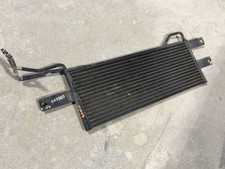
This is the one hardware upgrade Chrysler itself points to. Its P0218 procedure names an additional air-to-oil cooler as a solution for trucks that overheat from how they are used (Chrysler P0218 diagnostic). Mount it in clean airflow ahead of the condenser or radiator, plumb it in series after the factory cooler so the fluid gets the most temperature drop before it returns to the case, and use hose and clamps rated for ATF temperature. Ram's capacity data notes that overhaul fill varies with the type and size of the internal cooler, cooler line length and diameter, and the use of an auxiliary cooler (Ram Body Builder 2008 fluid capacities). So after installing one, fill and check the level properly instead of trusting the book number.
4. Replace the factory cooler if it is compromised
If the flow check comes up short and the lines are clear, the factory air-to-oil cooler is the next suspect, especially after any internal failure that sent clutch material downstream. Debris trapped in a cooler will come back into a fresh rebuild. A new cooler is cheap compared with a second overhaul.
5. Get a real temperature gauge
Chrysler notes that the true transmission oil temperature can only be read on a scan tool in Reverse or a forward gear (Chrysler Fluid Level Check). A plug-in OBD monitor that reads the transmission temperature PID gives you that on the dash. Watch it on the first long pull after any change. If it climbs toward 240F, you now know before the TCM tells you with delayed shifts.
6. A shift kit, for the right reasons
A quality shift kit that corrects known hydraulic weaknesses can help a working unit, but it does not replace cooling and it should never be used to mask slipping. On an RFE, most shift timing and firmness is software. Treat any hydraulic kit as a rebuild-time improvement, installed with the valve body clean and inspected, followed by a quick learn.
Fluid and Service for a Towing 45RFE
Chrysler specifies Mopar ATF+4 for these transmissions, states that Dexron II is not recommended, and strongly recommends against additives, supplements or sealers; it says claims that additives inhibit overheating, oxidation and varnish have not been supported to its satisfaction (Chrysler Automatic Transmission Fluid). Stick with ATF+4 and nothing else in the pan.
On intervals, Chrysler's towing section says the fluid and filter should be changed if you regularly tow for more than 45 minutes of continuous operation, following the severe schedule (Chrysler Trailer Towing). The RFE runs two filters, a main sump filter and a cooler return filter (Chrysler 545RFE Operation), and both should be changed together. On older units, be aware of Chrysler TSB 21-015-05, which covered a delayed engagement after service traced to a cooler return filter that allowed the converter to drain back.
Check the level correctly. Chrysler says to check it in Park with the engine idling for at least a minute on level ground. At about 180F the level should be in the HOT region of the dipstick; at 70F it will be near the upper COLD hole. Chrysler warns that both low and high fluid cause aeration, and that air bubbles can cause overheating, oxidation and varnish (Chrysler Fluid Level Check). Ram's data gives service fill of 5.2 liters (11 pints) for 4x2 and 6.2 liters (13 pints) for 4x4, with an overhaul fill of 14 to 16 liters (Ram Body Builder 2008 fluid capacities).
If It Already Overheated
Pull the pan. Burnt fluid, heavy friction material in the pan or on the magnet, and a varnished filter mean the clutches have already taken damage, and a fluid change alone will not bring them back. Clear any stored codes only after writing them down, because P0218 and converter clutch codes tell you what happened. If the unit still shifts cleanly with clean fluid, do the flow check, add cooling, and watch the temperature. If it slips, flares, or shudders at lockup, plan on an overhaul with the cooler replaced or flushed and the cooler return filter changed. Finish with a quick learn: ATRA notes that quick learn resets more than 70 learn parameters and is required after repair (ATRA Technical Bulletin 990).
Shop RFE transmission parts →
Frequently Asked Questions
What temperature is too hot for a 45RFE when towing?
ATRA's bulletin on Chrysler module strategies says the TCM switches to an overheat shift schedule when fluid passes 240F or engine coolant passes 244F. Chrysler's 45RFE/545RFE diagnostic for P0218 sets the code when the overheat schedule activates above 260F (127C). Treat anything that pushes the fluid past 240F as a warning that the cooling system or the driving style needs to change.
Does a 45RFE need an auxiliary transmission cooler for towing?
If the truck logs P0218 or regularly sees fluid above 240F under load, yes. Chrysler describes P0218 as a code meant to tell the technician whether a cooling system fault exists or whether an additional air-to-oil transmission cooler is needed to support how the customer drives. Plumb it after the factory cooler and plan on extra fluid, because Chrysler notes overhaul fill changes with auxiliary coolers.
Should I tow in Drive or a lower range with a 45RFE?
Chrysler's towing instructions say Drive can be used, but if the transmission shifts frequently in Drive you should select the 3 range. Chrysler says that reduces excessive shifting and heat build-up, extends transmission life and gives better engine braking. On trucks with a Tow/Haul or OD Off button, that button does the same job.
How often should I change 45RFE fluid if I tow?
Chrysler says to change the fluid and filter if you regularly tow for more than 45 minutes of continuous operation, following the severe-service schedule. Use Mopar ATF+4 or a licensed ATF+4 fluid only; Chrysler specifically says not to add supplements or sealers. On units with a cooler return filter, change it at the same time as the sump filter.
Sources
- Chrysler — 45RFE/545RFE service information, Operation (2007 Jeep Commander service manual). Backs the heat-protection strategy (shift schedule, line pressure and converter clutch changes), the dual-stage pump, the dual filters with cooler return filter, and the independent lube and cooler circuits. Chrysler 545RFE Operation
- Chrysler — P0218 High Temperature Operation Activated (45RFE/545RFE diagnostic). Backs the 127C/260F set condition, the informational purpose, the additional air-to-oil cooler guidance, and the listed causes including converter clutch slip and idling in gear. Chrysler P0218 procedure
- ATRA — Technical Bulletin 990, 41TE/42LE/42RLE/45RFE/545RFE Module Strategies and Learn Values (2006). Backs the temperature-based shift schedules, the 240F fluid / 244F coolant overheat trigger, the delayed shift speeds and converter clutch behavior in overheat, and the quick learn reset. atracom bulletin 990 (PDF)
- Sonnax — Resolving Stalling and Overheat Issues After Performance Tuning on RFE Transmissions. Backs cooler flow as a function of pressure regulator position, 1.3 GPM stock idle flow, the 0.5 and 0.3 GPM tuned figures, stock and tuned line pressure and duty cycle, and parts 44912-17K and 44912-03K. sonnax.com tech resource 947
- Chrysler — Trailer Towing (2007 Jeep Commander). Backs the trailer weight ratings by engine, tongue weight and trailer brake requirements, the 3-range towing advice, Neutral at stops, and the fluid change requirement for regular towing over 45 minutes. Chrysler Trailer Towing
- Chrysler — Fluid Level Check. Backs the Park/idle/level-ground procedure, the 180F HOT range and 70F COLD hole, aeration causing overheating and varnish, and true temperature read by scan tool. Chrysler Fluid Level Check
- Chrysler — Automatic Transmission Fluid. Backs Mopar ATF+4 as the specified fluid, Dexron II not recommended, and the recommendation against additives and sealers. Chrysler ATF specification
- Ram Body Builder — 2008 Ram Fluid Capacities. Backs the 45RFE/545RFE service fill of 5.2 L 4x2 and 6.2 L 4x4, the 14-16 L overhaul fill, and the note that auxiliary coolers change fill quantity. rambodybuilder.com