Nobody walks in and says their pressure control solenoid is bad. They say the truck bangs into Drive, or flares and then drops into third with the light on. On a 45RFE or 545RFE, either one can come down to line pressure control, which is the pressure control solenoid's whole job.
The PCS rarely fails loudly by itself. It works in a closed loop with the line pressure sensor, regulator valve, pump and filter, and the controller covers for a lot of wear before it sets a code. This guide covers how the loop works, what each code measures, which scan tool numbers matter, and when the fix is a pack versus a connector, filter or pump. Specs come from Chrysler's 45RFE/545RFE service information, Sonnax and GEARS Magazine, listed at the bottom.


What the Pressure Control Solenoid Does
Chrysler's theory of operation for the line pressure codes spells it out: line pressure is measured by the Line Pressure Sensor (LPS), and regulation is achieved by changing the duty cycle of the Pressure Control Solenoid (PCS).
Rob Faucett's GEARS Magazine article on Chrysler pressure control describes the hydraulic side. The pressure regulator valve and its spring are set up for high line pressure. The solenoid puts oil on the opposite end of the valve, working against the spring to bring pressure down. That gives the system its backwards-looking relationship:
- 5% duty cycle = solenoid off = maximum line pressure.
- 62% duty cycle = solenoid on = minimum line pressure.
Those are Chrysler's figures. They explain the failure modes. If the solenoid or its control circuit goes open, the valve sees no solenoid pressure and the spring wins: the truck runs at maximum pressure and every engagement gets harsh. If the solenoid sticks on, or its circuit is shorted so it stays energized, pressure is pulled down toward minimum and clutches start to slip.
The desired pressure is not fixed. Chrysler calls the strategy Torque Based Line Pressure: the controller calculates input torque from engine and transmission data and uses it as the primary input to the target. During shifts and in Park and Neutral, pressure is held at a preset 120 to 135 psi for consistent shift quality.
What the PCS looks like
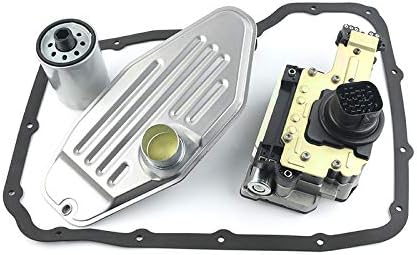
The PCS is not a separate part. It lives in the assembly as the shift solenoids, the five pressure switches and the range sensor, which Chrysler's manual calls the Transmission Solenoid/TRS Assembly. David Chalker's GEARS article on pressure codes describes it as a variable force solenoid integrated into the solenoid pack. On the 23-pin case connector, Sonnax's pin-out puts the PCS control on pin 12 and gives its resistance as about 3.5 ohms, against about 1.3 ohms for each shift solenoid. The Chrysler schematic calls the PCS control wire circuit T140.
The Line Pressure Sensor Closes the Loop
The LPS is a three-wire transducer threaded into the outside of the case: a 5-volt supply (circuit F856), a ground and a signal (circuit T38). Chrysler says the signal should always be between 0.35 and 4.75 volts. Outside that window the controller assumes the sensor or its wiring has failed, not the pressure.
Because the controller is constantly comparing desired to actual pressure and adjusting duty cycle to close the gap, it compensates for leaks. Faucett's point is that duty cycle is the most useful number on the truck. The closer the duty cycle gets to 5% just to maintain moderate pressure, the more oil the transmission is losing internally.
Symptoms of a PCS or Line Pressure Problem
The symptoms split by which way pressure goes:
Pressure too high
- Harsh Neutral-to-Drive and Neutral-to-Reverse engagements, even cold.
- Firm, banging upshifts at light throttle, where torque-based pressure should be low.
- P0869 Line Pressure High, or P0932 with actual pressure reading well above desired.
Pressure too low
- Flares on upshifts, slipping under load, a slow or soft engagement into gear.
- P0868 Line Pressure Low, often joined by pressure switch rationality codes or gear ratio codes as clutches slip.
In both cases a serious enough fault drops the transmission into its relay-off default: third gear in Drive. See our 45RFE limp mode guide.
The Line Pressure Codes and What Sets Them
Chrysler's 45RFE/545RFE set conditions, each pointing at a different part of the loop:
- P0868 Line Pressure Low. Actual line pressure more than 15 psi below desired for 3.5 seconds continuously, monitored while driving in a forward gear.
- P0869 Line Pressure High. Actual pressure above 120 psi while the PCS duty cycle is at or near its maximum (which should produce minimum pressure) for 3.5 seconds.
- P0932 Line Pressure Sensor Circuit (listed as P0933 range/performance on some later RFE documentation). Actual pressure more than 25 psi above desired, but still below the highest pressure ever used in the current gear. This is usually a sensor or connector that is reading wrong, not a real pressure event.
- P0934 / P0935 Line Pressure Sensor Circuit Low / High. Sensor voltage at or below 0.35 volts (P0934) for 0.18 seconds, or above 4.75 volts (P0935).
Chalker's GEARS article quotes 10 psi for P0868 on later calibrations. Either way, low means the loop ran out of room to raise pressure; high means it ran out of room to lower it.
There is no PCS circuit code here; a PCS electrical fault shows up as a line pressure code. Chrysler's P0869 cause list includes the T140 PCS control circuit open or shorted to ground, and its P0868 list includes that circuit shorted to another circuit.
Scan Tool Checks Before You Drop the Pan
Start with Chrysler's pre-diagnostic routine: fluid level, a charged battery, engine codes first, and all transmission codes and DTC event data recorded before anyone disconnects the battery. If P0934 or P0935 is present, Chrysler has you fix the sensor circuit first, because every other pressure number depends on it.
Then put these PIDs on one screen: Desired Line Pressure, Actual Line Pressure, PCS duty cycle, LPS voltage, plus engine load and transmission temperature.
- Park and Neutral at idle. Desired should sit in the 120 to 135 psi preset and actual should track it closely.
- Drive it. Actual should follow desired through shifts and load changes. If they match, look at the duty cycle. A duty cycle near 5% at moderate pressure is an internal leak: regulator bore wear, pump, seals. A duty cycle pinned high with pressure still above 120 psi is P0869 territory: the solenoid is not pulling pressure down.
- Check engine load. Faucett's warning is worth repeating: since desired pressure is torque based, an engine reporting low load will get low desired pressure. Actual and desired can match perfectly and the clutches still slip under a heavy pull. Confirm the load reading makes sense before you condemn anything in the transmission.
Chrysler's connector test
Step 3 in both the P0868 and P0869 procedures is simple and catches a lot of these. With the engine off, watch line pressure on the scan tool and push on the line pressure sensor connector. If the reading jumps to about 30 psi when you push the connector, the connection is bad: disconnect it, clean and inspect the terminals, and reconnect it properly. Chalker names the LPS connector wiring and terminals as the most frequent source of intermittent pressure codes.
From there Chrysler checks the controller and wiring with a transmission simulator (all three line pressure readings steady and within 2 psi), then checks the sensor against a mechanical gauge. For P0868, a gauge reading more than 5 psi away from the scan tool reading means replace the sensor.
Verify with a gauge
The case has only two external pressure ports, both for converter clutch apply and release on the right side. For line pressure, Chrysler's hydraulic pressure test has you install Line Pressure Adapter 8259 in the sensor bore, then thread both the gauge and the original sensor into the adapter so you can compare them at the same time. The procedure allows ±10 psi between gauge and scan tool. Take readings with fluid full and at normal operating temperature and the engine at 1500 rpm. For the 545RFE in the 2007 Commander, Chrysler lists garage shift pressures of 220 psi (4.7L) and 250 psi (5.7L) for Neutral-to-Reverse and 135/165 psi for Neutral-to-1st, and 120 psi for Reverse-to-Neutral. Our 545RFE pressure testing guide covers the valve body taps.
Low Pressure: It Is Usually Not the Solenoid
Chrysler's P0868 cause list reads like a warning against replacing the pack first: low fluid level, the 5-volt supply circuit, a poor sensor connection, the PCS control circuit shorted to another circuit, the sensor, a cracked, plugged or misinstalled primary oil filter, a loose cooler return spin-on filter, a stuck or sticking main regulator valve, internal transmission leaks and the controller.
Chrysler's repair order is telling: if the wiring and sensor check good, pull the pan and look for debris or a cracked filter or O-ring; if that is clean, inspect the pump and internal leaks; only if nothing is found, replace the Solenoid/TRS Assembly. A PCS fighting a worn regulator bore will look guilty and still be fine.
High Pressure: Now Look at the Solenoid
P0869 is where the pack and its wiring become real suspects. Chrysler lists the 5-volt supply circuit, the sensor connection, the PCS control circuit open, the PCS control circuit shorted to ground, the transmission control relay output circuit, the line pressure sensor, a stuck main regulator valve and the controller. An open PCS circuit leaves the regulator valve at spring pressure, which is maximum line pressure. A relay output problem does the same thing to every solenoid at once.
Jim Mobley's Sonnax article on Chrysler max line pressure describes what an open PCS circuit looks like on the gauge: 150 to 160 psi at idle in Park, Neutral and Drive, 250 psi in Reverse, and a line pressure duty cycle stuck at 38.38% with no activity on the scan tool. His quick check is a low-amp clamp on the PCS control wire; 0.20 to 1.00 amps means the circuit is not open.
Unplug the 23-pin connector and meter the pack side from the pin 1 feed to pin 12. Sonnax's spec is about 3.5 ohms. Open, or a short to the case, means the pack. A good reading cold that goes bad hot is still the pack, so heat-soak it before you clear it. If the pack meters good, check T140 to ground and to every other pin in the harness connector; Chrysler uses under 5 ohms as a short.
Replacing the PCS
Because the PCS is part of the Solenoid/TRS Assembly, you replace the assembly. That is a pan-off job, so replace the primary filter and its O-ring while you are there, and the spin-on cooler return filter on units that have one, since both are on Chrysler's low-pressure cause list. Match the pack to the model year and connector; the overdrive solenoid was deleted on 2010 and later valve bodies per Sonnax, so early and late packs are not interchangeable.
After the pack goes in, run the Quick Learn. Chrysler requires it after solenoid pack replacement, with the brakes applied, engine over 500 rpm, throttle under 3 degrees and oil temperature between 60 and 200 F. Then recheck Desired, Actual and duty cycle on a drive. A new pack that still needs near 5% to hold pressure means the leak is elsewhere. Our 45RFE shift solenoid guide covers pack testing and the Quick Learn in more detail.
RFE solenoid block pack, 1998-2010
The complete RFE solenoid and pressure switch assembly, pressure control solenoid included. Confirm your year and connector before you order.
View the RFE solenoid pack at Core Transmission Parts →Shop RFE transmission parts →
Frequently Asked Questions
What are the symptoms of a bad 45RFE pressure control solenoid?
It depends on which way it fails. An open solenoid or control circuit leaves line pressure at maximum, so engagements and shifts turn harsh and P0869 can set. A solenoid stuck on pulls pressure low, causing flares, slipping and P0868. A bad enough fault drops the truck into third gear in Drive.
Where is the pressure control solenoid on a 45RFE?
It is not a separate part. The PCS is built into the Transmission Solenoid/TRS Assembly on the valve body, along with the shift solenoids, pressure switches and range sensor. It is controlled through pin 12 of the 23-pin case connector, and Sonnax lists its resistance at about 3.5 ohms.
What does P0868 mean on a 45RFE?
P0868 is Line Pressure Low. Chrysler sets it when actual line pressure stays more than 15 psi below desired for 3.5 seconds while driving in a forward gear. The usual causes are low fluid, a cracked or plugged primary filter, a loose spin-on cooler filter, a sticking main regulator valve, internal leaks or the line pressure sensor connection, so check those before replacing the solenoid pack.
Can you raise line pressure on a 45RFE with a stiffer spring?
No. The controller measures actual pressure with the line pressure sensor and adjusts the PCS duty cycle to hit its target, so it simply adapts a stiffer spring back to stock pressure. Sonnax says an electrical booster is needed, and its RFE-LB1 adds about 10 psi at low pressure and 25 psi at high pressure.
Sources
- Chrysler — 45RFE/545RFE diagnostic procedures P0868 Line Pressure Low and P0869 Line Pressure High (2007 Jeep Commander service information). Backs the LPS/PCS closed loop, 5% = maximum and 62% = minimum pressure, Torque Based Line Pressure, the 120-135 psi preset, both set conditions, both cause lists including circuits F856 and T140, the 30 psi connector push test, the 2 psi simulator and 5 psi gauge checks, and the filter-then-pump-then-pack repair order. P0868, P0869
- Chrysler — P0932 Line Pressure Sensor Circuit, P0934 Line Pressure Sensor Circuit Low, Hydraulic Pressure Test and Quick Learn. Backs the 25 psi P0932 set condition, the 0.35-4.75 volt sensor window and circuit T38, the two external case ports, Adapter 8259 and the ±10 psi gauge comparison, the 1500 rpm test conditions and garage shift pressures, and the Quick Learn requirement and entry conditions. P0932, P0934, Pressure test, Quick Learn
- Sonnax — 45RFE, 545RFE, 68RFE Solenoid Identification and Connector Pin-Out; and "Diagnosing Chrysler Transmission Max Line Pressure: P0933, P0869, P1745 Codes" by Jim Mobley. Backs the 3.5-ohm PCS and 1.3-ohm shift solenoid resistances, PCS control on pin 12 of the 23-pin connector, the overdrive solenoid deletion on 2010-2018 valve bodies, and the open-PCS signature (150-160 psi idle, 250 psi Reverse, 38.38% frozen duty cycle) with the 0.20-1.00 amp clamp check. Pin-out, Max line pressure
- Sonnax — "Achieving a Progressive Pressure Boost in RFEs." Backs the RFE's full-range transducer and adaptive closed-loop control, why a stiffer spring or boost valve is adapted out, and the RFE-LB1's roughly 10 psi low-range and 25 psi high-range increase. sonnax.com
- GEARS Magazine (ATRA) — "Controlling Pressure 2: Chrysler" by Rob Faucett. Backs the regulator spring set for high pressure with the solenoid working against it, reading duty cycle to find internal leaks, and the low engine load warning. gearsmagazine.com
- GEARS Magazine (ATRA) — "Diagnosing Pressure Trouble Codes" by David Chalker. Backs the PCS as a variable force solenoid in the solenoid pack, the RFE line pressure code descriptions including the later P0933 naming and 10 psi threshold, comparing desired/actual and solenoid/sensor PIDs, and the LPS connector as the most common intermittent failure. gearsmagazine.com