The truck was fine yesterday, or it just came back from another shop, and now it sits in Drive and Reverse while the engine revs and nothing happens. The customer wants to know if the transmission is junk.
A 45RFE or 545RFE that will not move in any range is one of the easier no-move units to reason through, because of how the clutches are laid out and because the unit has a hydraulic limp-in mode that keeps working even when the electronics quit. If you understand those two things, you can usually tell in fifteen minutes whether you are looking at a pump and pressure problem, a broken input path, a linkage problem, or a rebuild. Here is the order I work it, with the specs and bulletins from Chrysler service information, Transmission Digest and MOTOR. Sources are at the bottom.
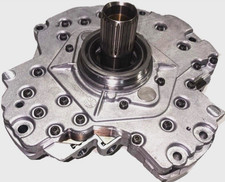


Why "No Movement in Any Gear" Narrows It Down Fast
The 45RFE does not use bands. Power comes off the converter into the input shaft and spins an input clutch housing that holds the underdrive, overdrive and reverse clutches. The holding clutches for 2nd and 4th sit at the center support, and the low/reverse clutch plus a low one-way roller clutch live in the back of the case. Every gear is one driving clutch plus one holding element, and in Park or Neutral only the low/reverse clutch is applied (MOTOR, June 2000). Third is underdrive plus overdrive at 1:1, and the extra "2nd prime" passing ratio is underdrive plus the 4th clutch.
So look at what Drive and Reverse have in common. First gear is driven by the underdrive clutch. Reverse is driven by the reverse clutch. Those are different pistons on different circuits. A single burnt clutch pack takes out one range, not both. When the truck will not move in Drive, Reverse, or manual low, you are looking for something every range shares:
- Line pressure — the pump, its suction side and the main regulator.
- The input path — converter, converter hub drive into the pump, and the input shaft.
- The manual valve and its linkage — if the valve never leaves Neutral, no clutch gets oil.
- The output side — a park pawl that is still engaged, or something downstream of the transmission.
There is one more piece of this that saves a lot of time. Chrysler designed the RFE hydraulic system so that, with no electronic help at all, the valve body still gives Park, Reverse, Neutral, 2nd and 3rd based purely on where the driver puts the lever.[1] That is the limp-in mode. Chrysler also notes that ERS-equipped vehicles (WK, WH, XK and XH Jeeps) do not get 2nd in limp-in because the lever has no "2" or "1" position (Chrysler 545RFE Operation). The practical meaning: a dead solenoid pack, a blown TCM fuse or a failed controller drops the unit into limp-in, which still moves the truck. A true no-move in every range is almost never "just electrical." Treat it as hydraulic or mechanical until the gauges say otherwise.
Step 1: Rule Out Everything That Is Not the Transmission
Spend two minutes on the obvious stuff first. Shops pull these units for problems that are not inside them.
- Transfer case in neutral. On a 4x4 Ram, Durango, Dakota or Jeep, a transfer case left in N, or one with a failed shift motor or broken chain, gives you a perfect "transmission no-move." Put it in 4-High and see if it moves.
- Shift cable and manual lever. Have someone run the column or console selector through the ranges while you watch the lever on the side of the case. If the case lever does not move, or stops short, the manual valve is sitting in the wrong place. A disconnected or stretched cable can still let the dash show "D."
- Driveline. Check that the driveshaft actually turns when someone shifts to Drive with the wheels off the ground. A broken axle shaft or a stripped yoke will feel just like the transmission.
Step 2: Check the Fluid the Way Chrysler Says To
It sounds basic, but on these units a level check is a real diagnostic step. Chrysler's procedure is selector in Park, engine idling for at least one minute, vehicle on level ground. At normal operating temperature, about 180°F, the level is correct in the HOT cross-hatched region of the indicator; at 70°F it sits around the upper COLD hole. The converter fills in both Park and Neutral, which is why the check is done in Park with the engine running (Chrysler Fluid Level Check).
Chrysler also explains why this matters for a no-move: low fluid lets the pump draw air along with the oil, the fluid turns spongy, and pressure is low and builds slowly. Overfilling causes the same thing, because the geartrain whips the fluid into foam. A unit that is several quarts low will often engage weakly when cold and then quit moving once it warms up and the oil thins out.
While the dipstick is out, look at the oil. Black friction material and a burnt smell mean the clutches are already gone. Clean ATF+4 at the right level with no movement points toward the pump, the input path or an assembly mistake.
Step 3: Line Pressure Tells You Which Half of the Problem You Have
This is where most no-moves get solved. Put a gauge on the line pressure tap, or at minimum read the line pressure sensor on the scan tool. The 45RFE has a line pressure sensor at the right rear of the case, and the TCM runs the pressure control solenoid as a pulse-width modulated valve where zero pulse width equals maximum line pressure (MOTOR, June 2000). Watch desired and actual line pressure together in Park, Neutral, Drive and Reverse.
Zero or near-zero pressure in every range
The pump is not making oil, or the oil it makes is going straight out a leak. In order of likelihood:
- The pump is not being driven. If the converter was not fully seated into the pump gears when the unit was installed, or the converter hub drive is broken, the pump never turns. On a fresh install, this is the first thing I check.
- The pump cannot pull fluid. A cracked or misinstalled primary oil filter, or a filter seal that rolled during installation, lets the pump suck air instead of oil. Chrysler lists a cracked or misinstalled primary filter or seal as a cause of a first-gear ratio fault for exactly this reason (Chrysler DTC P0731).
- Missing pump spacer-plate screws. Transmission Digest documented a 45RFE no-move after overhaul caused by the small hold-down screws on the pump spacer plate being left out. One of them sits right next to the pump suction port. Without it, a hole of about 0.190 inch opens into the suction circuit, and the pump cannot create enough vacuum to pull oil up from the pan through the filter. The fix is installing the screws and torquing them to 4.5 N·m (40 lb-in) (Transmission Digest, Feb. 2010).[4]
- Know which pump design you have. In a later Transmission Digest Shift Pointers column, ATSG's Pete Luban looked at new 45/545RFE pumps shipping with no spacer-plate screws at all. With help from Sonnax, he found the screws on the earlier design sit in a main-line-pressure passage, so a loose or missing one dumps line pressure and the truck creeps or will not move. On the redesigned pump those holes are cast shut, so it needs no screws. Luban gives the redesigned pump as part number 68009879AD and notes it back-services any 45/545RFE. A missing screw is a defect on the old pump and normal on the new one (Transmission Digest, July 2010).
- Missing pressure test plugs. In a 2026 Transmission Digest case, a 2010 Ram 3500 with a 68RFE had zero line pressure and no forward or reverse right after a new dealer valve body was installed. The service pressure test plugs had shipped in a separate bag in the box and were never installed (Transmission Digest, Sept. 2026). The 45RFE uses the same RFE valve body architecture. If the truck just had a valve body swap, look for open test ports before anything else.[5]
- A stuck main regulator valve. Debris or a scored bore can hold the regulator in the exhaust position. Chrysler lists a stuck or sticking main regulator valve and poor machining on the pump valve body face among first-gear failure causes (Chrysler DTC P0731). A worn regulator bore is the slower version of the same fault: Sonnax ties RFE pressure regulator bore wear to erratic or high line pressure and restricted converter and lube flow, and the lube-regulated version to delayed engagement and converter drain-back, so vacuum test that bore before you condemn the pump.[7]
Normal pressure in Park and Neutral, but no movement in gear
Now the pump is fine and you are looking past it. If pressure is good and drops away only when you select Drive or Reverse, oil is being dumped as soon as a clutch circuit opens. That is typically a big internal leak: a cut piston seal, broken sealing rings, or a cracked component in the input clutch housing. Chrysler's list of first-gear causes includes a cut underdrive piston seal, a cut underdrive accumulator seal ring, a broken underdrive accumulator piston, broken reaction shaft support seal rings, and a broken or missing dribbler orifice in the reaction shaft support (Chrysler DTC P0731). Most of those only kill Drive; when both ranges die with good pressure in Park, suspect a leak at the input clutch housing feed or a broken mechanical part.
Step 4: Let the Speed Sensors Tell You If the Input Is Turning
The input speed sensor sits at the base of the bellhousing and reads a tone wheel on the input side, while the output sensor reads the output shaft near the rear of the case. The TCM compares the two to figure out the gear ratio (MOTOR, June 2000). You can use those same two PIDs to split a no-move in half without touching a wrench.
- Neutral, engine idling. Input speed should read close to engine idle, because the converter is spinning the turbine and input shaft with nothing holding them. If input speed reads zero in Neutral with the engine running, the input shaft is not turning. That points to a broken input shaft, stripped turbine splines, or a converter that has failed internally.
- Drive, foot firmly on the brake. With the output held, a clutch that applies should pull input speed down to zero. If input speed stays up near idle in Drive with the brake on, nothing is holding. The clutch is not getting oil, or it is not holding.
- Drive, brake released. If input speed drops to zero, but output speed stays zero and the truck does not move, power is getting into the geartrain and stopping somewhere behind it: a failed planetary, a stripped output, an engaged park pawl, or the driveline you were supposed to check in Step 1.
Also read the pressure switch status in each range. The 45RFE has switches on the low/reverse, 2nd, 4th, underdrive and overdrive circuits so the TCM can see when a clutch circuit loses pressure (MOTOR, June 2000). In Park and Neutral, only the low/reverse switch should close. If it never closes in Park with good line pressure on the gauge, look hard at the low/reverse circuit in the valve body.
Step 5: The Post-Rebuild No-Move Checklist
A lot of 45RFE no-moves show up on the first drive after a rebuild or a valve body swap. If that is your situation, check these before you pull it back out:
- Converter fully seated. You should feel it drop in more than once as it engages the input shaft, then the pump gears.
- Pump spacer-plate hold-down screws installed and torqued to 40 lb-in on the earlier pump design; the redesigned 68009879AD pump has the holes cast shut and uses none (Transmission Digest).
- Primary filter seated straight, with the seal not rolled or cut.
- All pressure test port plugs installed, including any that came loose in the valve body box (Transmission Digest).
- Manual valve engaged with the manual lever. If the valve body went in without the manual valve pin in the lever slot, the shifter moves and the valve does not.
- Fluid level checked hot, in Park, engine running, per Chrysler. An overhaul fill takes far more oil than a pan service, and a unit that was "topped off" cold is often several quarts short.
- Quick learn run after the repair, so the TCM's clutch fill values match the new clutches.
When It Is a Rebuild
If the pan is full of friction material, line pressure is good, the input shaft is turning, and the clutches still will not hold in either range, the unit has worn through more than one clutch pack. Plan a full overhaul, replace the pump if the gears or pocket are scored, and correct valve body wear at the same time so the new clutches get full apply pressure.
If the pump is the only failure and the clutches are still decent, a pump and filter job can save the unit. Inspect the converter hub at the same time; a damaged hub will chew up a new pump quickly.
RFE Transmission Filter with Gaskets, 1999-Up
A cracked or misinstalled primary filter is on Chrysler's list for a pump that cannot pull oil. This filter is shared across the 45RFE, 545RFE and 68RFE family. Stocked by our sister store.
View the RFE filter kit →Shop RFE transmission parts →
Frequently Asked Questions
What causes a 45RFE to not move in Drive or Reverse?
Because Drive and Reverse use different driving clutches, a no-move in both ranges usually comes from something they share: no line pressure from the pump, a broken input path such as the converter or input shaft, a manual valve or shift cable that never leaves Neutral, or a problem behind the transmission. Low fluid, a cracked or misinstalled primary filter, and a stuck main regulator valve are all on Chrysler's cause list for lost first-gear apply.
Can a bad solenoid pack cause a 45RFE to not move at all?
Not usually. Chrysler designed the RFE hydraulic system so the valve body still provides Park, Reverse, Neutral, 2nd and 3rd from the shift lever alone when the electronics fail. A dead solenoid pack or controller normally puts the truck in limp-in, which still moves, so a true no-move in every range points to a hydraulic or mechanical fault.
Will low transmission fluid stop a 45RFE from moving?
It can. Chrysler says low fluid lets the pump draw in air, so the fluid turns spongy and pressure is low and slow to build. A unit that is several quarts low may engage when cold and then stop moving once warm. Check the level in Park with the engine idling for at least a minute on level ground.
Why won't my 45RFE move after a rebuild or valve body replacement?
The common causes are assembly items: a converter not fully seated into the pump, a rolled filter seal, missing pressure test plugs, or missing pump spacer-plate screws. Transmission Digest documented a 45RFE no-move from missing spacer-plate screws, one of which sits beside the pump suction port; they torque to 40 lb-in. Another case had zero line pressure after a new valve body because the test plugs were left in the box.
Sources
- Chrysler — 545RFE Operation (2007 Jeep Commander 45RFE/545RFE service information). Backs the hydraulic limp-in design giving Park, Reverse, Neutral, 2nd and 3rd from the shift lever alone, the ERS vehicles (WK, WH, XK, XH) with no 2nd in limp-in, the dual-stage pump and the dual filters. Chrysler 545RFE Operation
- Chrysler — Fluid Level Check. Backs low fluid letting the pump take in air with low, slow-building pressure, overfill foaming, the converter filling in Park and Neutral, and the Park/idle one minute/level ground check with the 180°F HOT and 70°F COLD marks. Chrysler Fluid Level Check
- Chrysler — DTC P0731 Gear Ratio Error in 1st (45RFE/545RFE). Backs the possible-cause list: cut UD piston seal, low fluid, cracked or misinstalled primary filter or seal, stuck main regulator valve, failed overrunning clutch, cut UD accumulator seal, broken reaction shaft support seal ring, missing dribbler orifice and poor machining on the pump valve body face. Chrysler DTC P0731
- Transmission Digest — Tech/Talk February 2010: 45RFE No Movement After Overhaul. Backs the missing pump spacer-plate hold-down screws, the screw next to the pump suction port, the roughly 0.190 inch suction leak, and the 4.5 N·m (40 lb-in) torque. Transmission Digest, Feb. 2010
- Transmission Digest — Pete Luban (ATSG), "45/545RFE Pump Mystery Solved," Shift Pointers, July 2010. Backs the spacer-plate screws sitting in a main-line-pressure passage on the earlier pump design, the creep or no-move when one is loose or missing, the cast-shut screw holes on the redesigned pump, and part number 68009879AD. Transmission Digest, July 2010
- Transmission Digest — RFE Series No Movement After Valve Body Replacement (Wayne Colonna, Sept. 2026). Backs the 2010 Ram 3500 68RFE with no forward or reverse and zero line pressure after a new valve body, caused by pressure test plugs left in a separate bag. Transmission Digest, Sept. 2026
- MOTOR Magazine — "Smart and Savvy: Chrysler 45RFE" (June 2000). Backs the clutch layout (UD, OD and reverse in the input housing, 2nd and 4th holding clutches, low/reverse and low one-way clutch at the rear), only the low/reverse clutch applied in Park and Neutral, 2nd prime, the input and output speed sensor locations, the line pressure sensor, the PWM pressure control solenoid, and the five clutch pressure switches. MOTOR, June 2000
- Sonnax — Chrysler 45RFE/545RFE/65RFE/66RFE/68RFE Vacuum Test Guide. Backs the RFE pressure regulator bore wear symptoms (erratic or high line pressure, restricted converter and lube flow, delayed engagement and converter drain-back on the lube-regulated valve) and vacuum testing the valve body and pump bores. sonnax.com