Two GM four-speeds, same case, same bellhousing, same bolt pattern, same 3.06 first gear. One is under almost every 1993-and-up half-ton GM product built. The other showed up in 2006 and quietly became the core everybody wants for a build. If both are sitting on the shop floor, the model number on the tag is the least useful thing in the room.
The honest version: the 4L70E is the same architecture as the 4L60E with GM's heavier gear train hardware and an input speed sensor system built into the pump. The case, the ratios and the valve body layout did not change. So the strength question and the fitment question have completely different answers, and the fitment answer is mostly electrical.
RPO Codes: How GM Actually Separates Them
Forget the casting. GM identifies these three by RPO code on the service parts label: M30 is the 4L60E, M32 is the 4L65E, and M70 is the 4L70E. GM's own bulletin PIP5072 lists them in one breath: "Equipped with 4L60E, 4L65E or 4L70E (RPO M30, M32 or M70) Automatic Transmission." That bulletin then prescribes a single service input housing and turbine shaft assembly, part number 19125752, across all three for the 1999–2007 applications it covers — Silverado, Sierra, Tahoe, Yukon, Suburban, Escalade, Avalanche, Trailblazer, Envoy, Camaro, Firebird, SSR, Bravada and the full-size vans.
One GM part number covering three model designations is the clearest statement you will get about how much of this family is shared. When somebody tells you a 4L70E is a fundamentally different transmission, that bulletin is the counterargument.
What GM Actually Changed for the 4L70E
ATRA published the change list in its 2005 GM update material before the parts hit the field, and the wording matters: "A major update is planned for the 4L60E/65E applications for the 2006 model year... In addition a new model transmission will be introduced in 2006 using the same technology, the 4L70E."
Same technology. The 4L70E did not arrive as a clean-sheet gearbox. It arrived as the ISS-equipped member of an existing family, at the same time the ISS hardware was being phased into the 4L60E and 4L65E alongside it. That is why a 2006 core can go either way, and why the tag lies to you often enough to be dangerous.
ATRA's list of what had to change to make the ISS work is the real hardware difference between a base 4L60E and a 4L70E:
- Shortening of the reverse boost pressure regulator valve line-up
- Pump casting changes to relocate the S3 bore boss
- Pump casting changes relocating the TCC release bore
- Updated stator support sleeve passages
- A turbine shaft with 15 reluctor teeth added and the seal ring locations moved 2.5 mm
- The input speed sensor itself plus a revised transmission and vehicle harness — and on non-ISS applications, a plug in the sensor hole
- Shift control features enabled in software that earlier calibrations did not fully use
- Two new diagnostic trouble codes, P0716 and P0717
Buried in that same ATRA material is the line that changes how you quote the job: with the revised S3 bore, the pressure regulator valve train can no longer be serviced without removing the pump. On an early 4L60E you can pull the PR valve line-up with the pump in the case. On an ISS-era unit you cannot. If you have been flat-rating a boost valve job off a 1990s memory, that estimate is wrong on a 4L70E.
The Gear Train: Where the Real Strength Difference Lives
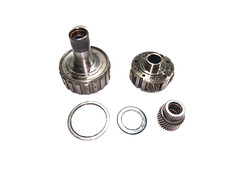
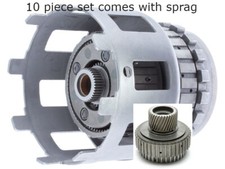
GM built the 4L65E and then the 4L70E around heavier gear train hardware than the base 4L60E — heavier planetary carriers, an induction-hardened turbine shaft and heat-treated stator shaft splines. The 4L60E's own weak link is documented in a place most rebuilders never look: a US patent.
US Patent 7,608,010 covers a replacement thrust bearing assembly for the rear planetary in the GM 4L60, 4L60E and 700R4, and it describes those units as having "a long history of rear planetary failures." It also documents what GM did about it: around the time the 4L60E electronic update arrived in 1993, GM added a pattern of four cross-drilled lube pins in the back face of the rear reaction carrier and mounted a lube shield behind it to catch stray fluid and force it into those pins. The patent's figures describe the carrier body's four support posts.
That is the mechanism worth understanding. The rear planetary in a base 4L60E does not usually let go because the pinions are outgunned in a straight-line torque sense. It lets go because the rear thrust bearing runs dry and hot, welds itself down, and takes the carrier with it. Heavier carriers help — so do cooler flow, correct endplay and a good thrust bearing, and those three are free on any core you build.
The ratios are identical, and that is worth fixing
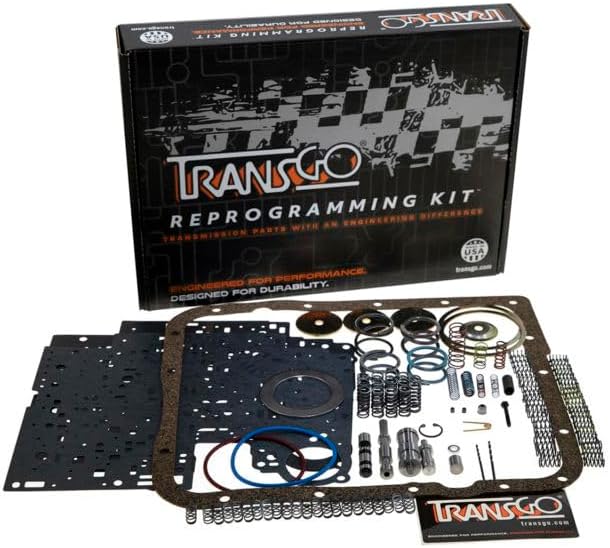
Both units run 3.06 first, 1.63 second, 1.00 third and an overdrive. Sonnax puts it plainly: 3.06 is the steepest first gear ratio of any four-speed automatic, and the 3.06-to-1.63 change on the 1-2 shift is a dramatic ratio drop — hard on the band, the clutches and the shafts in both transmissions. Their 2.84 ratio input carrier kit 77284-K converts it to 2.84/1.55, which cuts shock loading at the 1-2 and 2-3 shifts and reduces torque multiplication through the gear train.
One interchange landmine on that kit: Sonnax warns it cannot be used with an '07-later reaction shaft. If you are building a late 4L70E core, you need an '06-earlier reaction shaft or their universal heavy duty reaction shaft kit 74602-01K. This is exactly the kind of thing that stops a build at 11pm on a Friday.
The Pump, Stator and Turbine Shaft Are One Assembly
This is where a 4L70E-to-4L60E parts mix goes wrong, and it is the single most useful thing in this article.
The ISS bolts to the back of the pump and reads reluctor teeth on the turbine shaft. That means the pump cover, the stator support and the turbine shaft have to be matched to each other. Sonnax's Caleb Perham laid out a three-check procedure in Transmission Digest for verifying you have the right combination:
- Identify the shaft. Note the sealing ring locations, because there are several variations in circulation. Watch for the anomaly he calls out: a pump cover with no ISS hole drilled but a reluctor-style stator, paired with an input shaft that has no reluctor. That combination requires an ISS stator.
- Identify early versus late pump. Lay a straightedge through the center of the pump bolt holes. On earlier pumps the converter feed hole sits just to the right of that line. On later pumps it sits just to the left.
- Identify early versus late stator. Look at the converter feed and lube holes. On the early stator they are directly in line with one another. On the late stator the converter feed hole is offset to the right of the lube hole.
Get this wrong and the failure modes are ugly: no movement, converter charge concerns, input shaft failure and converter damage. A toothed shaft dropped into a pre-ISS pump will physically go in, but the seal rings land in the wrong place in the stator support and you have put a leak straight into the forward and direct circuits.
P0716 and P0717 on a fresh 4L70E
Two documented causes account for most of these, and neither one is a bad sensor.
First, the ISS wiring was not secured in its locating brackets on the back of the pump assembly. The reverse input drum spins close to that harness and it will chew the wires. Route and clip the harness exactly the way the pump was built.
Second, the ISS ground supplied by the control module can be lost internally to the TCM — which has sold a lot of modules that did not need selling. Transmission Digest documents the workaround: splice into circuit 1984/1231 and ground it externally. That circuit runs from terminal 45 at the TCM to terminal V at the case connector. Check for a good ground at the sensor with the key on before you condemn anything expensive.
What Interchanges: The Short List
The valve body crosses
Sonnax's 4L60-E valve body identification guide settles this one. Its remanufactured GM051 body is listed for the 4L60-E, 4L65-E and 4L70-E together for '03–'08, and the earlier annular-lockup GM049 body covers the same three for '00–'02. Identify by what is bolted to the body rather than by the case tag. For the '03–'08 body: five solenoids, late 3-2 control, a white plastic on/off 3-2 solenoid reading 20–31 ohms, a gray plastic PWM TCC solenoid reading 10–15 ohms, a vented manual valve, TCC annular exhaust ports top and bottom, and the 3-2 port cast shut.
Ohm both solenoids on the bench before the body goes in. A gray "PWM TCC" solenoid reading in the twenties is a 3-2 solenoid somebody put in the wrong hole, and it will not control lockup no matter what the scan tool commands.
What does not cross
- The internal harness and case connector. These carry the ISS circuits and must match the vehicle's control module, not the valve body casting.
- The pump, stator support and turbine shaft as a set. See the three checks above. Source them together.
- The reaction shaft on '07-later units if you are fitting an aftermarket input carrier.
- 2WD versus 4WD output shaft and tailhousing. The same fitment item that stops every swap in this family.
Mixing Parts? Set Endplay or Do Not Bother
If you are putting 4L70E-era gear train hardware into a 4L60E core, this step is not optional. The 4L60/E family is a total endplay unit: one measurement, front to back, as a single stack. The low/reverse one-way clutch outer housing is snap-ringed into the case but does not separate front play from rear play, because the inner race floats with gear set movement. Anyone hunting for two settings here is chasing a number that does not exist.
Sonnax technical specialist Randall Schroeder published the procedure in Transmission Digest:
- Check gear set play first. Assemble the gear set, hubs and inner one-way clutch race from the rear hub up to the retaining snap ring on the front planetary. There is no published spec, but you want no more than .030 in. of movement referenced between the output shaft and rear hub. Do this any time you change planetaries or the drive shell — the shell is the number one changed component in this family.
- Then set total endplay. Stack it dry with no clutch packs assembled, output shaft not needed, up through the input drum, selective shim and pump cover. Dial indicator, not feel. Target .005 to .036 in., with .020 to .025 in. as the sweet spot.
- Correct for the gasket. With a new pump gasket, subtract .005 in. from your measurement. With no gasket, add .005 in.
- Shimming. The selective shim lives under the bearing on top of the input drum. If the factory shim you need is unavailable, shim stock can go under the factory shim in the input drum in roughly .015 in. increments, or under the rear-hub-to-case bearing at the bottom of the case in roughly .010 in. increments.
Building Either One to Survive
The upgrades that matter apply to both models, because the hydraulic weak points are shared.
Line pressure stability is the pump killer, not peak pressure. Sonnax is direct about this: pressure pulsation from poor PR valve control is the real danger to the pump vane rings, and the sign of it is gauge needle bounce while you are testing line pressure. PR valve bore wear is common in this family. The fix is precise valve-to-bore clearance, a leak-free boost valve, and clean actuator feed limit oil reaching the EPC solenoid — oversized PR valve 77917-07, a boost valve kit such as 77898E-K, and AFL valve kit 77754-09K.
Never put a wide band on a used drum. The old band has compressed a subtle dish into the drum surface, and a wider band riding that dish slips, glazes, burns and eventually throws off band adjustment. Set servo travel between .075 in. and .125 in. with a dial indicator, and never shim the servo — shimming pushes the piston deeper into the bore where it bottoms out and takes the band with it.
Vacuum test before you decide anything. Sonnax's vacuum test guide covers the 4L60-E, 4L65-E and 4L70-E as one document, which again tells you how common the hydraulics are. Low vacuum at the TCC regulator valve reads as code 894 or 1870, low line pressure, second gear starts and 3-4 clutch failure. Low vacuum at the 3-4 shift valve reads as no fourth, burned 2-4 band and loss of fourth signal oil. Low vacuum at the forward abuse valve reads as delayed forward, forward clutch distress and a damaged valve body casting. Same tests, same bores, same symptoms in either transmission.
Which One Should You Build?
If the vehicle came with an ISS-equipped 4L70E, build a 4L70E. The control module wants that input speed signal, and handing it a pre-ISS unit gets you a P0717 and a default line pressure calibration on the first drive.
If the vehicle is a pre-2006 4L60E truck, build the 4L60E core and put the good hardware in it. You land in the same place mechanically without fighting a case connector and a harness the PCM cannot read.
If you are choosing between two loose cores, pick the cleanest one. Unscored pump, good case bores, quiet planets, no aluminum in the pan. A well-built 4L60E and a well-built 4L70E end up in the same place, because the parts that decide whether it lives — the pump, the endplay, the cooler flow, the thrust bearings and the valve body bores — are common to both.
Sonnax SmartShell Heavy Duty Reaction Shell Kit 77749-02K
The reaction sun shell is the shared weak point across this whole family, and it is the component most often swapped during a gear train repair — which is exactly why endplay has to be reset after it goes in. The SmartShell redesign redirects thrust load away from the bearings that kill the rear planetary. Fits 4L60, 4L60E, 4L65E and 4L70E.
See the SmartShell kit at CoreTransmissionParts →Building the whole unit? The full 4L70E parts collection and the 4L60E parts collection cover both cores.
FAQ
Is a 4L70E stronger than a 4L60E?
In stock form, yes, but not by a wide margin and not because of anything you can see from outside. The case, bellhousing, bolt pattern, valve body and ratios are the same. What GM changed is inside: the heavier planetary carriers and hardened shafts that came with the 4L65E and carried into the 4L70E, plus the input speed sensor that lets the control module see actual input speed and manage line pressure and converter clutch slip more precisely. A rebuilt 4L60E carrying the same hard parts is the same transmission.
Will a 4L70E bolt into a truck that came with a 4L60E?
Mechanically it drops right in. The 4L60E, 4L65E and 4L70E share the case, bellhousing, mount and tailhousing families, and GM services them as one population under RPO M30, M32 and M70. The problem is electrical. A 4L70E carries an input speed sensor and a case connector wired for it. A pre-2006 PCM has no ISS circuit, so the sensor is dead weight and the connector may not match. You also have to match 2WD versus 4WD output shaft and tailhousing, and the converter to the input shaft.
What is the difference between RPO M30 and RPO M70?
M30 is the base 4L60E, M32 is the 4L65E and M70 is the 4L70E. GM lists all three together in bulletin PIP5072 as one service population sharing a single input housing and turbine shaft assembly, part number 19125752, which tells you how much of the unit is common. The RPO on the service parts label is the fastest way to tell which one you actually have, because the cases look identical.
Can I put 4L70E internals in a 4L60E?
Yes, and that is the normal way to build one. The heavier planetary carriers, the hardened turbine shaft and the wider band all fit the earlier case. What you must do is reset endplay afterward. Changing planetaries or the drive shell moves the whole stack, and the 4L60/E is a single total-endplay unit measured front to back. Target .005 to .036 in. with a dial indicator, and check gear set play at no more than .030 in. before you go further.
Why does the rear planetary keep failing on these?
Heat and lube. The base 4L60/4L60E rear reaction carrier is a four-post design, and GM cross-drilled four lubrication pins in the back face in 1993 and added a lube shield specifically to push more fluid into the rear thrust bearing. That history is documented in US Patent 7,608,010, filed to replace the OE bearing because of what it calls a long history of rear planetary failures. Cooler flow, correct endplay and a good thrust bearing matter more here than pinion count.
Sources
- General Motors — Preliminary Information Bulletin PIP5072, "Slip In Forward Ranges Immediately After Replacing The Input Housing," October 2012 (hosted by NHTSA). Backs the RPO M30 / M32 / M70 grouping of the 4L60E, 4L65E and 4L70E as one service population, the 1999–2007 vehicle application list quoted here, and the single shared service input housing and turbine shaft assembly part number 19125752 covering all three models. static.nhtsa.gov
- ATRA (Automatic Transmission Rebuilders Association) — 2005 GM Update, "4L60E/4L65E/4L70E 2005 Updates." Backs the 4L70E being introduced for 2006 using the same technology as the 4L60E/4L65E, the full ISS hardware change list (shortened reverse boost PR valve line-up, pump casting changes relocating the S3 bore boss and the TCC release bore, updated stator support sleeve passages, 15 reluctor teeth added to the turbine shaft with the seal rings relocated 2.5 mm, the added ISS and revised harness, the plug used in non-ISS applications, newly enabled shift control software and the two new DTCs P0716 and P0717), and the note that the PR valve train can no longer be serviced without removing the pump. atracom.blob.core.windows.net
- Sonnax — GM 4L60-E Valve Body Identification Guide, April 12, 2017. Backs the valve body interchange across the 4L60-E, 4L65-E and 4L70-E (remanufactured GM049 for '00–'02 annular lockup, GM051 for '03–'08) and the '03–'08 identification detail: five solenoids, late 3-2 control, white plastic on/off 3-2 solenoid at 20–31 ohms, gray plastic PWM TCC solenoid at 10–15 ohms, vented manual valve, TCC annular exhaust ports and the 3-2 port cast shut. sonnax.com
- Transmission Digest — Caleb Perham (Sonnax TASC Force), "4L60-E Series input shaft, stator and pump cover compatibility: Three easy checks," July 26, 2024. Backs the three-check identification procedure, the no-ISS-hole-with-reluctor-stator anomaly that requires an ISS stator, the early-versus-late pump converter feed hole position relative to the bolt hole centerline, the early-versus-late stator converter feed and lube hole alignment, and the failure modes of a wrong stator: no movement, converter charge concerns, input shaft failure and converter damage. transmissiondigest.com
- Transmission Digest — "GM 4L70-E ISS DTC P0716 or P0717," Transmission Tech/Talk, October 8, 2020. Backs the ISS wiring not being secured in its locating brackets on the back of the pump and being damaged by the spinning reverse input drum, and the loss of the TCM-supplied ISS ground internal to the module with the external ground repair on circuit 1984/1231 between TCM terminal 45 and case connector terminal V. transmissiondigest.com
- Transmission Digest — Randall Schroeder (Sonnax TASC Force), "All Work and No Play: Setting Endplay to Prevent 4L60/E Gear Train Failure," August 4, 2026. Backs the 4L60/E being a single total-endplay unit, the low/reverse one-way clutch inner race floating with gear set movement, the .030 in. maximum gear set play check between output shaft and rear hub, the .005–.036 in. total endplay window with .020–.025 in. preferred, the plus-or-minus .005 in. pump gasket correction, the .015 in. and .010 in. shim stock increments, and the limits of the "H" gauge method. transmissiondigest.com
- Sonnax — "Building the Killer 4L60E: Top Tips for Optimizing Your Transmission Upgrades," March 2, 2016. Backs pressure pulsation from poor PR valve control as the real pump-vane-ring danger with gauge needle bounce as the sign, common PR valve bore wear, the recommended oversized PR valve 77917-07 / boost valve 77898E-K / AFL valve kit 77754-09K, the warning that adding thinner 3-4 frictions sacrifices the steel mass that carries heat, the prohibition on installing a wide band on a used drum, and the .075–.125 in. servo travel spec set with a dial indicator along with the instruction never to shim the servo. sonnax.com
- Sonnax — 2.84 Ratio Input Carrier Kit 77284-K product and technical page. Backs 3.06 as the steepest first gear ratio of any four-speed automatic, the OE 3.06/1.63 wide-ratio 1-2 change, the 2.84/1.55 close-ratio conversion and its reduced shock loading, and the compatibility warning that the kit cannot be used with an '07-later reaction shaft without sourcing an '06-earlier shaft or reaction shaft kit 74602-01K. sonnax.com
- Sonnax — GM 4L60-E, 4L65-E, 4L70-E Vacuum Test Guide. Backs the single vacuum test document covering all three models and the symptom-to-bore mapping used here: TCC regulator valve (codes 894 and 1870, low line pressure, 2nd gear starts, 3-4 clutch failure), 3-4 shift valve (no 4th, 2-4 band burned, loss of 4th signal oil) and forward abuse valve (delayed forward, forward clutch distress, damaged valve body casting). sonnax.com
- United States Patent and Trademark Office — US Patent 7,608,010 B2, "Thrust bearing assembly for automatic transmission rear planetary." Backs the documented long history of rear planetary failures in the GM 4L60, 4L60E and 700R4, GM's 1993-era countermeasure of four cross-drilled lubrication pins in the back face of the rear reaction carrier plus a lube shield to force fluid into them, and the four-support-post construction of the rear carrier body. patents.google.com