The 4L65E and the 4L70E are close enough that a lot of shops treat them as the same transmission with a different tag. On the gear train side that is almost true. Where they part ways is the pump, the turbine shaft and the electronics hanging off both — and those differences decide whether the core on your bench will run in the truck you pulled it out of.
The short version: the 4L70E is a 4L65E with the input speed sensor system built into it. GM added the sensor, and to make room for it the pump casting, the stator support and the turbine shaft all had to change. The planetaries, the clutch packs, the band, the servo, the ratios and the valve body carried straight over. So the strength answer and the fitment answer are two different answers, and most people mix them up.
Where the 4L70E Came From
ATRA laid out the whole plan in its 2005 GM update material, before the parts were even in shops. The wording is worth reading straight: "A major update is planned for the 4L60E/65E applications for the 2006 model — ISS fully implemented for the 2006 model year. As with other changes in the past, some of the changes will be pulled forward into the mid 2005 model year applications in preparation for the roll out of the completed ISS system. In addition a new model transmission will be introduced in 2006 using the same technology, the 4L70E."
That single paragraph explains most of the confusion in this family. The 4L70E did not arrive as a new gearbox. It arrived as the ISS-equipped member of an existing family, at the same time the ISS hardware was being phased into the 4L60E and 4L65E alongside it. That is why you can find a 2006 4L65E with an ISS-capable pump and a 2006 4L65E without one.
ATRA's list of what had to change to make the ISS work is the real difference list between a 4L65E and a 4L70E:
- Shortening of the reverse boost pressure regulator valve line-up
- Casting changes within the pump to relocate the S3 bore boss
- Casting changes relocating the TCC release bore
- Updated stator support sleeve passages
- An updated turbine shaft carrying reluctor teeth for the sensor, with the seal ring locations repositioned on the shaft
- The input speed sensor itself plus a revised internal wiring harness — and on applications not using an ISS, the sensor hole gets a plug
- Shift control features enabled in software that earlier applications did not fully use
- Two new diagnostic trouble codes for the ISS system: P0716 and P0717
Nothing on that list is a gear train part. That is the point.
What Is Actually Different on the Bench
The pump, the stator and the turbine shaft are a matched set
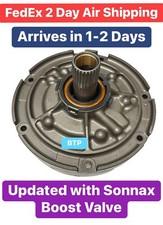
This is the one that bites people. The ISS bolts to the back of the pump assembly and reads reluctor teeth on the turbine shaft. A 4L70E pump has the sensor bore and the relocated S3 and TCC release bores; a pre-ISS 4L65E pump does not. The turbine shaft that runs in an ISS pump has the reluctor teeth and its seal rings in the repositioned locations.
You cannot mix halves of that. An ISS pump with a toothless shaft gives you a sensor staring at nothing and a P0717 the moment the truck moves. A toothed shaft in a pre-ISS pump physically fits but the seal rings land in the wrong place in the stator support, which puts a leak straight into the forward and direct circuits. Treat the pump, stator support and turbine shaft as one assembly and source them together.
The plug is not optional
ATRA notes that on non-ISS applications the sensor hole gets filled with a plug. Transmission Digest documented what happens when that instruction is ignored, or when the sensor goes in without its seal: after an overhaul, a 4L70E was pushing fluid out of the transmission vent with no cooler restriction, no filter problem and no sign of cavitation. The cause was that the input speed sensor passage and the vent passage in the pump connect to each other. The rebuilder had either left the O-ring off the ISS or left the retaining bolt out, and the sensor worked its way out of the passage far enough to feed pressurized fluid to the case vent. A P0717 came along with it. Installing the O-ring and the retaining bolt fixed it.
If a freshly built 4L70E is soaking the bellhousing area and you already checked the cooler and the fill level, pull the pump and look at the ISS before you chase anything else.
Everything the gear train needs is identical
Both units run five-pinion front and rear planetary carriers, the same 2-4 band and servo, the same reaction sun shell family, the same input housing and 3-4 clutch stack, and the same ratios: 3.06 first, 1.63 second, 1.00 third, 0.70 overdrive and 2.29 reverse. GM services them with common parts. In bulletin PIP5072 GM groups "4L60E, 4L65E or 4L70E (RPO M30, M32 or M70)" as one population and lists a single service input housing and turbine shaft assembly, part number 19125752, across all three for 1999–2007 applications. One part number, three transmissions — that is GM telling you how much of this is shared.
The Valve Body Crosses. Verify It Anyway.
Sonnax's 4L60-E valve body identification guide is the fastest way to settle a valve body question in this family, and it makes the interchange explicit: the '03–'08 valve body, Sonnax remanufactured part GM051, is listed for the 4L60-E, 4L65-E and 4L70-E together. The '00–'02 annular lockup body, GM049, covers the same three.
Identify by what is bolted to it, not by the case tag. For the '03–'08 body Sonnax specifies five solenoids, a late 3-2 control solenoid, an on/off 3-2 control solenoid that is white plastic reading 20–31 ohms, a PWM TCC solenoid that is gray plastic reading 10–15 ohms, a vented manual valve, the TCC annular exhaust port top and bottom, the 3-2 port cast shut, and a vent at the manual valve. Ohm the two solenoids on the bench before the body goes in. A gray PWM TCC solenoid measuring in the twenties is not a PWM solenoid, it is a 3-2 solenoid somebody put in the wrong hole, and it will not control lockup.
Where the valve bodies stop matching is at the harness and the case connector, because the ISS wiring runs through it. Match the internal harness to the transmission the case connector expects, not to the valve body casting.
Diagnosing the ISS When It Goes Wrong
The ISS is the one system that exists on a 4L70E and not on a pre-2006 4L65E, so it is also the one system that generates a whole class of complaints the 4L65E never had. Two codes matter: P0716, input speed sensor performance, and P0717, low or missing input speed sensor circuit voltage.
The sensor is a three-wire Hall-effect unit — power, a control-module-supplied ground, and a signal line back to the module. Scan-tool-wise, watch Input Speed (ISS) against Engine Speed with the vehicle stopped in Drive with the brake on. Below stall, the two should track each other with a normal converter slip spread; a signal that reads zero while the engine is clearly turning the converter is a hard failure, and a signal that drops out intermittently under load is a wiring or ground problem, not a bad sensor. In third gear locked up, ISS and engine RPM should sit within a few dozen RPM of each other. A spread that opens up under throttle in fourth is TCC slip, and that is where the ISS earns its keep — the module now measures slip directly instead of inferring it.
Transmission Digest has documented two real causes on these units that a parts swap will not fix. The first is mechanical: the ISS wiring not seated in its locating brackets on the back of the pump, where the spinning reverse input drum runs close enough to chew the harness. Secure that harness in its brackets on every build. The second is inside the control module — a loss of the ISS ground circuit provided by the TCM, with the failure internal to the module. The documented workaround is to splice into circuit 1984/1231, which runs from TCM terminal 45 to terminal V at the case connector, and ground it externally rather than replacing the TCM. Check the ground before you condemn a module or a sensor.
4L65E 5-Pinion Front Planet Update Kit (OEM 24243874)
The front carrier both of these units run from the factory. If you are pulling a four-pinion 4L60E core up to 4L65E or 4L70E internals, this is the part that does it — same case, same sun gear, same ring gear.
View the 5-pin front planet kit →Building the whole unit? Start from the full 4L65E parts collection.
Which Is Stronger?
Mechanically, neither. They hold the same clutches, the same band and the same carriers. Anyone quoting you a torque number that says the 4L70E is worth a hundred foot-pounds more than a 4L65E is quoting a rating, not a part difference, and ratings on this family move around depending on who published them and what vehicle they were rating.
What the 4L70E does have is better information. The module knows real turbine speed instead of calculating it from output speed and commanded ratio, so it can regulate line pressure, time shifts and manage torque converter clutch slip against a measured number. ATRA's list includes shift control features enabled in software that earlier applications did not fully use — that software is what the extra rating is really buying. In a truck that lives at the top of its rating, better pressure and slip control does translate into longer clutch life. It is a controls advantage, not a hardware one.
If you are building either one for real load, the durability money goes to the same three places on both units. Sonnax's 4L60E build guide is blunt about all three. First, unstable line pressure is what kills pumps, not high line pressure — pressure regulator valve bore wear is common across this family, and needle bounce on the gauge during a line pressure test is the tell. Second, do not chase 3-4 clutch capacity by cramming thinner plates into the stock input housing; adding friction surfaces that way removes steel, and steel is what carries heat out of the pack, so static capacity goes up while heat tolerance goes down. Third, set servo travel with a dial indicator between 0.075 in. and 0.125 in., and never shim the servo to get there — shimming drives the piston deeper into the bore where it bottoms out and takes the band with it.
Fluid and Service
Both call for DEXRON-VI, and there is no separate spec for either one. Mobil's DEXRON-VI ATF data sheet states the fluid meets GM DEXRON-VI, provides warranty protection for 2006-and-newer GM vehicles, and improves performance in older GM vehicles wherever DEXRON is specified — which covers every DEXRON-III-era unit in this family. Published properties are 5.83 mm2/s kinematic viscosity at 100 C, 29.5 mm2/s at 40 C and 11,500 mPa·s Brookfield at -40 C.
A pan-and-filter service on a shallow-pan unit takes roughly 5 quarts. A dry fill with the converter and cooler lines empty runs closer to 11 to 12 quarts on a 300mm-converter unit, and a deep pan adds to that. Fill to the level check, hot, in Park, with the engine running — not to a number.
Swapping One for the Other
Mechanically a 4L70E drops into a 4L65E application and vice versa. Electrically it depends on which direction you are going.
4L70E into a pre-2006 4L65E truck: the mechanical side is fine. The ISS will be present and unread. Depending on the vehicle's controller, you either leave it disconnected or you have a sensor the module has no provision for. The transmission drives; you lose the benefit of the sensor and gain nothing.
4L65E into a 2006-up 4L70E truck: this is the direction that leaves you stranded on a scan tool. The module expects an ISS signal, does not get one, and sets P0717 immediately. Depending on calibration, expect default line pressure and degraded shift quality. You need an ISS-configured pump, stator support and turbine shaft to make that swap work, which means you are converting the 4L65E to 4L70E internals anyway.
Either direction: confirm the bellhousing bolt pattern and depth, the converter, the input shaft-to-converter match, and the tailhousing and output shaft for 2WD versus 4WD before you order anything. Those are the fitment items that actually stop a swap in this family, not the model number on the tag.
FAQ
Is a 4L70E just a 4L65E with a sensor?
Close, but the sensor brought hardware with it. Adding the input speed sensor required casting changes in the pump to relocate the S3 bore boss and the TCC release bore, updated stator support sleeve passages, and a turbine shaft with reluctor teeth and repositioned seal rings. The gear train, clutches, band, servo and ratios are unchanged. So it is a sensor plus the pump and shaft changes needed to feed it.
Will a 4L65E work in a truck that came with a 4L70E?
It will bolt in and drive, but the control module expects an input speed signal and will set P0717 as soon as it does not see one. Expect default line pressure and poor shift quality depending on the calibration. To do the swap properly you need an ISS-configured pump, stator support and turbine shaft, at which point you have built a 4L70E.
Does the valve body interchange between a 4L65E and a 4L70E?
Yes for the '03 through '08 range. Sonnax lists its remanufactured GM051 valve body for the 4L60-E, 4L65-E and 4L70-E together, and the earlier annular-lockup GM049 body covers the same three. Verify by the solenoid line-up rather than the tag: five solenoids, a white on/off 3-2 solenoid at 20 to 31 ohms, and a gray PWM TCC solenoid at 10 to 15 ohms. The internal wiring harness is what has to match the ISS configuration, not the casting.
What causes P0716 and P0717 on a 4L70E?
Three things dominate. The ISS wiring not secured in its locating brackets on the back of the pump, where the spinning reverse input drum damages it. A loss of the sensor ground supplied by the control module, which can be worked around by grounding circuit 1984/1231 externally between TCM terminal 45 and case connector terminal V. And the sensor backing out of its bore when the O-ring or retaining bolt was left out during a rebuild, which also pushes fluid out the case vent.
Which one should I start a build with?
Whichever core is cleanest. The pump is not scored, the case bores are good, the planets are quiet. The hard parts are common, so a well-built 4L65E and a well-built 4L70E land in the same place mechanically. Let the vehicle's control module decide which ISS configuration you finish it in.
Sources
- ATRA (Automatic Transmission Rebuilders Association) — 2005 GM Update, "4L60E/4L65E/4L70E 2005 Updates." Backs the ISS rollout timeline (pulled forward into mid-2005, fully implemented for 2006), the introduction of the 4L70E in 2006 using the same technology, and the full hardware change list: shortened reverse boost PR valve line-up, pump casting changes relocating the S3 bore boss and the TCC release bore, updated stator support sleeve passages, the turbine shaft receiving reluctor teeth with repositioned seal rings, the added ISS and revised harness, the plug used in non-ISS applications, the newly enabled shift control software features, and the two new DTCs P0716 and P0717. atracom.blob.core.windows.net
- Sonnax — GM 4L60-E Valve Body Identification Guide, April 12, 2017. Backs the valve body interchange across the 4L60-E, 4L65-E and 4L70-E (remanufactured GM049 for '00–'02 annular lockup and GM051 for '03–'08), and the '03–'08 identification detail: five solenoids, late 3-2 control, white plastic on/off 3-2 solenoid at 20–31 ohms, gray plastic PWM TCC solenoid at 10–15 ohms, vented manual valve, TCC annular exhaust ports and the 3-2 port cast shut. sonnax.com
- Transmission Digest — "GM 4L70-E ISS DTC P0716 or P0717," Transmission Tech/Talk. Backs the two documented causes: ISS wiring not secured in its locating brackets on the back of the pump and damaged by the spinning reverse input drum, and the loss of the TCM-supplied ISS ground internal to the module, with the external ground repair on circuit 1984/1231 between TCM terminal 45 and case connector terminal V. transmissiondigest.com
- Transmission Digest — "GM 4L70E Leaking out of Vent," Transmission Tech/Talk, April 14, 2021. Backs the connection between the input speed sensor passage and the vent passage in the pump, the missing ISS O-ring or retaining bolt as the cause of fluid leaking from the transmission vent after overhaul, and the accompanying P0717. transmissiondigest.com
- General Motors — Preliminary Information Bulletin PIP5072, "Slip In Forward Ranges Immediately After Replacing The Input Housing," October 2012 (hosted by NHTSA). Backs the RPO M30 / M32 / M70 grouping of the 4L60E, 4L65E and 4L70E as one service population and the single shared service input housing and turbine shaft assembly part number 19125752 across 1999–2007 applications. static.nhtsa.gov
- Sonnax — "Building the Killer 4L60E: Top Tips for Optimizing Your Transmission Upgrades." Backs pressure regulator valve bore wear and gauge needle bounce as the sign of unstable line pressure, the warning that adding thinner 3-4 frictions sacrifices steel mass and heat capacity, and the 0.075 in. to 0.125 in. servo travel spec set with a dial indicator along with the instruction never to shim the servo. sonnax.com
- Sonnax — GM 4L70-E Transmission unit page. Backs the 4L70-E being carried as its own unit in the 4L60-E family parts catalog with shared symptom and component coverage. sonnax.com
- ExxonMobil — Mobil DEXRON-VI ATF product page and data sheet. Backs the GM DEXRON-VI specification claim, warranty coverage for 2006-and-newer GM vehicles, use in older GM vehicles wherever DEXRON is specified, and the published viscosities of 5.83 mm2/s at 100 C, 29.5 mm2/s at 40 C and 11,500 mPa·s Brookfield at -40 C. mobil.com