Most of what gets written about servicing a 4L70E is really written about a 4L60E, with the model number swapped out. That is close enough to be dangerous. The 4L70E carries an input speed sensor buried in the pump assembly, and that one part changes three things a fluid service touches directly: where fluid can escape after you button the unit up, what the controller does with the fluid once it is in there, and which codes light up when you get the job wrong.
Here is what GM's own documentation says about the fluid, the capacity and the interval, plus the failure modes that are specific to this unit rather than inherited from the 4L60E it grew out of.
The Fluid: DEXRON-VI, and There Is No Second Answer
On a 4L60E you can at least have the DEXRON-III argument, because early units were factory-filled with it. On a 4L70E you cannot. The unit is a 2006-and-later design, arriving alongside GM's move to DEXRON-VI, so it never had a DEXRON-III service fill to go back to. GM's Recommended Fluids and Lubricants table lists the automatic transmission requirement as flatly as it gets: "DEXRON-VI Automatic Transmission Fluid," in both the 2009 Silverado and 2008 TrailBlazer owner manuals.
What that fluid actually is, measured: per the ExxonMobil product data sheet for Mobil DEXRON-VI ATF, it runs 29.5 mm²/s kinematic viscosity at 40°C and 5.83 mm²/s at 100°C, with a Brookfield viscosity of 11,500 mPa·s at -40°C and a 220°C Cleveland open cup flash point. ExxonMobil states the product carries GM DEXRON VI approval and "provides warranty protection for 2006 and newer GM vehicles."
Two things follow from those numbers on this particular unit. First, the cold-flow figure is why a 4L70E truck does not stumble through the first three shifts on a January morning the way an old DEXRON-III unit did. Second, that 5.83 mm²/s hot viscosity is thin, and thin fluid finds worn valve bores and tired clutch piston seals faster than heavy fluid ever did. If a high-mileage 4L70E goes soft on shifts right after a fluid and filter service, the fluid did not cause the wear. It stopped hiding it. Vacuum test the valve body before you start apologizing for the fluid.
ACDelco DEXRON-VI, 1 Gallon
The GM-licensed service fill. A pan-and-filter on a 4L70E takes five quarts, so a gallon plus a spare quart covers one service with enough left to top off after the road test.
See the fluid →Capacity: Five Quarts for a Pan and Filter, and That Is Not the Dry Fill
GM publishes one capacity figure for this family, and it is worth reading the column header before you write it down. In the 2009 Silverado owner manual's Capacities and Specifications table, the row is labeled "Transmission Fluid (Pan Removal and Filter Replacement)", and the entry for the four-speed reads 5.0 qt (4.7 L). The 2008 TrailBlazer manual gives the identical 5.0 qt / 4.7 L for "Transmission (Drain and Refill)."
Note that GM lists that line as "Auto 4-Speed Transmission 4L60-E Electronic Transmission." GM's service literature routinely lumps the 4L60E, 4L65E and 4L70E together, because for a pan service they behave the same. That is the number for a pan drop with a filter change. It is not a dry fill and it never was.
| Service | What GM publishes | What it actually covers |
|---|---|---|
| Pan removal and filter replacement | 5.0 qt (4.7 L) | Pan volume only. Converter, cooler, lines and valve body stay full. |
| Deep pan (aftermarket or truck) | Not published by GM | Add roughly 1.5 to 2 qt over the shallow figure. Measure what came out. |
| Overhaul, dry unit and dry converter | Not published in owner literature | Plan on 10 to 11 qt total. Prime the converter separately before it goes on. |
The reason to be careful about the difference: a shop that reads "5.0 quarts" and then pours five quarts into a freshly overhauled unit with an empty converter has a transmission that will not build pressure on the first start. A shop that reads a dry-fill number off a forum and pours it into a pan service has an overfilled unit. Fill to the level procedure, not to the number.
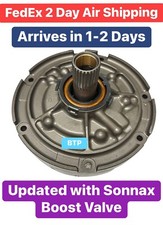
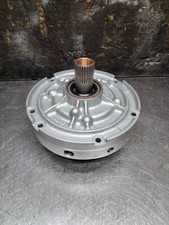
The Part That Makes a 4L70E Different: the ISS in the Pump
The 4L70E's input speed sensor is mounted internally to the pump assembly and reads a reluctor on the input shaft. Sonnax sells the heavy-duty input shaft for these in two distinct versions for units with the 300mm converter — non-reluctor style (part 77733-11SB) and reluctor style (77733-12SB) — which is the cleanest way to tell how far into the transition a given core sits. Get that wrong on a rebuild and you have an ISS staring at a shaft with nothing to count.
Two things about that sensor matter to anyone doing fluid work, and both come out of Transmission Digest tech bulletins.
The vent leak that is not an overfill
Per Wayne Colonna's April 2021 Tech/Talk item, a 4L70E that comes back after overhaul leaking fluid from the transmission vent — with no cooler restriction, no filter problem, and no evidence of cavitation — usually has an ISS problem, not a fluid level problem. The input speed sensor passage and the vent passage in the pump can be connected. If the rebuilder left the O-ring off the input speed sensor, or left out the ISS retaining bolt so the sensor worked its way out of its passage, fluid gets straight to the case vent. A P0717 sets alongside it. Install the O-ring and the retaining bolt and the leak stops.
That is worth committing to memory, because the instinct on a venting transmission is always to pull a quart out. On this unit, doing that just leaves you low and still leaking.
The wiring the drum eats
The October 2020 Tech/Talk bulletin covers the other half. After a repair, the unit comes back with P0716 (Input Speed Sensor Performance) or P0717 (Low Input Speed Sensor Circuit Voltage). The cause is the ISS wiring not being properly secured in its locating brackets on the back of the pump assembly — the spinning reverse input drum sits close enough to chew the wires. Secure the harness in its brackets and the codes go away.
The same bulletin flags a second cause worth knowing before you tear anything down: the ISS ground circuit supplied by the TCM can be lost inside the TCM itself. The published repair is to splice into circuit 1984/1231 and ground it externally. That circuit runs from terminal 45 at the TCM to terminal V at the case connector.
Setting the Level, Number for Number
GM's level procedure is specific, and every step in it exists because skipping it produces a wrong reading. From the owner manuals:
- Temperature. The fluid must be at normal operating temperature, which GM defines as 180°F to 200°F (82°C to 93°C).
- Getting there. Drive about 15 miles (24 km) when outside temperatures are above 50°F (10°C). Below 50°F, drive in THIRD until the engine temperature gage moves and then holds steady for 10 minutes.
- Cooling down first. Wait at least 30 minutes before checking if the vehicle has been driven above 90°F ambient, at high speed for a while, in heavy traffic in hot weather, or pulling a trailer. An overheated unit reads high.
- The check itself. Park level, engine running, parking brake set. With your foot on the brake, move the shift lever through every range, pausing about three seconds in each, then back to PARK. Let it idle three minutes or more — that is what lets the foam fall out of the fluid.
- Reading the stick. Wipe it, reinstall fully, wait three seconds, pull it back out. Check both sides and read the lower level. Keep the stick pointed down. Do it at least twice; GM specifically calls for repeatable readings.
- Adding. GM's own note is that it "generally" takes less than one pint (0.5 L) to bring the level from low to full. If you are adding a quart at a time, you are overfilling something.
A cold check — after the vehicle has sat eight hours or more, idled five minutes if it is 50°F or warmer — is a reference only. GM says outright that if the level reads low cold, you must check it hot before adding anything.
What the Controller Sees, and When It Complains
GM publishes the actual monitor thresholds in its OBD diagnostic parameter files. In the 2009 Group 7 transmission file — the certification group covering RPO MYD, the 4L70E — the numbers that bear on fluid work are:
| Code | Criteria | Time / trips |
|---|---|---|
| P0716 Input Speed Sensor Performance | Input speed drop of 1000 RPM or more | 3.25 sec, two trips |
| P0717 Input Speed Sensor Circuit Low Voltage | Input speed below 50 RPM | 4.5 sec, two trips |
| P0712 TFT high temperature (short to ground) | TFT resistance at or below 43.1875 ohms | 12 sec |
| P0713 TFT low temperature (open or short to power) | TFT resistance at or above 171,862 ohms | 80 sec |
The ISS monitors only run inside a window: ignition between 8 and 18 volts, engine speed between 500 and 6500 RPM, engine torque between 50 and 1492 N·m, vehicle speed at or above 16 km/h (about 10 mph), and throttle at or above 8 percent. That window is why an ISS fault you can feel on a road test sometimes will not set a code in the bay — you never got the truck over 10 mph with real torque on it.
The practical scan-tool habit on this unit is to watch Input Speed against engine RPM. In converter lockup they should track within a few RPM of each other. A 4L70E with a marginal ISS ground shows a clean input signal at idle and a signal that drops out under load, which reads on the scan tool as an impossible input speed and feels to the driver like a shift that never happened.
The Service Interval GM Actually Publishes
Under Additional Required Services, GM lists two separate schedules. Normal service: change the fluid and filter at 100,000 miles. That is the only mark on the normal line. Severe service: 50,000, 100,000 and 150,000 miles.
Footnote (h) defines severe service, and it is broad enough that most of the vehicles carrying a 4L70E live there permanently:
- Heavy city traffic where the outside temperature regularly reaches 90°F (32°C) or higher
- Hilly or mountainous terrain
- Frequent trailer towing
- Taxi, police or delivery service
The 2009 Silverado version of that footnote adds a trigger that has nothing to do with how the truck is driven: if the Gross Vehicle Weight Rating is over 8,600 lb, it is on the severe schedule. Full stop. Check the door jamb sticker before you quote an interval, because a 2500-series truck qualifies sitting still in the driveway.
My own line to customers is that 50,000 miles is the number for anything with a hitch on it and 100,000 is for a half-ton that has genuinely never towed. The fluid is cheap; the 3-4 clutch pack is not.
4L70E filters and pan gaskets, DEXRON-VI, input speed sensors and O-rings, coolers, solenoid kits and rebuild kits — shipped fast from the USA.
Shop 4L70E parts →The Short Version
- Fluid: DEXRON-VI, licensed. There is no DEXRON-III option on this unit.
- Pan and filter: 5.0 qt (4.7 L) per GM. Overhaul with a dry converter is roughly double that.
- Level: 180°F to 200°F, range-cycle, three-minute idle, read the lower side of the stick, twice. Add in half-pints.
- Interval: 50,000 miles severe, 100,000 normal. GVWR over 8,600 lb is automatically severe.
- If it vents fluid after an overhaul: check the ISS O-ring and retaining bolt before you touch the level.
- If it sets P0716 or P0717: check the ISS harness routing on the back of the pump, then the TCM ground on circuit 1984/1231.
Sources
- General Motors — 2009 Chevrolet Silverado Owner Manual. Capacities and Specifications table listing "Transmission Fluid (Pan Removal and Filter Replacement) — Auto 4-Speed Transmission 4L60-E Electronic Transmission: 5.0 qt (4.7 L)"; Recommended Fluids and Lubricants specifying DEXRON-VI Automatic Transmission Fluid; the 180°F to 200°F normal operating temperature for the level check; and footnote (h) adding the GVWR-over-8,600-lb trigger to the severe-service schedule. experience.gm.com
- General Motors — 2008 Chevrolet TrailBlazer Owner Manual. Additional Required Services table showing the fluid and filter change at 50,000 / 100,000 / 150,000 miles for severe service and 100,000 miles for normal service; footnote (h) listing the four severe-use conditions; the 5.0 qt (4.7 L) Transmission (Drain and Refill) capacity; the 30-minute cool-down precondition; the 15-mile warm-up and the below-50°F THIRD-gear alternative; the range-cycle and three-minute idle procedure; reading the lower level on the dipstick; and the "generally less than one pint (0.5 L)" fill note. experience.gm.com
- General Motors Service Information — 2009 OBD Group 7 Transmission Diagnostics. The certification group covering RPO MYD. Published monitor criteria used above: P0716 Input Speed Sensor Performance at an input speed drop of 1000 RPM or more for 3.25 seconds; P0717 Input Speed Sensor Circuit Low Voltage at input speed below 50 RPM for 4.5 seconds; P0712 at TFT resistance of 43.1875 or below; P0713 at TFT resistance of 171,862 or above for 80 seconds; and the enable window of 8 to 18 volts, 500 to 6500 RPM, 50 to 1492 N·m engine torque, 16 km/h vehicle speed and 8 percent throttle. gsitlc.ext.gm.com
- Wayne Colonna, ATSG, in Transmission Digest — "GM 4L70E Leaking out of Vent" (April 14, 2021). The input speed sensor passage and the vent passage in the pump being connected; a missing ISS O-ring or missing retaining bolt letting the sensor work out of its passage and routing fluid to the case vent; the accompanying P0717; and the confirmation that the complaint occurs with no cooler restriction, no filter problem and no cavitation. transmissiondigest.com
- Transmission Digest Tech/Talk — "GM 4L70-E ISS DTC P0716 or P0717" (October 8, 2020). ISS wiring not secured in its locating brackets on the back of the pump assembly being damaged by the spinning reverse input drum; and the loss of the ISS ground circuit inside the TCM, with the published repair of splicing into circuit 1984/1231 from terminal 45 at the TCM to terminal V at the case connector. transmissiondigest.com
- ExxonMobil — Mobil DEXRON-VI ATF product data sheet. GM DEXRON VI approval and warranty protection for 2006 and newer GM vehicles; 29.5 mm²/s kinematic viscosity at 40°C and 5.83 mm²/s at 100°C (ASTM D445); 11,500 mPa·s Brookfield viscosity at -40°C (ASTM D2983); and the 220°C Cleveland open cup flash point (ASTM D92). mobil.com