A 4L70E shudder complaint gets misdiagnosed more often than almost anything else in a GM four-speed, and the reason is structural: on this unit the converter clutch is supposed to slip. The customer describes driving over rumble strips at 45 mph under light throttle. The tech feels it, pulls codes, finds nothing, and either sells a converter that did not need replacing or flushes the fluid and hands the truck back for two weeks.
The 4L70E sits at the top of the 4L60-E family and carries the EC3 converter clutch strategy GM brought to the 1998-and-later units, so most of what follows applies to a 4L60E or 4L65E with EC3 as well. The sequence: understand the strategy, read the right PIDs, then decide between fluid, valve body, and converter.
EC3: The Clutch Is Slipping On Purpose
Before the mid-1990s the 4L60-E converter clutch was on or off. A command to the TCC solenoid stroked the converter clutch valve, release fluid exhausted, and the apply circuit opened. PWM control replaced that with a second solenoid modulating the regulated apply valve, ramping duty cycle linearly from 0 percent unlocked to about 90 percent at full lockup so the clutch loads gradually instead of slamming on.
EC3 went one step further. Under EC3, per Sonnax, it is generally undesirable to fully lock the clutch at all. The controller targets a consistent 20 to 40 RPM of slip under most operating conditions and holds it there. That is also why the friction material changed again: an on/off paper lining burns up under modulated slip, and the PWM-era lining wears out prematurely in an EC3 unit. EC3 needs a high thermal slipping lining built to live in a controlled-slip condition.
The apply sequence is worth memorizing, because it is the whole diagnostic. When the controller decides to apply, it raises the regulator solenoid duty cycle in rapid steps to around 50 percent, which is roughly where the 20–40 RPM slip target lands in normal driving. From there it constantly trims pulse width to hold that window. Only under high torque or sustained freeway load does it push duty cycle to about 98 percent to fully lock the clutch and kill the slip heat.
So a 4L70E showing 30 RPM of TCC slip at cruise is not broken. A 4L70E showing 30 RPM of slip that the controller is buying with 80 percent duty cycle is dying.
The Numbers That Expose the Failure
Because EC3 is adaptive, the duty cycle required to hold the slip target rises as the hydraulic circuit leaks. Sonnax puts it plainly: as the regulator bore wears, the duty cycle needed to keep slip in range increases, and you can spot the problem before it ever sets a code. Their example is a low-mileage vehicle showing an average TCC duty cycle of 79 percent — that controller is compensating for circuit wear, most likely in the regulator bore.
Log these on a road test in fourth gear, light throttle, 45–65 mph, with fluid temperature above 160°F:
| PID | Healthy | What it means when it is off |
|---|---|---|
| TCC Slip Speed (engine RPM minus input shaft RPM) | 20–40 RPM applied at normal cruise; near zero when fully locked under load | Slip oscillating 60–150 RPM in time with the felt shudder is a real converter clutch problem, not a driveline vibration |
| TCC PWM Duty Cycle | Steps to roughly 50% at apply; about 98% under high torque or sustained freeway load | Sitting at 75–90% just to hold normal slip means the controller is chasing a leak. Regulator bore wear is the first suspect |
| Transmission Fluid Temperature | Above 20°C (68°F) before the slip monitor will even run | Cold fluid disables the monitor, which is how an intermittent shudder carries no codes for weeks |
The code thresholds matter because they tell you how far gone a unit has to be before the PCM says anything. In GM's published OBD monitor criteria for its electronic four-speeds, P0894, "TCC or Overdrive unit has excessive slip," does not set until slip is at or above 100 RPM and below 1500 RPM, held for 10 seconds, three fail counts, across two trips — and only inside an enable window requiring fluid temperature of 20–130°C, engine torque of 108 N·m or more, and vehicle speed of 48 km/h (about 30 mph) or more. P0741 (TCC System Stuck Off) needs slip error above its table threshold for 5 seconds and 4 counts, with TCC capacity commanded at 65 percent or more for at least 3 seconds. P0742 (Stuck On) looks the other way, at slip of 15 RPM or less, 4 counts. P2763 and P2764 are pure circuit faults on the TCC PWM solenoid, needing 44 fail counts out of 50 samples on the 100-millisecond loop.
So a unit can shudder badly enough to bring the customer back at 60–90 RPM of oscillating slip and never trip P0894, because the threshold is 100 RPM held for ten straight seconds inside a narrow enable window. Duty cycle is the early warning here, not the MIL.
4L60E / 4L65E / 4L70E 300mm Stock Stall Torque Converter
If the lining is delaminated, or the unit was previously modified for full-line apply, the converter is not a rebuild candidate. This is the stock-stall 300mm replacement covering 4L60E, 4L65E, 4L70E and 700R4 applications.
View the converter →Cause 1: Fluid, and Only DEXRON-VI
Controlled slip is a fluid-dependent strategy. The clutch rides on a film the entire time it is applied, and when the friction modifier package in that film degrades, the interface goes stick-slip and you feel it. That is why the first repair on a shudder with no other evidence is a correct fluid service, not a converter.
For 4L70E applications GM specifies DEXRON-VI Automatic Transmission Fluid, and the 2008 Chevrolet TrailBlazer owner manual lists 5.0 qt (4.7 L) for a drain and refill. That is the pan number, not a dry fill — the converter and cooler still hold their share.
The level check is where techs create their own shudder. GM's procedure is worth following exactly:
- Wait at least 30 minutes if the vehicle has been driven above 90°F ambient, at high speed, in heavy traffic, or pulling a trailer.
- Fluid must be at normal operating temperature, which GM defines as 180°F to 200°F (82°C to 93°C). Get there by driving about 15 miles (24 km) if it is above 50°F out. Below 50°F, drive in THIRD until the temperature gauge steadies for 10 minutes.
- Park level, engine running, parking brake set, shifter in PARK.
- Foot on the brake, move the lever through every range, three seconds in each, then back to PARK.
- Idle three minutes or more, then pull the dipstick, wipe it, reinstall fully, wait three seconds, pull again. Read both sides and take the lower level. Check twice.
Overfilled fluid aerates, and a converter charged with aerated fluid shudders on apply. Underfilled starves the pump. Neither gets fixed by a converter.
Cause 2: TCC Regulator and Isolator Bore Wear
This is the real 4L60-E-family killer, and it is a direct consequence of EC3. The regulator valve never stops moving, because it is trimming apply pressure continuously against the controller's slip target. That constant oscillation wears the aluminum valve body casting, and once the bore is open, critical apply pressure exhausts.
Sonnax lists the symptom set for a worn TCC regulator and isolator bore in these units as code 894 or 1870, overheated converter, low TCC apply pressure, burned 3-4 clutch, harsh 1-2, and low line pressure. That last one catches people out: the exhausting apply circuit bleeds line pressure too, which is how a "converter problem" ends up burning clutches.
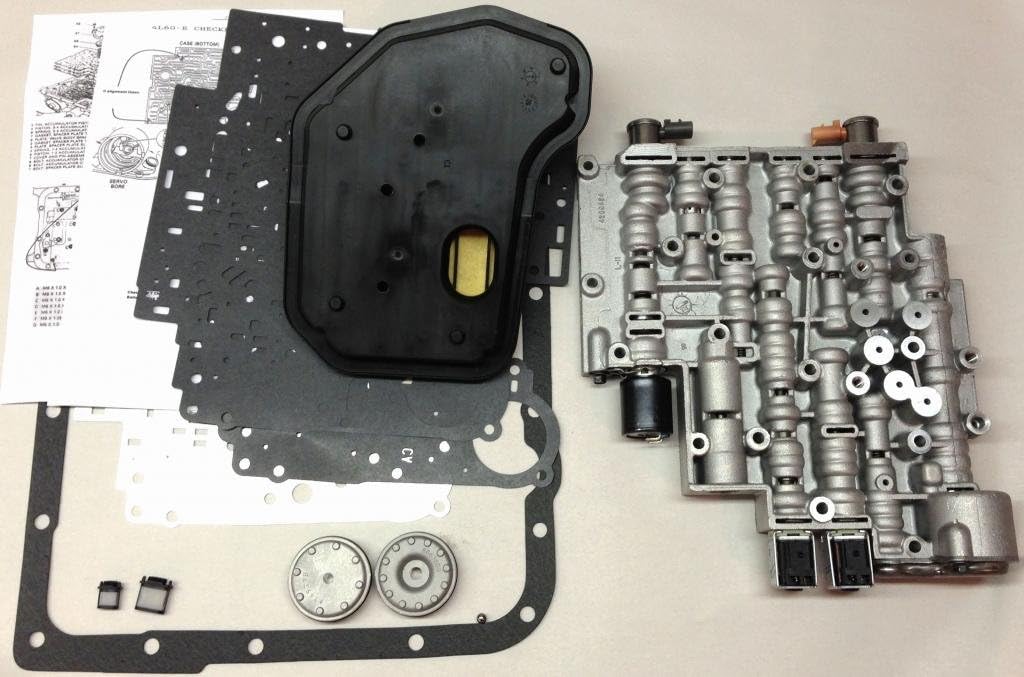
The repair is a bore repair, not a parts swap. Ream the bore and install the Sonnax TCC regulator and isolator valve kit 77754-04K, which puts a hardcoat-anodized aluminum regulator valve in a wear-resistant sleeve and lengthens the isolator valve to run in unworn casting. Sonnax's 2025 follow-up on this repair is the part builders miss: on high-mileage units the isolator end of the bore is often worn too, and 77754-04K alone will not restore it. Vacuum test that section separately. If it leaks, oversize it with reamer 77754-RM5 (or tool kit F-77754-TL4) and install isolator sleeve kit 77754-ISO so the new isolator valve also runs in a sleeve.
Vacuum test before you decide. Casting wear is not visible, and the valve will feel fine in your fingers.
Cause 3: The Modification That Destroys Converters
If you are diagnosing a shudder on a unit somebody else built, check for this before condemning the converter. Builders learned they could make the slip codes disappear by blocking the TCC regulator valve — commonly with an inner pump slide spring out of a 700-R4 — which reverts the circuit to on/off and dumps full line pressure into the apply circuit. It hides the bore wear. It does not repair it.
The numbers are ugly. OE apply pressures on these units run roughly 60 to 80 psi. Blocked, the circuit sees full line, up to 140 psi under load, and higher still if line pressure has also been raised. Sonnax attributes cracked and deformed TCC pistons, broken damper rivets, torsional driveline disturbance, damaged crankshaft bearings, harsh apply, friction lining delaminating off the piston, and outright converter failure to exactly this modification. Bob Warnke of Sonnax, writing in Transmission Digest, describes the same chain: the converter will not release properly so up- and downshifts go harsh, the lining flakes under stress, damper springs break, the piston deforms, and the lining ends up in the cooler.
If you want more clamping than stock without that damage, the Sonnax TCC pressure limiter converts the regulator into a pressure limit valve and caps apply at about 100 psi (roughly 110 psi paired with the increased-apply-rate 77754-03K kit). It is a performance part, not a repair — it does nothing for a worn bore and is designed to work in a circuit that already seals. For scale, Warnke notes most converter clutch circuits are designed to cap apply pressure at the piston around 130 psi, and a modified circuit with raised line pressure can put 150 to 200-plus psi across that area.
Cause 4: Flow, Not Pressure
A shudder can also come from the cooler side. Restriction inside the converter or the cooler circuit affects valve action: a cooler partially plugged from a previous failure, a lining changed to a non-grooved type, or changed turbine washers all slow TCC apply and show up as shudder or slip. The field test is simple, bypass the radiator cooler and re-drive, or put a flow meter in the circuit and compare against a known-good unit.
Same category: a plugged case vent, a restrictive filter, or a warped pump surface lets the pump pull air instead of fluid. The resulting cavitation gives poor converter charge, which means reduced torque capacity and lube starvation long before it looks like a clutch problem.
The Imposter: It May Not Be the Transmission
Before you pull anything, rule out mounts. Wayne Colonna of ATSG, writing in Transmission Digest, points out that malfunctioning mounts are notorious for producing what gets called converter clutch vibration, judder or shudder, worst of all on vehicles running cylinder deactivation. The liquid-filled, electrically or vacuum controlled mounts on those applications exist to damp the pulses of an engine running on half its cylinders. When one collapses it transmits deactivation straight through the chassis, at nearly the same load point where the converter clutch applies.
The tell is timing. If the shudder starts and stops with cylinder deactivation rather than with TCC apply, look at the mounts.
Working Order of Operations
- Road test logging TCC slip speed, TCC PWM duty cycle and fluid temperature. Confirm the shudder tracks slip oscillation and TCC apply, not cylinder deactivation.
- Read duty cycle, not just codes. Normal slip bought with 75–90 percent duty is a leaking apply circuit even on a clean scan.
- Service the fluid correctly. DEXRON-VI, 5.0 qt on a pan drop, level set at 180–200°F using GM's range-cycle procedure. Re-drive.
- If duty cycle is still high, pull the valve body and vacuum test the TCC regulator and the isolator sections of that bore separately.
- Repair the bore with 77754-04K, adding 77754-ISO if the isolator section leaks. Do not block the valve.
- Inspect the cooler circuit and converter. Lining debris in the cooler means the converter is scrap and the cooler needs flow-verified cleaning or replacement.
Building or repairing a 4L70E this week?
Torque converters, valve body components, TCC and shift solenoids, filters and fluid, plus the hard parts to finish the job — shipped fast from the USA.
Shop 4L70E parts →For the same failure pattern on the six- and eight-speeds, see our torque converter clutch shudder diagnosis guide, and for the fluid side of this unit, 4L70E fluid type, capacity and service interval.
Sources
- Sonnax — "20 Years Later: What's New with 4L60-E PWM Modifications," February 8, 2018. Backs the PWM second solenoid controlling the regulated apply valve and the 0 to 90 percent linear duty cycle ramp; the EC3 target of 20–40 RPM of controlled slip; the apply sequence stepping duty cycle to about 50 percent and to 98 percent under high torque or freeway load; the friction lining progression from paper to high-carbon to high thermal slipping material; the 79 percent average duty cycle on a low-mileage unit as evidence of regulator bore wear; regulator valve oscillation causing bore wear that sets P1870 and/or P0894; OE apply pressure of about 60–80 psi versus up to 140 psi with the regulator valve blocked by a 700-R4 inner pump slide spring; the damage list from that modification; and the Sonnax pressure limiter capping apply at 100 psi, about 110 psi with 77754-03K. sonnax.com
- Sonnax — "Understanding 4L60-E Series Isolator Bore Wear & How to Address It," Tory Royce, Sonnax technical support engineer and TASC Force member, January 27, 2025. Backs EC3 arriving on '98-later units and 20–40 RPM of slip being normal operation; constant oscillation of the TCC regulator and isolator valves causing aluminum casting wear that exhausts apply pressure; the 77754-04K TCC regulator and isolator valve kit and its cure list (code 894 and 1870, overheated converter, low TCC apply pressure, burned 3-4 clutch, harsh 1-2, low line pressure); the warning that 77754-04K does not restore the isolator section of a high-mileage bore; and the 77754-ISO sleeve kit with reamer 77754-RM5 or tool kit F-77754-TL4 as the fix for that section. Listed for 4L60-E, 4L65-E and 4L70-E. sonnax.com
- General Motors Service Information — 2009 OBD Group 7 Transmission Diagnostics certification document. Backs the published monitor criteria quoted above: P0894 "TCC or Overdrive unit has excessive slip" at slip speed of 100 RPM or more and 1500 RPM or less, fail timer of 10 seconds, 3 fail counts, two trips, with enable conditions of transmission fluid temperature 20–130°C, engine torque of 108 N·m or more and vehicle speed of 48 km/h or more; P0741 TCC System Stuck Off at 5 seconds and 4 counts with TCC capacity commanded at 65 percent for 3 seconds; P0742 TCC System Stuck On at slip of 15 RPM or less and 4 counts; and P2763/P2764 TCC PWM solenoid circuit high and low voltage at 44 fail counts out of 50 samples on the 100-millisecond loop. gsitlc.ext.gm.com
- General Motors — 2008 Chevrolet TrailBlazer Owner Manual. Backs DEXRON-VI as the specified automatic transmission fluid in Recommended Fluids and Lubricants; the 5.0 qt (4.7 L) Transmission (Drain and Refill) capacity; the 180°F to 200°F (82°C to 93°C) normal operating temperature for the level check; the 30-minute cool-down precondition after hot-weather, high-speed, heavy-traffic or trailering operation; the 15-mile (24 km) warm-up and the THIRD-gear alternative below 50°F; the three-second pause in each range followed by three or more minutes of idle; and reading the lower level on the dipstick. experience.gm.com
- Bob Warnke, Sonnax vice president of technical development and TASC Force member, in Transmission Digest — "Converter Clutch Control Part 2," June 1, 2019. Backs slip speed being the difference between engine RPM and turbine RPM; the regulator valve moving continuously with slip control and that activity equating to bore wear; the failure chain from blocking the apply valve into high apply pressure (harsh up- and downshifts, lining flaking, broken damper springs, deformed piston, lining in the cooler); most valves limiting apply pressure at the piston to around 130 psi with modified circuits reaching 150 to 200-plus psi under raised line pressure; restriction in the converter or radiator slowing TC apply and producing shudder or slip, with the bypass-and-re-drive or flow-meter test; low solenoid regulator pressure causing TCC shudder and slip; and the pump inlet, case vent and cavitation conditions behind poor converter charge. transmissiondigest.com
- Wayne Colonna, ATSG, in Transmission Digest — "TCC Vibration, Judder or Shudder Misdiagnosed," June 1, 2017. Backs malfunctioning mounts producing what is commonly diagnosed as converter clutch vibration, judder or shudder, particularly on vehicles performing cylinder deactivation; the electrically and vacuum controlled liquid-filled mounts used to damp deactivation; collapsed or fluid-depleted mounts transmitting deactivation through the vehicle; the timing correlation with deactivation as the diagnostic tell; and the guidance to start simple before investing time chasing the wrong cause. transmissiondigest.com