Set an E4OD and a 4R100 side by side on the bench and most people cannot tell them apart. Same case shape, same bellhousing, same four speeds, same ratios. That surface similarity is exactly why these two units generate so many comebacks. Ford changed the pump, the coast clutch drum, the converter clutch control and the case between them, and several of those parts will physically install in the wrong unit and then fail. Transmission Digest put the warning right in its headline back in 2014: with the E4OD and 4R100, mix and match is not an option.
This is the builder's version: what actually changed, what genuinely interchanges, which one is stronger and why, and the identification checks that keep you from assembling a hybrid that eats itself.
The Short Version
The E4OD arrived in 1989 as Ford's electronically controlled heavy-duty four-speed, essentially a computerized C6 with an overdrive section grafted on the front. It ran behind big-block gas engines and the 7.3L diesel through 1997. For 1998 Ford replaced it with the 4R100: same basic architecture, plus a stack of durability and control revisions. The name follows Ford's convention — four speeds, rear-wheel drive, roughly a 1,000 lb-ft torque class.
Gearing did not change. Per the ATRA/Gears Magazine gear ratio reference chart, the 4R100 runs 2.71 first, 1.54 second, 1.00 third, 0.71 overdrive and 2.18 reverse, and the E4OD carries the same gearset. Everything that separates them is durability, hydraulic control and electronics.
The Pump: The Single Biggest Difference
If you only learn one thing about these units, learn the pump. It changed twice, and the 1998 change is what makes a 4R100 a 4R100.
Early E4OD pump castings were designated E9 or F1 and carried 11 lobes on the outer gear. Sonnax is blunt about them: those castings suffered from low pump output. Ford superseded them in 1995 with the F5 casting and again in 1998 with F8, both using a 10-lobe outer gear. Sonnax's guidance is to replace an E9 or F1 casting outright with an F5 or F8; their pump gear set 36438A-03 fits F5 and F8 castings only. Rebuild a pre-1995 E4OD on its original pump and you are rebuilding the weakest pump Ford shipped in this family.
The 1998 change was a standardization move. Per Transmission Digest, Ford went to a common pump body and cover casting marked F81P covering three assembly types: E4OD, 4R100 with on-off lockup, and 4R100 with PWM lockup. The new E4OD pump assembly (OE part number F81Z-7A103BA) retrofits back to 1989 — a genuinely useful upgrade path for an early unit.
How to tell an E4OD pump from a 4R100 pump
Because the castings are shared, the casting number will not tell you which unit a pump belongs to. Compare the stator supports instead. On the E4OD support, the coast-clutch-drum sealing rings sit toward the pump cover, putting the drum bushing journal away from the cover. Every 4R100 is the opposite: journal forward, because the PTO gear hanging on the coast clutch drum adds load that has to be supported. That orientation check is your fastest positive ID.
How to tell PWM from non-PWM
Look into the TCC valve bore and check end-plug depth. On an E4OD and a non-PWM 4R100 the plug sits more than an inch down from the pump cover outside diameter. On a PWM unit it is recessed only about 1/4 inch, because the PWM plug is not a flat plug at all — it is a long sleeve with a valve inside it. Get this wrong and the solenoid block will not match the pump. All diesel and some gas applications ran PWM lockup; only a few gas models used the on-off style.
Part number housekeeping matters here too. The PWM pump was originally F81Z-7A103CA, later changed to 8C3Z-7A103C. The on-off pump, XC3Z-7A103EA, has been discontinued by Ford because of limited usage — and the field fix is to use an E4OD pump and change the stator support.
4R100 PWM vs non-PWM solenoid packs
This is the mix-and-match mistake that puts units back on the bench. The solenoid block has to match the pump's TCC valve design, not the year on the tag. CoreTransmissionParts stocks both, so you can order the one your pump actually takes instead of guessing: the PWM pack for 1998-up diesel and PWM gas units, and the non-PWM pack for 1995-up on-off applications.
4R100 PWM Solenoid Pack 1998-Up →Non-PWM (on-off) solenoid pack, 1995-up · all 4R100 / E4OD parts
The Coast Clutch Drum and the PTO
The other component that changed alongside the pump is the coast clutch drum, and this is where the 4R100's PTO option drives everything.
The E4OD drum never changed: cast iron, support bushing toward the back of the bore, non-selective thrust washer between drum and pump.
For 1998 Ford released two 4R100 drums, both stamped steel rather than cast iron, with wider teeth on the coast clutch steels to suit:
- Non-PTO drum, YC3Z-7G387AA. Bushing supported like the E4OD, but the bushing sits toward the front. Two friction plates. Uses the thrust washer between drum and pump.
- PTO drum, YC3Z-7G387BA. Same basic drum with a large gear mounted to it. Holds three frictions instead of two, and rides on a ball bearing rather than a bushing. No thrust washer between pump and drum, because the bearing inner race extends outward to contact the stator support.
Then Ford revised both. The non-PTO drum was upgraded from bushing to bearing to increase capacity, becoming 1C3Z-7G387AA — still two frictions, and now with no thrust washer. The PTO drum was revised to 1C3Z-7G387BA with a narrower bearing inner race for better lubrication, sitting flush with the outer race, plus an oil dam washer with a slight undercut to control flow.
Read that last one carefully, because it is a real trap: the oil dam must be used with the 1C3Z-7G387BA drum and must not be used with the earlier PTO drums, or the stack-up is wrong — and a wrong endplay stack puts you back inside the case. The 1C3Z-7G387BA assembly does retrofit back to 1998.
On the case side, identification is easy: a 4R100 case has a PTO port. An E4OD case does not.
Which One Is Stronger?
The 4R100, and it is not close — but the reason is more interesting than a spec sheet.
The 4R100 got the better pump casting from the factory, the stamped-steel coast drum with wider clutch teeth, later a bearing-supported drum instead of a bushing, and a PWM converter clutch that can be modulated rather than slammed on and off. Behind a 7.3L Power Stroke that last one matters, because converter clutch control drives how much heat the fluid ever sees.
Here is the part that surprises people: the same defect is a minor annoyance in an E4OD and a catastrophe in a 4R100. Sonnax lists the overdrive piston retaining ring popout with two different outcomes — "OD loss (E4OD)" and "Catastrophic failure (4R100)". The cause is identical in both: first and second design open-end retaining rings have no locking mechanism and get pulled out of the groove by piston spring forces. The E4OD just loses fourth. The 4R100, carrying more torque, tears itself up.
So the 4R100 is the stronger unit with the narrower margin at the top. It handles more, and when the overdrive section lets go it takes more with it.
Sonnax Sure Lock spiral snap ring 36744-01
This is the one part I put in every E4OD and 4R100 that comes across the bench, regardless of the complaint that brought it in. The OE open-end ring can walk out of its groove; the Sure Lock mechanically locks its tabs into place and cannot come out. Cheap insurance against a full teardown on a 4R100.
Sonnax 36744-01 Sure Lock ring →Valve Body: Three Eras, Not Two
People assume the valve body split is E4OD versus 4R100. It is not. Per Sonnax's E4OD/4R100 vacuum test guide, the real breakpoint is 1996:
- 1989-1995 E4OD: worm tracks and vacuum test locations are different from everything later.
- 1996-1998 E4OD: worm tracks and test locations are the same as the non-PTO 4R100.
- PTO 4R100: worm tracks are slightly different, but the test locations are the same.
So a 1996 or 1997 E4OD valve body and a non-PTO 4R100 valve body test identically, while a 1991 E4OD does not. Test off the wrong layout and you will chase bores that are not there.
Vacuum testing the bores that matter
Pull the valve body, test each valve in its rest position, and read the gauge. A low reading means the bore is worn past the valve. The high-value locations and what the wear causes:
- Line pressure modulator valve — intermittent harsh shifts, soft 1-2 and 2-3, low line rise, low EPC pressure.
- Low/reverse modulator valve plunger and sleeve — no engine braking, burnt low/reverse clutch, low pressure at the low/reverse clutch. Check the inside diameter of the sleeve, not just the valve.
- TCC control plunger valve — lockup shudder, TCC cycling, overheated converter.
- Engagement control valve — delayed forward and reverse engagement, burnt forward clutch.
- 1-2 manual transition valve — burnt direct clutch.
- 3-4 shift valve and 4-3-2 timing valve — 3-4 shift concerns, burnt direct clutch.
Sonnax ties pressure-loss failures on both units to codes 62, 628 and 1744. If you have one of those stored alongside a converter that keeps coming back, the pump gears and the pressure circuits are where to look before you condemn another converter.
Shift Firmness: Pick the Right Modulator Ratio
Swapping in a bigger line pressure modulator plunger is the most common change made to these units, and the most commonly overdone. Sonnax warns that the accumulator control body is very sensitive, and a .500" kit very often shifts far harder than the customer wanted. Their application chart:
- .331" (36948-03K) — 6-cylinder and small V8
- .372" (36948-05K) — large V8
- .427" (96948-01K) — heavy duty / high performance
- .500" (96948-05K) — extreme heavy duty / high performance
For a modestly modified street truck, Sonnax recommends the .372" modulator with the performance-rated accumulator spring kit 36948-18K and a line pressure booster kit 4R100-LB1 in the pump — a progressive increase in firmness without the harshness a large-ratio modulator brings. On any heavy-duty build, add the line-to-lube pressure regulator valve 36424-04K so converter and cooler flow are maintained regardless of where the pressure regulator valve sits. On a truck that tows, cooler flow is not optional.
Interchange Rules
The two share the case family and bellhousing pattern, so a swap is mechanically plausible. The parts-level rules are where the discipline is needed:
- Never mix a pump and a stator support across units without checking journal orientation. The E4OD support puts the bushing journal away from the cover; the 4R100 puts it forward. Wrong support means the coast drum is not properly supported, and it will not last.
- Match the solenoid block to the pump's TCC design, not to the year on the tag. Verify end-plug depth first.
- Do not put an E4OD cast-iron coast drum behind a 4R100 stator support, or a bushing-style stamped drum where a bearing-design drum's stack-up is expected.
- Check the thrust washer and oil dam rule for the specific drum part number. Bearing-design drums delete the thrust washer. Only the 1C3Z-7G387BA takes the oil dam.
- Upgrade an E9 or F1 E4OD pump rather than rebuilding it. Go to an F5 or F8 casting, or use the F81Z-7A103BA assembly that retrofits to 1989.
- Verify PTO or non-PTO before you order anything. The PTO drum holds three frictions; the non-PTO holds two.
Fluid and Service
Both units call for MERCON V. Ford's original MERCON specification is defunct and MERCON V supersedes it, so do not substitute a DEXRON-type fluid. Total capacity is roughly 17 quarts including the torque converter, and dropping the pan gets only about half of that out, so plan on a repeat drain-and-fill or a proper exchange if you want a real fluid change. Common filter callouts are Ford YC3Z-7A098-BA / Motorcraft FT114, and pan bolts go back at 10 to 12 ft-lb in a criss-cross pattern.
Two habits pay for themselves here. Verify cooler flow after every rebuild — low cooler flow is on the failure list for both units and it is the fastest way to cook a fresh converter. And if you are already in the pan for a filter, vacuum test the valve body while it is off. The bores wear on every high-mileage unit, and finding it now is free.
Need parts for this job?
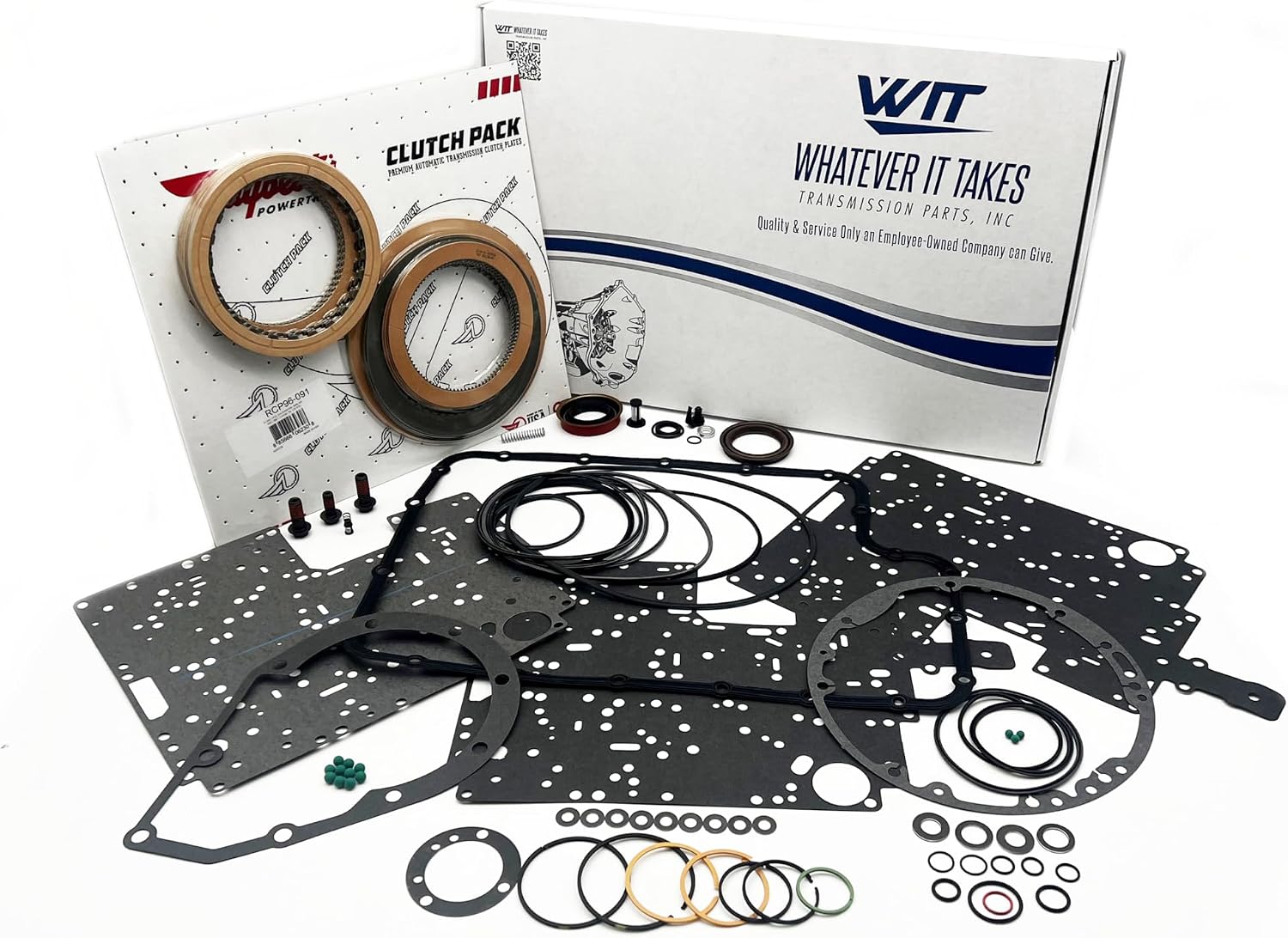
Pumps, coast clutch drums, solenoid packs, Sonnax valve body kits, filters and full rebuild kits for the E4OD and 4R100 — matched to the right pump casting and PWM or non-PWM setup.
Shop 4R100 / E4OD parts →Shop 4R100 / E4OD parts →
FAQ
Will a 4R100 bolt in place of an E4OD?
The two share the case family and bellhousing pattern, so the swap is mechanically workable in most Ford truck applications. The complications are electronic and hydraulic rather than dimensional. A 4R100 may use a PWM converter clutch that an older controller cannot modulate, and the solenoid block, pump and stator support all have to be a matched set. Confirm the pump type by TCC valve end-plug depth, and confirm your controller can drive PWM lockup, before you commit to the swap.
What is the actual difference between an E4OD and a 4R100?
Same gearset and same ratios: 2.71, 1.54, 1.00, 0.71 with 2.18 reverse. The 4R100 replaced the E4OD for 1998 with a revised pump using the shared F81P casting, a stamped-steel coast clutch drum with wider clutch teeth (later bearing-supported instead of bushing-supported), an available PTO port and PTO drum that holds three frictions, and PWM torque converter clutch control on diesel and many gas applications. The E4OD case has no PTO port; the 4R100 case does.
Which is stronger, the E4OD or the 4R100?
The 4R100. It got the better pump casting, a stronger coast clutch drum, and modulated converter clutch control that reduces heat. One caution: because it carries more torque, the same overdrive piston retaining ring popout that usually just costs an E4OD its fourth gear can cause catastrophic failure in a 4R100. Fitting a mechanically locking Sonnax Sure Lock ring 36744-01 on any build of either unit is cheap protection.
Can I use E4OD parts in a 4R100?
Some parts cross over and some will install and then fail, which is the dangerous part. The pump assembly is the clearest example: an E4OD pump can substitute for the discontinued on-off 4R100 pump, but only by changing the stator support, because the E4OD support puts the coast clutch drum bushing journal away from the cover while every 4R100 needs it forward to carry PTO load. Always check journal orientation, TCC end-plug depth, and the thrust-washer or oil-dam rule for the specific coast drum part number.
What fluid does a 4R100 take, and how much?
MERCON V, which superseded the now-defunct original MERCON specification. Total capacity including the torque converter is roughly 17 quarts, but a pan drop only releases about half of that, so a single drain and fill leaves a lot of old fluid in the converter and cooler. Torque the pan bolts to 10 to 12 ft-lb in a criss-cross pattern.
Sources
- Transmission Digest — Mike Riley, "E4OD/4R100 Component Upgrade: Mix and Match Is Not an Option" (September 1, 2014). Backs the 1998 shared F81P pump body and cover casting covering E4OD / 4R100 on-off / 4R100 PWM, pump part numbers F81Z-7A103BA, F81Z-7A103CA, 8C3Z-7A103C and the discontinued XC3Z-7A103EA, the stator support journal orientation test, the TCC end-plug depth test (over 1 inch versus about 1/4 inch for PWM), the PTO port on the 4R100 case, and every coast clutch drum detail and part number (YC3Z-7G387AA, YC3Z-7G387BA, 1C3Z-7G387AA, 1C3Z-7G387BA, the oil dam rule and the thrust washer deletion). transmissiondigest.com
- Sonnax — Pump Gear Set 36438A-03 (E4OD, 4R100). Backs the pump casting history: pre-1995 E9 and F1 castings with 11 lobes on the outer gear suffering low output, superseded by F5 in 1995 and F8 in 1998 with 10-lobe outer gears, the recommendation to replace E9/F1 with F5 or F8, and the pressure-loss symptom set including codes 62, 628 and 1744, low line pressure, pump noise and repeat converter failure. sonnax.com
- Sonnax — Sure Lock Spiral Snap Ring 36744-01 (E4OD, 4R100). Backs the differing severity of the overdrive piston retaining ring popout between the two units — listed symptoms "OD loss (E4OD)" and "Catastrophic failure (4R100)" — the cause (first and second design open-end rings have no locking mechanism and are pulled from the groove by piston spring forces), and the mechanically locking correction. sonnax.com
- Sonnax — Ford E4OD, 4R100 Vacuum Test Guide (September 28, 2017). Backs the three valve body eras (1989-1995 E4OD worm tracks and test locations differ; 1996-1998 E4OD matches the non-PTO 4R100; PTO 4R100 worm tracks differ slightly but test locations are the same) and the per-valve wear symptoms listed for the line pressure modulator, low/reverse modulator plunger and sleeve, engagement control, 1-2 manual transition, and 3-4 shift / 4-3-2 timing valves. sonnax.com
- Sonnax — "How to Choose the Right E4OD/4R100 Line Pressure Modulator Plunger Valve Kit" (December 29, 2022). Backs the modulator ratio application chart (.331" 36948-03K, .372" 36948-05K, .427" 96948-01K, .500" 96948-05K), the warning that the accumulator control body is very sensitive and .500" kits often shift harder than expected, and the recommended street combination of the .372" ratio with accumulator spring kit 36948-18K, line pressure booster 4R100-LB1 and line-to-lube pressure regulator valve 36424-04K. sonnax.com
- Gears Magazine (ATRA) — Gear Ratios reference chart, January/February 2006, page 58. Backs the 4R100 gear ratios used throughout: 2.71 first, 1.54 second, 1.00 third, 0.71 overdrive, 2.18 reverse. atracom.blob.core.windows.net
- Sonnax — Zip Kit E4OD-4R100-ZIP. Backs the shared pressure-loss failure profile of both units (codes 62, 628, 1744; burnt low/reverse clutch; delayed engagement; lockup shudder; TCC cycling; overdrive planetary failure; overheated converter) and the circuits involved — main line, accumulator control, line pressure modulator and lockup control. sonnax.com
- DieselHub — Ford 4R100 Automatic Transmission Service Guide. Service figures only: MERCON V as the specified fluid superseding the defunct original MERCON spec, roughly 17 quarts total capacity with only about half draining on a pan drop, filter callouts Ford YC3Z-7A098-BA / Motorcraft FT114, and the 10 to 12 ft-lb criss-cross pan bolt torque. dieselhub.com
Free transmission fluid spec chart
One page, every common unit: the exact ATF specification, capacity and service notes. Printable for the toolbox, so you stop guessing between MERCON, MERCON V and DEXRON.
Get the fluid spec chart →