The E4OD is a C6 that went to computer school. Ford bolted an overdrive section and an electronic control package onto a case design that had been hauling weight since the sixties, ran it behind everything from a 300 six to a 7.3 Power Stroke from 1989 through 1998, then turned it into the 4R100. That heritage is why the hard parts hold up, and it is also why the failures cluster so tightly. It is almost always lube, almost always a snap ring, or almost always a bore that quietly stopped sealing three owners ago.
The short version: a burnt overdrive section on an E4OD is usually a lube problem, not a clutch problem — Sonnax attributes overdrive planetary failure to a melted front lube/drainback valve restricting the lube feed circuit in the stator. The second big one is the open-end retaining ring behind the OD piston return spring walking out of its groove. Everything after that is bore wear: boost sleeve, manual valve, accumulator control valves. Soft parts and steels will not fix any of those, which is why a unit that got a clutch-and-seal overhaul comes back angry.
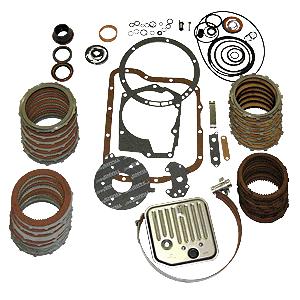

Identify the Unit Before You Order a Single Part
The E4OD had a real mid-life split, and the parts do not cross. Get this wrong and you will be waiting on a second shipment with the case already stripped.
| Component | Early units | Late units |
|---|---|---|
| Solenoid block | '89–'94 (Sonnax reman 36424A-RRP) | '95–'98 (36424B-RRP) |
| Rear case bushing | '89–'94, three grooves front, none to the back (36008B), 1.593" housing bore | '95-later, three grooves front and one to the back (36008D), 1.624" housing bore |
| Pump gear set | Pre-'95 pumps use their own set | '95-later F5 and F8 pumps share the 4R100 set (36438A-03) |
| Rear sun gear bearing | '89–'96 bearing kit SBK-F5 | '95-later ball bearing 96423-01, 0.352" thick, 1.180" ID, 1.850" OD |
| Main valve body casting | E9 ('89), F0 or F1 ('90–'95) | F6 ('96–'98) |
That last row matters more than it looks. Sonnax's vacuum test guide notes that the worm tracks and test locations on a '96–'98 E4OD match the 4R100, while '89–'95 E4OD castings are laid out differently. If you are working off a printed test map, make sure it is the right one for the casting in your hand or you will be testing dead ports and calling good valves bad.
Wear Point 1: The Front Lube Valve That Melts and Takes the OD Planet With It
This is the one that costs people a second rebuild. The complaint that walks in is a burnt overdrive section — blued OD planet pinions, cooked thrust washers, sometimes a planet that has come apart entirely. The natural read is heat and towing, so the builder puts in a good planet, better clutches, maybe an auxiliary cooler, and sends it.
The actual mechanism is upstream. Sonnax lists a single cause against OD planetary failure on this unit: a melted front lube/drainback valve restricting the lube oil feed circuit in the stator. The OE valve does not survive the temperatures this unit sees in service, and once it distorts it chokes the lube feed. The planet then runs on whatever oil gets past it, which is not enough, and it cooks. Put a new OE-style valve back in and the clock starts over. The fix is the aluminum front lube/drainback valve kit, Sonnax 36425-01K, specified as melt-proof. It is a small part in a pump that is already apart, and there is no reason to skip it on a unit that came in with overdrive damage or on a truck that tows.
Wear Point 2: The OD Piston Retaining Ring Walks Out
First- and second-design E4OD and 4R100 retaining rings behind the overdrive piston return spring are open-end style. There is no locking mechanism on them, and spring force works on the ring every time the piston strokes. Sonnax's description is blunt: they are susceptible to being pulled out of the groove by piston spring forces. On an E4OD the result is loss of overdrive. On a 4R100 it is listed as catastrophic failure.
Transmission Digest documented exactly this on a 4R100 that came in with no fourth gear, burnt fluid and clutch material in the pan: on teardown, "the snap ring that holds the overdrive-clutch-piston return spring had come out of the groove and the overdrive clutches were destroyed." The replacement is the Sure Lock spiral snap ring 36744-01, which mechanically locks its tabs into place so it cannot be worked back out. It is a twenty-dollar-class part standing between you and a comeback.
Wear Point 3: The Center Support Leaks and Chews Its Lugs
The center support is a three-part problem and each part has its own cure.
- Leakage between the support and the hub shows up as forward clutch failure and low lube oil flow. The repair is the printed-silicone-bead gasket, 36743G. Its instruction sheet is specific about assembly: deburr and stone the mating surfaces, clean both parts including the tapped holes with solvent, coat the gasket lightly with assembly gel, use Loctite 242 on the three screws, then torque progressively to 75–85 in-lb first and finish at 100–120 in-lb. That is inch-pounds. A quarter-inch drive click wrench, not a three-eighths ratchet and a guess.
- Cross leaks and second clutch feed passage leaks at the case-to-support joint get the aluminum shim 36743-01 — 0.204" thick, 0.480" ID, 0.750" OD.
- Lug wear, where the center support has hammered notches into the case lugs and the input drum has worn into the support, gets center support ring 36743-02. This one is machine work, not a drop-in: the support has to be cut to 1.010" +/-.002" measured through the support land, and the support plus ring stacked together must measure 1.060" +/-.002".
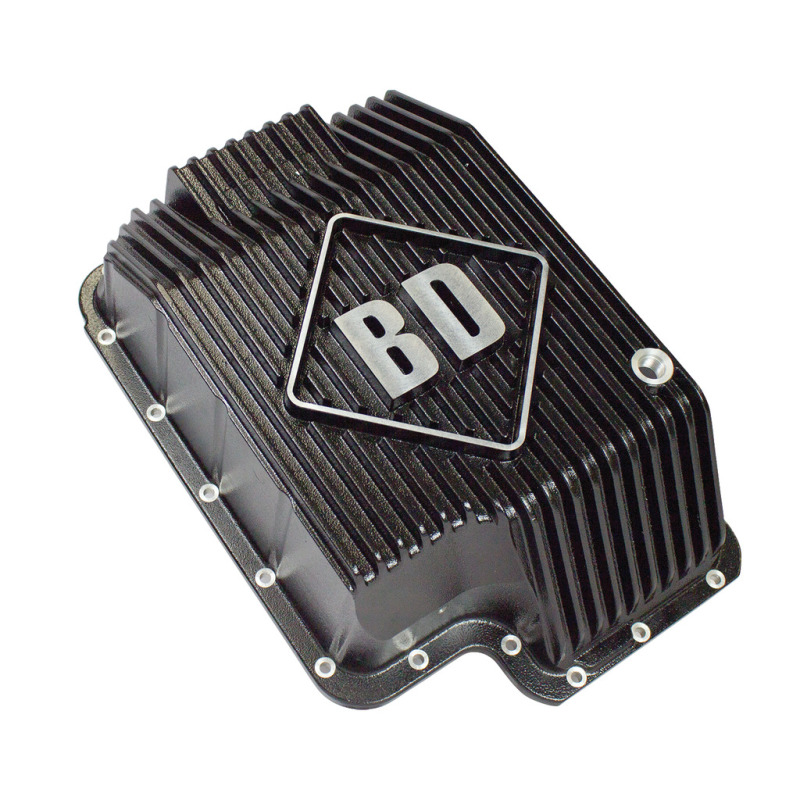
E4OD/4R100 deep pan filter and gasket kit
Deep sump filter and pan gasket for the E4OD and 4R100, Ford part reference F6TZ-7A098-BB. If the unit is coming apart anyway, the filter is not optional and a reused pan gasket is a slow leak you get to chase later.
View the E4OD filter kit →Wear Point 4: Pump and Boost Sleeve
Soft shifts and poor line rise on an E4OD are a pump complaint far more often than a solenoid complaint. The pressure regulator boost sleeve wears from continuous valve oscillation, and the wear lets EPC and Reverse boost oil leak past. You lose line rise exactly when the unit needs it, the clutches slip during the shift instead of grabbing, and the burnt material that comes off them plugs the filter and completes the circle.
Check it with a vacuum stand, not with your eyes. The instruction sheet for the O-ringed boost valve kit 36424-01K puts the pass mark plainly: the port should hold a recommended minimum of 18 in-Hg. Below that, the bore is leaking. While you are in the pump, the line-to-lube pressure regulator valve on F1, F5, F8 and E9 castings is worth a look too — when it is worn, Sonnax ties it to codes 62, 628 and 1744, high line pressure, engine stall or stumble on engagement in Reverse, and an overheated converter.
Wear Point 5: Valve Body Bores That Outlive Your Soft Parts
The E4OD valve body wears in predictable spots, and each one has a signature complaint:
- Manual valve bore. Delayed Reverse, Reverse slip, low line pressure in Reverse and manual low, low/reverse clutch failure. The valve is steel and the bore is aluminum, so the bore loses and the valve looks perfect.
- 1-2 and 2-3 accumulator control valves. Soft shifts, no second, no third, premature clutch failure. Repaired with 36948-13K, which fits either of the two locations.
- 3-4 accumulator control valve. No fourth, soft shifts, premature clutch failure. That is 36948-09K.
- Low/reverse modulator plunger and sleeve. No engine braking in D1, burnt low/reverse clutch, low/reverse clutch distress on '96-later units.
- Solenoid regulator valve on '96-later two-spool units. Second- or third-gear starts, TCC cycling, TCC slip, and reduced lube oil out of the center support — a lube complaint hiding in the valve body.
Two notes on the vacuum test itself, because this is where most people get a false result: OE valves are tested in the rest position unless the instructions say otherwise, and on some ports you have to flip the casting and seal the opposite side with a foam mat before the reading means anything. Sonnax also deliberately does not publish one universal pass number for a whole valve body — record your readings, average them per bore, and set a minimum that matches your own warranty exposure. The 18 in-Hg on individual kit sheets is the practical floor most shops land on.
The Assembled Air Test That Catches What Vacuum Testing Misses
Vacuum testing checks a valve in a bore. It does not check the whole circuit. There is a case in Transmission Digest every E4OD and 4R100 builder should know: a unit came back with no fourth gear and a P0734 gear ratio error after a full soft-parts overhaul, new steels, a rebuilt converter and a new solenoid block, and the valve body was torn down twice with no sticking valves found.
What found it was an air test on the assembled unit. The method: assemble everything except pan and filter, put the manual lever in Drive or Reverse depending on the circuit, block the filter inlet, feed air into the line pressure port, and listen. Every clutch applied except overdrive, and a lot of air was escaping around the manual valve. The manual valve bore was worn. Because the E4OD family is fully non-synchronous — once a clutch applies on an upshift it stays applied — the leak only got big enough to matter by the time all the piston areas were charged, so it looked like an overdrive-only fault. One caution from the same article: if air escapes from the converter charge circuit in the pump area, install the converter and bolt a box wrench across the bellhousing so it cannot push out.
Do Not Ignore the Cooler Circuit
The cooler bypass on '97-later units is a checkball, seat and spring assembly, and all three age badly. Sticking components, a relaxed spring or a poor ball seat let the bypass open at a lower cracking pressure than it should, which drops TCC apply pressure, cuts cooler flow to the overdrive section and reduces radiator flow. The symptoms read as TCC slip, soft TCC apply, overheating and codes 1741, 1744 and 1783. A correct rebuild of that assembly maintains cracking pressure at 70–75 psi.
That circuit is also why converter and lube flow deserve attention on any E4OD build. Sonnax's Ed Lee, writing in Transmission Digest, traced the E4OD's era-defining TCC clutch-crowding complaint back to it: low pump volume at low speed could not supply enough converter-charge and TCC-release oil to keep the clutch off the cover, and shops chased it as an engine driveability problem for years.
Fluid and Fill
The E4OD is a MERCON transmission. Ford stopped licensing the original MERCON specification years ago, and MERCON V is what the service world runs in these units — Mobil's Multi-Vehicle ATF application listing, for example, covers both the MERCON position (Ford P/N XT-2-QDX) and the MERCON V position (XT-5-QM or -DM). Do not put a Type F or a DEXRON-only fluid in one; the friction requirement is not the same and the shift feel and TCC behavior will tell on you.
Capacity varies enough between chassis, pan depth and 2WD versus 4WD that the number you want is the one in the manual for that VIN, not a number off a forum. The final level is set hot on the dipstick with the engine running through the gears. On a unit that just ate a converter or an overdrive section, flush or replace the cooler and lines — debris left in the cooler finds its way back to the new bushings.
The Upgrades Worth Buying
Firming up the shifts on an E4OD usually means changing the line pressure modulator ratio, and this is the easiest place on the unit to overdo it. Sonnax's own guidance is that the accumulator control body is very sensitive to this change, and that a.500" plunger frequently produces shifts much firmer than the customer wanted. Size it to the application:
| Application | Modulator ratio | Part No. |
|---|---|---|
| 6-cylinder and small V8 | .331" | 36948-03K |
| Large V8 | .372" | 36948-05K |
| Heavy duty / high performance | .427" | 96948-01K |
| Extreme heavy duty / high performance | .500" | 96948-05K |
For a street truck with modest modifications, the combination Sonnax recommends instead of a big plunger is the.372" ratio plus the performance-rated accumulator spring kit 36948-18K and a line pressure booster kit in the pump — a progressive increase in firmness without the side effects of a large-ratio change. On any heavy-duty build, add the line-to-lube pressure regulator valve so converter and cooler flow are maintained regardless of where the PR valve sits. Beyond the hydraulics, the parts that earn their keep on a towing E4OD are the heavy duty input shaft (36670-HD), oversized pump gears where the casting allows them, the intermediate and direct clutch feed seal kit, and the correct oversized rear case bushing if the case is worn.
TransGo HD2 reprogramming kit for E4OD/4R100
The shop-standard shift correction package for these units when the goal is firmer, better-timed shifts and more clutch holding capacity in a towing truck. Install it with the valve body already inspected and vacuum tested — a kit will not seal a worn bore.
View the TransGo HD2 kit →Putting It Together
A durable E4OD rebuild is not a longer clutch list. It is four decisions: replace the front lube/drainback valve so the overdrive section gets oil, lock the OD piston retaining ring so it cannot walk, seal the center support and torque it correctly, and vacuum test the pump and valve body instead of assuming the bores are fine because the valves look fine. Do those and the soft parts you installed get to do the job you paid for. Skip them and the unit will be back, with the same burnt overdrive section and the same clean-looking valves.
Master rebuild kits, valve bodies, solenoid blocks, pumps, filter and gasket kits, torque converters and shift kits for the Ford E4OD — shipped fast from the USA.
Shop E4OD parts →Related reading: 4R100 problems and service covers the successor unit that inherited most of these circuits, and 4R100 valve body wear goes deeper on the bore repairs above.
Sources
- Sonnax — Ford E4OD transmission parts and symptom index. Backs the early/late split on solenoid blocks (36424A-RRP for '89–'94, 36424B-RRP for '95–'98), rear case bushings (36008B early with a 1.593" housing bore, 36008D late with a 1.624" bore), the '95-later F5/F8 pump gear set, bearing kit SBK-F5 for '89–'96 versus ball bearing 96423-01 for '95-later with its 0.352"/1.180"/1.850" dimensions, the E9, F0/F1 and F6 main valve body castings, the center support shim 36743-01 dimensions, the center support ring and gasket applications, the valve body bore complaints and their repair kits (36947-13K manual valve, 36948-13K, 36948-09K, 36947-06K, 36947-14), the line-to-lube pressure regulator valve symptom list including codes 62, 628 and 1744, and the heavy duty parts referenced (36670-HD, 36424-24K, oversized pump gears). sonnax.com/units/352-e4od
- Sonnax — "Ford E4OD, 4R100 Vacuum Test Guide" (published September 28, 2017). Backs the instruction that OE valves are shown and tested in the rest position unless otherwise indicated, the requirement to flip the casting and seal the opposite side with a foam mat at certain ports, the valve-by-valve complaint map used above, and the critical note that worm tracks and test locations on '96–'98 E4OD castings match the 4R100 while '89–'95 E4OD castings differ. The related Sonnax vacuum testing overview backs the recommendation to record readings, average them per bore and set your own pass/fail standard rather than relying on one universal number. sonnax.com/tech_resources/639-ford-e4od-4r100-vacuum-test-guide
- Sonnax — Front Lube/Drainback Valve Kit 36425-01K product and application page. Backs the stated cause of E4OD/4R100 overdrive planetary failure: a melted front lube/drainback valve restricting the lube oil feed circuit in the stator, and the aluminum melt-proof replacement as the correction. sonnax.com/parts/2067-front-lube-drainback-valve-kit
- Sonnax — Sure Lock Spiral Snap Ring 36744-01 product page. Backs the statement that first- and second-design E4OD and 4R100 open-end retaining rings have no locking mechanism and are susceptible to being pulled out of the groove by piston spring forces, the resulting symptoms of OD loss on the E4OD and catastrophic failure on the 4R100, and the mechanically locked replacement design. sonnax.com/parts/2083-sure-lock-spiral-snap-ring
- Sonnax — Center Support Gasket 36743G product page and installation instructions (document 36743G-IN). Backs the forward clutch failure and low lube oil flow symptoms of center support to hub leakage, and the assembly procedure and torque sequence: deburr and stone the mating surfaces, solvent-clean both parts including the tapped holes, Loctite 242 on the three screws, then torque progressively to 75–85 in-lb and finish at 100–120 in-lb. The companion center support ring page backs the 1.010" +/-.002" machining spec and the 1.060" +/-.002" stacked thickness. The boost valve kit 36424-01K instruction sheet backs the recommended minimum 18 in-Hg vacuum reading. sonnax.com/parts/2081-center-support-gasket
- Sonnax — Cooler Bypass Valve Kit 36605-02K product page. Backs the cause statement that sticking bypass components, spring relaxation or a poor ball seat let the bypass open at lower cracking pressure, the resulting loss of TCC apply pressure, overdrive-section cooler flow and radiator flow, the symptom list including TCC slip, soft TCC apply, overheating and codes 1741, 1744 and 1783, and the 70–75 psi cracking pressure specification. sonnax.com/parts/2078-cooler-bypass-valve-kit
- Transmission Digest — Joe Cangelosi, "The 4R100 with a Mysterious No 3-4 Shift" (published March 1, 2013). Backs the documented case of an overdrive-clutch-piston return spring snap ring coming out of its groove and destroying the overdrive clutches, the repeat no-fourth-gear complaint with code P0734 after a complete overhaul, the assembled air-test procedure (manual lever position, blocking the filter inlet, feeding air into the line pressure port), the discovery of a worn manual valve bore on a steel valve showing no visible wear, the explanation that the unit is completely non-synchronous so the leak surfaced only in fourth, and the caution to retain the converter with a box wrench across the bellhousing during the test. Ed Lee's "4R100 Flow Issues" in the same publication backs the E4OD TCC clutch-crowding history and the finding that insufficient converter-charge/TCC-release oil at low pump volume was the root cause. transmissiondigest.com/the-4r100-with-a-mysterious-no-3-4-shift
- Mobil (ExxonMobil) — Mobil Multi-Vehicle ATF product page, Ford application listing. Backs the MERCON (Ford P/N XT-2-QDX) and MERCON V (XT-5-QM or -DM) service positions referenced for this unit. Always confirm the fluid specification called out for the specific vehicle and model year. mobil.com/en/lubricants/for-personal-vehicles/our-products/products/mobil-multi-vehicle-atf