A 4R100 that bangs into drive or slams every upshift almost always has too much line pressure, and on this unit line pressure belongs to the PCM. The electronic pressure control (EPC) solenoid sets it, and the PCM decides where to set it from a list of inputs: throttle, mass airflow, vehicle speed, range position, fluid temperature and PTO status. That's why a harsh 4R100 is often an electrical or engine-sensor problem, not a transmission problem. It's also why so many trucks get a valve body they didn't need.
This guide covers how the pressure system works, the codes that cause harsh shifts, how to test the EPC circuit and read a pressure gauge, and the hydraulic and hard-part causes left once the electrical side checks out. Specs and code descriptions are from the ATSG 4R100 manual. The valve and field-failure material is from Sonnax and Transmission Digest (full list under Sources).
How the 4R100 sets line pressure
ATSG describes the 4R100 hydraulic system as having five electronically controlled solenoids, one of them dedicated to "shift feel, through line pressure control." That's the EPC solenoid. It is a variable-force solenoid in the solenoid body. The PCM varies the current to it, the solenoid produces EPC oil, and that oil acts on the main regulator boost valve and on the line pressure modulator valve in the accumulator control body. More current means less EPC pressure and lower line pressure. Zero current means maximum EPC and maximum line pressure.
ATSG's component chart marks EPC as "Mod" in every range, meaning the PCM modulates it all the time "based on throttle position, engine load and vehicle speed." So any input that lies about load, speed or throttle changes line pressure. That's the whole story of most harsh-shift 4R100s.
The baseline you're comparing against is ATSG's line pressure chart, taken at the line pressure tap with a 300 psi gauge:
| Range | Idle | Stall |
|---|---|---|
| P, N | 50-65 psi | n/a |
| R | 70-100 psi | 220-240 psi |
| OD, Manual 2 | 50-65 psi | 136-156 psi |
| Manual 1 | 70-115 psi | 175-210 psi |
ATSG's rules for the test: turn the PTO off if equipped, do the line pressure test before the stall test, don't stall-test if idle pressure is low, and never hold wide open throttle more than 5 seconds in any range.
Step 1: Pull codes and read the PIDs before you touch anything
A harsh 4R100 with stored codes is usually telling you exactly what's wrong. Here's what ATSG's trouble chart ties to harsh or firm shifts:
- P1746, EPC solenoid open circuit. ATSG: "Open circuit causes maximum EPC pressure, harsh engagements and shifts. May flash TCIL." This is the classic. A broken wire, a bad pin at the case connector or an open coil puts the unit at full pressure.
- P1747 and P1760, EPC shorted or intermittently shorted. These go the other way. ATSG says a shorted EPC circuit causes minimum EPC pressure, and on P1747 the PCM limits engine torque with partial fuel shutoff to protect the unit. That's a soft or slipping truck, not a harsh one, but an intermittent short can alternate between the two and feel erratic.
- Mass airflow faults. ATSG lists MAF system faults with "High EPC pressure. Firm shifts and engagements. May flash TCIL." When the PCM can't trust its load signal it defaults pressure high.
- Throttle position (gas) or accelerator pedal position (diesel) out of range. ATSG: "Harsh engagements, firm shift feel, abnormal shift schedule, abnormal TCC operation or does not engage." On the 7.3L, ATSG notes the PCM uses the AP sensor for both EPC and shift scheduling.
- P0500, vehicle speed input. ATSG lists harsh engagements, firm shift feel, abnormal shift pattern and unexpected closed-throttle downshifts.
- P0705 and P0708, digital transmission range (DTR) sensor. ATSG: "Harsh engagements, firm shift feel." If the PCM doesn't know what range the lever is in, it can't schedule the right engagement pressure.
- BARO faults. Firm shift feel and late shifts at higher altitudes.
- P1783, fluid temperature over 270°F. The PCM raises EPC slightly to protect the clutches.
Fix engine-side and sensor codes first. Replacing a solenoid pack on a truck with a MAF code won't change anything.
No codes? Watch the data
With a scan tool that reads Ford PCM data, drive the truck warm and watch commanded EPC pressure (or EPC amperage/duty), TP or AP, MAF, TFT, turbine speed (TSS) and output speed (OSS). ATSG says the PCM uses both the OSS and TSS signals to control EPC. Things to look for:
- EPC command pinned at max or not changing with throttle. If the PCM isn't modulating EPC at all, it's in a failsafe strategy. Find out why.
- TP or AP that doesn't read closed at idle. A pedal sensor that reads a few percent open at rest raises engagement pressure on every garage shift.
- TFT that doesn't match the pan. ATSG's TFT chart runs from roughly 37k-16k ohms at 69-104°F down to 2.7k-1.5k ohms at 195-230°F. A sensor stuck cold keeps the PCM on its cold-start strategy.
- Erratic OSS or TSS. A noisy speed signal gives the PCM bad data for shift timing and pressure. ATSG lists the OSS at 781-1979 ohms.
Step 2: Test the EPC circuit
At the transmission case connector, ATSG gives 3.0-5.0 ohms across pins 11 and 12 for the EPC solenoid. If you read open at the case, the fault is inside. Pull the pan and check the internal harness before condemning the solenoid body. If the case connector reads good, back-probe at the PCM end and look for an open or high resistance in the harness. Also check the connector's pins for spread terminals and fluid wicking. A marginal connection can produce the intermittent harsh shift that comes and goes with temperature.
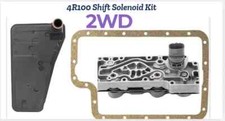
The EPC solenoid is part of the 4R100 solenoid body, so a failed EPC circuit inside the transmission usually means replacing the pack. Match the pack to the truck: 4R100s came with both non-PWM (on/off) and PWM converter clutch control, and the packs aren't interchangeable.
If the ohms are good, check the signal. ATRA's E4OD/4R100 quick reference shows how to back-probe the EPC terminals with the harness connected and watch the command with a high-impedance voltmeter or signal monitor. The signal should move as you open the throttle and change ranges. A resistance that reads in spec with a dead or flat signal puts you back on the harness or the PCM. ATRA's pressure flowchart says the same thing from the hydraulic side: when line pressure is high at idle in all positions, check the main regulator valve, the solenoid body and the wiring harness, and run the electrical quick test.
The PCM itself can be the fault. ATSG's code chart includes a failure of the EPC pressure driver inside the PCM, and Transmission Digest wrote up a 2002 F-550 7.3L with a 4R100 that set P1747 (EPC short) with P0221, flashed the O/D OFF light and ran gutless. Circuit 925 from PCM pin 81 to solenoid block pin 11 tested fine. The PCM had a bad EPC driver, and a new PCM fixed it. ATSG explains the gutless part: with an EPC short, the PCM limits engine torque with partial fuel shut-off. For the older E4OD version of this diagnosis, see our E4OD harsh shift guide.
Step 3: Rule out the PCM, PTO and the wrong calibration
PTO input held on
On PTO-capable Super Duty trucks, ATSG says that when the PCM sees battery voltage at pin 4 (gas) or pin 66 (7.3L diesel), it raises EPC to about 55 psi, turns on SS2 and the coast clutch solenoid, blocks 4th, and runs a shift schedule that is "early and shift feel is very firm." A PTO switch stuck on, or wired to a feed that's always live, gives you a firm-shifting truck that never gets overdrive. Check that pin for voltage with the PTO off.
A phantom speed signal with the truck parked
ATRA's 2003 Ford technical book has a 4R100 item worth checking when the complaint is an erratic 1-2 upshift or a hard 2-1 downshift: a VSS input while the vehicle is stationary. With the key on and the engine off, the PCM's vehicle speed reading must be zero. If your scanner shows speed with the truck parked, ATRA's fix is Ford ground jumper kit 1C3Z-13N850-AA, which moves the PCM ground wires at pins 3, 23, 24, 51, 76, 77 and 103 to a single body ground cable. Our 4R100 P0500 guide walks through the speed input diagnosis and the kit install.
The wrong PCM
Transmission Digest ran a case from David Finley at Certified Transmission: a 1998 E-350 with a harsh engagement into gear, rough and harsh upshifts, and a P0720 output speed sensor code. The van had been given an engine from a 2000 school bus along with that engine's PCM. The newer PCM expected speed sensor inputs the 1998 transmission didn't provide, set the code and put the transmission in failsafe. The fix wasn't a transmission part. It was the correct 1998 PCM, after which the van shifted normally. On any truck with a swap history, confirm the PCM calibration matches the drivetrain before you go further.
Step 4: Hydraulic causes in the valve body
If codes are clear, EPC is modulating correctly on the scan tool and the truck is still harsh, the pressure gauge becomes your main tool. High pressure at idle in every range, with the PCM commanding low EPC, points into the valve body.
Line pressure modulator valve and sleeve
Sonnax lists "Intermittent harsh shifts" first among the complaints for its E4OD/4R100 line pressure modulator plunger valve kit (36948-05K), along with soft 1-2 and 2-3 shifts, low line rise and low EPC pressure. Their stated cause: "Severe wear of line pressure modulator sleeve allows EPC oil leakage and/or plunger valve hang-up." A plunger that hangs in a worn sleeve can stick in the high-pressure position, then free up, which is why the complaint is intermittent. The kit is a plunger valve, sleeve and O-ring.
A previous shift kit
Sonnax sells that modulator plunger in four diameters: 0.331 in. for 6-cylinder and small V8s, 0.372 in. for large V8s, 0.427 in. for heavy-duty and performance, and 0.500 in. for extreme heavy-duty. Their selection guide says larger diameters give progressively firmer shifts, warns that the accumulator control body "is very sensitive to changes," and notes that with the 0.500 in. valve the result is often "much firmer shifts than anticipated." If a truck has been rebuilt or kitted and has been harsh ever since, pull the accumulator body and see what's in it. Oversized plungers and stiff aftermarket springs are a very common cause of complaints on otherwise healthy units.
The EPC blow-off ball
ATSG shows a 0.250 in. steel EPC blow-off ball and spring in a case pocket under the spacer plate, separate from the eight 5/16 in. rubber checkballs. It's easy to lose during teardown. If it's missing, stuck or has the wrong spring, the EPC circuit loses its pressure limit. Check it any time the spacer plate comes off.
The opposite problem: soft shifts that get "fixed" wrong
Sonnax's boost valve kit (36424-01K) targets soft shifts, delayed reverse and low line rise caused by boost sleeve wear that leaks EPC and reverse boost oil. That's the opposite complaint, but it matters here. Trucks with a worn boost sleeve often get a stiffer regulator spring or a shift kit to cover the soft shift, and then they're harsh at light throttle. Fix the leak, not the symptom.
Step 5: Hard-part causes of harsh engagement
If the complaint is only the garage shift into Drive, and pressure checks out, look at the forward clutch. In a Transmission Digest article, rebuilder Russ Sylvis recommends discarding the wave plate in the E4OD/4R100 forward clutch and putting back the friction Ford left out, using waved steels instead. His point, in his words: "Waving the clutches keeps it from banging on the neutral-to-drive engagement." He suggests about 0.005-0.008 in. of wave. Clearance matters too. A forward pack stacked tight engages harder, and a pack that's worn loose delays and then bangs.
Don't forget the basics: fluid level and condition, engine mounts, U-joints and the transmission mount. A worn mount turns a normal engagement into a clunk that sounds like a transmission problem.
Torque specs for the job
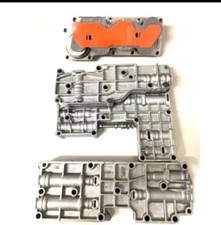
Per ATSG: all valve body bolts and nuts (accumulator body, main control body, solenoid body and reinforcing plate) torque to 9-11 N·m (80-100 in-lb). The accumulator body uses 11 bolts and 2 nuts, the main control body 14 bolts and 2 nuts, and the solenoid body 9 bolts and 1 nut. Follow ATSG's bolt location chart, since bolt lengths vary. Overtightening warps the bodies and creates the cross-leaks that cause the next complaint.
Shop the part for this fix: 4R100 PWM solenoid pack (1998-up)
If the EPC circuit reads open at the case connector (P1746) or the solenoid is out of the 3.0-5.0 ohm range, the EPC solenoid lives in the solenoid pack, and this is the part. If the scan data shows the range sensor lying to the PCM instead, see the 4R100 transmission range sensor (1997-up).
See the 4R100 solenoid pack at CoreTransmissionPartsNeed parts for this job?
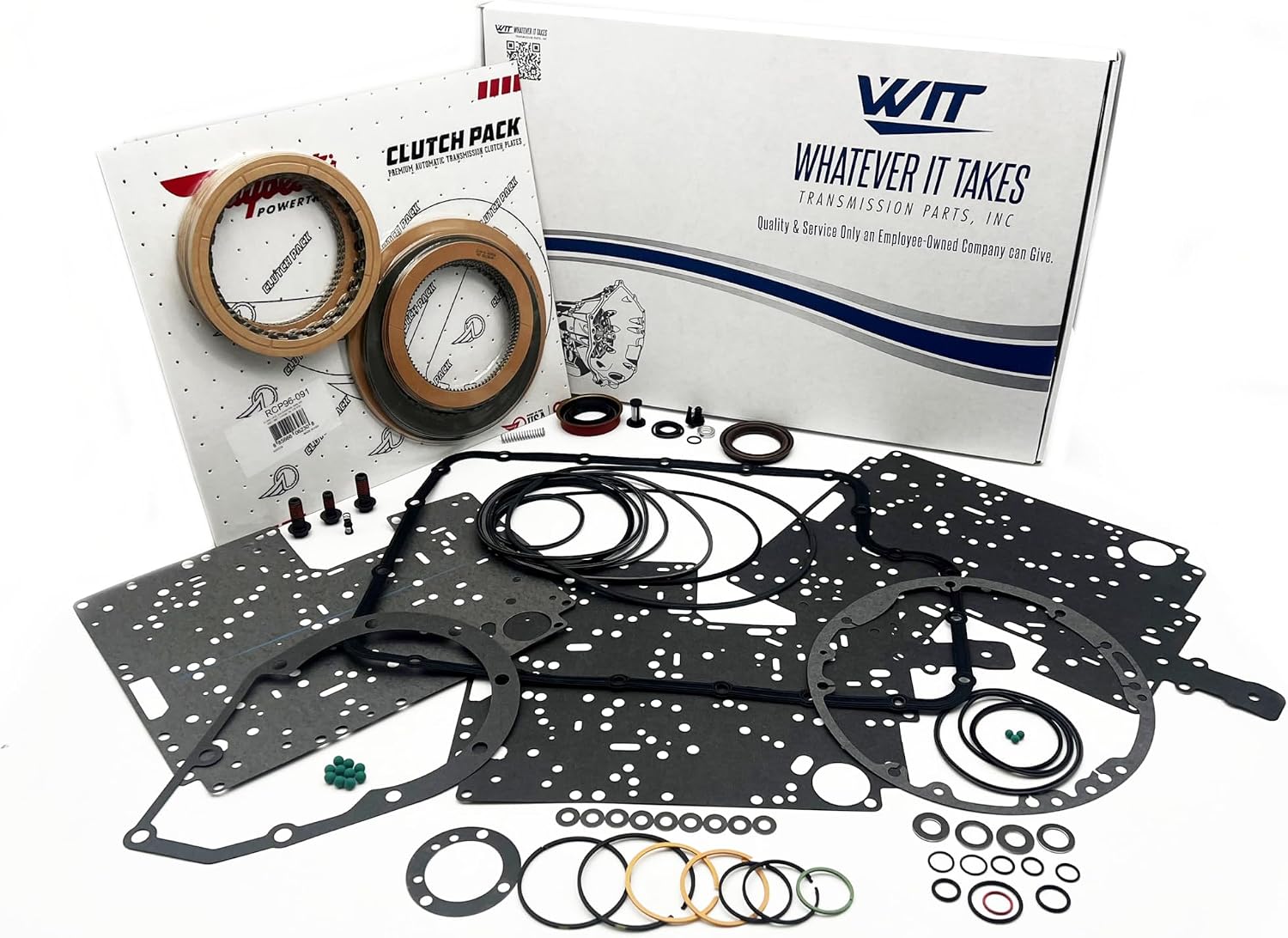
Our parts shop carries 4R100 solenoid packs, valve bodies and master rebuild kits, with checkout on site. Before you order, confirm PWM or non-PWM (it has to match your pump), your model year and 2WD or 4WD.
FAQ
Why does my 4R100 shift so hard?
Most harsh 4R100s have high line pressure. The PCM sets line pressure through the EPC solenoid, and an open EPC circuit (P1746) or a bad load, throttle, speed or range input makes the PCM run high pressure. Pull codes and check EPC before replacing hard parts.
What does P1746 mean on a 4R100?
P1746 is an EPC solenoid open circuit. ATSG says an open circuit causes maximum EPC pressure, harsh engagements and harsh shifts, and may flash the O/D OFF light. Check for 3.0-5.0 ohms across pins 11 and 12 at the case connector, then check the harness to the PCM.
Can a bad sensor make a 4R100 shift hard?
Yes. ATSG lists mass airflow faults, throttle or accelerator pedal position faults, vehicle speed faults (P0500) and transmission range sensor faults (P0705 and P0708) as causes of harsh engagements or firm shifts. The PCM raises line pressure when it can't trust those inputs.
What is normal 4R100 line pressure?
Per ATSG, idle line pressure is 50-65 psi in P, N, OD and Manual 2, 70-100 psi in Reverse and 70-115 psi in Manual 1. At stall it is 220-240 psi in Reverse, 136-156 psi in OD and Manual 2, and 175-210 psi in Manual 1.
Related guides
- 4R100 Shift Solenoid Symptoms, Codes and Replacement
- 4R100 Valve Body Problems: Symptoms and Testing
- 4R100 Slipping: Causes, Codes and the Fix
- 4R100 Won't Shift Into Overdrive: Causes and Fix
- 4R100 Valve Body Wear and Fix
- E4OD Harsh Shift Causes and Fix
Sources
- ATSG (Automatic Transmission Service Group), Ford 4R100 technical service manual (2003). Backs the EPC solenoid's role and the "Mod" line pressure strategy; the line pressure chart and test procedure; the P1746, P1747, P1760, MAF, TP/AP, P0500, P0705/P0708, BARO and P1783 descriptions and symptoms; OSS/TSS use for EPC; the TFT resistance chart and OSS resistance; EPC resistance of 3.0-5.0 ohms at pins 11 and 12; the PTO strategy (EPC about 55 psi, very firm shift feel); the EPC blow-off ball and spring; and the valve body torque and bolt counts. ATSG manual (PDF)
- Sonnax, "Line Pressure Modulator Plunger Valve Kit 36948-05K." Backs the intermittent harsh shift, soft 1-2/2-3, low line rise and low EPC complaints and the worn-sleeve leak/hang-up cause. sonnax.com
- Sonnax, "How to Choose the Right E4OD/4R100 Line Pressure Modulator Plunger Valve Kit." Backs the four plunger diameters and applications, firmer shifts with larger diameters, and the accumulator control body sensitivity warning. sonnax.com
- Sonnax, "Boost Valve Kit 36424-01K." Backs the soft shift, delayed reverse and low line rise complaints from boost sleeve wear leaking EPC and reverse boost oil. sonnax.com
- David Finley, Transmission Digest, "A Case of Mistaken Identity." Backs the 1998 E-350 harsh engagement case, the P0720 code, the swapped 2000 PCM running failsafe and the correct-PCM fix. transmissiondigest.com
- Russ Sylvis, Transmission Digest, "The Wave of the Future." Backs discarding the E4OD/4R100 forward clutch wave plate for waved steels to stop the neutral-to-drive bang, and the 0.005-0.008 in. wave figure. transmissiondigest.com
- ATRA (Automatic Transmission Rebuilders Association), "Quick Reference E4OD/4R100" (2009). Backs the EPC signal check at the case connector with a high-impedance voltmeter or signal monitor, and the "high at idle in all positions" line pressure flowchart (main regulator valve, solenoid body, wiring harness, electrical quick test). ATRA quick reference (PDF)
- Transmission Digest, "EPC Code Causing Loss of Power." Backs the 2002 F-550 7.3L 4R100 case with P1747 and P0221, the flashing O/D OFF light and loss of power, circuit 925 between PCM pin 81 and solenoid block pin 11 testing good, and the bad PCM EPC driver fixed by PCM replacement. transmissiondigest.com
- ATRA, 2003 Ford technical seminar book, 4R100 "Vehicle Speed Sensor Input when Vehicle is Stationary" (pages 152-154). Backs the erratic 1-2/2-1 shift cause from a stationary VSS signal, the key-on engine-off check, Ford ground jumper kit 1C3Z-13N850-AA and the PCM pins it replaces. ATRA 2003 Ford book (PDF)