A 4R100 that stays in 3rd on the highway is one of the most common Super Duty complaints we see, and one of the most commonly misdiagnosed. It gets blamed on the solenoid pack, and the truck comes back still stuck in 3rd. The fix starts with one question: is the PCM commanding 4th and the transmission not delivering it, or is the PCM never asking for 4th in the first place? A scan tool tells you which in about ten minutes.
This guide walks through both sides: the inputs that stop the PCM from commanding overdrive, and the hydraulic and mechanical failures that stop the unit from applying it. Specs, codes and solenoid logic are from the ATSG 4R100 manual; the field failures are from Sonnax and Transmission Digest (full list under Sources).
How the 4R100 gets into 4th
The 4R100 has a front overdrive planetary that runs locked 1:1 in 1st through 3rd. In those gears the overdrive roller clutch holds the overdrive gearset, and the coast clutch applies whenever you want engine braking through it. For 4th, the PCM turns off both shift solenoids, the 3-4 shift valve strokes, and oil goes to the overdrive clutch. That clutch holds the overdrive sun gear and the front gearset overdrives to the 0.71 ratio ATSG lists for 4th.
| Commanded gear (D, O/D on) | SS1 (SSA) | SS2 (SSB) | Coast clutch solenoid | Ratio |
|---|---|---|---|---|
| 1st | ON | OFF | OFF | 2.71 |
| 2nd | ON | ON | OFF | 1.54 |
| 3rd | OFF | ON | OFF | 1.00 |
| 4th | OFF | OFF | OFF | 0.71 |
| 3rd, O/D cancelled | OFF | ON | ON | 1.00 |
That table explains most no-overdrive trucks. The only electrical difference between 3rd and 4th is SS2 going from on to off. The coast clutch solenoid has to be off in 4th too: the coast clutch locks the overdrive gearset 1:1, so if it applies while the overdrive clutch is trying to hold the sun gear, the two fight each other. Anything that keeps SS2 on, keeps the coast clutch applied, or starves the overdrive clutch of oil leaves you in 3rd.
Step 1: Commanded or not commanded?
Hook up a scan tool that reads Ford PCM data and drive the truck at a steady 50-55 mph with light throttle and the fluid warm. Watch commanded gear, SS1 and SS2 states, the TCS/overdrive cancel status, TFT, turbine shaft speed (TSS) and output shaft speed (OSS).
- PCM commands 4th, SS1 and SS2 both read off, and turbine divided by output stays at 1.00: the command is there and the transmission isn't doing it. Go to the hydraulic and mechanical section.
- PCM commands 4th and the ratio drifts toward 1.00 under load, or engine rpm flares on the 3-4: the overdrive clutch is applying and slipping. That's P0734 territory, and it's a clutch or apply-volume problem.
- PCM never commands 4th: the transmission may be fine. Something is telling the PCM not to use overdrive. Go to Step 2 before you pull the pan.
The ATSG trouble chart describes P0734 as "3-4 shift error because of SSA, SSB, or internal transmission components," and P0783 the same way. Take that wording seriously. A 3-4 code only says the PCM didn't see the speed change it expected. It doesn't say the solenoid is bad.
Step 2: Why the PCM won't command overdrive
The overdrive cancel switch (TCS)
Per ATSG, the Transmission Control Switch on the end of the shift lever is a momentary switch that tells the PCM to toggle between 1-2-3-4 and 1-2-3, and the PCM lights the TCIL ("O/D OFF") when overdrive is cancelled. With O/D cancelled, ATSG says you get coast braking in 3rd, which means the coast clutch solenoid is on. The TCS is fed through fuse 19 in the central junction box (Red/Yellow circuit), and on diesels that same fuse also feeds the idle validation switch. If the O/D OFF light is on solid and pressing the button does nothing, check that fuse and the switch circuit. ATSG lists P1780 as "TCS not cycled during the On-Board Diagnostics or the circuit is open or shorted," with the symptom "No overdrive cancel when switch is cycled."
Look at the wire itself, too. Transmission Digest's E4OD/4R100 safety alert covers any truck with the O/D cancel button on a column shifter. The switch wire can be routed so it rubs against a steering column mounting screw, usually near the shift lever pivot, and short to ground. On the trucks in that alert it blew the 10-amp #17 fuse, and the listed symptoms included 3-4 shift cycling, the transmission control lamp cycling on and off, dead instruments and no self-test codes. TD's fix is to reroute and sleeve the wire with heat-shrink tubing. A 4R100 that toggles in and out of 4th with the O/D OFF lamp flickering should get the column wiring checked before the solenoid pack.
PTO input on work trucks
ATSG states that when the PTO is engaged, the PCM turns on SS2 and the coast clutch solenoid, raises EPC to about 55 psi, lights the TCIL, and will not allow 4th under any conditions. The PCM knows the PTO is on because the installer supplies battery voltage to PCM pin 4 on gas engines or pin 66 on the 7.3L diesel. A PTO switch wired to the wrong feed, a backfed circuit, or a switch stuck on will hold that input high, and the truck acts exactly like a failed transmission: no 4th, O/D OFF lit, engine braking in 3rd. On any PTO-capable Super Duty (ATSG says PTO was offered on 8500 GVW and above F-Series with the 6.8L and 7.3L), check that pin for voltage with the PTO off before you do anything else.
4x4 Low and other inputs
ATSG says the PCM uses the 4x4 Low switch to change the shift schedule for low range, and if the 4x4 LOW indicator fuse is blown, the transmission shifts on the 4x4 Low schedule no matter where the transfer case lever is. Speed inputs matter too. ATSG says the PCM uses the OSS signal (781-1979 ohms, part F81Z-7M101-AA) for EPC, shift scheduling and TCC strategy. It lists P0720 for insufficient OSS input, which flashes both the TCIL and the MIL, and P0500 for insufficient or intermittent vehicle speed input, with an abnormal shift pattern among the symptoms. Clear engine-side codes first.
Temperature is the last input. The PCM uses TFT to decide when to enable TCC and the stabilized shift schedule after a cold start (ATSG's P0713 note says an open TFT circuit lets them come in sooner), and ATSG's TFT resistance chart runs from 37k-16k ohms at 69-104°F down to 2.7k-1.5k ohms at 195-230°F. A sensor or circuit reading cold when the fluid is hot can make the PCM hold a cold schedule. Compare TFT on the scan tool against a thermometer on the pan.
Step 3: Commanded but not achieved
Shift solenoid B stuck on
Since 3rd and 4th differ only by SS2, a mechanically stuck SSB gives the classic pattern. The ATSG "SSB always on" chart shows 2nd-gear starts and no overdrive: you get 2-2-3-3 in D. If SSB is stuck on, the truck also launches in 2nd, so a truck that starts in 1st and only misses 4th usually isn't an SSB problem. Resistance specs from ATSG at the case connector: SS1 pins 1-3 and SS2 pins 1-2, both 20-30 ohms, and the coast clutch solenoid pins 1-5, 20-30 ohms. ATSG lists P0755 for an SSB circuit fault and P1715 for an SSB mechanical fault. A bad SSB means a new pack. See our 4R100 shift solenoid guide for the full pin chart.
Coast clutch solenoid stuck on
ATSG lists P1754 for a coast clutch solenoid circuit failure. Failed on, the symptom is engine braking in 3rd in the O.D. range, and ATSG warns the coast clutch "may be damaged causing eventual failure." If you feel strong engine braking in D on a truck with O/D on, and the 3-4 either won't happen or feels like a bind-up, look at the coast clutch solenoid and the coast clutch circuit.
The 3-4 accumulator control valve
This is the valve body item most people skip. Sonnax lists "No 4th" as the first complaint for its 3-4 accumulator control valve kit (36948-09K) for the E4OD and 4R100. Their explanation: wear ridges form as the OE accumulator control valve cycles in its bore, and on high-pressure shifts the valve strokes too far, hangs on those ridges, and blocks oil to the clutch it feeds. Their valve adds a stepped spool that keeps oil flowing to the clutch, a clip that stops over-stroking, and spring shims. They recommend (but don't require) their 36948-12 bore sizing tool to clean up the bore. A burned overdrive clutch in an otherwise clean unit points here.
Worn manual valve bore
Transmission Digest ran a case from Joe Cangelosi that every 4R100 builder should read. A truck came in with no 4th, burnt fluid and P0734. The overdrive clutch piston return spring snap ring had come out and destroyed the overdrive clutches. After an overhaul, new overdrive steels, a rebuilt converter and a new solenoid block, it still had no 4th. The cause turned out to be a worn manual valve bore, found by air-testing the circuits with the unit assembled and hearing air escape around the manual valve. The valve looked fine; the bore was dumping pump oil to the pan. Cangelosi's point: the leak was too big for the volume the overdrive clutch needs. In a non-synchronous unit, the last clutch applied is the first to go without.
The overdrive clutch itself
If the scan data shows 4th commanded and the ratio slipping, the overdrive pack or its piston is suspect. Things to check on teardown, per ATSG:
- Molded piston. ATSG's rebuild procedure has you discard and replace the overdrive clutch molded piston in the intermediate/overdrive cylinder. Don't reuse it.
- Return spring snap ring. Compress the spring and make sure the snap ring is fully seated. This is the ring that failed in the Transmission Digest case. Sonnax says the open-end OE ring has no lock and can be pulled out of its groove by piston spring force, and lists catastrophic failure on the 4R100 as the result. Its Sure Lock spiral snap ring (36744-01) locks into the groove, and the Zip Kit includes one.
- Clearance. Overdrive clutch clearance is 0.68-1.33 mm on the 2-plate stack and 0.81-1.47 mm on the 3-plate stack. Set it with the selective snap ring.
- Feed bolts. ATSG calls for new feed bolts on the center support and overdrive cylinder. Torque the overdrive clutch cylinder feed bolt to 8-14 N·m (6-10 ft-lb) and the center support feed bolts to 11-16 N·m (8-12 ft-lb). ATSG warns that overtightening them warps the case and causes transmission failure.
After a rebuild: no 4th or no coast clutch
If the truck shifted into 4th before the rebuild and doesn't after, look at parts compatibility. Transmission Digest's Mike Riley covers how many different pumps and coast clutch drums were used. The 4R100 has separate PWM and on/off pumps, and the solenoid block has to match the pump's TCC valve design. There are also early and late non-PTO and PTO coast clutch drums. On the later PTO drum, the oil dam must be used, and on earlier PTO drums it must not be, or the stack-up will be wrong. A wrong stack-up in the coast clutch area gives you a coast clutch that drags or won't release, and a coast clutch that won't release fights the overdrive clutch in 4th. Air-check the coast and overdrive circuits separately at the case.
Shop the part for this fix: Sonnax 3-4 accumulator control valve kit
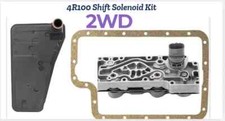
The drop-in 36948-09K valve Sonnax built for the E4OD/4R100 "No 4th" and soft 3-4 complaint. It keeps oil flowing to the overdrive clutch when the OE valve would hang on a worn bore. If the scan data points at SSB instead, the 4R100 PWM solenoid pack (1998-up) is the part.
See the 3-4 accumulator valve kit at CoreTransmissionPartsNeed parts for this job?
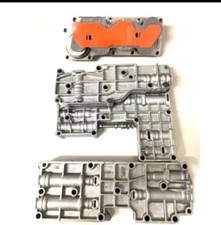
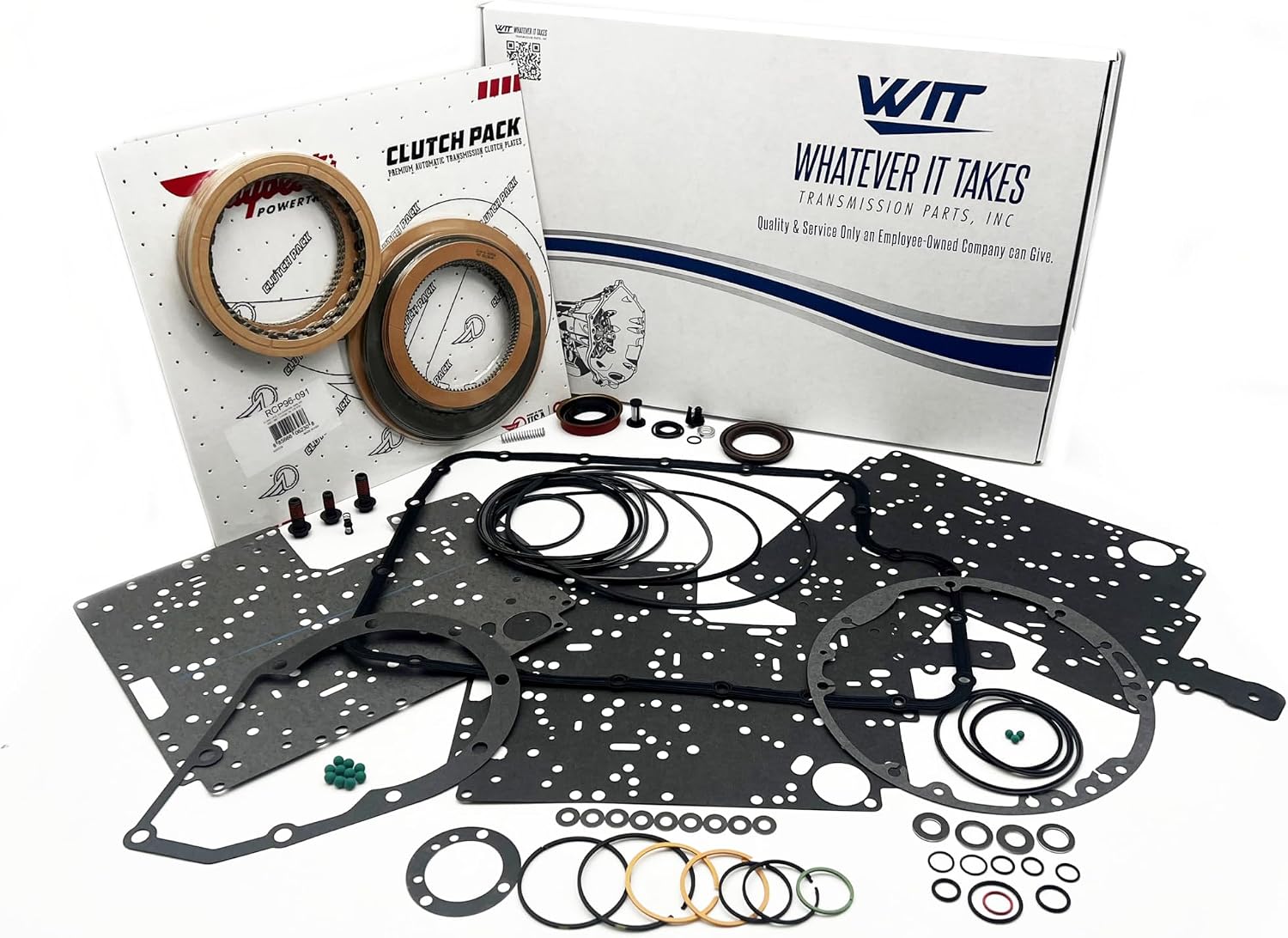
Our parts shop carries 4R100 solenoid packs, valve bodies and master rebuild kits with Raybestos frictions, with checkout on site. Before you order, confirm PWM or non-PWM, 2WD or 4WD pan, and whether your overdrive stack is 2-plate or 3-plate.
FAQ
Why won't my 4R100 shift into overdrive?
Either the PCM isn't commanding 4th or the transmission can't apply the overdrive clutch. Common PCM-side causes are the overdrive cancel switch circuit, a PTO input held on, or a speed or temperature sensor fault. Common transmission-side causes are shift solenoid B stuck on, a worn 3-4 accumulator control valve, a worn manual valve bore, or a burnt overdrive clutch.
Why is the O/D OFF light flashing on my 4R100?
A flashing O/D OFF (TCIL) light means the PCM has stored a transmission-related code, not that the switch is pressed. Per ATSG, faults such as P0715 and P0720 (turbine and output speed sensor input) and P1744 (converter clutch slip) flash the TCIL. Pull the codes before you replace anything.
What does P0734 mean on a 4R100?
ATSG describes P0734 as a 3-4 shift error caused by SSA, SSB or internal transmission components. It means the PCM commanded 4th and didn't see the ratio change. In the Transmission Digest case, P0734 came back after a new solenoid block because a worn manual valve bore was starving the overdrive clutch.
Can a PTO stop a 4R100 from shifting into 4th?
Yes. ATSG states that with the PTO engaged, the PCM turns on SS2 and the coast clutch solenoid and does not allow 4th under any conditions. The PCM reads PTO status from battery voltage at pin 4 on gas engines or pin 66 on the 7.3L diesel, so a stuck or miswired PTO input will lock out overdrive.
Related guides
- 4R100 Slipping: Causes, Codes and the Fix
- 4R100 Shift Solenoid Symptoms, Codes and Replacement
- 4R100 Valve Body Problems: Symptoms and Testing
- Ford 4R100 Common Problems, Service Tips and Rebuild Considerations
- 4R100 vs E4OD: What Changed
- E4OD Won't Shift Into Overdrive: Causes and Fix
Sources
- ATSG (Automatic Transmission Service Group), Ford 4R100 technical service manual (2003). Backs the gear ratios and component application chart; the shift solenoid application and SSB-always-on trouble charts; the TCS/TCIL operation, fuse 19 feed and P1780; the PTO strategy (SS2 and CCS on, EPC about 55 psi, no 4th, PCM pin 4/pin 66, 7-mile relearn); the 4x4 Low switch and fuse behavior; OSS function and P0500/P0720; the TFT resistance chart; P0734, P0783, P0755, P1715 and P1754 descriptions and symptoms; solenoid resistance by pin; the overdrive molded piston, return spring snap ring and clearance specs; and the feed bolt torque and warning. ATSG manual (PDF)
- Sonnax, "3-4 Accumulator Control Valve Kit 36948-09K." Backs the No 4th, soft shift and premature clutch failure complaints, the wear-ridge hang-up mechanism, the stepped spool, retaining clip and shims, and the 36948-12 bore sizing tool recommendation. sonnax.com
- Sonnax, "Zip Kit E4OD-4R100-ZIP." Backs the overdrive planetary and piston failure coverage, the included 3-4 accumulator control valve kit and the spiral snap ring. sonnax.com
- Joe Cangelosi, Transmission Digest, "The 4R100 with a Mysterious No 3-4 Shift." Backs the no-4th / P0734 case, the dislodged overdrive return spring snap ring, the repair steps that didn't fix it, the assembled air test, and the worn manual valve bore starving the overdrive clutch. transmissiondigest.com
- Mike Riley, Transmission Digest, "E4OD/4R100 Component Upgrade: Mix and Match Is Not an Option." Backs the PWM and on/off pump differences, the solenoid block matching the pump, the coast clutch drum variants, and the PTO drum oil dam stack-up warning. transmissiondigest.com
- Transmission Digest, "E4OD/4R100 Safety Alert." Backs the O/D cancel switch wire shorting against a steering column mounting screw near the shift lever pivot on column-shift E4OD/4R100 trucks, the 10-amp #17 fuse on the trucks covered, the 3-4 shift cycling and control lamp cycling symptoms, and the reroute-and-sleeve fix. transmissiondigest.com
- Sonnax, "Sure Lock Spiral Snap Ring 36744-01." Backs the open-end OE overdrive piston retaining ring being pulled from its groove by piston spring force, and the catastrophic failure (4R100) complaint. sonnax.com