A slipping 4R100 is almost never a mystery once you know which clutch is holding in which gear. The unit has seven clutch packs, a band and three one-way clutches, and every gear uses a different combination of them. If you write down exactly which gears slip, hot and cold, you've usually narrowed it to one or two components before the pan comes off.
Below: the apply chart, what slip in each gear points to, the codes, the line pressure specs, and the leak points that burn clutches in these units over and over. Specs and codes are from the ATSG 4R100 manual; the leak data is from Sonnax and Transmission Digest (full list under Sources).
What holds in each gear
ATSG's component and solenoid application chart for the 4R100 lists the ratios as 2.71 first, 1.54 second, 1.00 third, 0.71 fourth and 2.18 reverse. Here is what is applied or holding in each range:
| Range / gear | Applied | Holding (one-way) |
|---|---|---|
| OD 1st | Forward clutch | Overdrive roller clutch, low roller clutch |
| OD 2nd | Forward, intermediate clutch | Overdrive roller clutch, intermediate sprag |
| OD 3rd | Forward, intermediate, direct clutch | Overdrive roller clutch |
| OD 4th | Forward, intermediate, direct, overdrive clutch | None |
| OD 3rd, O/D cancelled | Forward, intermediate, direct, coast clutch | Overdrive roller clutch |
| Manual 2nd | Forward, intermediate, coast clutch, intermediate band | Overdrive roller clutch, intermediate sprag |
| Manual 1st | Forward, coast, low/reverse clutch | Overdrive roller clutch, low roller clutch |
| Reverse | Direct, coast, low/reverse clutch | Overdrive roller clutch |
Two things matter most on that chart. The 4R100 is non-synchronous: once a clutch is on, it stays on for every higher gear, so fourth gear has four clutches applied at once, and every one of those circuits has to hold pressure at the same time. And several clutches work in two unrelated ranges. The direct clutch is used in both third and reverse. The low/reverse clutch is used in both manual 1st and reverse. That overlap is what lets you pin down the failure from the driver's seat.
Match the slip to the part
| Where it slips | Common element | What to suspect first |
|---|---|---|
| All forward gears, reverse OK | Forward clutch | Forward clutch pack, forward clutch sealing rings, center support to hub leakage |
| Every range, forward and reverse | Pressure supply | Low fluid, plugged filter, pump, EPC or main regulator, worn manual valve bore |
| 2nd, 3rd and 4th, 1st OK | Intermediate clutch | Intermediate clutch or its feed at the case-to-support joint |
| 3rd and reverse, 1st and 2nd OK | Direct clutch | Direct clutch pack, direct feed at the center support, center support sealing rings |
| 4th only | Overdrive clutch | Overdrive clutch, piston return spring snap ring, OD feed, low volume at the top of the shift sequence |
| Reverse and manual 1st | Low/reverse clutch | Low/reverse clutch or its modulator circuit |
| Engine flare or no engine braking in manual 2nd, but OD 2nd is fine | Intermediate band / coast clutch | Band, servo, or coast clutch |
| RPM creeps up at steady cruise in 3rd or 4th with no gear change | Torque converter clutch | TCC apply circuit, converter, or TCC control valve |
Codes that come with a slipping 4R100
The ATSG trouble code chart has two codes that describe slip directly, plus the ratio and pressure codes that often come with it:
| Code | ATSG description | ATSG symptom |
|---|---|---|
| P1728 | Excessive amount of transmission slippage has been detected | Transmission slippage, erratic or no TCC operation. May flash TCIL. |
| P1744 | PCM picked up an excessive amount of TCC slippage during normal operation | TCC slippage, erratic or no converter clutch operation. Flashes TCIL. |
| P0731-P0733 | Gear ratio errors | Improper gear selection |
| P1746 | EPC control pressure driver failure inside the PCM | Open circuit causes maximum EPC pressure, harsh engagements and shifts |
| P1747 | EPC shorted circuit, or PCM | Minimum EPC pressure, limits engine torque with partial fuel shutoff, flashing TCIL |
P1728 means the PCM saw the turbine-to-output ratio drift outside what it expects for the gear. It doesn't tell you which clutch, so go back to the table above. P1747 matters because a shorted EPC circuit drops line pressure to minimum, and a unit running at minimum pressure will slip and burn clutches with nothing mechanically wrong at first. Sort out the electrical code before you condemn the hard parts.
Scan data before you touch a wrench
According to ATSG, the PCM uses the turbine shaft speed (TSS) sensor to control EPC pressure and TCC strategy, and the output shaft speed (OSS) sensor to control EPC, shift scheduling and TCC. Those two signals are what you use to prove slip:
- Calculate the ratio. Turbine speed divided by output speed should match the gear: about 2.71, 1.54, 1.00 or 0.71. If it reads 1.00 one moment and wanders toward 1.3 under load in 3rd, that's direct or intermediate clutch slip, not an electrical fault.
- Check engine rpm against turbine speed. With the converter clutch commanded on, engine rpm and turbine speed should be almost the same. A steady difference of more than a few dozen rpm while the TCC is commanded on is converter slip, which is P1744 territory.
- Watch TFT. Note whether the slip shows up cold, only hot, or both. Slip that shows up only as the fluid heats and thins points to a leak (a worn bore, sealing rings, or the support joints below). In its PTO section, ATSG gives 250°F as the recommended maximum fluid temperature, and slipping at those temperatures cooks clutches fast.
Check fluid level and condition first. A low level lets the pump suck air under braking, cornering or on grades, and that feels like slip. Our 4R100 fluid guide has the capacity, the hot dipstick check procedure and the fluid spec. Burnt-smelling fluid with friction material in the pan means at least one clutch has already failed. A fluid change won't bring it back.
Line pressure test
ATSG's line pressure chart for the 4R100, tested with a 300 psi gauge on the line pressure tap:
| Range | Idle | Stall |
|---|---|---|
| P, N | 50-65 psi | n/a |
| R | 70-100 psi | 220-240 psi |
| OD, M2 | 50-65 psi | 136-156 psi |
| M1 | 70-115 psi | 175-210 psi |
ATSG's rules for this test: check idle pressure in every range first. If idle pressure is low, don't do the stall test, or you'll cause more damage. Never hold wide-open throttle for more than 5 seconds in any range. On PTO-equipped trucks, you may need to remove the PTO unit and install the cover and gasket to reach the port, and the PTO should be switched off during the test.
Low pressure in every range points to the supply side (pump, filter, regulator, EPC). Normal pressure with slip in certain gears points to a leak or worn pack in the circuit those gears share. Normal idle pressure that doesn't rise at stall is a boost or EPC problem; Sonnax lists "Delayed Reverse" and "Low line rise" among the symptoms its E4OD/4R100 boost valve kit addresses.
The leak points that burn 4R100 clutches
Case-to-support feeds
This is the classic one. Sonnax says a major cause of low clutch apply pressure, soft shifts and burned clutches in the 4R100 and E4OD is leakage between the case and the clutch feed passages in the intermediate clutch support and the center support. There's no positive seal where the oil crosses from the case into those supports. Sonnax says "clearance and movement between the case and center support allows apply fluid to leak, lowering clutch apply pressure," and that it gets worse as the supports move under load. The symptoms Sonnax lists for this leak include burnt intermediate clutches, direct clutch failure, 2-3 slip, 3-2 slip, no 2nd, a soft 1-2, and delayed reverse. That's the intermediate and direct columns from the table above. Their fix is the 36424-24K feed seal kit, which puts a sprung seal and adapter tube at both feeds.
Case deflection at the center support
Sonnax also documents that torquing the center support bolts deflects the case where the valve body mounts, with typical distortion of about .005 in. around the center support bolts. That causes valve body cross leaks and 2nd clutch feed leaks at the case and center support. Their 36743-01 aluminum shim (.204 in. thick) fills the gap so the bolts don't pull the case in. Sonnax notes that the inner case surface is unfinished, so the shim works in most units but isn't guaranteed in every case.
Overdrive clutch and the snap ring
Fourth-gear slip deserves special attention. In a Transmission Digest case from Joe Cangelosi, a 4R100 came in with no 4th, badly burnt fluid and clutch material in the pan. The snap ring that retains the overdrive clutch piston return spring had come out of its groove and the overdrive clutches were destroyed. Sonnax's Zip Kit includes a Sure Lock spiral snap ring for that return spring for exactly this reason. Even after an overhaul, new overdrive steels, a rebuilt converter and a new solenoid block, the truck still had no 4th and set P0734. Air checks found air escaping around the manual valve. The manual valve bore was worn, and it was dumping pump oil to the pan. Because the unit is non-synchronous, by the time it reached 4th there wasn't enough oil volume left to apply the overdrive clutch.
The lesson: if 4th slips or goes missing after a rebuild, air-check the circuits with the unit assembled, and check the valve body bores, not just the clutch pack.
Missing checkball after a valve body job
If the slip showed up right after an overhaul or valve body job, check the checkballs before you tear it back down. A Transmission Digest Tech/Talk bulletin (November 2001) covers 1996-98 E4OD and 4R100 units that slip, have no reverse, or lose engine braking in manual 2 or 1. The cause is a missing or misplaced BS1 checkball, which lets reverse, manual 2 and manual 1 oil exhaust at the manual valve. The same bulletin lists BS1 or BS6 for 1990-95 E4OD units. A worn manual valve bore gives similar symptoms. Sonnax says the steel valve scores its aluminum bore, "reducing line pressure in reverse and manual low positions," and lists reverse slip and low/reverse clutch failure (fix: oversized valve 36947-13K). Our E4OD slipping guide covers the earlier units.
Converter clutch slip
If P1744 is stored and the slip only happens in lockup, check the converter and its control valves before the clutch packs. Sonnax ties a worn line-to-lube pressure regulator valve (36424-04K) to "Code 62, 628, 1744," high line pressure and an overheated converter, and a worn TCC control plunger valve (36424-08K) to lockup shudder and TCC cycling on PWM units. Our 4R100 valve body testing guide covers that side.
PTO trucks and the coast clutch
On PTO trucks, ATSG explains that engaging the PTO turns on SS2 and the coast clutch solenoid, blocks 4th, and raises EPC to about 55 psi. The pressure increase depends on the installer running a battery-voltage wire to the PCM (pin 4 gas, pin 66 on the 7.3L diesel). Without it, ATSG warns the coast clutch will be "smoked in a short period of time." Check that circuit before rebuilding a PTO truck with burnt coast clutches a second time.
Fixing it right: clearances matter
Once the unit is apart, fix the leak that burned the clutches, not only the burned clutches. Then set every pack to spec. Too much clearance means a slow, slipping apply. Too little means drag. ATSG's clearance specs, measured between the selective snap ring and the backing plate:
| Clutch pack | Clearance |
|---|---|
| Forward clutch | 0.76-1.40 mm (.030-.055 in.) |
| Direct clutch | 1.15-2.06 mm (.045-.081 in.) |
| Coast clutch | 0.76-1.27 mm (.030-.050 in.) |
| Overdrive clutch, 2-plate | 0.68-1.33 mm |
| Overdrive clutch, 3-plate | 0.81-1.47 mm |
ATSG notes that the forward clutch plate count varies by model, and that the 2-plate and 3-plate overdrive stacks have different specs, so count what came out before ordering the frictions. Use the selective snap rings to set clearance. Don't add or remove plates to get there.
Before it goes back in the truck, air-check every circuit at the case passages ATSG identifies in its air pressure check diagram: forward, direct, coast, overdrive, intermediate and low/reverse, plus intermediate lube. A good apply is a clean thump with no hiss. Hissing at the case-to-support joints is the leak Sonnax describes, and it's much cheaper to find on the bench than in the customer's driveway.
Shop the part for this fix: Sonnax intermediate and direct clutch feed seal kit
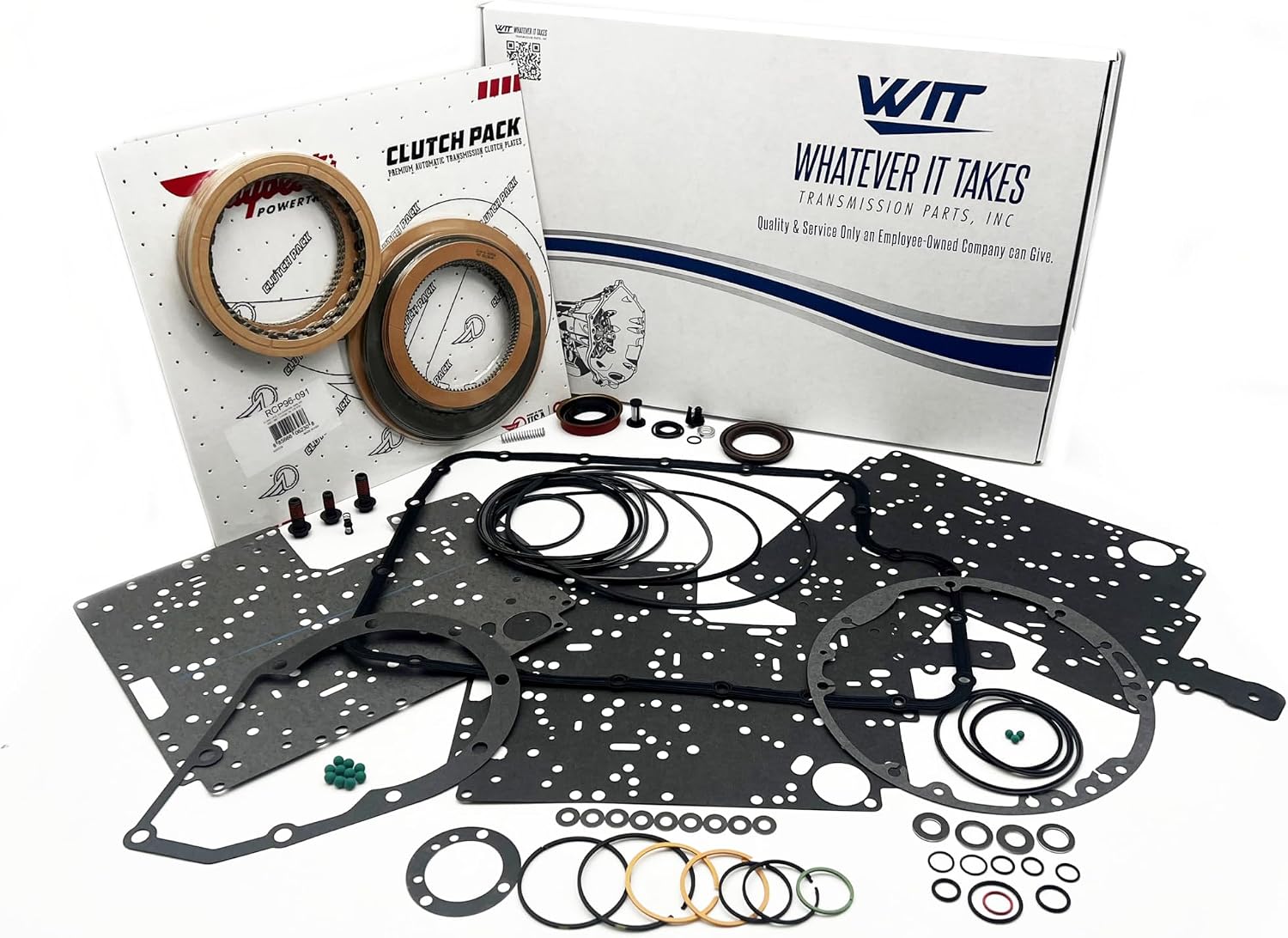
The drop-in seal kit (36424-24K) that seals the case-to-support feeds behind the classic 4R100 burnt intermediate, burnt direct, 2-3 slip and delayed reverse complaints. If the clutches are already gone, pair it with the 4R100 master rebuild kit with friction module.
See the feed seal kit at CoreTransmissionPartsNeed parts for this job?
Our parts shop has 4R100 master rebuild kits with Raybestos frictions, pumps and valve bodies, with checkout on site. Check 2WD or 4WD, PWM or non-PWM, and the 2-plate or 3-plate overdrive stack before you order.
FAQ
Why is my 4R100 slipping?
The most common causes are low or burnt fluid, a leak at the case-to-support clutch feeds that lowers apply pressure, a worn clutch pack, or low line pressure from the pump, EPC or a worn valve body bore. Which gears slip tells you which clutch is involved, because each gear uses a different combination of clutches.
What does it mean when a 4R100 slips in 3rd and reverse?
The direct clutch is the only friction element applied in both 3rd and reverse, so slip in both points to the direct clutch or its feed. Sonnax lists direct clutch failure, 2-3 slip and delayed reverse as symptoms of leakage between the case and the center support, which lowers direct clutch apply pressure.
What code does a slipping 4R100 set?
ATSG lists P1728 for excessive transmission slippage and P1744 for excessive torque converter clutch slippage. Both can flash the O/D OFF light. Gear ratio codes P0731-P0734 often come with them, and P1747 (EPC shorted) causes minimum line pressure that can make the unit slip.
What should 4R100 line pressure be?
Per the ATSG chart, idle pressure is 50-65 psi in P, N, OD and M2, 70-100 psi in reverse and 70-115 psi in M1. Stall pressure is 220-240 psi in reverse, 136-156 psi in OD and M2, and 175-210 psi in M1. If idle pressure is low, do not perform the stall test.
Related guides
- 4R100 No Reverse: Diagnosis and Fix
- E4OD Slipping: Causes and Fix
- Ford 4R100 Common Problems, Service Tips and Rebuild Considerations
- 4R100 Shift Solenoid Symptoms, Codes and Replacement
- 4R100 Valve Body Problems: Symptoms and Testing
- 4R100 Valve Body Wear: Symptoms and the Bench Fix
- 4R100 Fluid Change Cost: What a Real Service Takes
- 4R100 Won't Shift Into Overdrive: Causes and Fix
Sources
- ATSG (Automatic Transmission Service Group), Ford 4R100 technical service manual (2003). Backs the gear ratios and the component and solenoid application chart; the TSS and OSS functions; the P1728, P1744, P0731-P0733, P1746 and P1747 descriptions and symptoms; the line pressure specification chart and test cautions; the PTO operation, 55 psi EPC rise, PCM pin 4/pin 66 wire and coast clutch warning; the forward, direct, coast and overdrive clutch clearance specs; and the air pressure check locations. ATSG manual (PDF)
- Sonnax, "Intermediate & Direct Clutch Feed Seal Kit 36424-24K." Backs the case-to-support feed leak, the quote on clearance and movement lowering clutch apply pressure, and the symptom list (burnt intermediate clutches, direct clutch failure, 2-3 and 3-2 slip, no 2nd, soft 1-2, delayed reverse). sonnax.com
- Sonnax, "Center Support Shim 36743-01." Backs the approximately .005 in. case deflection around the center support bolts, the valve body cross leaks and 2nd clutch feed leaks it causes, the .204 in. aluminum shim, and the effectiveness caveat. sonnax.com
- Sonnax, "Zip Kit E4OD-4R100-ZIP." Backs the Sure Lock overdrive piston return spring snap ring, the boost valve kit symptoms (delayed reverse, low line rise), the line-to-lube regulator valve symptoms (codes 62, 628 and 1744, reverse engagement stall, high line pressure, overheated converter), and the TCC control plunger valve symptoms on PWM units. sonnax.com
- Joe Cangelosi, Transmission Digest, "The 4R100 with a Mysterious No 3-4 Shift." Backs the overdrive return spring snap ring failure with destroyed overdrive clutches, the repeat no-4th with P0734 after overhaul, the air test finding, and the worn manual valve bore starving the overdrive clutch in a non-synchronous unit. transmissiondigest.com
- Transmission Digest, Transmission Tech/Talk, November 2001 issue. Backs the 1996-98 E4OD/4R100 BS1 checkball bulletin (slipping or no reverse and no engine braking in manual 2 or 1, oil exhausting at the manual valve) and the 1990-95 E4OD BS1/BS6 version. transmissiondigest.com
- Sonnax, "Oversized Manual Valve Kit 36947-13K." Backs the manual valve bore wear reducing line pressure in reverse and manual low, and the reverse slip and low/reverse clutch failure symptoms. sonnax.com