When a 4R100 starts pulling away in the wrong gear, refuses overdrive, or flashes the O/D OFF light at you, the solenoid pack is usually the first thing people blame. Sometimes they're right. The problem is that a $250 solenoid pack gets thrown at plenty of trucks that really have a broken connector lock tab, corroded pins, or a worn valve body bore. Then the same code comes back a week later.
This post covers how the 4R100 uses its two shift solenoids to pick a gear, which gear you get when each one sticks on or off, the codes that go with each failure, and how to prove it's the pack before you buy one. The solenoid application logic, failure charts, resistance specs, DTC descriptions, TCIL behavior and torque values come from the ATSG 4R100 manual. The connector and misdiagnosis cases come from Transmission Digest, and the pack design notes come from Sonnax. All of them are listed under Sources at the bottom.
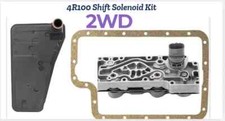
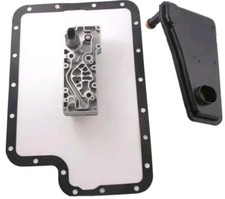

What's in the 4R100 solenoid pack
Per the ATSG manual, the 4R100 solenoid assembly bolts to the case inside the bottom pan and contains shift solenoid 1 (SSA), shift solenoid 2 (SSB), the coast clutch solenoid (CCS), the torque converter clutch (TCC) solenoid, the electronic pressure control (EPC) solenoid and the transmission fluid temperature (TFT) sensor. ATSG is clear that the solenoids are not serviced individually. When one goes bad, you replace the whole assembly.
There are two versions of the pack. ATSG's PWM/non-PWM section says that starting in 1999, V10 gas and all diesel applications got a pulse-width-modulated TCC strategy, while the other gas engines kept an on/off TCC solenoid. The two versions use different packs and different pumps, and ATSG lists them as not interchangeable:
- PWM solenoid pack: Ford F81Z-7G391-AB (6.8L V10 and 7.3L Power Stroke)
- Non-PWM solenoid pack: Ford F81Z-7G391-BA (other gas engines)
Put the wrong one in and the converter clutch won't behave, no matter how good the shift solenoids are. A resistance check across the TCC pins (below) tells you which one you're holding.
How two solenoids pick four gears
The 4R100 has only two shift solenoids. The PCM gets four gears from them by using on/off combinations, and the shift valves in the valve body follow the solenoid signal pressure. This is the pattern from ATSG's shift solenoid application chart for the D (overdrive) range:
| Commanded gear | Shift solenoid A (SS1) | Shift solenoid B (SS2) |
|---|---|---|
| 1st | ON | OFF |
| 2nd | ON | ON |
| 3rd | OFF | ON |
| 4th | OFF | OFF |
Two things fall out of that table. First, 4th gear is both solenoids off. If the pack loses power or the case connector is unplugged, the shift valves go to their 4th-gear position in D. Second, since each solenoid is used in two gears, a single stuck solenoid never gives you just one bad gear. It swaps pairs of gears, and that pattern is how you find the failed solenoid from the driver's seat.
The coast clutch solenoid controls engine braking. ATSG's range description says that in D with the Transmission Control Switch (TCS) off you get 1-2-3-4 with coast braking in 4th. With overdrive cancelled (TCIL lit) you get 1-2-3 with coast braking in 3rd. The 2 position pulls in to 3rd and holds 2nd after a downshift. The 1 position pulls in to 2nd and holds 1st.
4R100 shift solenoid symptoms by failure mode
ATSG's shift solenoid trouble chart shows what gear you actually get when the PCM commands each gear with a solenoid stuck. The D-range results follow directly from the on/off table above:
| Failure | Commanded 1-2-3-4, actual gear in D | What the driver notices |
|---|---|---|
| SSA always OFF | 4 - 3 - 3 - 4 | Very soft, lazy launch because it starts in 4th, then drops to 3rd. Never sees 1st or 2nd in D. |
| SSA always ON | 1 - 2 - 2 - 1 | Starts normally, tops out in 2nd, and drops to 1st when the PCM commands overdrive. Engine flares hard at cruise. |
| SSB always ON | 2 - 2 - 3 - 3 | 2nd-gear starts and no overdrive. High rpm on the highway. |
| SSB always OFF | 1 - 1 - 4 - 4 | Holds 1st, then jumps straight to 4th. Big 1-4 shift with a lugging engine. |
"Stuck" can be electrical (an open or shorted circuit, which the PCM usually catches) or mechanical (a solenoid that's electrically fine but won't move because of debris or a worn plunger). The mechanical kind is the one that fools people, because the resistance reading is normal.
The O/D OFF light is a warning light too
The Transmission Control Indicator Lamp (TCIL), on the end of the shifter and labeled "OVERDRIVE OFF," normally just lights up solid when the driver presses the Transmission Control Switch to cancel overdrive. ATSG's own DTC chart for this transmission shows it doing something else, too: a long list of codes, including P0731, P0732, P0750 and P0755, are documented to flash the TCIL as their driver-facing symptom, separate from the dashboard MIL. A flashing O/D OFF light on a 4R100 is the PCM telling you it has a stored transmission fault -- pull the codes before anything else.
The codes that go with a bad shift solenoid
The ATSG diagnostic trouble code chart splits shift solenoid faults into circuit faults, mechanical faults and shift/ratio errors:
| Code | ATSG description | Symptom |
|---|---|---|
| P0750 | SSA circuit failure | Improper gear selection per the solenoid chart |
| P0755 | SSB circuit failure | Improper gear selection per the solenoid chart |
| P1714 | SSA mechanical failure detected | Improper gear selection per the solenoid chart |
| P1715 | SSB mechanical failure detected | Improper gear selection per the solenoid chart |
| P0781 / P0782 / P0783 | 1-2 / 2-3 / 3-4 shift error because of SSA, SSB or internal components | Improper gear selection |
| P0731 / P0732 / P0733 | Gear ratio errors | Improper gear selection |
| P1754 | Coast clutch solenoid circuit failure | Failed off: no 3rd-gear engine braking with O/D cancelled. Failed on: engine braking in OD, coast clutch can be damaged. |
Pay attention to the wording on P0781-P0783: "because of SSA, SSB, or internal transmission components." A shift error or ratio code means the PCM didn't see the expected speed change. That can be a solenoid, but it can also be a sticking valve, a leaking circuit or a burned clutch. Only P0750/P0755 (circuit) and P1714/P1715 (mechanical) point straight at the solenoids.
How to test it before you buy a pack
1. Scan data first
With a scan tool that reads Ford PCM data, watch the commanded gear, the SS1 and SS2 command states, turbine and output shaft speeds, and TFT while you drive. Compare the commanded gear with the ratio you're really getting (turbine speed divided by output speed). If the PCM commands 2nd and the ratio matches 3rd, you've got the kind of pair swap that's in the failure table. If the PCM never commands the gear at all, look at inputs such as the DTR sensor, TSS/OSS or the TCS circuit before you blame the transmission.
2. The connector, before the solenoids
Writing in Transmission Digest, Jim Stokes says the E4OD/4R100 family has the most connector problems of any unit he deals with. The lock tab breaks easily and causes poor contact, codes and performance problems. In his experience, shops that get a circuit code often install a new solenoid pack, only to have the same code come back or a different circuit code show up, because the tab on the harness side was broken the whole time. He also documents heavy corrosion. On one truck, the pins in the solenoid pack were eaten away within four weeks.
So before you drop the pan, unplug the case connector at the driver's side of the case. Check the lock tab, look for green corrosion or pushed-back pins, and check the pin fit. A tab that won't lock is a harness repair, not a solenoid pack.
3. Resistance at the case connector
ATSG's test is done with a DVOM on ohms and the ignition off, at the transmission case connector. Pin 1 is the shared power feed (VPWR) for the solenoids:
| Component | Case pins | Spec |
|---|---|---|
| Shift solenoid A (1) | 1 and 3 | 20-30 ohms |
| Shift solenoid B (2) | 1 and 2 | 20-30 ohms |
| Coast clutch solenoid | 1 and 5 | 20-30 ohms |
| TCC solenoid, on/off (non-PWM pack) | 1 and 4 | 20-30 ohms |
| TCC solenoid, PWM pack | 1 and 4 | 10-20 ohms |
| EPC solenoid | 11 and 12 | 3.0-5.0 ohms |
| TFT sensor | 7 and 8 | About 37k-16k ohms at 69-104°F; 2.7k-1.5k ohms at 195-230°F |
An open or a dead short on SSA or SSB confirms the pack, provided the harness tests good from the case connector back to the PCM. A normal reading doesn't clear the solenoid, though. It only proves the coil is intact. If you have P1714 or P1715, or a failure pattern that matches the table, with good resistance and a clean connector, the solenoid is probably sticking mechanically.
4. Don't skip the hydraulic side
Transmission Digest ran a 4R100 case from Joe Cangelosi that shows why a ratio code isn't proof of a bad solenoid. The truck came in with no 4th gear, burnt fluid and a P0734 (4th-gear ratio error). The shop verified that the PCM was commanding 4th, reinstalled and tested the solenoid block, air-checked the clutches and checked the valve bodies for sticking valves. The real cause was a worn manual valve bore that was dumping pump oil to the pan. The steel manual valve showed no wear, so it was easy to miss. By the time the unit reached overdrive, there wasn't enough oil volume left to apply the overdrive clutch. A new solenoid pack would not have fixed that truck.
The valve body can do the same thing. Sonnax lists "No 4th" as the first complaint for its E4OD/4R100 3-4 accumulator control valve kit (36948-09K): wear ridges form in the accumulator control valve bore, and on high-pressure shifts the OE valve over-strokes, hangs on the ridge and blocks oil to the overdrive clutch. A truck with that problem also commands 4th with both shift solenoids off and still doesn't get it. If your no-overdrive truck starts in 1st and pulls 2nd and 3rd normally, a stuck SSB is unlikely (SSB stuck on also gives 2nd-gear starts). Our 4R100 no-overdrive guide walks through the full commanded-versus-achieved diagnosis.
If the electrical checks pass, do a line pressure test with a 300 psi gauge. ATSG warns that if line pressure is low at idle, you should not do a stall test, and never hold wide-open throttle for more than 5 seconds in any range. Low or unstable pressure points toward the EPC side, the pump or valve body wear rather than the shift solenoids. Our 4R100 valve body testing guide walks through that side.
When it's the EPC solenoid, not the shift solenoids
The EPC solenoid lives in the same pack, and it fails in a way that feels nothing like a stuck shift solenoid. Per ATSG's code chart, an open EPC circuit or a failed EPC driver in the PCM gives maximum line pressure: harsh engagements and firm shifts, but at the right shift points. A shorted EPC circuit (P1747) gives minimum pressure, and the PCM limits engine torque with partial fuel shut-off and heavy misfire. In a Transmission Digest case on a 2002 F-550 7.3L with P1747, a flashing O/D light and no power, the shop had already replaced the solenoid pack and pedal sensor. Scoping PCM pin 81 showed a failed EPC driver in the computer, and a new PCM fixed it [6]. If the pack ohms good, 3.0-5.0 ohms on the EPC, and pressure is still soft or erratic, Sonnax lists a worn line pressure modulator sleeve as a cause of intermittent harsh shifts, soft 1-2 and 2-3 shifts and low EPC pressure [7]. Our E4OD EPC solenoid symptoms guide covers the full test on the same hardware.
Replacing the 4R100 solenoid pack
The pack is inside the pan, but it isn't the first thing you reach. In ATSG's disassembly sequence, the pan and filter come off, then the accumulator valve body (11 bolts, 2 nuts), then the upper and lower main valve bodies together as a package (14 bolts, 2 nuts). Leave the two bolts that hold the upper and lower bodies together alone. Only then do you remove the solenoid body (9 bolts, 1 nut), lifting with a small twist to free the connector O-ring from the case bore. The solenoid screen sits in the spacer plate under it.
Reassembly, per ATSG:
- Install the solenoid screen in the spacer plate and turn it clockwise to lock it.
- Install a new spacer-plate-to-valve-body gasket.
- Put a new O-ring on the solenoid case connector, lube it with Trans-Jel, and install the solenoid body.
- Install the 9 solenoid body bolts and the nut hand tight only.
- Install the main valve bodies, making sure the manual valve engages the manual lever, then the accumulator body, all hand tight.
- Torque every valve body bolt and nut to 9-11 N·m (80-100 in-lb), using ATSG's bolt location chart so each length goes back in the right hole.
- New filter, pan gasket, and pan bolts at 10-12 ft-lb. Fill with MERCON V and set the level hot on the dipstick.
Don't run the bolts down with an impact. The valve bodies are aluminum, and over-torque warps them and causes cross-leaks that give you the same shift complaints you were trying to fix.
New, reman or OE?
Sonnax's remanufactured solenoid block for 1998-and-later PWM 4R100 units (36424D-RRP) is worth knowing about because of what it changes. Sonnax says the OE circuit assembly inside the pack uses a ribbon cable with barbed, press-fit connections that fail from fatigue. Their reman replaces it with a printed circuit board and soldered connections, rebuilds the EPC solenoid, uses new Viton O-rings, and 100% tests every unit. Whatever brand you buy, match PWM or non-PWM to the truck, and fix the harness side of the connector if the lock tab is broken, or the new pack will set codes just like the old one.
Preventing a repeat failure
- Keep the fluid clean. Solenoids stick because of debris. If the old pack failed mechanically, find where the material came from before you bolt a new one in, and change the filter.
- Protect the connector. Clean the harness side, confirm the lock tab latches, and route the harness away from the exhaust and the crossmember.
- Watch temperature. The ATSG code list includes P1783 for fluid over 270°F. Heat cooks the fluid and the solenoid O-rings. Tow with a gauge, and use overdrive cancel on grades.
- Don't ignore a flashing O/D OFF light. ATSG's own DTC chart ties it directly to stored shift solenoid and ratio-error codes, and a stored shift solenoid code usually comes with a limp-mode gear the truck shouldn't tow in.
Shop the part for this fix: 4R100 PWM solenoid pack (1998-up)
The PWM solenoid pack for 7.3L Power Stroke and 6.8L V10 4R100 units. It contains SSA, SSB, the coast clutch, TCC and EPC solenoids and the TFT sensor as one assembly. If you have a non-PWM gas truck, get the non-PWM pack instead.
See the PWM pack at CoreTransmissionPartsNeed parts for this job?
Our parts shop has 4R100 shift solenoid kits that come with the pan gasket and filter, the deep-pan filter kit, valve bodies and master rebuild kits, with checkout on site. Match PWM or non-PWM and 2WD or 4WD pan depth before you order.
FAQ
What are the symptoms of a bad 4R100 shift solenoid?
It depends on which solenoid fails and how. Per the ATSG trouble charts, shift solenoid B stuck on gives 2nd-gear starts and no overdrive, SSB stuck off holds 1st then jumps to 4th, SSA stuck off starts in 4th, and SSA stuck on tops out in 2nd. Most failures also flash the O/D OFF light and set a code.
What codes does a bad 4R100 shift solenoid set?
ATSG lists P0750 and P0755 for shift solenoid A and B circuit failures, and P1714 and P1715 for SSA and SSB mechanical failures. P0781-P0783 shift errors and P0731-P0733 ratio errors can also be caused by the solenoids, but they can just as easily come from valve body or clutch problems.
How do you test a 4R100 solenoid pack?
With the ignition off, measure at the transmission case connector. ATSG specs are 20-30 ohms for SSA (pins 1-3), SSB (pins 1-2) and the coast clutch solenoid (pins 1-5), 10-20 ohms for a PWM TCC solenoid or 20-30 for an on/off one (pins 1-4), and 3.0-5.0 ohms for EPC (pins 11-12). A good reading does not rule out a mechanically stuck solenoid.
Can you replace just one solenoid on a 4R100?
No. ATSG states the 4R100 solenoids are not serviced individually, so the whole solenoid assembly is replaced. Match the pack to the truck: PWM for the 6.8L V10 and 7.3L diesel, non-PWM for the other gas engines. The two are not interchangeable.
Do you have to remove the valve body to change a 4R100 solenoid pack?
Yes. In the ATSG sequence the accumulator valve body and the main valve bodies come off before the 9-bolt solenoid body. On reassembly, everything goes in hand tight first, then all valve body bolts are torqued to 80-100 in-lb.
Related guides
- Ford 4R100 Common Problems, Service Tips and Rebuild Considerations
- 4R100 Valve Body Problems: Symptoms and Testing
- 4R100 Valve Body Wear: Symptoms and the Bench Fix
- 4R100 Fluid Change Cost: What a Real Service Takes
- 4R100 vs E4OD: What Changed
- E4OD Shift Solenoid Symptoms and Replacement
- 4R100 Won't Shift Into Overdrive: Causes and Fix
Sources
- ATSG (Automatic Transmission Service Group), Ford 4R100 technical service manual (2003). Backs the solenoid assembly contents and that solenoids are not serviced individually; the PWM (V10 and diesel) and non-PWM packs, F81Z-7G391-AB and F81Z-7G391-BA, not interchangeable; the shift solenoid application chart and SSA/SSB always-on/always-off trouble charts; the D, overdrive-cancel, 2 and 1 range operation; the TCIL function and the DTC chart showing P0731, P0732, P0750, P0755 and others documented to flash the TCIL as a driver-facing fault indicator; the resistance specs by case pin and the TFT resistance chart; the DTC descriptions (P0750, P0755, P1714, P1715, P0781-P0783, P0731-P0733, P1754, P1783); the line pressure test cautions; and the valve body and solenoid body removal order, fastener counts and 9-11 N·m (80-100 in-lb) torque. ATSG manual (PDF)
- Jim Stokes, Transmission Digest, "Top 10 Problems at Installation, Part 2." Backs E4OD/4R100 connector problems: broken lock tabs causing poor contact and codes, repeat circuit codes after a new solenoid pack, and pack pins corroded away in four weeks. transmissiondigest.com
- Joe Cangelosi, Transmission Digest, "The 4R100 with a Mysterious No 3-4 Shift." Backs the no-4th / P0734 case where the solenoid block tested good and the cause was a worn manual valve bore exhausting pump oil. transmissiondigest.com
- Sonnax, "Remanufactured Solenoid Block 36424D-RRP." Backs the 1998-later PWM 4R100 application, the OE ribbon cable and press-fit connection fatigue failure, the printed circuit board replacement, the rebuilt EPC solenoid, new Viton O-rings and 100% testing. sonnax.com
- Sonnax, "3-4 Accumulator Control Valve Kit 36948-09K." Backs the E4OD/4R100 No 4th, soft shift and premature clutch failure complaints, and the wear-ridge over-stroke mechanism that blocks oil to the overdrive clutch. sonnax.com
- Jesse Zacarias and Roy Delfran, Transmission Digest, "EPC Code Causing Loss of Power" (2009). Backs the 2002 F-550 4R100 case: P1747, flashing overdrive light, loss of power from partial fuel shut-off, a replaced pack that did not fix it, and the failed EPC driver found at PCM pin 81. transmissiondigest.com
- Sonnax, "Line Pressure Modulator Plunger Valve Kit 36948-05K." Backs the worn modulator sleeve causing EPC oil leakage and plunger hang-up, with intermittent harsh shifts, soft 1-2 and 2-3 shifts, low line rise and low EPC pressure on the E4OD and 4R100. sonnax.com