These two land on the bench for the same reason: somebody put a plow on the truck, or hooked a gooseneck to it, and asked a four-speed automatic to do a job it was barely rated for. The 4L80E is GM's heavy-duty electronic four-speed, the overdrive descendant of the TH400. The 4R100 is Ford's, the last revision of the E4OD, which traces back to the C6. They sit behind 3/4-ton and 1-ton trucks doing identical work, and shops that run both see the same trucks come back for different reasons.
The honest comparison is not "which one is stronger." It is "which one fails first, and why." Sonnax settled that in a technical article aimed at plow trucks, and the answer comes down to one control strategy difference in the overrun clutch circuit. That is where this starts, because it is the difference that actually predicts what lands on your lift.
The difference that matters: overrun clutch strategy
Mechanically these two are more alike than the badges suggest. Per the Sonnax TASC Force, the 4L80E and 4R100 use similar arrangements of the overdrive planetary and the overrun/coast clutch, and the overdrive one-way roller clutch inside that drum is similar between them. On both units it holds in 1st through 3rd and freewheels in 4th.
Now the divergence. On the 4L80E, the clutch and band application chart shows that in the Overdrive (D4) range the OD roller clutch is holding by itself. The overrun clutch only comes on in the manual ranges, D3, D2 and D1. Leave the selector in Overdrive while pushing snow and nothing is backing up that roller clutch.
The 4R100 has an out. Its coast clutch is controlled by the PCM through computer strategy and the Transmission Control Switch (TCS), acting through a dedicated coast clutch solenoid, and that solenoid is energized on hard-throttle takeoffs in the Overdrive range. The roller clutch gets backed up even when the driver never touches the selector. Sonnax names this as the likely reason the 4L80E overdrive roller clutch fails more often than the 4R100's under extreme use. Ford also applies the coast clutch through the manual valve in Reverse; GM does not. If you back heavy trailers for a living, that is holding capacity the 4L80E simply does not have.
The practical takeaway for a 4L80E owner is free, and nobody tells them: pull it out of Overdrive when working the truck. Running D3 applies the overrun clutch, moves load off the roller clutch, and gives engine braking. The other half is heat — under overheat the plastic cage of the overdrive roller clutch melts, and the roller clutch fails fast after that.
Master rebuild kits for both units
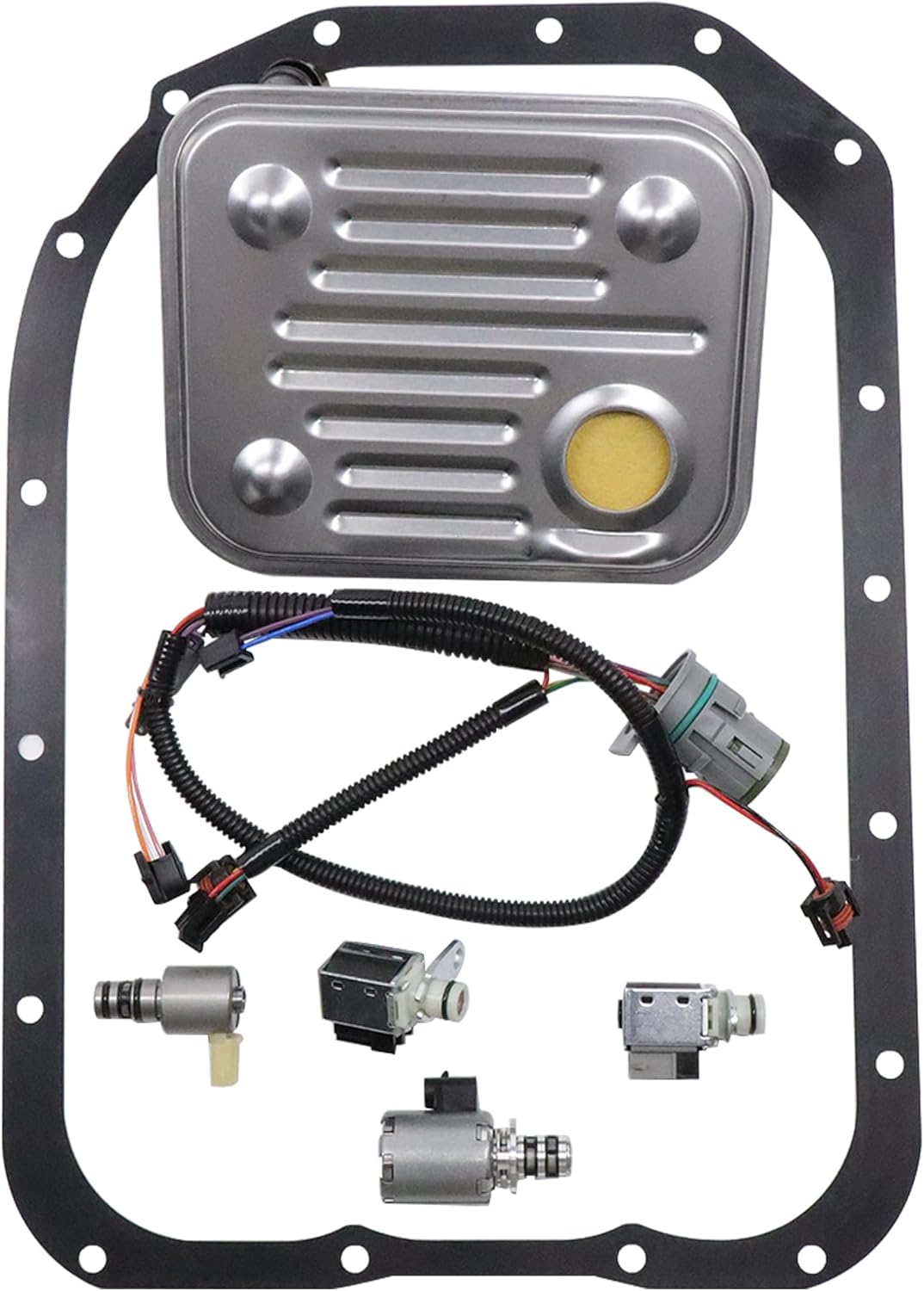
If the roller clutch or the drum came apart, you are into the whole unit anyway. Core Transmission Parts stocks the master kits for both sides of this comparison, frictions, steels, gaskets, seals and bushings in one box, so you are not waiting on a second shipment mid-build.
4L80E Master Rebuild Kit →Ford side: 4R100 Stage-1 Master Rebuild Kit. Full catalogs: 4L80E and 4R100.
Gearing, and why the Ford feels quicker loaded
The 4L80E's nominal ratios show up cleanly in its own diagnostic limits. The TCM calculates ratio from the input and output speed sensors and sets a ratio error outside these windows: 1st between 2.38 and 2.65, 2nd between 1.43 and 1.58, 3rd between 0.95 and 1.05, Reverse between 1.97 and 2.17. Center those and you get the familiar 2.48 / 1.48 / 1.00 with a 0.75 overdrive.
The 4R100 runs a deeper first and a deeper overdrive: 2.71 / 1.54 / 1.00 / 0.71. Published Reverse figures for the 4R100 disagree across sources. You will see both 2.18 and 2.88 quoted, so verify against the service data for your specific application rather than trusting a spec chart.
That 2.71 against 2.48 first gear is why a loaded Super Duty leaves easier than a loaded 2500 at similar power, and the 0.71 overdrive drops cruise RPM further than the GM's 0.75. The cost is a wider 1-2 step on the Ford, which is part of why the intermediate band and its servo get so much attention on 4R100 builds.
Electrical: what you actually measure
This is where the two units stop resembling each other at all, and where most misdiagnosis happens.
4L80E, on the meter
Two on/off shift solenoids run the shift pattern: 1st is A ON / B OFF, 2nd is both OFF, 3rd is A OFF / B ON, 4th is both ON. Resistances at the pass-through connector are 18 to 24 ohms for each shift solenoid, 3.5 to 5.2 ohms for the pressure control solenoid, and 10 to 14 ohms for the TCC solenoid. The output speed sensor should read 1,000 to 2,000 ohms across its pins.
Line pressure is commanded by current, and the relationship is inverse: more current, less pressure. At 0.0 to 0.02 amps expect 157 to 177 psi; at 0.98 to 1.1 amps, 35 to 55 psi. The TCM sets a PCS current error when return amperage varies more than 0.16 amp from commanded for one second, and its failsafe is maximum line pressure. A shift solenoid circuit fault gives you max line pressure, no TCC, and 2nd or 3rd gear only.
Road-test gauge specs: minimum 35 psi at idle in Park, Neutral and both Drive ranges, up to 171 psi at larger throttle; Reverse at least 67 psi at idle and up to 324 psi. Use a gauge good for 325 to 350 psi — a 200 psi gauge gets destroyed on the first Reverse snap.
4R100, on the meter
The 4R100 story is solenoid body generations, and getting it wrong buys a comeback. Per ATRA's GEARS interchange write-up, the 4R100 went to a pulse-width-modulated torque converter clutch for diesel applications in 1998, with gas applications following in 1999. The PWM solenoid body carries Ford part number F81Z-7G391-CB, and its TCC solenoid reads 10 to 20 ohms rather than the 20 to 30 ohms of the earlier on/off design. That is your fastest bench check for which generation is in front of you.
Which trucks got PWM matters too. The ATSG 4R100 manual puts the PWM converter clutch on V-10 gas and all diesel trucks, with the on/off solenoid on the other gas engines. The change is not only in the solenoid pack. The PWM pump cover has a larger converter clutch control valve and an added .036" orifice in the TCC signal passage, and ATSG says the two pump and solenoid pack versions do not interchange. Measure the TCC solenoid across case connector pins 1 and 4 to confirm which one you have.
The PWM pump also adds a wear point the 4L80E does not have in the same form. Sonnax explains that the TCC control plunger valve that cushions PWM apply oscillates constantly and wears its sleeve. The leak shows up as lockup shudder and TCC cycling, which is why a 4R100 with a shudder complaint needs the pump cover inspected, not just a converter. Our 4R100 torque converter shudder guide walks through the full diagnosis.
Two more from that article that save real money. The PWM body added a filter screen to keep the TCC solenoid clean, and it is not serviceable — a clogged or damaged screen means the whole solenoid body. And never swap solenoid bodies across generations directly: the harnesses differ, and 1995-and-later bodies have no spike suppression diodes, because the EPC protection diodes moved out to the ECM.
Where each one actually breaks
4L80E: the boost valve, and everything downstream of it
The signature 4L80E failure is not a clutch. It is a worn pressure regulator boost valve sleeve. Sonnax documents the pattern precisely in its 4L80-E boost valve kit service notes: uncontrollable line rise upward of 500 to 600 psi, high line pressure in Reverse, a buzzing noise, and broken direct clutch drums or cracked cases. The mechanism is Reverse boost oil crossing into the torque signal circuit through a wear-created cross leak at the sleeve. The buzz and the high line come from oil leaking past the aluminum balance plug.
That chain explains most "the 4L80E broke a drum" stories. The drum did not fail because the unit was weak. It failed because a worn valve fed it 500 psi. Reuse the original boost valve and sleeve during a rebuild and you have rebuilt the failure back into it. Sonnax's own note: if you find leakage between the sleeve and the pump bore, use the O-ringed sleeve version to compensate for bore wear rather than scrapping the pump.
4R100: converter flow, and clutch feed leakage
The 4R100's defining complaint is a dragging converter clutch that reads like an engine driveability problem: off-idle hesitation, stumble, what feels like a lean condition. Sonnax walked through how the industry misdiagnosed this on the E4OD for years by chasing apply oil — tap the apply passage and it sits at zero any time the circuit is not charged. The real cause is on the release side. Low pump volume at low RPM does not supply enough converter charge and TCC release oil to keep the clutch off the cover.
Converter charge and release oil pass between the stator support and the turbine shaft, around the front stator bushing, and out through three slots between the turbine shaft and the turbine hub. On an E4OD, oil past the hub continues on to the lube circuit. But a 4R100 turbine hub with a bearing has no lube passages that bypass the bearing, only those three inside-diameter slots. Restrict flow there and you starve both the clutch and lube.
The second 4R100 money-loser is leakage between the case and the clutch feed passages in the intermediate clutch support and the center supports: low apply pressure, soft shifts, burned clutches. If a 4R100 burned a set of frictions for no visible reason, look there first.
Fluid and capacity
4L80E. The recommended fluid is DEXRON III. The Army's 4L80E training material gives HMMWV capacities that map closely to truck applications: about 5 quarts to refill after a filter change, roughly 11.5 quarts dry after an overhaul, and 1 to 2 quarts living in the cooler and lines. That last number is the one people forget when they wonder why the unit is a quart low after a cooler flush.
4R100. Originally MERCON, and that fluid is gone. Ford's own bulletin states that after July 1, 2007, MERCON Automatic Transmission Fluid would no longer be manufactured, with MERCON V (XT-5-QM in quarts, XT-5-DM in drums) as the service fluid going forward. So a 4R100 rebuilt today gets MERCON V. Motorcraft's published typicals put it at 7.5 cSt at 100°C, 33.2 cSt at 40°C, viscosity index 205, pour point below -48°C — better cold flow than what these trucks originally shipped with, which matters if the truck plows.
Do not substitute across brands. DEXRON III in a 4R100, or MERCON V in a 4L80E, is not a shortcut: the friction modification is different, and shift feel and clutch life will tell on you. Our transmission fluid spec chart lists both.
Interchange: within the family, not across the aisle
The obvious question first: nothing interchanges between a 4L80E and a 4R100. Different bellhousing pattern, case, connector and control strategy, no shared service part. Swapping one for the other means an adapter, a custom flexplate and converter, a standalone controller, and driveshaft work.
The interchange that actually matters is E4OD to 4R100, and ATRA's GEARS write-up lays out the traps:
- Pumps. All E4OD pumps interchange freely. Of the four pumps made for the 4R100, only one interchanges with the E4OD pump, and only as a complete assembly. In 1998 every pump assembly used the same body but the stator supports varied, so rough forge codes will not identify them. Look instead at whether the TCC valve is on/off or PWM, and at where the coast clutch drum bushing sits, since the stator support journal moved with it.
- Low/reverse clutch assembly. Replaceable with E4OD parts as a complete set: roller clutch, reverse hub, inner race, return spring, ring gear and hub, planetary, clutches and steels. Never mix individual components.
- Direct drum and sun shell. As of 2000 the direct drum no longer uses the #8 thrust washer, and the sun shell was redesigned to support it. Washer and no-washer versions interchange as sets only.
- Mechanical diode. Ford briefly used a diode-type one-way clutch instead of a sprag. Toothed hub means diode, smooth hub means sprag. ATRA's verdict is blunt: the diode did not work well and was short-lived. Build it with the sprag.
- Accumulator bodies. This one bites people. The 1989-95 E4OD bodies do not interchange with 1996-and-later E4OD or 4R100 bodies, which have three exhaust slots against the earlier four. Put a four-slot 1995 body on a later unit and Reverse oil exhausts through the line modulator exhaust slot, giving you a slip in Reverse that looks like a clutch problem all day long.
Diagnosing before you pull it
Both units reward splitting the circuits: separating hydraulic, electrical and mechanical causes before you touch a wrench. Sonnax's 4L80E no-reverse write-up is the cleanest example, and the method transfers to either unit.
Hydraulically: in a 4L80E no-reverse the players are the direct clutch (also used in 3rd and 4th) and the low/reverse band (also used for engine braking in manual 1st). Test line pressure in Reverse, 3rd, 4th and manual 1st. If 3rd and 4th are present, the direct clutch works. If you get engine braking in manual 1st, the band holds. No engine braking in manual low points at the band, or at a missing or leaking checkball.
Electrically: these units carry a rolling-speed safety. If the control module sees a speed reference greater than about 8 mph during a shift into Reverse, it can block the engagement. Unplug the case connector to force the failsafe pattern and see whether Reverse returns. The catch: with the connector unplugged, line pressure goes to uncontrolled maximum, which masks a real hydraulic leak by overpowering it.
For the Ford side, ATRA publishes a quick-reference set for the E4OD/4R100 with the clutch and band application, pressure, solenoid sequence and fluid temperature charts. The solenoid sequence chart alone settles most "which gear is it commanding" arguments.
Which is stronger? The real answer
Pick the 4L80E when the work is torque, not duration: hauling, moderate towing, a big-block or LS build. TH400 bones handle load well, the diagnostics are thoroughly documented, and parts are everywhere and cheap. Conditions: replace the boost valve and sleeve during the rebuild, add real cooling, and tell the driver to run D3 under load.
Pick the 4R100 when the work is sustained: plowing, long grades, a 7.3 Power Stroke that lives loaded. The commanded coast clutch backing up the overdrive roller clutch is a real durability advantage in exactly that duty, and the coast clutch in Reverse helps when you back heavy. Conditions: seal the intermediate and direct clutch feed, address converter charge flow, and confirm the solenoid body generation before ordering anything.
Neither is fragile. Both die from heat, worn-out fluid, and a valve or seal nobody replaced last rebuild. The 4L80E dies from pressure it should never have seen. The 4R100 dies from flow it never got. Fix the right one and either unit outlasts the truck.
FAQ
Is the 4L80E stronger than the 4R100?
Neither is clearly stronger on paper, and the honest answer is that they fail in different places. The 4L80E carries TH400 architecture and holds up well mechanically, but Sonnax documents uncontrollable line rise of 500 to 600 psi from a worn boost valve sleeve that breaks direct clutch drums and cracks cases. The 4R100 has a coast clutch the PCM can command, which backs up the overdrive roller clutch the 4L80E cannot back up in Overdrive. In plow and tow service the 4L80E overdrive roller clutch fails more often than the 4R100's.
Will a 4L80E bolt up in place of a 4R100?
No. They are competing designs from GM and Ford with different bellhousing patterns, different case lengths, different electrical connectors, and different control strategies. A 4L80E behind a Power Stroke or a 4R100 behind a Vortec means an adapter plate, a custom flexplate or converter, a standalone controller, and driveshaft work. There is no shared service part between the two units.
What fluid does each one take?
The 4L80E was specified for DEXRON III, and Army training material for the HMMWV 4L80E lists roughly 5 quarts to refill after a filter change and about 11.5 quarts dry, plus 1 to 2 quarts in the cooler and lines. The 4R100 originally called for MERCON. Ford stopped manufacturing MERCON after July 1, 2007 and directed MERCON V as the service replacement, so a 4R100 built today gets MERCON V.
Why does my 4R100 shudder or drag at light throttle?
Sonnax traces this to converter charge and clutch release oil flow, not apply oil. At low RPM the pump does not move enough volume to keep release oil behind the converter clutch, so the clutch drags on the cover. The 4R100 inherited the problem from the E4OD, and a 4R100 turbine hub with a bearing has no lube passage that bypasses that bearing. Chasing it on the apply side is how techs waste days.
What line pressure should a 4L80E make?
The U.S. Army's HMMWV 4L80E troubleshooting supplement gives a minimum of 35 psi at idle in Park, Neutral and both Drive ranges, rising to a maximum of 171 psi at larger throttle openings. In Reverse it should be at least 67 psi at idle and up to 324 psi as throttle opens. Use a gauge rated for at least 325 to 350 psi. Pressure that does not fall as pressure control solenoid current rises points at the solenoid, the TCM ground, or the boost valve.