The 4L80E lives under the heaviest things GM sold with an automatic: 2500 and 3500 pickups, cutaway vans, box trucks, motorhome chassis, and a lot of plow rigs. That matters for a fluid discussion, because every one of the maintenance rules GM wrote has a weight or a duty-cycle trigger attached to it, and the 4L80E trips almost all of them by existing. A shop that services this unit on the same schedule it uses for a half-ton is servicing it wrong.
Here is the fluid, the capacity, and the interval, each traced back to factory documentation instead of forum consensus — plus the scan-tool thresholds GM's own diagnostic tables use.
The Fluid: DEXRON-III Originally, DEXRON-VI Now
The factory spec changed mid-life, and both answers are correct for their model years. In the 2004 Chevrolet Silverado owner manual, the Recommended Fluids and Lubricants table lists the automatic transmission as taking "DEXRON-III Automatic Transmission Fluid." Two model years later, the same table in the 2006 manual lists "DEXRON-VI Automatic Transmission Fluid." Nothing changed inside the 4L80E between those books. The fluid program changed.
What makes DEXRON-VI the right service fill for every 4L80E, including a 1994 unit, is GM's own language when it launched the fluid. Wayne Colonna of ATSG reprinted the April 2005 GM press release in Transmission Digest, and its fourth bullet reads: approved for service application on all prior-model-year Hydra-Matic automatic transmissions. GM developed the fluid around the then-new 6L80, made it the factory fill starting April 4, 2005, and simultaneously blessed it for everything it had ever built.
The other half of that story is availability. As Colonna noted at the time, the DEXRON-III licensing program was winding down along with Ford's Mercon program. A jug labeled DEXRON-III today is not carrying an active GM license, so the label tells you what the blender wants you to think, not what GM verified. DEXRON-VI is the spec GM still licenses.
What Actually Changes in the Pan
DEXRON-VI is thinner and more shear-stable than what it replaced. Per the ExxonMobil product data sheet for Mobil DEXRON-VI ATF, the fluid measures 29.5 mm²/s kinematic viscosity at 40°C and 5.83 mm²/s at 100°C, with a Brookfield viscosity of 11,500 mPa·s at -40°C and a 220°C (428°F) flash point. ExxonMobil states the fluid "provides improved performance in older GM vehicles, wherever DEXRON is specified."
On a 4L80E the cold-flow number is the one you feel. These trucks sit outside, and a -40°C Brookfield figure that low means the pump primes and the pressure regulator behaves on a cold start instead of hammering the first two shifts. The trade going the other way: thinner fluid finds worn bores. If a 200,000-mile 4L80E develops a soft 1-2 right after a fluid change, the fluid did not wear the boost valve sleeve out — it stopped covering for it. Vacuum test the valve body before you argue with the fluid.
Capacity: Two Numbers, and Neither One Is the Target
Worth saying plainly before the numbers: GM does not publish an automatic transmission fluid capacity in the owner literature for these trucks. The Capacities and Specifications tables in the 1997 C/K, 2004 Silverado, and 2006 Silverado manuals list cooling system, crankcase, fuel tank and refrigerant, and skip the transmission entirely. That is deliberate — GM's instruction is to fill to a level, not to a volume.
The working figures for a 4L80E, which tell you how much fluid to have on the bench rather than how much to pour in:
| Service | Plan on | Notes |
|---|---|---|
| Pan and filter, deep sump (most 2500/3500 and van applications) | ~7.5 to 8 quarts | Converter stays full. This is the routine service. |
| Pan and filter, shallow sump applications | ~5 quarts | Several 4L80E applications shipped a shallower pan. Measure what drains out. |
| Total dry fill, unit and converter | ~13.5 quarts (12.8 L) | Overhaul or converter-drained R&R only. |
| Aftermarket deep pan | Add 2 to 4.5 quarts | Varies by pan. The stock dipstick still reads correctly if the pan is designed for it — confirm with the pan maker. |
Why the exact number is not the point sits in the 1997 C/K manual's fill instruction: after a hot check, "add only enough of the proper fluid to bring the level up to the HOT area," and GM notes it "doesn't take much fluid, generally less than one pint (0.5 L)." One pint is the resolution the dipstick works at. Pour a full quart because the stick looked a little low and you have overfilled it, and an overfilled 4L80E aerates fluid into the rotating drums and shows up as a shudder nobody can find.
The Level Check, the Way GM Wrote It
Most 4L80E level complaints are procedure errors, not leaks. Skipping any of GM's preconditions puts the reading off by more than the amount you are trying to measure.
- Wait 30 minutes before checking if the truck has been driven when it is above 90°F (32°C) outside, at high speed for a while, in heavy traffic in hot weather, or while pulling a trailer.
- Get the fluid to 180°F to 200°F (82°C to 93°C) — GM's stated normal operating temperature for an accurate reading. Drive about 15 miles (24 km) if it is over 50°F out. Below 50°F, drive in THIRD until the temperature gauge comes up.
- Park level, engine running, parking brake set, shifter in PARK.
- With your foot on the brake, cycle the shifter through every range, pausing about three seconds in each, then return to PARK. This fills the circuits you are about to measure around.
- Idle three minutes or more before pulling the stick, so entrained air comes out of suspension.
- Pull, wipe, push all the way in, wait three seconds, pull again. Read both sides of the stick and take the lower of the two readings. It must land in the HOT or cross-hatched area for a hot check.
- Only add fluid after a hot check. GM states flatly that a cold check "is used only as a reference." Setting a 4L80E level cold and calling it done is how units leave the shop a half quart light.
The 2006 manual also documents what the dash gauge means, and it is a useful sanity check: normal operating range is 180°F (82°C) to about 200°F (93°C). At approximately 265°F the DIC throws a TRANSMISSION HOT message and the transmission enters a protection mode with altered shift patterns, and it will not return to normal shifting until fluid temperature drops below 260°F.
Reading Fluid Temperature on the Scan Tool
The dash gauge is coarse. The PID is not. GM's published 2005 4L80E transmission diagnostic parameter tables — the same document that defines the DTC enable conditions in the PCM — give you the thresholds the module is actually watching on the TFT (transmission fluid temperature) sensor:
- P0711, TFT range/performance. Two tests. The stuck-sensor test fails if TFT has not changed more than 2.25°C over the monitoring window; the rationality test fails on a change greater than 20°C. A TFT reading that never moves is a fault even when the number looks plausible.
- P0712, TFT circuit low input (high temperature indicated). Raw TFT below 7 A/D counts — a short to ground in the signal circuit or the sensor. This is the one that shows up as an absurd high temperature and puts the unit in protection mode with cool fluid in the pan.
- P0713, TFT circuit high input (low temperature). Raw TFT above 253 A/D counts — an open or short to voltage. Set time is 407 seconds, so a marginal connection can drive for seven minutes before it flags.
- P0741, TCC stuck off. Sets on TCC slip at or above 125 RPM commanded on in 2nd or 3rd. Note the enable window: the test only runs with fluid temperature above +20°C and below 150°C. Above 302°F the PCM stops evaluating converter slip entirely, which is exactly when a cooked converter is slipping most.
- P0742, TCC stuck on. Sets when slip stays between -15 and +15 RPM with the clutch commanded off.
Practical use: watch TFT and TCC slip together on a loaded pull. Slip under 60 RPM locked and a TFT that stabilizes under 200°F on a grade is a healthy cooling system. A TFT that walks past 240°F towing is a cooler problem you can fix before it becomes the failure in the next section.
The Service Interval: 50,000 Miles Is the Default, Not the Exception
This is where the 4L80E separates from everything else in the GM lineup, and it is stated outright in the 1997 C/K owner manual under Automatic Transmission Fluid:
"Change both the fluid and filter every 50,000 miles (83 000 km) if the vehicle's GVWR is over 8,600 or if the vehicle is mainly driven under one or more of these conditions" — heavy city traffic where the outside temperature regularly reaches 90°F (32°C) or higher, hilly or mountainous terrain, frequent trailer towing, or taxi, police, or delivery use.
GM then gives the other branch: if the GVWR is not over 8,600 lb and none of those conditions apply, "the fluid and filter do not require changing." The 2004 manual carries the identical rule forward in the Additional Required Services table, with the severe-service fluid and filter change marked at 50,000, 100,000 and 150,000 miles under footnote (h), and normal service standing alone at 100,000.
Now apply it. GM's own diagnostic documentation lists the 2005 4L80E behind the 4.8L, 6.0L and 8.1L in Express, Savana, Suburban, Yukon XL, Silverado, Sierra, Avalanche, P30, W-series W-3500 and Isuzu NPR. Nearly every one of those is over 8,600 lb GVWR before you add a driver.
So the honest reading of GM's own rule is that 50,000 miles is the interval for a 4L80E, full stop. The 100,000-mile "normal service" column was written for the light-duty units. When a customer says the dealer told them the fluid is lifetime, that advice belonged to a different truck.
Why the Interval Is Really About Heat
Fluid does not wear out on a calendar. It oxidizes, and the 4L80E has a specific, well-documented failure that follows overheated fluid.
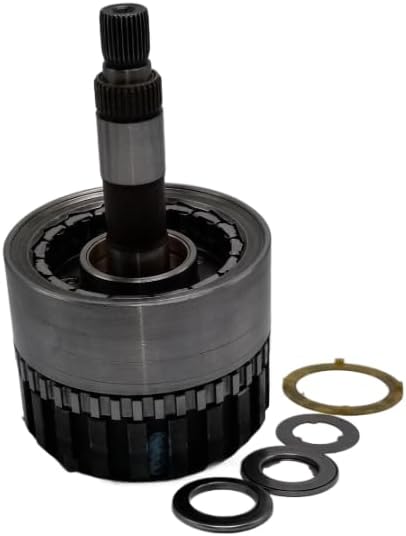
Transmission Digest covered this in its write-up on 4L80-E overdrive clutch failure in plow trucks, and the description will be familiar to anyone who has torn one down after a hard winter: converter fluid turned shades of blue from overheating, anything plastic reduced to a melted blob, every bushing discolored. The specific casualty is the overdrive one-way roller clutch. Its cage is plastic. When the unit overheats, the cage melts, and the roller clutch fails immediately after.
What makes the 4L80E worse than a Ford 4R100 in the same duty is the clutch strategy. In both units the OD roller clutch holds in 1st through 3rd and freewheels in 4th. But on the 4L80E, in overdrive range the roller clutch is holding by itself — the overrun clutch only applies in the manual ranges. The 4R100 has a PCM-controlled coast clutch solenoid that backs the roller clutch up on hard throttle in overdrive. The 4L80E has no equivalent. If the driver is pushing snow or dragging a trailer in D, that plastic-caged roller clutch is carrying the whole job alone.
Two things follow. Tell plow and tow customers to run a manual range under load — it applies the overrun clutch, gives engine braking, and shares the load off the roller clutch. And treat cooling capacity as part of the fluid service: if a 4L80E is in for its 50,000-mile fluid and filter and it tows, the cooler is the other half of that job.
Stacked-plate auxiliary cooler
The single most effective thing you can sell alongside a 4L80E fluid service on a truck that works. A 13-row stacked plate flows better and rejects more heat than the tube-and-fin coolers these trucks left the factory with.
See the cooler kit →The Short Version
- Fluid: DEXRON-VI for every 4L80E. GM approved it for service in all prior-model-year Hydra-Matics in 2005, and DEXRON-III is no longer a licensed, verifiable spec.
- Capacity: Have about 8 quarts on hand for a deep-pan service, about 5 for a shallow pan, and about 13.5 for a dry fill. Then set the level, not the volume.
- Level: Hot check at 180°F to 200°F, on level ground, engine idling after a full range cycle and three minutes of idle. Read the lower side of the stick. Add by the half pint.
- Interval: 50,000 miles for fluid and filter, because a 4L80E vehicle is over 8,600 lb GVWR and GM's severe-service trigger is met by definition.
- Watch: TFT on the scan tool. Anything walking past 240°F under load is eating the overdrive roller clutch cage on a schedule of its own.
4L80E filters and pan gaskets, deep pans, coolers, solenoid kits, rebuild kits, and the tools that keep a fluid service clean — shipped fast from the USA.
Shop 4L80E parts →Sources
- General Motors — 1997 Chevrolet C/K Pickup Owner's Manual. The Automatic Transmission Fluid section: the 50,000-mile fluid and filter interval tied to GVWR over 8,600 lb and the four severe-use conditions; the statement that the fluid and filter do not require changing outside those conditions; the 30-minute cool-down precondition; 180°F to 200°F normal operating temperature for the check; the range-cycle, three-minute idle and lower-reading dipstick procedure; and the "generally less than one pint (0.5 L)" fill note. assets.gm.com
- General Motors — 2006 Chevrolet Silverado Owner Manual. Recommended Fluids and Lubricants listing DEXRON-VI as the automatic transmission requirement; the Transmission Temperature Gage section giving the 180°F to 200°F normal range, the TRANSMISSION HOT message and protection mode at approximately 265°F, and the return to normal shifting below 260°F. (The 2004 edition of the same manual lists DEXRON-III and carries the severe-service footnote (h) schedule.) assets.gm.com
- General Motors Service Information — 2005 4L80E Transmission Diagnostic Parameters. The published PCM enable conditions and thresholds used above: P0711 stuck-sensor and rationality limits of 2.25°C and 20°C; P0712 at raw TFT below 7 A/D counts; P0713 at above 253 A/D counts with a 407-second set time; P0741 at TCC slip of 125 RPM or more with the fluid-temperature enable window of +20°C to 150°C; P0742 at slip between -15 and +15 RPM; and the vehicle and engine application list for the 2005 4L80E. gsitlc.ext.gm.com
- Wayne Colonna, ATSG — "The Path of Least Resistance: The Future of Transmission Fluids," Transmission Digest. Reprints the April 2005 GM press release introducing DEXRON-VI, including the statement that it is approved for service application on all prior-model-year Hydra-Matic automatic transmissions, the April 4, 2005 factory-fill date, the 6L80 as the development driver, and the expiry of the DEXRON-III and Mercon licensing programs. transmissiondigest.com
- Transmission Digest — "Understanding 4L80-E Overdrive Clutch Failure." The overheat failure chain in plow and heavy-duty service: converter fluid turned blue, melted plastic and discolored bushings, and the plastic cage of the overdrive roller clutch melting and taking the roller clutch with it; plus the clutch-strategy comparison showing the 4L80E overrun clutch applies only in the manual ranges while the 4R100 has a PCM-controlled coast clutch backing its roller clutch in overdrive. transmissiondigest.com
- ExxonMobil — Mobil DEXRON-VI ATF product data sheet. GM DEXRON VI approval and the typical properties cited: 29.5 mm²/s kinematic viscosity at 40°C, 5.83 mm²/s at 100°C, 11,500 mPa·s Brookfield viscosity at -40°C, 220°C flash point, and the statement that the fluid provides improved performance in older GM vehicles wherever DEXRON is specified. mobil.com