The GM 4L80E is the heavy-duty 4-speed automatic that GM put behind every big-block and diesel application from 1991 through 2013. Every 2500HD and 3500 Silverado and Sierra, the full-size vans, the commercial chassis trucks, Hummers, and a significant number of motorhome applications all used the 4L80E. On top of that, the 4L80E is the most popular swap transmission in the performance world for anyone who has outgrown the 4L60E. There are probably more 4L80E units in service today than at any point in their production run.
This guide covers everything a shop or owner needs to know about the 4L80E: fluid specs, service procedures, common failure points with actual part numbers, and the 4L60E-to-4L80E swap considerations.
See all Chevy transmission guides on our Chevy hub page or visit our GM transmission hub for coverage across all GM brands.
4L80E Application and Identification
The 4L80E was produced from 1991 to 2013. It is the electronically controlled successor to the TH400 (Turbo-Hydramatic 400), and shares the same basic planetary gearset layout. Key applications include:
- 1991-2000: Chevrolet/GMC C/K 2500 and 3500 with 7.4L (454) V8 and 6.5L diesel
- 2001-2007: Silverado/Sierra 2500HD and 3500 with 8.1L (496) V8 and 6.6L Duramax
- 2007-2013: Silverado/Sierra 2500HD and 3500HD with 6.0L V8 (some applications)
- 1996-2014: Express/Savana 2500 and 3500 vans
- 2003-2009: Hummer H2
- Motorhome chassis: P30, P32, Workhorse W-series
To identify a 4L80E vs. a 4L60E on the vehicle: the 4L80E is physically larger in every dimension. The pan is a different shape -- the 4L80E pan is roughly rectangular with squared-off corners, while the 4L60E pan has a distinctive irregular shape. The 4L80E also has a 2-piece case (the bellhousing is integral on the 4L60E but bolted on the 4L80E in some configurations). The quickest visual ID is the pan shape and the overall length -- the 4L80E is approximately 26.4 inches long, compared to 23.5 inches for the 4L60E.
Fluid Specification and Capacity
Fluid Type
The 4L80E requires Dexron III (1991-2005 applications) or Dexron VI (2006+ applications). Dexron VI is backward-compatible with Dexron III, so using Dexron VI in any 4L80E is acceptable and recommended. GM obsoleted Dexron III in favor of Dexron VI, and Dexron VI is a superior fluid with better oxidation stability and a wider operating temperature range. For any 4L80E service in 2026, use Dexron VI regardless of the vehicle's original spec.
Capacity
The 4L80E has the largest fluid capacity of any common GM automatic transmission:
- Total system capacity (dry fill): approximately 13.5 quarts
- Pan drop and filter change: approximately 7.7 quarts recovered
- Torque converter drain (where accessible): adds approximately 4-5 quarts
- Deep pan (aftermarket): adds 2-4 quarts depending on the pan
The torque converter on the 4L80E holds a significant amount of fluid. A pan-drop service only replaces about 55-60% of the total fluid. For a thorough fluid exchange on a high-mileage unit that has never been serviced, two drain-and-fill cycles approximately 1,000 miles apart will replace the majority of the fluid without the risks associated with a full flush on a neglected transmission.
For a detailed comparison of Dexron VI against other ATF types, see our complete ATF fluid types guide.
Service Procedure
Pan Drop and Filter Change
The 4L80E does not have a drain plug from the factory (some aftermarket pans add one). The service procedure is a pan drop:
- Warm the transmission to operating temperature (180-200F) by driving the vehicle for 15-20 minutes. Warm fluid drains more completely.
- Position a drain pan that holds at least 10 quarts under the transmission pan.
- Remove the pan bolts starting from one corner, leaving 2-3 bolts on the opposite side finger-tight. Let the pan tilt and drain. The 4L80E pan holds a lot of fluid -- be prepared for volume.
- Remove the remaining bolts and lower the pan. Inspect the pan for debris: normal wear produces a thin film of gray material on the magnet. Metal flakes, brass shavings, or chunks of clutch material indicate internal damage.
- Remove the old filter. The 4L80E filter (AC Delco TF289 / Wix 58955 / Fram FT1130A) pulls straight down off the valve body. Note the orientation of the filter seal -- the new filter seal must seat flush against the valve body surface.
- Clean the pan thoroughly. Clean the magnet. Inspect the pan gasket surface.
- Install the new filter. Push it firmly into the valve body until it seats.
- Install the pan with a new gasket (AC Delco 24206182 or equivalent cork/rubber gasket). Pan bolt torque: 18 ft-lbs for steel pans, 10 ft-lbs for cast aluminum aftermarket pans. Tighten in a cross pattern.
- Add 7 quarts of Dexron VI through the dipstick tube. Start the engine, shift through all gears with the brake held, return to Park, and check the level. Add fluid to bring it to the correct level on the dipstick at operating temperature.
Service Interval
GM's original recommendation varied by year and application, but most 4L80E applications called for service at 50,000 miles under normal conditions and 25,000 miles under severe service (towing, commercial use, high ambient temperature). For a 3/4 or 1-ton truck that tows -- which is what most of these trucks do -- use the severe service interval: every 25,000-30,000 miles. The 4L80E is a tough transmission, but it generates real heat under towing loads, and hot fluid degrades faster.
Common 4L80E Failures and Diagnosis
Forward Sprag Failure
The forward sprag (one-way clutch) is the single most common hard failure inside the 4L80E. When the forward sprag fails, the transmission loses 2nd and 4th gears. The vehicle will launch in 1st, then either flare (RPMs spike with no acceleration) or slip badly on the 1-2 shift. Some forward sprag failures are intermittent at first -- the sprag slips under load but grabs under light throttle. This gets worse quickly. Once you confirm a sprag failure, the transmission needs to come out. The forward sprag is not accessible without a full disassembly.
The factory one-way clutch is a Borg-Warner-style sprag, and the upgrade path is well documented. Per Sonnax, the OE intermediate sprag in the TH400 and 4L80E family is a 34-element unit, and builders have long swapped in the 36-element OE forward clutch sprag from the 4T80E. The Borg-Warner 27499AM that performance builders relied on is discontinued; Sonnax replaced it with heavy duty sprag element 34658-HD, a 40-element sprag manufactured by GMN that supersedes OE numbers 24210445 and 27499AM (inner diameter 3.460 in, outer diameter 4.115 in, width 0.834 in). The higher element count spreads the load across more contact points, which is exactly what you want behind a big-block or a boosted LS. If you are rebuilding a 4L80E for any performance application, upgrade the sprag. The factory unit is the weak link in an otherwise very strong transmission.
1-2 Accumulator Piston Failure
The 1-2 accumulator piston is an aluminum piston that cushions the 1-2 shift. Over time, the aluminum piston bore wears, and the piston can crack. A cracked or worn accumulator piston causes a harsh 1-2 shift that gets progressively worse. The fix is an upgraded accumulator piston -- Sonnax makes a steel replacement (PN 74204-01) that does not wear like the factory aluminum unit. This is a standard upgrade during any 4L80E rebuild and should be done on every unit regardless of application.
Shift Solenoid Failures
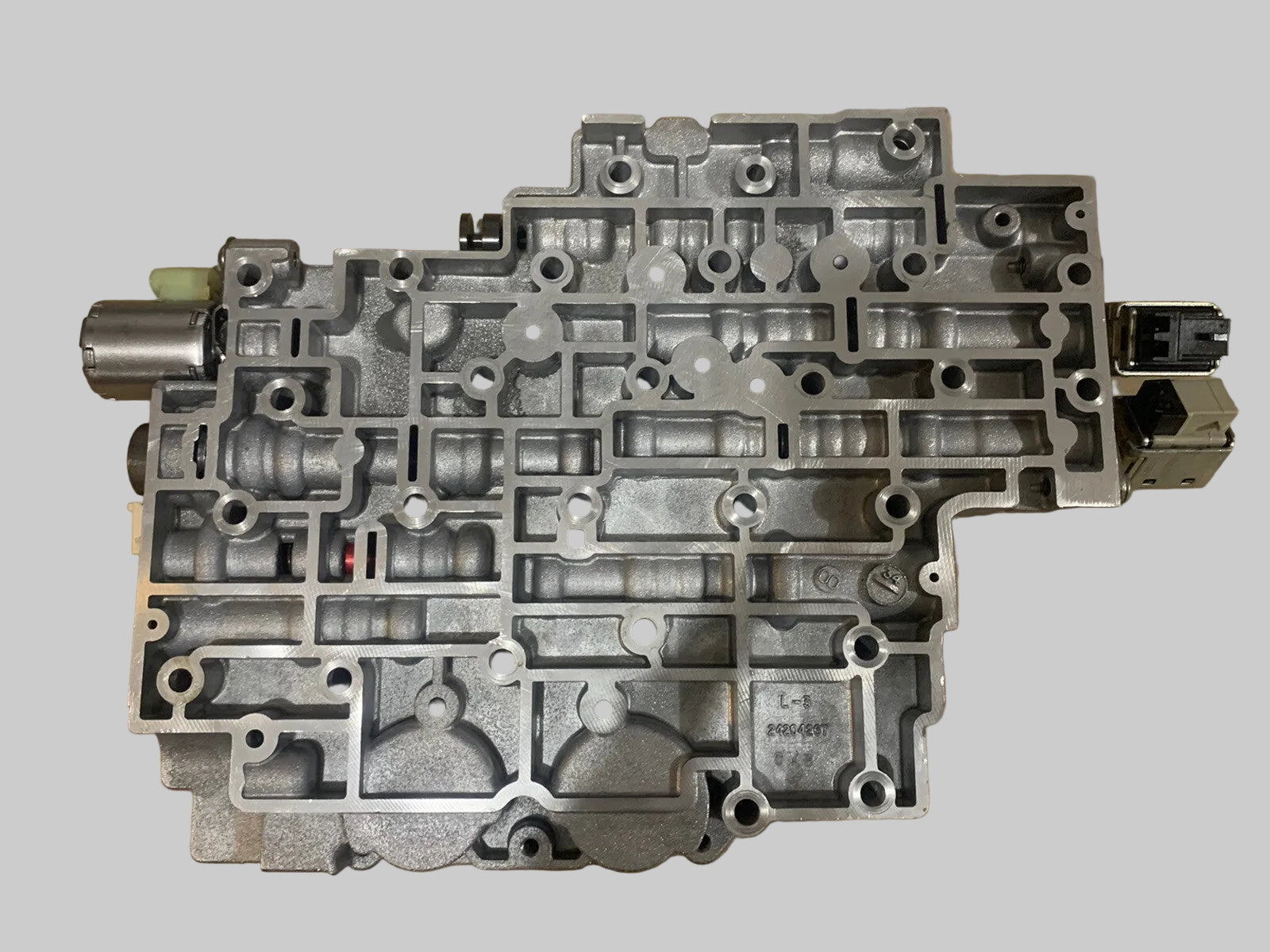
The 4L80E uses two shift solenoids (Solenoid A and Solenoid B) and a TCC solenoid, plus a force motor (pressure control solenoid). These solenoids are mounted on the valve body inside the pan. Common failure modes:
- Shift Solenoid A (third design, GM 24201004): Controls the 1-2 and 3-4 shifts. Failure causes stuck in one gear or no upshift from 1st. Often sets code P0751 (Shift Solenoid A Performance) or P0753 (Shift Solenoid A Electrical).
- Shift Solenoid B (third design, GM 24201005): Controls the 2-3 shift. Failure causes no 2-3 shift or harsh 2-3 shift. Code P0756 (Shift Solenoid B Performance) or P0758 (Shift Solenoid B Electrical).
- TCC Solenoid (PN AC Delco 24227747): Controls torque converter lockup. Failure causes TCC shudder, no lockup (poor fuel economy, overheating), or stuck lockup (engine stalls when coming to a stop). Code P0741 (TCC Performance) or P0742 (TCC Stuck On).
- Force Motor / Pressure Control Solenoid (PN AC Delco 24248893): Controls line pressure. Failure causes harsh shifts across all gears, low line pressure, or erratic shift timing. Code P1860 (TCC PWM Solenoid) in some applications.
Those are the third-design shift solenoids. Per ATRA Technical Bulletin #266, the 4L80E went through three shift solenoid designs identified by color: first design blue (A) and red (B), second design gray and green, and the third design released in November 1993 in purple (A) and tan (B). The third-design parts were a reliability update and can be used on any model year 4L80E, so there is no reason to install an early-design solenoid in a unit you want to keep.
The same bulletin flags the pressure control solenoid trap that catches a lot of shops: 1991-93 units used a silver Bosch PCS, GM 8677314, and 1994-up units use a black Holley PCS, GM 8684216. The 1994 change removed balance oil from the end of the solenoid, so installing a Bosch unit in a Holley-era transmission produces high line pressure. Check the color before you order.
All four solenoids can be replaced with the pan dropped -- no transmission removal required. When replacing one shift solenoid, replace both. They have the same service life and the labor to access them is the same. Test solenoid resistance at the case connector before ordering parts: Shift solenoids should read 20-30 ohms. TCC solenoid should read 10-15 ohms. The Holley force motor reads 3-8 ohms per ATRA, and its scan tool duty cycle normally sits around 50-70% at idle, falling as load increases. Out-of-spec resistance confirms a failed solenoid coil.
For the full line pressure diagnostic sequence, including the 6.5L diesel injection pump failure that burns 4L80E clutches without ever setting a transmission code, see our 4L80E low line pressure diagnosis guide.
For more on solenoid testing procedures, see our solenoid testing without a factory scan tool guide.
Valve Body Wear
The 4L80E valve body develops bore wear over time, particularly in the TCC apply valve bore and the pressure regulator valve bore. Bore wear causes inconsistent hydraulic pressure that manifests as erratic shifts, delayed engagements, and TCC shudder that does not respond to solenoid replacement. There is a specific, well-documented failure at the pump end worth checking on any unit that came in with broken parts: Sonnax reports that worn 4L80E and 4L85E boost valve sleeves let reverse boost oil cross-leak into the torque signal circuit, producing uncontrollable line rise upward of 500-600 psi, high line pressure in Reverse, a buzzing noise, and broken direct clutch drums or cracked cases. Oil leaking past the aluminum balance plug contributes to the same complaint. Sonnax boost valve kit 34200-01K addresses it with a hardened steel valve with over 20% wider spools and an O-ringed steel sleeve. TransGo sells a shift kit (PN 4L80E-HD2) that addresses the most common bore wear issues with oversized valves and recalibrated springs. The Sonnax valve body repair kit lineup covers specific bore repairs if you are doing a selective repair rather than a full rebuild.
Rear Band Failure
The 4L80E uses a band for 2nd gear (unlike the 4L60E which uses a band for reverse). The rear band adjustment on the 4L80E is accessible through an access point on the case, but band adjustment on a 4L80E is not a common standalone service -- it is typically done during a rebuild. If the band is burned, the drum is usually scored and both need replacement.
The 4L60E-to-4L80E Swap
This is the single most common transmission swap in the GM performance world. The 4L60E handles roughly 400 lb-ft of torque before it starts breaking parts. The 4L80E handles 600+ lb-ft in stock form and 800+ lb-ft with basic upgrades. Anyone running a built LS engine, a supercharged application, or a turbo setup that makes real power will eventually break a 4L60E. The answer is a 4L80E.
We have a complete standalone guide covering the 4L60E-to-4L80E swap in detail: crossmember modifications, driveshaft length differences, wiring harness considerations, and ECM tuning requirements. See our 4L60E-to-4L80E swap guide for the full walkthrough.
Key Swap Considerations (Summary)
- Length difference: The 4L80E is approximately 3 inches longer than the 4L60E. The driveshaft must be shortened, or a slip yoke eliminator kit used.
- Crossmember: The factory crossmember for a 4L60E-equipped truck will not work. You need a crossmember from a 4L80E-equipped truck (same generation) or an aftermarket adjustable crossmember.
- Wiring harness: The 4L80E uses a different case connector than the 4L60E. A conversion harness (available from Howell, PSI, or custom builders) adapts the 4L60E engine harness to drive the 4L80E solenoids and sensors. The connector pinout is completely different.
- ECM/PCM tuning: The PCM must be tuned to recognize the 4L80E gear ratios and shift logic. A 4L60E tune running a 4L80E will cause shift timing errors, incorrect speedometer readings, and potentially trigger limp mode. HP Tuners, EFI Live, or similar platforms can handle this calibration.
- Torque converter: The 4L80E uses a different converter bolt pattern than the 4L60E. Do not attempt to use a 4L60E converter on a 4L80E. The 4L80E converter is larger in diameter and has a different input shaft spline count.
- Flexplate: A 4L80E-specific flexplate is required. The bolt pattern and converter mounting are different from the 4L60E flexplate.
The swap is not trivial, but it is well-documented and parts are widely available. Budget approximately $2,500-$4,500 for a complete swap using a used or reman 4L80E, converter, crossmember, driveshaft modification, harness, and tuning.
4L80E vs. 4L85E
The 4L85E is the heavy-duty variant of the 4L80E, introduced in 2002 for the 8.1L Vortec and some Allison-adjacent applications. The differences are internal: the 4L85E has a 5-pinion planetary gearset (vs. 4-pinion on the 4L80E), wider clutch packs, and a heavier-duty input shaft. Externally, the two transmissions are identical -- same case, same pan, same bellhousing bolt pattern, same case connector.
For performance builds, the 4L85E internals are the preferred starting point if you can source one. The 5-pinion planetaries distribute the load better and survive higher torque levels without upgrade. For a stock-power 3/4 or 1-ton truck, the standard 4L80E is more than adequate.
Recommended Products
Transmission Cooling for Towing Applications
The 4L80E generates significant heat under towing loads. A 2500HD pulling a 10,000-lb trailer on a summer highway will push transmission fluid temps well above 220F with the factory cooler alone. Every 20F above 200F cuts fluid life roughly in half. If the truck tows regularly, an auxiliary transmission cooler is not optional -- it is required maintenance.
Cooler Sizing
For a 3/4 or 1-ton truck that tows at or near its GVWR rating, install a cooler rated for at least 30,000 GVW. The Tru-Cool 40,000 GVW plate-and-fin cooler (PN LPD47391) is the standard recommendation for heavy-duty towing applications. Mount it in front of the A/C condenser where it gets direct airflow. Do not stack it behind the radiator where it receives pre-heated air.
Temperature Monitoring
Install a transmission temperature gauge or monitor fluid temps with a scan tool during towing. Normal operating range for the 4L80E is 175-220F. Sustained temps above 240F mean the cooler is undersized, the fluid is degraded, or both. If you see temps above 260F, pull over and let the transmission cool. Driving at 280F+ will cook the clutch packs and seals in minutes, not hours.
For a deeper look at overheating causes and prevention across all transmissions, see our transmission overheating guide.
Part Numbers Quick Reference
For shop owners and DIYers ordering parts, here are the most commonly needed 4L80E part numbers:
- Filter: AC Delco TF289, Wix 58955, Fram FT1130A
- Pan gasket (cork): AC Delco 24206182, Felpro TOS18753
- Shift Solenoid A (third design, purple): GM 24201004
- Shift Solenoid B (third design, tan): GM 24201005
- TCC Solenoid: AC Delco 24227747
- Force Motor / PCS: GM 8677314 (Bosch, silver, 1991-93) or GM 8684216 (Holley, black, 1994-up) — not interchangeable; later service number AC Delco 24248893
- Internal wiring harness: AC Delco 24200161 (1991-2003), verify by year
- Intermediate sprag (upgraded): Sonnax 34658-HD, 40-element (supersedes BorgWarner 27499AM / GM 24210445)
- 1-2 accumulator piston (steel): Sonnax 74204-01
- Shift kit: TransGo 4L80E-HD2
Related Reading
- Chevy Transmission Hub Page -- all Chevy/GMC guides and resources
- GM Transmission Hub Page -- coverage across all GM brands
- 4L60E-to-4L80E Swap Guide -- complete swap walkthrough
- 4L60E Common Problems and Fixes -- covers the lighter-duty sibling
- 6L80 Transmission Service Guide -- the 4L80E's modern replacement in HD applications
- Complete ATF Fluid Types Guide -- Dexron VI vs. ATF+4 vs. Mercon LV
- Transmission Overheating: Causes and Prevention -- critical for towing applications
- How to Read Transmission Live Data
Need parts for this job?
Rebuild kits, hard parts, solenoids, valve bodies, filters, gaskets and the correct fluid for this unit — shipped fast from the USA on secure checkout.
Shop 4L80E parts →Sources
- ATRA — Technical Bulletin #266, "4L80E Updates," Chevrolet, 1995. Backs the three shift solenoid designs identified by color (first design blue A / red B, second design gray / green, third design purple A / tan B released November 1993) and the third-design GM part numbers 24201004 and 24201005; the pressure control solenoid change from the silver Bosch GM 8677314 (1991-93) to the black Holley GM 8684216 (1994-up); the oil channeling change that removes balance oil from the end of the solenoid and the resulting warning that a Bosch unit must not replace a Holley or high line pressure will result; and the Holley PCS specification of 3 to 8 ohms with a 50 to 70 percent duty cycle at idle that decreases as load increases. atracom (PDF)
- Sonnax — Heavy Duty Sprag Element 34658-HD product page (GM TH400, 4L80-E, 4L85-E, 4T80-E). Backs the 34-element OE intermediate sprag in TH400 and 4L80-E series units, the common builder swap to the 36-element OE 4T80-E forward clutch sprag, the discontinuation of the BorgWarner 27499AM, the 40-element GMN-manufactured direct replacement, the superseded OE part numbers 24210445 and 27499AM, and the published dimensions (3.460 in inner diameter, 4.115 in outer diameter, 0.834 in width). sonnax.com
- Sonnax — Boost Valve Kit 34200-01K product page (GM 4L80-E, 4L85-E pump). Backs the uncontrollable line rise upward of 500 to 600 psi, high line pressure in Reverse, buzzing noise and broken direct clutch drums or cracked cases; the wear-created cross leak at the sleeve that admits reverse boost oil into the torque signal circuit; the contribution of leakage past the aluminum balance plug; and the hardened steel boost valve with over 20 percent wider spools plus the O-ringed steel sleeve that compensates for pump cover bore wear. sonnax.com
- Transmission Digest — "Low Line Pressure in 4L80-E in Diesel-Powered Trucks," Gregg Nader, Sonnax TASC Force, March 1, 2002. Backs the 1994-and-later 6.5L diesel drive-by-wire APP sensor serving as the main input for both fuel delivery and commanded transmission line pressure, the internal injection pump leak that overfuels the engine, the resulting 2 to 10 percent launch throttle in place of a normal 50 to 100 percent, and the soft sliding shifts and burned forward, intermediate and direct clutches that follow — the reason a 4L80E behind a 6.5L can fail repeatedly with no transmission fault. transmissiondigest.com
- Sonnax — Lube Regulated Pressure Regulator Valve 34200-14K product page (GM 4L80-E, 4L85-E pump). Backs the statement that the OE pressure regulator valve design prevents adequate cooler flow at low rpm under high pressure and high demand conditions, which can create overheating, and that 1999-and-later vehicles left the factory with EPC pressure set high at idle, producing an engine surge complaint. sonnax.com