A 4R100 converter shudder feels like driving over rumble strips at 40 to 55 mph under light throttle, usually right as the truck settles into 4th or when it is pulling a trailer up a long grade. The torque converter clutch is being asked to hold, but it is slipping and grabbing instead of applying smoothly. On a Super Duty or an E-Series this complaint is common. Most of the time the fix is fluid, a worn valve in the pump, or a cooler bypass valve, not an automatic converter replacement.
This guide covers how the 4R100 applies its converter clutch (there are two different systems), how to prove the shudder is the TCC, the codes and solenoid readings, and the known hydraulic causes in order from cheapest to most expensive. Specs come from the ATSG 4R100 manual and Ford TSB 06-14-4. The valve and flow failures come from Sonnax and Transmission Digest (full list under Sources).
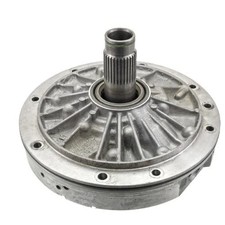
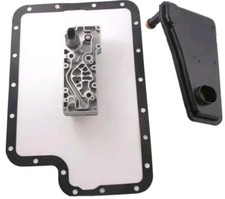
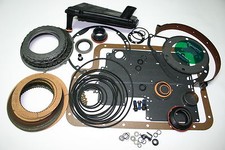
Two lockup systems: PWM and on/off
Before you diagnose anything, find out which lockup system the truck has. ATSG explains that from the start of 4R100 production Ford built two converter clutch strategies. A pulse width modulated (PWM) version went on V-10 gas trucks and all diesels. An on/off version went on the other gas engines. They are not the same transmission in the front:
| Item | On/off (non-PWM) | PWM |
|---|---|---|
| Applications | Other gas engines | V-10 gas and all diesels (7.3L) |
| TCC solenoid resistance (pins 1 and 4) | 20-30 ohms | 10-20 ohms |
| Solenoid pack (Ford) | F81Z-7G391-BA | F81Z-7G391-AB |
| Pump assembly (Ford) | F81Z-7A103-AA (cast iron coast drum) or -BA (stamped steel) | F81Z-7A103-CA |
| Converter clutch control valve | Valve and spring | Larger land (about .070" bigger), plus a bushing and plunger valve line-up |
| Pump cover passages | Has a .070" converter release orifice | Release orifice omitted; .036" orifice and air bleed added in the TCC solenoid signal passage |
ATSG is clear that none of these parts interchange between the two versions. A PWM solenoid pack on a non-PWM pump, or the other way around, is a shudder or lockup complaint you built into the truck. If it came in with a used or rebuilt unit, check that the pump and the solenoid pack match each other and the engine.
Also note where the hardware lives. The converter regulator valve, the converter clutch control valve and (on PWM units) the plunger valve line-up are all in the pump cover, not the main valve body. So a hydraulic lockup fix on a 4R100 usually means pulling the transmission.
Step 1: Prove it is the converter clutch
A 7.3L misfire, a worn U-joint or a driveshaft angle problem can all feel like a shudder. Separate them on the road test:
- The brake-tap test. Hold a steady speed in the range where it shudders, then barely touch the brake pedal without slowing the truck. The brake pedal position switch tells the PCM to release the TCC. If the shudder stops right away and the tach rises a little, it was the converter clutch. If the vibration stays, look at the driveline or the engine. (ATSG lists a failed BPP switch as causing the TCC not to disengage when the brake is applied, so if the tach never moves, check the switch before you trust this test.)
- Load sensitivity. TCC shudder shows up during apply and under light load, and gets worse when hot and when towing. A driveline vibration follows road speed whatever the throttle is doing.
- Which gears. ATSG's application chart says the TCC may be on in any forward gear except Manual 1st. Most complaints happen in 3rd and 4th, because that's where the PCM applies it at cruise.
One PTO note. On PTO-equipped trucks in stationary PTO mode, ATSG says the TCC engages once the engine reaches 1200-1300 rpm. That's normal. Don't write it up as a lockup fault.
Step 2: Codes, scan data and solenoid checks
Run the on-board diagnostics, including the KOER test. The codes that point at the converter clutch per ATSG's DTC charts:
- P0741: the PCM saw excessive TCC slippage during normal operation. Result: slipping, erratic or no converter clutch operation, and a flashing TCIL.
- P0743: TCC solenoid circuit failure. ATSG gives the failure modes: a short makes the engine stall in D or 2 at idle with the brake applied, and an open means the TCC never engages.
- P1740 / P1744: the Ford TCC mechanical and performance codes. Sonnax lists 1744 (along with 1741 and 1783) as a result of a failed cooler bypass valve, and 1744 again for a worn line-to-lube pressure regulator valve. So a P1744 does not automatically mean a bad converter.
On the scan tool, log engine rpm, vehicle speed, commanded gear and the TCC command or duty cycle together. When the TCC is commanded fully on at a steady cruise, engine rpm should settle and stay flat. If the rpm hunts up and down while the command is steady and the truck shudders at the same moment, the clutch is slipping and grabbing. Hydraulics or the lining are the problem, not the command.
Know what the PCM is grading you on. Ford's 2004 OBD System Operation Summary describes the converter clutch functional check (P0741) as running only during lockup, at steady throttle with positive drive torque and no shift in progress, and it needs a working turbine shaft speed sensor. It flags a fault when slip across the converter exceeds 100 rpm, or on some applications when the speed ratio drops below 0.93, over 5 lock-up events. A truck that shudders but never logs P0741 is usually grabbing and releasing inside that window, so trust the rpm trace over the code list. If the code is set, the full walk-through is in our 4R100 P0741 guide.
Then check the solenoid at the case connector, key off, with a DVOM on ohms. Per ATSG, the TCC solenoid reads across pins 1 and 4: 20-30 ohms for on/off, 10-20 ohms for PWM. EPC is pins 11 and 12 at 3.0-5.0 ohms. Check it while you're there, because low EPC pressure also makes a soft converter apply. ATSG notes the solenoids are not serviced individually. If the TCC solenoid is out of range, the whole solenoid pack gets replaced.
Step 3: Fluid first
ATSG's 4R100 fluid requirement was Motorcraft Mercon (XT-2-QDX). Ford then released TSB 06-14-4: Mercon was replaced by Mercon V (XT-5-QM) as the service fluid, and the bulletin's application chart includes 1981-2004 E-Series and F-Super Duty and 2000-2005 Excursion. The same TSB carries a caution that matters for shudder: do not use ATF supplements, additives, treatments or cleaning agents. A bottle of shudder fix is not a repair.
Worn ATF loses the friction modifiers that let the converter clutch slip smoothly while it applies. On a unit whose lining is still healthy, a complete exchange with fresh Mercon V often cures a mild shudder. A pan drop is not enough, because the converter holds a large share of the fluid. Set the level hot, 150-170 F, at idle in Park, per ATSG. Look at what comes out. Dark fluid with fine black lining material in the pan means the converter clutch is already wearing, and fluid alone won't fix that for long.
Step 4: The hydraulic causes
Worn TCC control plunger valve sleeve (PWM units)
On PWM units, the converter clutch control valve is cushioned by a plunger valve and coil spring. That assembly uses regulated converter pressure as a variable hydraulic spring to control how fast the TCC applies. Sonnax explains that constant oscillation of the plunger valve wears the sleeve bore. Regulated converter pressure then leaks, which causes early or bumpy TCC apply and shudder, plus TCC cycling. Its fix is the 36424-08K kit, a hardcoat anodized valve in a wear-resistant aluminum sleeve that drops in. It fits PWM units only, since the on/off pump doesn't have this plunger assembly. It keeps the factory PWM control and does not convert the unit to on/off.
Cooler bypass valve opening early
This one can be fixed without a teardown, so check it before you pull the unit. Sonnax lists TCC slip and soft apply, codes 1741/1744/1783, converter overheating and reduced cooler flow as symptoms of a failed cooler bypass valve on 1997-later E4OD and 4R100 units. Sticking parts, a tired spring or a poor ball seat let the valve open at too low a pressure. That dumps oil that should be going through the converter and cooler, so both run short. The Sonnax 36605-02K kit rebuilds the existing assembly, keeps the original fittings and tubing, and sets the cracking pressure back to 70-75 psi. A hot converter shudders more, so a truck that shudders mostly when towing and runs hot is a good candidate.
Line-to-lube pressure regulator valve
Sonnax reports that the OE pressure regulator valve on the E4OD and 4R100 can restrict converter charge and cooler flow as it wears. Weak balance oil can also hold the valve in the high line pressure position. Symptoms include codes 62, 628 and 1744, elevated line pressure, engine stumble or stall on reverse engagement, and an overheated converter. The 36424-04K replacement adds an internal line-to-lube passage with an anti-drainback check and a revised balance orifice. It fits the F1, F5, F8 and E9 pump castings. This is another pump-cover part. If the pump is already out for the TCC plunger valve, deal with both.
Release oil and converter endplay
Transmission Digest ran a piece by Sonnax technical specialist Ed Lee on 4R100 flow problems carried over from the E4OD. Converter charge and clutch release oil has to be forced through, or squeezed around, the turbine hub bearing. At low engine speed the pump may not move enough oil to fully release the clutch. Symptoms include the clutch dragging on the converter cover, an off-idle hesitation or stumble, and a soft lockup apply. The article calls for at least .035-.040" converter endplay so release oil can circulate. It also describes the fixes shops use: milling bypass slots, slotting the cover, or drilling turbine hub holes like the 5R110W design. All of them have to leave the bearing support intact. That is converter-builder work. What you can do is make sure any replacement converter meets the endplay spec.
Measure flow and pressure together before you condemn the converter
Sonnax's Ed Lee, in Transmission Digest's "Troubleshooting Lockup Issues," sets a hard number on converter drag: once TCC release oil flow drops below 0.45 gpm, the clutch piston starts to drag on the cover. His method is to read line pressure and cooler flow at the same time. Normal pressure with low flow points at a restriction in the cooler or lines. Low pressure with low flow points at the pump. Normal pressure and normal flow leaves the converter. He also suggests looping the cooler lines: if the shudder goes away with the cooler bypassed, the restriction is after the TCC piston. And to rule out the engine, watch a vacuum gauge during the shudder. TCC shudder doesn't move vacuum; an engine problem does.
Know what normal looks like on this unit. Sonnax's Bob Warnke, in "4R100: Repeated Converter Failure," explains that 4R100 cooler flow is higher before lockup and drops during TCC apply, because of its modulated converter control and exhaust orifice. That's the opposite of the E4OD, where flow rises on the TCC command (see our E4OD converter shudder guide). For repeat 4R100 converter failures, Warnke points at a restriction in the modulated control circuit that starves the TCC piston of pressure, and also lists a leaking or stuck-open bypass checkball and reduced pump volume.
Step 5: When it is the converter itself
If the fluid is contaminated with lining, the shudder comes back soon after a fluid exchange, or the scan data shows slip with a known-good pump and bypass valve, the converter clutch lining is glazed or worn. At that point:
- Replace the converter with one built for the correct PWM or on/off pump, and confirm the endplay.
- Flush or replace the cooler and lines. Lining debris left in the cooler goes straight back into the new converter.
- Pull the pan and look at the filter. Heavy friction debris means the clutch packs have to be inspected too, and that usually turns the job into an overhaul.
- With the pump out, inspect the TCC plunger valve sleeve (PWM), the converter regulator valve and the line-to-lube valve. A new converter behind a leaking control valve will shudder again.
Diagnostic order at a glance
| Step | Check | Pull the unit? |
|---|---|---|
| 1 | Brake-tap test to confirm TCC | No |
| 2 | Codes (P0741, P0743, P1744), scan data, solenoid ohms | No |
| 3 | Full Mercon V exchange; inspect for lining debris | No |
| 4 | Cooler bypass valve (70-75 psi cracking) | No |
| 5 | Solenoid pack if the TCC solenoid is out of range | No (pan off) |
| 6 | Pump cover: TCC plunger valve (PWM), line-to-lube valve | Yes |
| 7 | Converter replacement, cooler flush, endplay check | Yes |
Keeping it from coming back
- Use Mercon V only, with no additives, per TSB 06-14-4. Shorten the change interval on trucks that tow.
- Keep the cooler flowing: a good bypass valve and a clean cooler.
- Match the pump, solenoid pack and converter to the truck's PWM or on/off system.
- On PWM units, treat the TCC plunger valve sleeve as a wear item at every overhaul.
- After the repair, recheck for codes and log a TCC apply on the scan tool, loaded and hot.
Shop the part for this fix: Sonnax TCC control plunger valve kit 36424-08K
For PWM 4R100s (V-10 and 7.3L diesel) with lockup shudder or TCC cycling. This drop-in kit replaces the worn plunger valve and sleeve that leak converter pressure during apply.
See the Sonnax TCC plunger valve kit at CoreTransmissionPartsNeed parts for this job?
Our 4R100 parts page carries pumps, solenoid packs and master rebuild kits, with checkout on site. Before you order, confirm the PWM or on/off system, the model year, and 2WD or 4WD.
FAQ
What causes torque converter shudder on a 4R100?
Most often it is worn-out fluid that has lost its friction modifiers, a worn TCC control plunger valve sleeve in the pump on PWM units, or a cooler bypass valve that opens too early and starves converter and cooler flow. Once the converter clutch lining itself is glazed or worn, the converter has to be replaced. Start with the fluid and the checks that do not need a teardown.
How do I know it is the converter clutch and not the driveline?
Hold a steady 40-55 mph with light throttle until the shudder starts, then barely touch the brake pedal without slowing down. The brake switch tells the PCM to release the TCC. If the shudder stops right away, it is the converter clutch. A driveline or U-joint vibration will stay when the TCC lets go.
Which 4R100 trucks have PWM lockup?
Per ATSG, the PWM converter clutch strategy went on V-10 gas trucks and all diesels, including the 7.3L Power Stroke. The other gas engines got an on/off TCC solenoid. The two use different pumps and different solenoid packs, and ATSG says none of those parts interchange.
What fluid should a 4R100 use to stop shudder?
Ford TSB 06-14-4 replaced Mercon with Mercon V (Motorcraft XT-5-QM) as the service fluid for 1981-2004 F-Super Duty and E-Series and 2000-2005 Excursion. The same bulletin says not to use ATF supplements or additives. Check the level hot, 150-170 F, at idle in Park per ATSG.
Related guides
- 4R100 P0741: TCC Stuck Off Causes & Fix
- 4R100 Slipping: Causes, Codes and the Fix
- 4R100 Shift Solenoid Symptoms
- 4R100 Limp Mode Causes and Fix
- 4R100 Harsh Shift Causes and Fix
- E4OD Torque Converter Lockup Shudder Fix
- Torque Converter Clutch Shudder Diagnosis
Sources
- ATSG (Automatic Transmission Service Group), Ford 4R100 technical service manual (2003). Backs the PWM and non-PWM converter clutch strategies and their applications, the pump cover and valve differences, the Ford pump and solenoid pack part numbers and the no-interchange note, the TCC solenoid resistance (pins 1 and 4: 20-30 ohms on/off, 10-20 ohms PWM) and EPC resistance, the DTC charts (P0741, P0743 short and open failure modes, BPP switch), TCC apply in stationary PTO, and the Mercon fluid requirement and 150-170 F check temperature. ATSG manual (PDF)
- Ford Motor Company, TSB 06-14-4, "Mercon ATF Is Being Replaced by Mercon V ATF as a Service Fluid" (2006). Backs Mercon V (XT-5-QM) as the service fluid for F-Super Duty, E-Series and Excursion, and the caution against ATF supplements and additives. TSB 06-14-4 (PDF)
- Sonnax, "TCC Control Plunger Valve Kit 36424-08K." Backs the PWM plunger valve's job, the sleeve wear that leaks converter pressure and causes early or bumpy apply, lockup shudder and TCC cycling, and the PWM-only fitment. sonnax.com
- Sonnax, "Cooler Bypass Valve Kit 36605-02K." Backs the failed bypass valve causing TCC slip and soft apply, codes 1741/1744/1783, overheating and low cooler flow on 1997-later units, and the 70-75 psi cracking pressure. sonnax.com
- Sonnax, "Line-To-Lube Pressure Regulator Valve 36424-04K." Backs the worn OE valve restricting converter charge and cooler flow, codes 62/628/1744, and the overheated converter and reverse-engagement stumble. sonnax.com
- Transmission Digest, Ed Lee (Sonnax), "4R100 Flow Issues." Backs the release oil flow restriction at the turbine hub bearing, the converter clutch drag, off-idle stumble and soft lockup apply, the .035-.040" minimum endplay, and the flow modifications shops use. transmissiondigest.com
- Transmission Digest, Ed Lee (Sonnax), "Troubleshooting Lockup Issues." Backs the 0.45 gpm release flow threshold for piston drag, reading line pressure and cooler flow together, looping the cooler lines, and the vacuum gauge test for engine versus TCC shudder. transmissiondigest.com
- Transmission Digest, Bob Warnke (Sonnax), "4R100: Repeated Converter Failure." Backs 4R100 cooler flow dropping during TCC apply (the opposite of the E4OD), the modulated control circuit restriction, and the bypass checkball and pump volume causes. transmissiondigest.com
- Ford Motor Company, 2004 OBD System Operation Summary (revision August 7, 2003), Transmission Outputs, "Torque Converter Clutch Check Operation." Backs the P0741 entry conditions, the TSS requirement, the 100 rpm slip or 0.93 speed ratio threshold, and the 5 lock-up event duration. Ford OBD summary (archive.org PDF)